
The budget that looks complete on opening day can still fail before occupancy stabilizes. Creating a budget for a new care home in California means planning not only for property preparation and licensing, but also for the cash needed to carry the business through delays and a gradual move-in period.
It’s easy to focus on purchase or lease costs and overlook expenses that begin before the first resident arrives. Licensing milestones, renovations, insurance, staffing, supplies, and working capital all affect how much funding you’ll need, while revenue depends on how quickly occupancy builds. The assumptions matter even more when the facility type, transaction structure, or setup plan changes the scope of work.
This guide will help you build a practical startup and operating budget for a California RCFE or ARF, identify which figures need local quotes or professional verification, and plan cash reserves around opening milestones. You’ll also learn how to model a measured occupancy ramp, so your financial plan supports reliable operations and compassionate care without assuming a full house from day one.
Key Takeaways
- When creating a budget for a new care home, build a forecast that covers startup expenses, monthly operations, and the path to sustainable occupancy, not just the initial investment.
- Define the California care model and facility before estimating costs, since RCFE and ARF plans may require different assumptions.
- Turn startup expenses into documented estimates, checking property, preparation, furnishings, equipment, and pre-opening administration with relevant local sources.
- Separate fixed, variable, and occupancy-sensitive costs, then test how opening delays, added setup needs, slower move-ins, or changing expenses could affect cash flow.
- Assign an owner and verification date to each major budget assumption so property decisions, setup work, licensing planning, staffing, and opening expectations stay coordinated.
What Belongs in a California New Care Home Budget?
A care-home budget is a forecast, not a single startup-cost total. It should show what you expect to spend before opening, what it may cost to operate month by month, and how much cash you’ll need if expenses rise or revenue takes longer to build. This broader view helps you assess whether the plan can sustain both sound operations and compassionate care.
California estimates need to reflect the proposed location, property condition, care model, and planned capacity. A property that needs substantial preparation creates different assumptions from one that is closer to being ready for the intended use. Capacity also shapes staffing, furnishings, supplies, and other operating plans. Treat estimates as provisional until checked against local quotes and the facility’s specific plans.
Which California care-home model are you budgeting for?
Start by identifying whether the proposed facility is a Residential Care Facility for the Elderly (RCFE) or an Adult Residential Facility (ARF). These are distinct care models, so don’t assume one budget can be transferred to the other. The choice affects the staffing, property, and planning assumptions you need to investigate. For an overview of the California RCFE pathway, see this California RCFE licensing guide. Verify licensing details with authoritative sources as your plans develop.
Keep revenue assumptions specific to your proposed California facility, too. Identify the payment arrangements relevant to the planned RCFE or ARF and verify them for that care model; don’t substitute assumptions from a different facility type. This keeps projected income connected to the actual operating plan rather than a generic care-facility example.
How to organize the budget before researching amounts
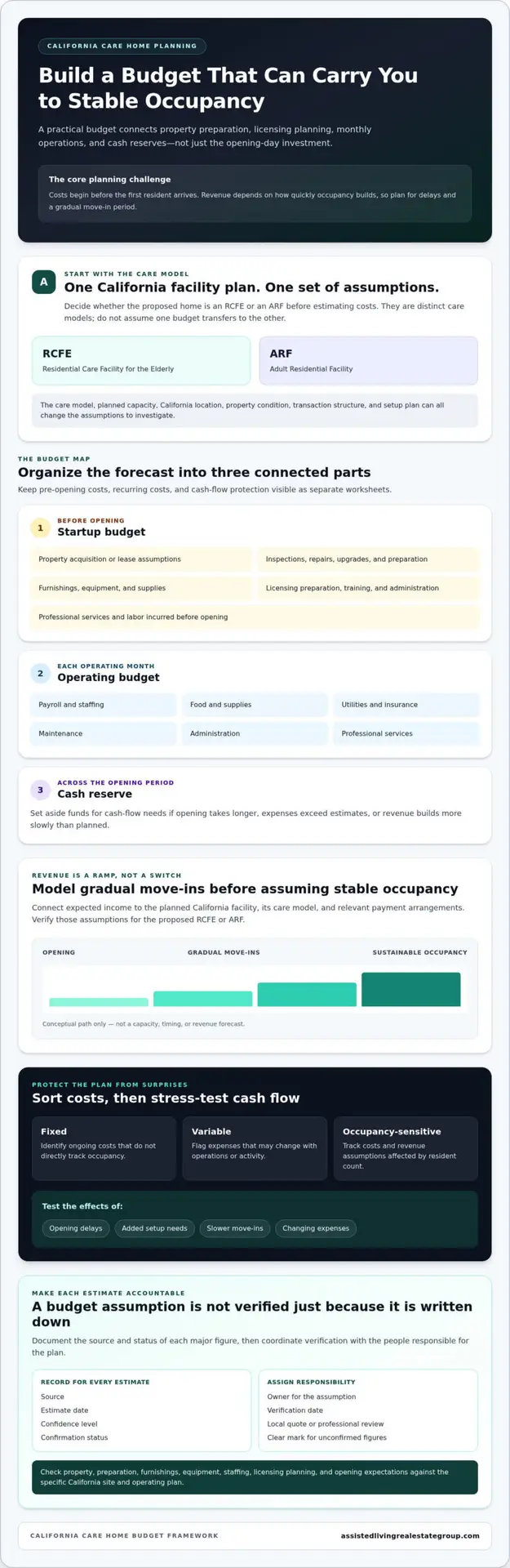
Create separate worksheets before collecting estimates. This makes it easier to see what must be funded before opening, what continues each month, and which costs may change with occupancy or operations.
- Startup budget: One-time and pre-opening costs, such as property acquisition or lease assumptions, preparation, furnishings, equipment, professional services, and administration.
- Operating budget: Recurring expenses, including payroll, food, utilities, insurance, maintenance, supplies, administration, and professional services.
- Cash reserve: Funds set aside to cover cash-flow needs when opening takes longer, expenses exceed estimates, or revenue ramps more slowly than planned.
For every estimate, record its source, date, confidence level, and the person responsible for verifying it. Mark unconfirmed figures clearly instead of treating them as settled. This discipline is central to creating a budget for a new care home that can guide decisions, not just describe an optimistic opening scenario.
How to Estimate Startup Costs Before Opening a Care Home
Build startup estimates in sequence. First settle on the California care model and planned capacity, then evaluate the property, define the setup scope, and collect documented quotes. This order matters: a building that appears suitable may need work, while a care model may affect what furnishings, equipment, and pre-opening preparation you need to investigate. Generic national figures can provide context, but they can’t replace California-specific quotes tied to your site and plans.
Assess the property and its readiness
Start with the acquisition or lease assumptions: proposed terms, deposits, and other transaction costs. Then budget for inspections and property preparation based on the actual building and intended use. Separate written contractor proposals based on a site review from preliminary estimates that still need inspection or clarification. Before committing, ask qualified California professionals to verify zoning and property suitability for your proposed use.
Keep property-dependent costs distinct from care-model-dependent costs. Repairs, upgrades, and other site work depend on the building’s condition; furnishings, equipment, and setup decisions depend more on the services and capacity you plan to support. If transaction structure or facility setup is still uncertain, mark those amounts as provisional rather than hiding the uncertainty inside a single total.
Budget for licensing preparation and opening needs
Create a separate worksheet for licensing preparation and pre-opening needs. Include application-related planning, training, professional guidance, furnishings, supplies, and labor incurred before opening. Don’t assume every expense applies to every facility. Confirm current California requirements and any related costs for the specific model with appropriate sources, including California’s official licensing requirements for senior care facilities.
For an RCFE, the California RCFE application process can help you identify planning milestones to investigate. Treat it as a starting point, not a substitute for checking current information with the state or qualified professionals. An ARF plan requires assumptions specific to that model; don’t copy RCFE categories without verification.
For each startup line, record the estimate, source, date, confidence level, and who will confirm it. Ask contractors and suppliers for California, property-specific quotes where possible. Mark open questions clearly, such as whether a proposed scope includes all planned work or whether a quote needs another site review. If a California RCFE or ARF transaction is shaping your property or setup assumptions, explore the firm’s facility transaction experience as one potential resource while developing your estimates.
How to Forecast Monthly Costs and Early Revenue
A monthly forecast should connect operating expenses to opening readiness and the pace of admissions. Costs may begin before the facility can welcome residents, while revenue grows only as residents move in and begin paying under verified arrangements. Model this timing month by month so you can see how a delayed opening or slower occupancy affects cash needs, rather than assuming revenue starts as soon as setup work begins.
Organize expense estimates by behavior. Fixed or recurring commitments may include rent or property costs, insurance, administrative systems, and professional services. Variable expenses, such as food and some supplies, may rise as resident count or service needs change. Other costs, including payroll, utilities, and maintenance, can have both baseline and occupancy-sensitive elements. Categorize each line based on your California facility’s actual plan, not a generic template.
Which operating expenses should appear every month?
Investigate payroll, food, utilities, insurance, maintenance, resident supplies, administration, and professional services. For each category, record the expected billing frequency, what could cause the amount to change, and who will confirm the estimate. Validate California staffing assumptions with qualified professionals familiar with the proposed care model, and obtain local insurance quotes. Expense estimates are credible only when they match the facility’s care model, planned capacity, and the needs it intends to support.
Build the forecast from current California quotes and facility-specific information. Ask local providers and professionals to clarify what each estimate covers, when the expense may begin, and what could cause it to change. This helps distinguish recurring commitments from costs that fluctuate with resident count or property needs.
How should a new operator model occupancy?
Build conservative, expected, and stronger-occupancy scenarios using your planned capacity, documented pricing assumptions, and anticipated admission timing. For each scenario, show when residents are expected to arrive and how revenue changes as occupancy grows. Verify the rates and payment arrangements applicable to your specific California facility; don’t assume that a rate used by another care model will apply to yours.
Then compare projected collections with expenses for each month. A slower admission pace can extend the period when payroll, property costs, utilities, and other commitments must be covered before revenue stabilizes. If the opening date moves, shift both the pre-opening expense timeline and the revenue start assumptions. This reveals where cash reserves may be strained without relying on an unsupported break-even date or profitability promise.
When creating a budget for a new care home, treat each scenario as a planning tool, not a prediction. Update the forecast as California quotes, opening milestones, and occupancy information become more reliable.
How to Stress-Test the Budget and Protect Cash Flow
A forecast is useful only if it can withstand setbacks. Before committing to a California launch plan, test what happens if the property needs more preparation, the opening date shifts, hiring begins earlier than expected, or resident admissions build more slowly than planned. The goal isn’t to predict every disruption. It’s to understand how each could change cash needs and which assumptions still need verification.
Which assumptions are most important to test?
Track the opening date, property readiness, hiring schedule, expected admissions, and operating expenses. Label each assumption verified, quoted, provisional, or unknown, and assign someone to resolve open items. Then compare scenarios using the same forecast period and planned facility assumptions:
- Expected case: Current opening, preparation, hiring, and admission assumptions.
- Delayed opening: Later revenue alongside continued property, professional, and pre-opening costs.
- Higher preparation needs: Additional site work and a possible shift to the opening schedule.
- Slower occupancy: Lower early revenue while recurring commitments continue.
For each case, calculate the cash required by month, not a speculative return. A scenario table or worksheet makes it easier to see when reserves may be drawn down and which decisions depend on uncertain estimates. Set aside a written contingency reserve, but determine its size from documented risks and facility-specific estimates rather than an unsupported rule of thumb.
How can a California operator reduce avoidable uncertainty?
Replace broad assumptions with local evidence: request California property, insurance, contractor, payroll, and professional-service estimates. Ask what each quote includes, how long it remains valid, and what could change the amount. Confirm licensing questions with the appropriate California authorities or qualified professionals, and verify property suitability with professionals familiar with the location and proposed use.
Buying, leasing, and acquiring an operating facility each create different budget considerations. Buying may involve acquisition and property-preparation assumptions; leasing shifts attention to lease terms, deposits, and permitted setup work; acquiring an operating facility requires reviewing the transaction structure and the condition of the business and property. None is automatically the best choice. Compare the cash required before opening, ongoing commitments, and uncertainties under each path. This California guide to buying an RCFE can help frame questions to investigate.
Update the forecast whenever a major assumption changes, such as a revised contractor proposal, a licensing milestone, a hiring decision, or a new opening estimate. If a California RCFE or ARF acquisition affects your budget, discuss the facility transaction with Assisted Living Real Estate Group. That disciplined review is central to creating a budget for a new care home that protects cash flow without relying on best-case assumptions.
Turn Your Care Home Budget Into a California Opening Plan
A budget becomes useful when it drives decisions in the right order. For a California RCFE or ARF, connect the proposed care model to the property, then map the work and funding needed to move from transaction planning toward opening. Assign an owner and a verification date to each major assumption. That way, property readiness, licensing planning, setup work, staffing, and the opening timeline stay linked rather than becoming separate workstreams.
Build a simple action tracker alongside your forecast. For example, assign a qualified professional to confirm property questions, a project lead to obtain setup estimates, and the appropriate licensing contact or advisor to clarify licensing-planning steps. Set dates for reviewing each item, and record how a change affects the schedule and cash needs. Creating a budget for a new care home is an ongoing planning process, not a one-time spreadsheet exercise.
What should the final pre-opening budget review include?
Before relying on the plan, check that every major line item has an amount, source, timing, confidence status, and responsible person. Flag estimates that are still provisional or unknown, especially those tied to property condition, contractor scope, staffing, or the anticipated opening date. Confirm that one-time startup spending is separate from ongoing operating costs and cash reserved to cover operations. Don’t count the same funds in multiple categories.
Set a dated review schedule and update the forecast when quotes arrive, a milestone changes, setup work expands, or occupancy assumptions shift. Keep prior versions so decision-makers can see what changed and why. A clear revision history helps distinguish new information from earlier assumptions and supports more disciplined launch decisions.
When can a specialized care-facility advisor help?
Property and transaction assumptions can be difficult to evaluate in isolation. Assisted Living Real Estate Group focuses on California RCFE and ARF transactions and provides guidance related to facility setup and relicensing. The firm states that its team has more than 25 years of combined care-facility experience. That perspective may help prospective operators identify questions to investigate about a facility or transaction, but it doesn’t replace independent professional verification or legal representation for licensing.
Once your care model, property criteria, and budget questions are defined, you can discuss California care-facility opportunities with the firm. Bring your documented assumptions and open questions to the conversation. A disciplined plan keeps the financial decisions connected to the purpose behind the project: building a sustainable operation that can deliver thoughtful care.
Build a Budget That Supports a Confident California Opening
A strong care-home budget is more than a startup total. It connects property and setup decisions with recurring expenses, cash reserves, and a realistic occupancy ramp. Creating a budget for a new care home also means tracking which estimates are verified and revisiting the forecast as quotes, milestones, and opening assumptions change.
Keep your plan specific to the California facility and care model you intend to operate. RCFE and ARF assumptions aren’t interchangeable, and property condition, capacity, staffing plans, and timing can all affect the funding required. Careful forecasting helps you prepare for uncertainty while keeping your focus on building a sustainable operation and delivering compassionate care.
For prospective operators weighing facility or transaction assumptions, Assisted Living Real Estate Group focuses on California RCFE and ARF transactions and facility setup guidance. The team states it brings more than 25 years of combined care-facility experience. Discuss your California care-facility plans with a specialized team as you evaluate your next steps. With documented assumptions and the right questions in hand, you can move forward with greater clarity and purpose.
Frequently Asked Questions
What should a startup budget for a new care home include?
A startup budget should cover the costs of preparing the specific California facility to open, along with funding for the early operating period. Include property acquisition or lease assumptions, inspections, preparation, furnishings, equipment, professional services, application-related planning, training, and pre-opening labor. Separate quoted amounts from provisional estimates, and note the source and date for each. The categories and assumptions should reflect whether you’re planning an RCFE or ARF.
How do I create a monthly budget for a care home?
List each expected monthly expense, then identify whether it stays relatively fixed or changes with resident count, service needs, or property use. Include payroll, food, utilities, insurance, maintenance, supplies, administration, and professional services. Forecast revenue separately using planned capacity, documented pricing assumptions, admission timing, and occupancy scenarios. For a Southern California facility, use current local quotes and revise estimates as your opening schedule and operating plans become clearer.
How much money should I set aside before opening a care home?
Set aside enough to cover pre-opening spending and projected operating cash needs through a delayed opening and gradual occupancy ramp. For California RCFE applicants, the research provided states that applicants must demonstrate three months of operating funds in a bank account before a license is issued. Treat that as a licensing-related planning point, not a complete reserve target. Verify current requirements and calculate your total need from facility-specific estimates.
What are the biggest expenses when starting a care home?
The largest categories depend on the California property, transaction structure, care model, and planned capacity. Property acquisition or lease costs and preparation work can be substantial, while furnishings, equipment, professional services, training, and pre-opening labor also need estimates. Don’t assume another facility’s spending will match yours. Obtain local quotes tied to the site and planned use, and separate confirmed proposals from amounts that still require inspection or verification.
How do I budget for low occupancy in a new care home?
Build a conservative occupancy scenario that assumes admissions take longer than expected, then forecast monthly revenue and cash needs against ongoing expenses. Include the possibility that payroll, property costs, insurance, utilities, and other commitments continue while resident count is still growing. Avoid relying on a specific break-even date unless your assumptions support it. Keep a written reserve plan and update the forecast as opening milestones and admissions change.
What is the difference between startup costs and operating costs for a care home?
Startup costs are one-time or pre-opening expenses, such as property preparation, furnishings, equipment, and opening-related professional services. Operating costs recur after launch, including payroll, food, utilities, insurance, maintenance, supplies, and administration. Keep both categories separate from your cash reserve, which helps cover timing gaps or unexpected expenses. This distinction makes it easier to see whether funding covers setup as well as early operations in California.
Should I buy or lease a property for a new California care home?
There’s no universal answer. Buying and leasing create different upfront and ongoing commitments, and suitability depends on the property, transaction terms, planned care model, and setup requirements. Compare acquisition or lease costs, deposits, property condition, permitted work, and ongoing obligations using California-specific information. If you’re considering an operating facility, evaluate the business and property assumptions together. Have qualified professionals review property and licensing questions before committing.