
A medication record can reveal more than whether a dose was documented. It can show whether a California RCFE’s daily practices respect residents’ rights, follow individual instructions, and stay within staff members’ roles. That’s why RCFE medication management rules matter: in a busy routine, the line between assisting with self-administration and administering medication can be easy to blur.
California RCFEs are non-medical facilities, so medication support must be individualized, carefully documented, and aligned with applicable requirements. This guide explains the regulatory framework, including relevant provisions of Title 22 and the role of the California Department of Social Services’ Community Care Licensing Division. It also shows how to turn requirements into a practical daily process.
You’ll learn how to build a resident-centered medication-support workflow, organize records for review, and align written policies with what staff actually do. For buyers and sellers, medication documentation can also offer a useful view of an RCFE’s operations and point to topics for due diligence.
Key Takeaways
- Use California Title 22 and the Community Care Licensing Division as starting points for verifying current RCFE medication requirements.
- Understand how RCFE medication management rules distinguish support with self-administration from other medication-related actions. Consider each resident’s circumstances and staff authorization.
- Build a consistent workflow that connects current instructions, written policies, staff preparation, documentation, and follow-up.
- Review medication records as part of understanding an RCFE’s operations. A preliminary buyer review is not a legal, clinical, or regulatory assessment.
RCFE Medication Management Rules in California: Who Is Responsible?
Medication management in a California Residential Care Facility for the Elderly (RCFE) means supporting residents’ medication needs within the facility’s permitted role. It involves following applicable requirements, maintaining clear procedures, and matching support to each resident’s circumstances. It is not a substitute for clinical care or prescribing decisions. Assisted living offers a general introduction to this type of residential support; California’s RCFE requirements establish the rules facilities must follow.
California’s RCFE medication-support framework is established in Title 22, Division 6, Chapter 8 of the California Code of Regulations, including Sections 87465 and 87465(h). The California Department of Social Services’ Community Care Licensing Division (CCLD) is a key source for applicable requirements and current regulatory language. Regulations set binding requirements; a facility’s written policies and procedures explain how its team applies them. Internal procedures can support consistent work, but they do not replace the regulations.
Which California rules govern medication support in an RCFE?
Section 87465 addresses incidental medical and dental care, and subsection 87465(h) addresses centrally stored medications. These provisions are useful starting points for understanding medication-related responsibilities in an RCFE. Regulatory language can change, and requirements may depend on the situation, so review the current official California text rather than relying only on a copied policy, older manual, or summary. RCFE medication management rules describe a regulatory framework, not a single procedure that applies to every resident.
How do residents, staff, and prescribers share responsibilities?
Medication support should reflect the resident’s needs and the arrangements that apply to that individual. A resident’s ability to manage medication independently is relevant, and the level of support should not be assumed to be the same for everyone. The resident’s role, staff actions, and prescriber instructions each inform the plan, but they are not interchangeable. Clinical directions come from the appropriate prescriber, while facility staff follow applicable requirements and procedures within their authorized role.
One resident may manage medication with limited support, while another may need a different arrangement based on documented needs. Make the resident-specific instructions clear to the team and keep procedures aligned with current California requirements. This gives staff a consistent reference without turning a general facility policy into a clinical decision or assuming every resident needs the same assistance.
How California RCFE Medication Rules Address Support, Orders, and Records
Medication instructions, resident-specific arrangements, and records need to function as one system. California’s Title 22 provisions address incidental medical and dental care and centrally stored medications. Facility procedures should translate applicable requirements into consistent practice without replacing prescriber instructions or expanding staff roles. For operational context, the California Assisted Living Association’s Medication management best practices resource can complement review of California’s governing requirements.
What medication instructions and documentation should a facility review?
Start with the instructions and records relevant to the resident’s arrangement, including current prescriber directions and information about medications stored centrally by the facility. Compare them with the resident’s documented needs and the facility’s written procedures. The goal is not simply to keep paperwork on file. Clear, timely records help staff understand the expected support, give responsible personnel a basis for oversight, and make later review more reliable.
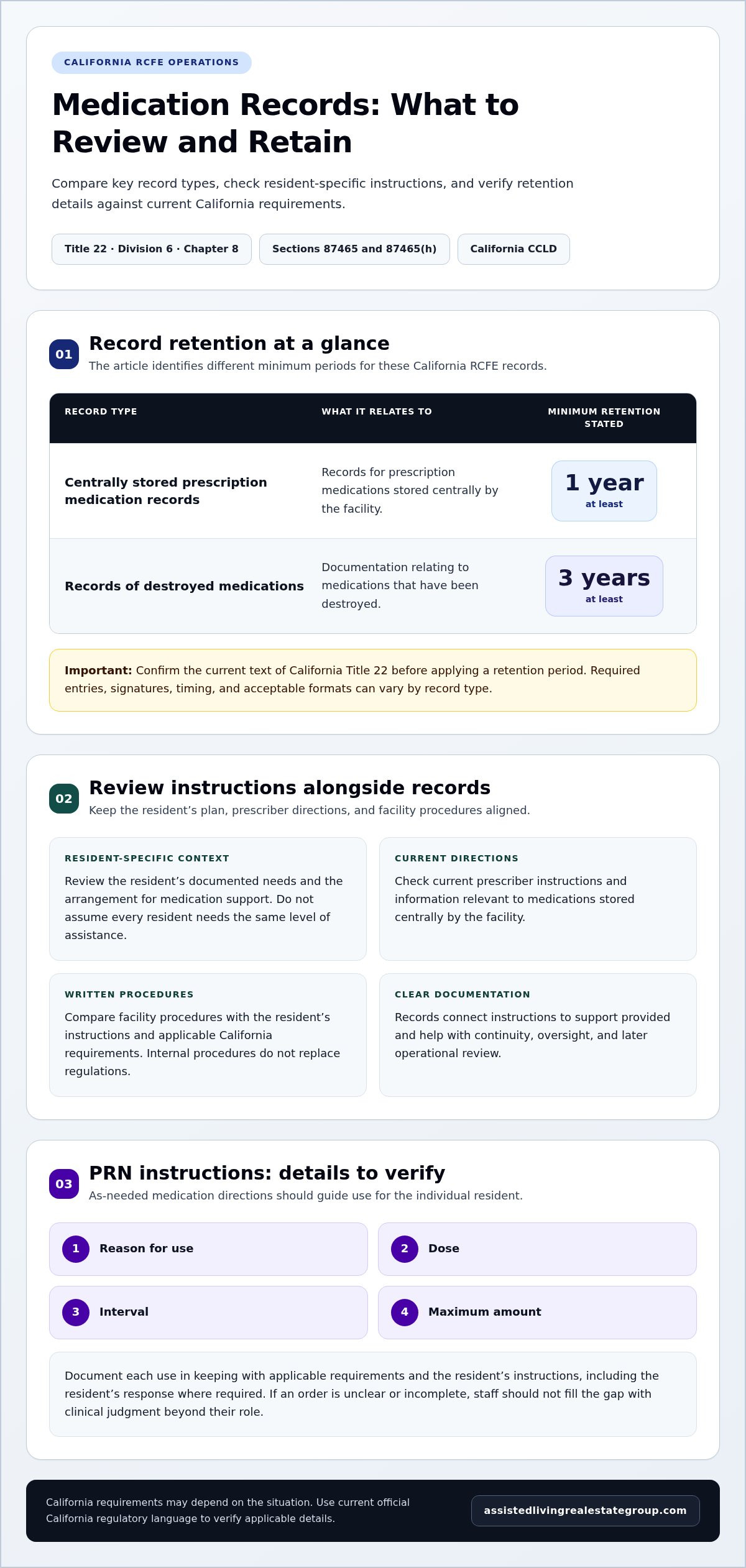
California requirements include recordkeeping for centrally stored prescription medications. The regulatory guidance referenced here states that those records must be retained for at least one year, and records of destroyed medications for at least three years. Confirm the current text of Title 22 before applying these periods to a particular record. Required entries, signatures, timing, and acceptable formats can vary by record type, so verify the details in the applicable California provision rather than treating a facility template as the legal standard.
Medication records connect instructions to the support actually provided, creating a useful account for continuity, oversight, and operational review. Check which fields and retention periods California requires for each record type.
How should facilities approach as-needed medications?
As-needed, or PRN, medications require particular care because the order must guide use for the individual resident. Review the current prescriber’s instructions and applicable California requirements. A generic facility rule should not be used to supply missing clinical direction. The regulatory guidance referenced here identifies clear instructions about the reason for use, dose, interval, and maximum amount as important elements to verify. Document each use in keeping with applicable requirements and the resident’s instructions, including the resident’s response where required.
If an order is unclear, incomplete, or does not appear to match the resident’s circumstances, staff should not fill the gap with a clinical judgment beyond their role. Route the question to the appropriate licensed clinical professional and consult authoritative California guidance as needed. Facility policies should explain how staff escalate questions and record resulting direction, while remaining aligned with current requirements.
For buyers and sellers, these documents can help frame questions about operational consistency during an RCFE transaction. California RCFE transaction guidance provides context for evaluating care-facility operations.
Medication Assistance vs. Administration: The California RCFE Boundary
Medication help isn’t automatically medication administration. California’s Title 22 distinguishes assistance with a resident’s self-administration from staff administering a medication. That distinction affects what an RCFE team may do and must be considered alongside current regulations, the resident’s circumstances, and the staff member’s training and authorization. Review relevant provisions, including Section 87465, in the California Code of Regulations Title 22, and verify current language through California’s official regulatory resources.
The examples below are a practical orientation, not a determination that an action is permitted in every situation. Verify each example against current California requirements and the resident’s documented arrangement.
| Type of action | Illustrative example | Regulatory check |
|---|---|---|
| Assistance with self-administration | Reminding a resident, bringing medication to them, opening a container, reading its label, or observing the resident take it. | Confirm the action fits applicable Title 22 provisions, the resident’s circumstances, and facility policy. |
| Administration | A staff member directly applying medication, such as by injection, inhalation, or ingestion. | Review the current regulation and the staff member’s professional authorization before proceeding. |
What may assistance with self-administration involve?
California regulations address assistance that supports a resident in taking their own medication. A reminder or help opening a container may differ from a staff member directly giving medication, but the label used for an action does not settle its status. Staff should follow resident-specific instructions and facility policy, and pause to clarify an action that falls outside the approved procedure.
When do staff scope and professional oversight become critical?
Pay close attention to the boundary when a task involves direct application, a change in the resident’s ability, unclear instructions, or uncertainty about staff training or authorization. Routine practice does not prove an action is permitted. Escalate questions through established clinical and regulatory channels, consulting the appropriate licensed professional and current California guidance before changing how support is provided.
Applied consistently, the RCFE medication management rules help teams distinguish supportive assistance from actions that may require a different level of authority. That distinction supports resident-centered practice and gives staff a clearer basis for deciding when to pause and seek direction.
A California RCFE Medication Compliance Workflow for Daily Operations
A dependable process turns written policies into consistent, resident-centered practice. In California, an RCFE’s medication procedures should align with current Title 22 requirements and each resident’s documented arrangements. Use this workflow as an operational framework, then verify specific duties against current regulations and facility policy.
- Review current instructions. Before providing support, check the resident-specific medication directions and relevant records. Confirm staff can identify which instructions apply and know how to raise questions about unclear or conflicting information.
- Confirm the support arrangement. Make sure the planned action matches the resident’s documented needs and the staff member’s role, preparation, and authorization. If the situation has changed or the task is uncertain, pause and seek direction through the facility’s established process.
- Prepare staff for their assigned responsibilities. Use role-specific procedures to explain what staff may do, what requires escalation, and where to find current instructions. Provide orientation and ongoing training consistent with applicable California requirements. Verify specific training standards in current regulatory sources.
- Document support consistently. Record medication-related support according to applicable requirements and facility procedures. Consistent entries help the team maintain continuity, support appropriate oversight, and make it easier to review what occurred. Verify which information, timing, signatures, and retention rules apply to each record type.
- Review concerns and follow up. Address refusals, discrepancies, changed instructions, and suspected errors through the facility’s process. Document the concern and actions taken as appropriate, seek clinical guidance for resident-specific questions, and verify notification or incident-reporting duties under current California rules before treating them as requirements.
Make policies and staff preparation reinforce each other
A policy is useful only if staff can apply it during routine work. Assign responsibility for reviewing procedures against current California requirements, communicating updates, and responding to staff questions. Keep instructions accessible and make sure training reflects the written process. If policy language and day-to-day practice diverge, clarify the procedure and address the gap instead of allowing separate routines to persist.
Workflow summary: Review instructions, confirm the resident-specific arrangement, prepare staff, document support, and follow up on concerns. The RCFE medication management rules provide the regulatory foundation; clear procedures and reliable records help teams apply it without assuming every resident or situation is the same.
For buyers and sellers assessing how operational practices fit into a California RCFE transaction, see California RCFE transaction opportunities.
Medication Records as an RCFE Operating and Acquisition Due-Diligence Signal
Medication records can show how an RCFE’s written procedures connect with daily operations. During a California facility review, buyers may look at whether records are organized, documented practices align with facility policies, and questions or changes have a clear follow-up path. These are areas for further inquiry, not proof of compliance or a finding of a violation. A single record rarely tells the full story.
What can medication documentation reveal during an operational review?
Reviewing relevant records alongside facility policies may help identify patterns, gaps, or points that need clarification. For example, a buyer might note whether records are maintained consistently and whether documented procedures appear to match the process staff describe. These observations can guide follow-up, but they do not establish whether a facility meets every applicable requirement. That determination depends on the facts, current California rules, and appropriate assessment.
Material questions deserve careful review. A concern about clinical instructions calls for qualified clinical input; a question about legal obligations or regulatory interpretation may require qualified legal or regulatory review. The RCFE medication management rules are one part of the operating picture. Interpret records in context rather than treating them as a stand-alone verdict.
How should a prospective California RCFE buyer use this information?
Use medication procedures and records as one part of broader due diligence. Consider how they fit with the facility’s licensing status, staffing practices, resident needs, written policies, and the proposed transaction. A preliminary buyer review can surface topics for further examination, but it is not a clinical assessment, legal opinion, or regulatory determination. Keep the review focused on understanding operations and identifying questions that warrant appropriate follow-up.
For additional context, see the guide to California RCFE licensing guidance and the California RCFE buying guide. Together, these resources frame operational records within the wider licensing and acquisition process.
Medication documentation is most useful when it prompts informed questions, not quick conclusions. Assisted Living Real Estate Group specializes in California RCFE and ARF transactions. Explore California RCFE transaction guidance when evaluating an acquisition or preparing a facility for sale.
Build Stronger RCFE Operations With Clear, Resident-Centered Practices
Sound medication practices begin with understanding California requirements, matching support to each resident’s documented needs, and keeping records that reflect daily operations. The distinction between assistance and administration deserves careful attention. Written procedures, staff preparation, and consistent documentation help teams respond thoughtfully when instructions or circumstances change.
These records also provide useful context when evaluating an RCFE’s operations during a transaction. They can surface questions for further review, but they are not, on their own, proof of compliance or a substitute for qualified clinical, legal, or regulatory assessment.
For buyers and sellers, specialized transaction experience can bring perspective to a complex facility review. Assisted Living Real Estate Group focuses on California RCFE and ARF transactions, with more than 25 years of combined care-facility industry experience, as stated by the team. Explore specialized California RCFE transaction guidance to discuss your next acquisition or sale.
Frequently Asked Questions
What are the medication management rules for California RCFEs?
California RCFEs should assess medication support under current Title 22 regulations and applicable state requirements. The RCFE medication management rules depend on factors such as the resident’s circumstances, staff role, and facility procedures. Administrators should use current official California sources rather than outdated summaries. This overview is educational and does not replace legal, regulatory, or clinical guidance for a specific situation.
Can RCFE residents in California self-administer their medications?
A resident’s ability to manage medication should be considered individually, not assumed to be the same across a facility. Review the resident’s circumstances, applicable California requirements, and relevant instructions when arranging support. The facility should document its process in line with current rules and policy. Check current official California sources for precise regulatory language before applying a general explanation to an individual resident.
Can RCFE staff administer medication in California?
Assistance with self-administration and medication administration are not interchangeable terms. What a staff member may do depends on current California requirements, their preparation and authorization, and the resident’s circumstances. Verify the applicable regulatory language before deciding whether a specific task is within that staff member’s role. For resident-specific questions, follow facility procedures and seek appropriate clinical guidance rather than relying on a general online summary.
What records must a California RCFE keep for resident medications?
California RCFEs should verify current requirements for medication instructions, records, documentation, and retention before finalizing procedures. Organized records can support continuity of support and internal review, but a facility checklist is not automatically a complete legal standard. Confirm which entries, signatures, timing, formats, and retention periods apply to each record type under current California rules, then align written policies and staff practices with those requirements.
How should a California RCFE handle a resident’s PRN medication?
A California RCFE should handle as-needed, or PRN, medication according to applicable instructions, the resident’s circumstances, facility policy, and current state requirements. Staff should not invent clinical criteria or treat a general online explanation as a substitute for appropriate guidance. Verify what documentation is required, who may provide support, and when concerns should be escalated. Use authoritative California sources when adopting or revising a procedure.
What should an RCFE do if a resident refuses medication?
A California RCFE should respond to a medication refusal through its established procedures and the resident’s applicable instructions, while attending to safety and documentation. The appropriate response may depend on the resident’s circumstances and current California requirements. Staff should understand whom to notify and when to seek clinical guidance. Verify specific notification, documentation, or reporting duties in current authoritative sources before describing them as mandatory.
Should medication records be reviewed when buying an RCFE in California?
Yes. Medication procedures and records can inform a broader operational review, but they do not establish compliance on their own. A prospective buyer should consider them alongside licensing, staffing, policies, resident needs, and other facility information. For a Southern California acquisition, a specialized RCFE brokerage can help buyers understand the transaction context. Questions about legal duties or resident care require appropriately qualified review.