
A clean-looking profit-and-loss statement can hide liabilities that change the value of a California RCFE acquisition. A thorough rcfe due diligence checklist looks beyond reported revenue to verify earnings, resident stability, and the facility’s regulatory record before you close.
Buying an RCFE involves more than real estate. The operating business, its records, and the property each carry distinct risks, while California Title 22 requirements add another layer of review. This guide covers two tracks: verifying financial performance and examining operations, staffing, and potential DSS concerns. It also explains how DSS Public Information Provider reports can help surface issues that may not appear in a seller’s financial statements.
You’ll learn which documents to review, how to assess private-pay resident stability and reported earnings, and what to plan for as escrow transitions to operations. Because an RCFE license isn’t transferable, understanding the change-of-ownership process is essential to planning a responsible handoff and reducing the risk of immediate compliance problems.
Key Takeaways
- Use an rcfe due diligence checklist to examine the California care business and its residential property as two connected but distinct parts of an acquisition.
- Reconcile reported revenue with resident payment sources, and review staffing and maintenance expenses for gaps that could affect operating performance.
- Review Title 22 records, staffing documentation, and DSS Public Information Provider reports for potential compliance concerns before closing.
- Inspect fire-safety features and accessibility, then determine how any deficiencies could affect your acquisition plans.
- Plan the ownership transition early, including the change-of-ownership application process and the steps from escrow to responsible operations.
The Dual-Track Audit: Why California RCFE Due Diligence is Unique
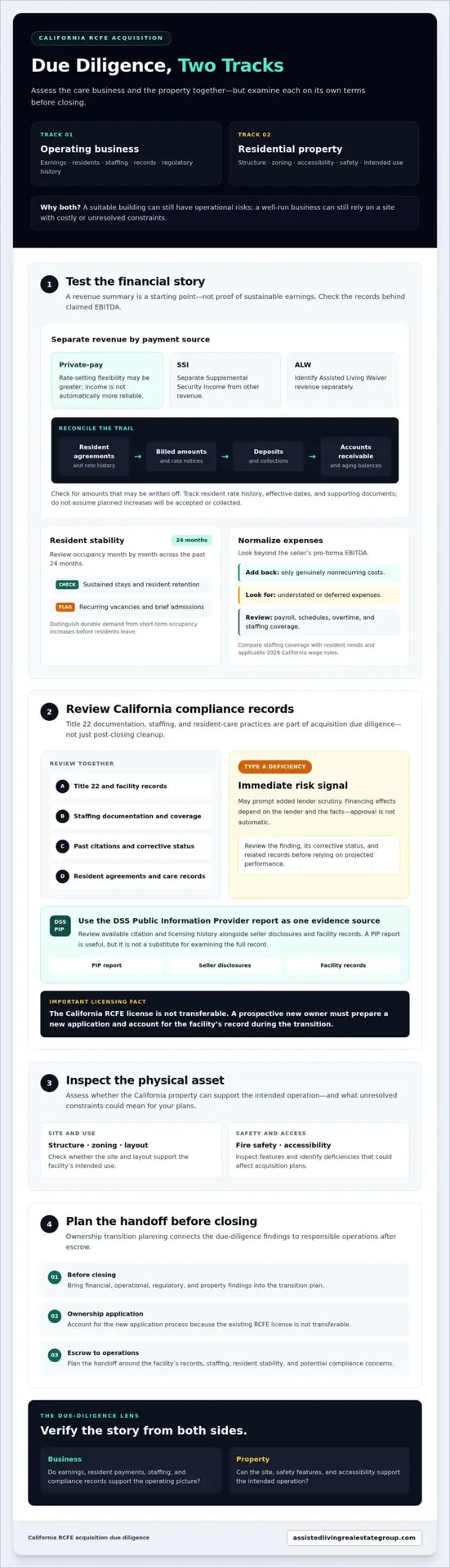
A California RCFE acquisition involves two connected investments: the licensed care business and the property that supports its operations. Your rcfe due diligence checklist should examine both. An RCFE is a form of Residential care, but California’s Title 22 rules make operating records, staffing, and resident-care practices central to the purchase decision. A building may appear suitable while the business records reveal risks that affect the transition plan.
Private-pay demand can make a facility an attractive opportunity, but buyers still need to verify how care is documented and delivered under California Title 22 standards. Don’t assume a change in ownership erases a facility’s regulatory history. Identify past citations early and consider how they could affect the new application and operational handoff.
The Business vs. The Real Estate: A Crucial Distinction
The business audit examines the license, staffing records, resident agreements, and reputation. The property audit covers the physical structure, zoning, and accessibility, including whether the layout supports the facility’s intended use. Review both tracks at the same time: a compliant property may still have operational issues, while a well-run business may depend on a site with costly or unresolved constraints. Reviewing only one side can leave you with an asset that cannot support the operation you intend to acquire.
The Cost of Regulatory Red Flags
California’s Title 22 requirements make documentation and operational readiness part of due diligence, not just post-closing cleanup. A Type A deficiency signals an immediate risk and may prompt added scrutiny from lenders. Its effect on financing depends on the lender and the facts, so don’t assume approval is automatic. Review the finding, its corrective status, and related records before relying on projected performance.
The California Department of Social Services (DSS), through its Community Care Licensing Division, oversees RCFE licensing and maintains information about a facility’s compliance history. The license itself isn’t transferable, so a prospective new owner must prepare a new application and account for the facility’s record during the transition.
A DSS Public Information Provider (PIP) report is a useful due-diligence tool for reviewing a California RCFE’s available citation and licensing history. Read it alongside the seller’s disclosures and facility records. It is one part of the review, not a substitute for examining the full record. A California-focused RCFE broker can help buyers consider potential liability issues across regulatory records and financial statements.
Financial Integrity Checklist: Verifying the Bottom Line
A seller’s revenue summary is a starting point, not proof of sustainable earnings. A California RCFE’s financial picture depends on who pays, how consistently residents pay, and whether reported expenses reflect the staffing and upkeep required to operate the facility. Use this part of your rcfe due diligence checklist to test the records behind claimed EBITDA, not just the headline figure.
Revenue Mix and Rate Stability
Separate private-pay, Supplemental Security Income (SSI), and Assisted Living Waiver (ALW) revenue in your analysis. Private-pay income can offer greater rate-setting flexibility, but it isn’t automatically more reliable. Confirm resident retention, actual collections, and whether rates match signed agreements. Compare billed amounts with deposits and accounts-receivable records to identify aging balances or amounts that may be written off.
Review resident agreements and rate-change notices for consistency with applicable California requirements. Track each resident’s rate history, effective dates, and supporting documents. Don’t assume a planned increase will be accepted or collected. Then examine occupancy month by month over the past 24 months. Look for sustained stays and recurring vacancies, and distinguish durable demand from brief admissions that temporarily raise occupancy before residents leave.
Operational Expense Deep Dive
Normalize expenses before accepting the seller’s pro-forma EBITDA. Add back only costs that are genuinely nonrecurring, and account for expenses the seller may have understated or deferred. Review payroll records, schedules, overtime, and staffing coverage against resident needs and applicable 2026 California wage rules. Compare staffing practices and documentation with the California Title 22 RCFE Regulations. Understaffing or incomplete records can create both operational and compliance exposure.
- Labor: Reconcile payroll registers with schedules, time records, and contractor invoices. Check whether the staffing plan depends on unpaid owner labor or unusually low coverage.
- Insurance: Review current policies and renewal history for professional liability, workers’ compensation, and property coverage. Look for gaps, exclusions, or unexplained premium changes.
- Food and utilities: Compare invoices and usage across periods, accounting for occupancy and facility size. Investigate unusual swings rather than relying on broad industry averages.
- Maintenance: Match repair expenses against inspection records and visible property needs. Deferred work may represent a future cash requirement, not a valid EBITDA add-back.
A specialized RCFE broker can help scrutinize financial statements for liability issues that a general review may miss. For a California acquisition, RCFE transaction guidance can help buyers connect the numbers to the facility’s operating realities.
Regulatory and Operational Audit: Title 22 Compliance
A clean financial review can’t replace a close examination of a California facility’s Title 22 records. Use this part of your rcfe due diligence checklist to compare the seller’s procedures with evidence in personnel files, resident records, and day-to-day documentation. Flag missing, expired, or inconsistent records for follow-up before finalizing your acquisition plan.
The Personnel Audit: Beyond the Resume
Review each employee’s file for the criminal record statement, LiveScan clearance documentation, health-screening records, and training records applicable to the role. Confirm that the administrator’s RCFE certificate is current. California RCFE administrators must complete an 80-hour certification course and pass a state exam. Check schedules and coverage records to understand who is responsible for residents across shifts and whether staffing appears sufficient for their assessed needs.
Review training records against current requirements. Dementia-aware practices are expected throughout the facility, not only in designated memory-care areas. If you encounter a proposed 40-hour initial training requirement for new direct-care staff, verify it against current California requirements rather than treating the figure as confirmed. Compare the facility’s training logs with the rules that apply to each staff member and role.
Resident Care and Documentation
Personnel files tell only part of the story. Match resident assessments and care documentation to the needs the facility has agreed to serve. California requires resident reappraisals at least every 12 months and when there’s a significant change in a resident’s physical, mental, cognitive, or functional condition. Review completed appraisals, including LIC 603 records where applicable, for dates, accuracy, and alignment with care plans.
- Medication records: Review centrally stored medication documentation, administration records, and medication destruction logs for completeness and consistency with facility procedures.
- Health conditions: Identify residents with hospice arrangements or restricted health conditions, then verify that relevant records, care plans, and approvals support the facility’s ability to meet their needs. Distinguish restricted conditions from prohibited ones rather than assuming they are interchangeable.
- Routine medical visits: Check whether the facility has requested and documented annual routine visits with a licensed medical professional for each resident.
- Dementia care: Look for evidence that dementia-aware practices are reflected in staff preparation and resident support throughout the facility.
Don’t rely on a policy manual alone. Compare written procedures with actual files, schedules, and records. Document unresolved gaps and review them with qualified California compliance professionals before closing. This helps clarify whether the facility’s current operations can support a responsible ownership transition.
Physical Asset Inspection: Safety Codes and 2026 Standards
A California RCFE’s physical condition affects more than maintenance costs. It can influence resident safety, operational readiness, and whether the property can support the facility’s intended use. Include a hands-on site review in your rcfe due diligence checklist, and compare your observations with inspection records, permits, and the seller’s disclosures. For a Southern California property, confirm site-specific requirements with the relevant local authorities rather than assuming they are the same from one city to another.
Fire Marshal and Safety Systems
Request the latest fire clearance documentation and review any listed corrections. Check smoke detectors, sprinklers, and fire extinguishers, and confirm their condition and service records with qualified inspectors or the relevant local fire authority. Review the facility’s disaster and mass-casualty plan to see whether it is current, accessible to staff, and posted where required. Treat fire clearance as a critical part of the licensing transition, and verify the applicable steps with California licensing officials and the local fire authority before closing.
Environmental and Structural Integrity
Look beyond cosmetic finishes. Have qualified professionals assess the roof, HVAC, plumbing, electrical systems, and foundation, then compare their findings with repair history and maintenance records. Deferred work can create substantial post-closing obligations and may surface during a licensing or safety review. Inspect common areas for safe, usable layouts, appropriate lighting, and applicable Title 22 requirements. Check accessibility features such as ramps, grab bars, and doorway clearances against the standards that apply to the property.
Make the inspection specific to the site. A checklist should prompt questions, not replace a qualified evaluation.
- Permitted use: Review zoning records, permits, and any Conditional Use Permit (CUP) to confirm that approved use and capacity align with the facility’s current operation. Confirm details with the local planning authority. Don’t assume a prior approval automatically covers a proposed bed count or ownership change.
- Life-safety features: Test the emergency call system and inspect perimeter security for functionality and suitability for residents’ needs.
- Accessibility: Examine routes through entrances, hallways, bathrooms, and shared spaces. Note barriers that could affect resident access or require remediation.
- Open corrections: Compare inspection reports with completed repair documentation, and identify unresolved items for review before finalizing the transaction.
Document deficiencies with photographs, reports, and repair estimates from qualified professionals. Use the findings to clarify which issues must be addressed before closing and which need a post-acquisition plan. California RCFE transactions involve both property condition and licensing readiness, so coordinate the physical review with the ownership transition rather than treating it as a standard building inspection.
For guidance on California RCFE transactions that considers operational and property factors, explore RCFE acquisition guidance.
The Transition Strategy: From Audit to Ownership
Due diligence creates value when its findings shape the transaction and transition. Use your rcfe due diligence checklist to turn unresolved issues into specific closing conditions, documented repair obligations, or negotiated adjustments. Before releasing funds, have qualified California legal and licensing professionals review the purchase agreement’s regulatory contingencies, required notices, and responsibility for outstanding corrections.
Navigating the DSS Licensing Gap
An RCFE license isn’t transferable. The buyer must submit a new application to the California Department of Social Services, and a change-of-ownership application typically takes 60–120 days for approval. Plan escrow and operational responsibilities around that gap. An Interim Management Agreement (IMA) may be considered as part of a transition, but don’t assume it authorizes the buyer to operate or replaces licensing requirements. Confirm its structure and any required approvals with qualified advisers and CDSS before relying on it.
Provide the required written notice to the licensing agency and residents at least 30 days before transfer. For a broader acquisition overview, see The Ultimate Guide to Buying an RCFE Facility in California.
Protecting Continuity After Closing
Residents and families need clear, timely communication. Coordinate messages with the seller and transition team so residents understand what is changing, what is staying consistent, and whom to contact with questions. Avoid promises about staffing, services, or rates until they’re verified and approved. A thoughtful communication plan supports trust and can help protect occupancy during an ownership change.
Build a practical 90-day post-close plan around verified priorities, not assumptions. Assign responsibility for licensing follow-up, staffing and training records, resident documentation, safety corrections, vendor continuity, and financial controls. Track open items with named owners and due dates, and escalate anything that could affect resident safety or compliance.
- Before closing: Confirm contingencies, notices, correction responsibilities, and the transition structure.
- At handoff: Reconcile resident and staff records, operating procedures, and outstanding obligations.
- After closing: Monitor compliance tasks, collections, staffing coverage, and resident concerns against the transition plan.
A specialized California RCFE broker can help connect diligence findings to transaction decisions and the ownership handoff. Assisted Living Real Estate Group, led by Teri Szoke, brings 25+ years of combined senior-care experience and provides guidance on buying, selling, and leasing care facilities. For a confidential discussion about a California RCFE acquisition, contact Assisted Living Real Estate Group.
Make Your Next California RCFE Acquisition a Confident One
A sound California RCFE purchase depends on seeing the whole investment clearly. Audit the operating business and property as distinct but connected assets, verify collections and expenses before trusting projected EBITDA, and examine Title 22 records and physical conditions before closing. Then use what you find to plan a careful transition, including the new licensing process and continuity for residents.
A disciplined rcfe due diligence checklist can help reveal risks early and support decisions grounded in financial records and responsible care. The process is complex, but specialized transaction guidance can help buyers assess both the operating business and property. Assisted Living Real Estate Group uses confidential marketing strategies to help protect sellers’ reputations and operations while connecting them with qualified buyers in the assisted living sector.
Contact Assisted Living Real Estate Group to discuss a confidential California RCFE acquisition.
Frequently Asked Questions
What is the most common red flag found during RCFE due diligence?
There isn’t a verified statewide ranking of the most common RCFE due diligence red flags, but missing or inconsistent records deserve close attention. Compare the seller’s financial statements with payroll, collections, resident agreements, and maintenance records. Separately review DSS Public Information Provider records and facility documentation for citations or unresolved compliance concerns. A discrepancy may point to a liability or operating cost that isn’t reflected in reported performance.
How long does the due diligence process typically take for a California care home?
The due diligence period depends on the purchase agreement, the completeness of the records, and any findings that require follow-up. There isn’t one reliable timeline for every California care home. Keep it distinct from licensing: a change-of-ownership application for an existing, licensed RCFE typically takes 60–120 days for CDSS approval. Plan around both the agreed diligence period and the separate licensing process.
Can I operate the facility under the seller’s license after escrow closes?
No. In California, an RCFE license isn’t transferable, so a new owner must submit a new application rather than simply operating under the seller’s license. Don’t assume that closing escrow or signing an Interim Management Agreement (IMA) gives you authority to operate. Confirm the permissible transition structure and any required approvals with CDSS and qualified advisers before taking operational control. Plan responsibilities for residents and staff during the licensing gap.
What is a PIP report and why is it essential for RCFE buyers?
A DSS Public Information Provider (PIP) report is a resource for reviewing available licensing and citation information about a California RCFE. It can help buyers identify regulatory history that may not be obvious from the seller’s financial records or marketing materials. Treat it as one part of the review: compare its information with facility files, seller disclosures, and corrective-action documentation, and follow up on discrepancies before making a final acquisition decision.
Are staffing requirements different for a 6-bed facility vs. a 30-bed facility?
Don’t assume bed count alone determines staffing needs. California RCFEs must provide sufficient staff for residents’ needs, so review current residents’ acuity, care plans, shift schedules, and actual coverage at either facility size. A 30-bed home may have different operational demands than a 6-bed home, but resident needs and records should guide your assessment. Verify applicable Title 22 requirements and identify any reliance on unrecorded owner labor.
Does a clean financial audit guarantee a successful license transfer?
No. A clean financial audit can support confidence in the business’s reported performance, but it doesn’t establish Title 22 compliance or guarantee CDSS approval of a new application. The buyer must separately review the facility’s licensing history, personnel and resident records, physical safety, and operational readiness. California RCFE due diligence is strongest when financial and regulatory reviews are conducted together and unresolved issues are addressed before the transaction moves forward.
What are the 2026 updates for RCFE administrator certification?
As of 2026, California RCFE administrators must complete an 80-hour certification course and pass a state exam. During due diligence, check the administrator’s certificate and supporting records, and confirm qualification status with the appropriate California licensing authority. Also identify who will hold the administrator role during the ownership transition. Don’t rely solely on a seller’s verbal assurance that certification requirements have been met.
How do I verify the acuity level of current residents during the audit?
Review each resident’s appraisal, care plan, and relevant health documentation, then compare those records with the services and staffing the facility actually provides. Check that reappraisals are completed at least every 12 months and when a significant change occurs in a resident’s condition. Look closely at hospice arrangements and restricted health conditions, and clarify whether the facility can appropriately meet each resident’s documented needs under California requirements.