
The more affordable option for a resident isn’t automatically the simpler choice for a California RCFE. In the private pay vs Medi-Cal RCFE decision, the key distinction is that Medi-Cal support may come through the Assisted Living Waiver, which helps cover eligible care services but not room and board. That difference affects both resident affordability and facility operations.
Comparing payment sources means looking beyond what a resident can afford or what revenue a facility might expect. The payer mix also needs to fit the services offered, resident needs, program eligibility, and the facility’s operating capacity. The Assisted Living Waiver has specific participation rules and is not available in every California county, so assumptions can lead to a poor fit.
This guide explains how private pay differs from Medi-Cal-related support, what the waiver may and may not cover, and which eligibility, participation, and California requirements to verify. It also shows how payer mix can inform an RCFE acquisition or business strategy, so you can assess the opportunity with both operating realities and resident care in view.
Key Takeaways
- Use the private pay vs Medi-Cal RCFE comparison to weigh resident affordability alongside facility operations. Neither payer model is automatically the better fit.
- Check resident eligibility, facility participation, covered services, and other expenses separately against current California program requirements.
- Evaluate payer strategy in sequence: define the resident profile, confirm program fit, review operating capacity, validate assumptions, and document open questions.
- For an existing RCFE, examine its current payer mix and operating records. For a prospective acquisition, verify how those factors fit the facility’s business model.
- Make strategy and transaction decisions based on the specific facility’s needs and capacity.
Private Pay vs. Medi-Cal RCFE: What the Terms Mean in California
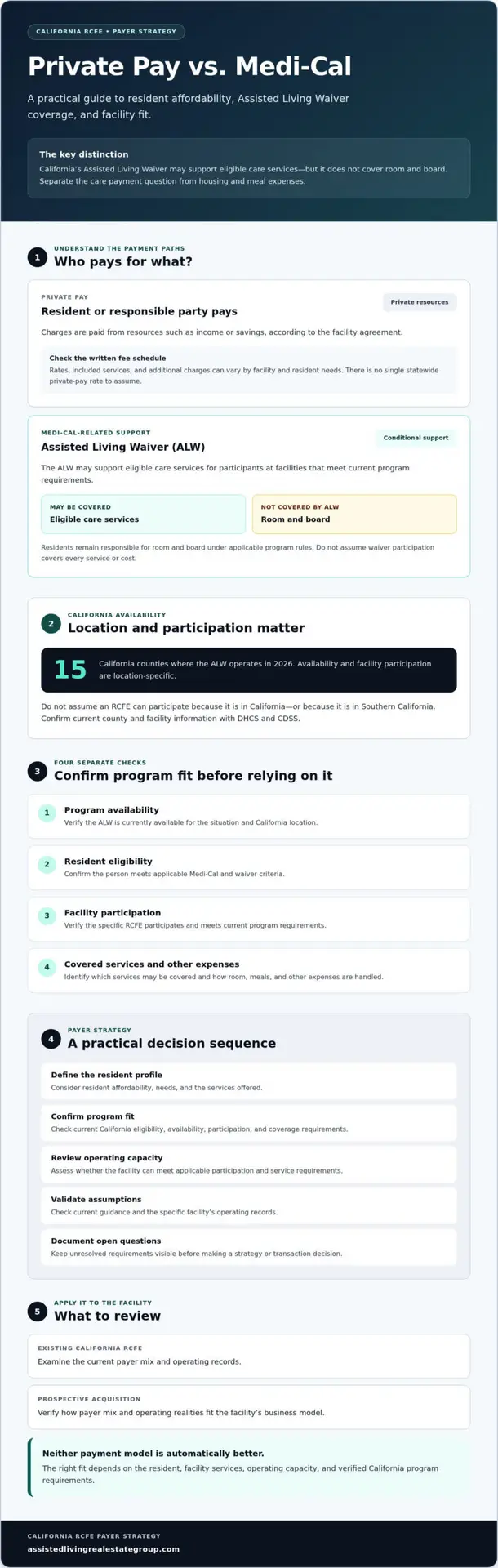
In California RCFE discussions, private pay means a resident or responsible party pays the facility from private resources. Medi-Cal-related support means assistance available through applicable California programs, including the Assisted Living Waiver (ALW) for eligible participants at participating facilities. These are different payment arrangements, not interchangeable labels for every RCFE expense.
The distinction matters because an RCFE combines housing, meals, and care services. Funding for one part may not cover the others. For a neutral overview of the broader assisted living model, see this background reference. California program rules and facility agreements determine the specifics.
What does private pay mean in a California RCFE?
With private pay, the resident or a responsible party uses resources such as income or savings to meet the charges set out in the facility agreement. Rates, included services, and additional charges can vary by facility and resident needs. There is no single statewide private-pay rate to assume. Review the written fee schedule and agreement to see what each charge covers.
What does Medi-Cal mean for RCFE care?
Medi-Cal isn’t a blanket payment source for every RCFE charge. California’s ALW can support eligible care services for participants at facilities that meet current program requirements. Eligibility, participation, availability, and covered services must be confirmed under current California guidance. Check the California Department of Health Care Services (DHCS) and Department of Social Services (CDSS) before relying on a specific program detail, especially when evaluating a facility in Southern California.
Under California’s Assisted Living Waiver, Medi-Cal may cover eligible care services, but it does not cover room and board. Residents remain responsible for those living expenses under applicable program rules. Confirm how those expenses are handled for the individual resident. Don’t treat waiver participation as proof that every service or cost is covered.
That’s the practical starting point for the private pay vs Medi-Cal RCFE comparison: identify who pays for care, who pays for housing and meals, and which conditions apply. The right model depends on resident affordability, facility services, operational capacity, and verified program requirements. Neither approach is universally better; each needs to fit the resident and the business model.
How California Medi-Cal Programs Can Interact With RCFE Services
Medi-Cal doesn’t make every California RCFE, or every person seeking care, eligible for program support. One pathway to examine is the Assisted Living Waiver (ALW), administered by California’s Department of Health Care Services (DHCS). Start with its ALW program information to check current eligibility, services, and participation requirements. Confirm details with DHCS and the California Department of Social Services (CDSS) before using them in a resident plan or facility forecast.
Where the Assisted Living Waiver may fit
The ALW can support eligible participants receiving care services in participating assisted-living settings. It does not automatically pay every RCFE expense: room and board remain separate from covered care services. In 2026, the program operates in 15 California counties, but availability and facility participation are location-specific. Check DHCS’s current county and facility information rather than assuming a Southern California RCFE can participate.
Keep the decision in four separate checks:
- Confirm the program: Verify that the ALW is currently available for the situation and location.
- Check resident eligibility: Confirm that the person meets the applicable Medi-Cal and waiver criteria.
- Confirm facility participation: Verify that the specific RCFE participates and meets current program requirements.
- Verify covered services: Identify which services may be covered and how room, meals, and other expenses are handled.
What operators must verify before relying on Medi-Cal
Before including ALW-related revenue in an operating plan, review current DHCS and CDSS guidance on enrollment, assessment, documentation, and service requirements. Verify the individual resident’s status and the facility’s participation separately. Because program rules, availability, and requirements can change, retain current official guidance when documenting assumptions for operations or a potential acquisition.
Resident eligibility and facility participation are separate checks. Confirming one does not establish the other. This distinction is essential in a private pay vs Medi-Cal RCFE analysis. A resident’s potential eligibility doesn’t prove that a particular facility can serve them through the waiver. Likewise, facility participation doesn’t mean every resident or expense qualifies.
For a business decision, treat payer assumptions as diligence items, not guaranteed revenue. Review the facility’s actual payer mix and operating records, then confirm program details with official California sources. For transaction questions about an RCFE opportunity, a California care-facility brokerage such as Assisted Living Real Estate Group may be a relevant resource. It isn’t a substitute for benefits or legal guidance.
Private Pay vs. Medi-Cal RCFE: Compare the Business and Resident Trade-Offs
A payer strategy affects more than where funds come from. It can shape resident access, administrative workflows, and service planning. The comparison below is a starting framework, not a promise of occupancy or financial performance. For current program terms, consult California’s Assisted Living Waiver (ALW) guidance and confirm facility-specific details.
| Consideration | Private pay | Medi-Cal-related support |
|---|---|---|
| Resident payment source | The resident or responsible party pays from private resources under the facility agreement. | Potential support may apply to eligible services through a California program. Verify what the resident pays for other expenses. |
| Eligibility checks | Review the resident’s ability to meet the agreement’s payment terms. | Confirm current Medi-Cal and program criteria for the individual with official California sources. |
| Facility participation | Check the facility’s admission criteria and agreement. | Verify that the specific facility participates and meets current program requirements. Don’t assume all RCFEs do. |
| Administration | Review billing, collections, and agreement administration as part of operations. | Assess program documentation, billing workflows, and staff familiarity. Confirm current requirements and payment processes before forecasting. |
| Service fit | Match the resident’s needs and resources to the facility’s services and terms. | Match resident needs and covered services to program criteria, facility capacity, and applicable rules. |
How payer mix can affect facility operations
Neither payment pathway guarantees a full building, a particular resident profile, or profitability. Private-pay demand depends on the facility, its market, its services, and prospective residents. Medi-Cal-related participation may involve distinct eligibility, documentation, and billing steps. Review cash-flow timing and reimbursement assumptions at the facility level and confirm them against current program sources rather than relying on general estimates.
In Southern California, evaluate the actual service mix and operating capacity alongside the needs of the residents the RCFE intends to serve. A payer source only makes sense if the facility can deliver appropriate services and manage the related workflow. Staff experience with required processes is another diligence question, not an automatic feature of either model.
Which model may fit a particular RCFE?
Start with the RCFE’s licensed scope, service capabilities, staffing, and administrative capacity. Then compare those facts with resident needs and verified payment rules. Without facility-specific information, no payer model can be recommended as universally preferable. For acquisition diligence, use this California RCFE buying guide to consider payer mix alongside the facility’s broader business operations.
How to Evaluate an RCFE Payer Strategy Before You Commit
Test a payer strategy against the facility’s services, records, and operating capacity. Don’t build it on assumptions about who may qualify or what revenue a program might generate. Use this sequence to assess a private pay vs Medi-Cal RCFE decision in California:
- Define the resident profile. Identify the needs and service expectations of the residents the RCFE is equipped and licensed to support. Compare that profile with the facility’s documented services and capacity.
- Check program fit. If considering Medi-Cal-related support, confirm current resident criteria, facility participation requirements, and program availability through official California DHCS guidance. Verify licensing information through CDSS resources.
- Review operations. Map the facility’s payment workflows, documentation practices, and staff familiarity with applicable processes. Flag unresolved questions that could affect implementation.
- Validate assumptions. Compare projected payer mix with actual facility records. Confirm program or reimbursement assumptions against current official sources, and don’t treat an estimate as established revenue.
- Document risks. Record what has been verified, what remains uncertain, and who should resolve each open question before a business or operating decision.
Questions current RCFE operators should answer
Can the facility’s licensed scope, services, and capacity support the residents it plans to serve? Do existing records clearly show payment arrangements and services provided? Is the team prepared to manage the relevant documentation and billing workflows? For program interpretation or compliance questions, consult qualified California professionals rather than relying on assumptions.
Questions prospective RCFE buyers should investigate
Review the existing payer mix alongside operating records, service documentation, and the assumptions behind any forecasts. Ask which resident services and payment arrangements are supported by facility records. Independently verify current licensing and program details with California authorities. A broker can help with transaction questions, but broker guidance is not legal advice, licensing advice, or a determination of Medi-Cal eligibility.
For licensing context, consult the California RCFE licensing guide, then confirm current requirements with official state sources. If you’re evaluating an RCFE acquisition, explore California RCFE acquisition opportunities as part of your transaction research.
Turn the Private Pay vs. Medi-Cal RCFE Comparison Into a Sound Business Decision
The right payer strategy depends on the RCFE. Weigh resident needs and affordability against verified California program rules, facility services, and the capacity to manage related operations. A private-pay model may offer a straightforward contractual payment arrangement, but demand and collections still need scrutiny. Medi-Cal-related support may broaden access for eligible residents, but participation and covered services must be confirmed. Neither model guarantees occupancy, profitability, or a particular resident profile.
For buyers, the private pay vs Medi-Cal RCFE question belongs in a broader review of the business. Independently verify financial and operational assumptions before making an offer, and separate documented performance from projections or expectations.
When professional transaction guidance can help
Payer mix can inform how you evaluate an RCFE’s business operations, but it is only one part of a transaction. A specialized California care-facility brokerage can support the property or business transaction process. It cannot determine a resident’s Medi-Cal eligibility or replace licensing, benefits, or legal guidance. For sellers, confidential marketing may be relevant when considering how to bring a facility opportunity to market while protecting its reputation and operations.
Practical next steps for California owners and buyers
Before a facility discussion, organize the records and questions that will help test payer assumptions:
- Current payer mix and supporting operating records, with projections clearly separated from actual results.
- Facility agreements and records describing resident services and payment arrangements.
- Questions about current Medi-Cal or Assisted Living Waiver eligibility, participation, covered services, and documentation, ready to confirm with official California sources.
- Licensing records and open questions about the facility’s licensed scope, to review with qualified California resources or professionals.
- Operating assumptions about staffing, service capacity, and the workflows needed to support the proposed resident profile.
Bring unresolved program questions to the appropriate California agency or a qualified professional. For a transaction-focused discussion about buying or selling a California RCFE, discuss a California RCFE opportunity with a specialized brokerage. Use the conversation to examine the transaction context while verifying program, licensing, and financial details independently.
Build a California RCFE Strategy on Verified Facts
The private pay vs Medi-Cal RCFE decision isn’t a choice between a universally superior payer and a weaker one. It is a facility-specific assessment: match resident needs with the services the RCFE can provide, verify current California program requirements, and test financial and operational assumptions against documented records.
For buyers, payer mix is one diligence factor among many. For owners, a clear view of services, payment arrangements, and operating capacity can support more informed planning. Keep eligibility and licensing questions with qualified California sources and professionals. Don’t treat a broker’s transaction guidance as benefits or legal advice.
Assisted Living Real Estate Group specializes in California RCFE and ARF sales, leases, and business transactions. The team reports more than 25 years of combined care-facility industry experience. If you’re weighing a sale, lease, or acquisition, discuss a California RCFE opportunity with a brokerage focused on this market.
With careful diligence and the right expertise, you can pursue a business decision grounded in operating realities and the opportunity to serve California communities.
Frequently Asked Questions
Does Medi-Cal pay for room and board in a California RCFE?
No. Under California’s Assisted Living Waiver (ALW), Medi-Cal supports eligible care services, but it doesn’t pay an RCFE resident’s room and board. Residents remain responsible for housing and meals under the applicable arrangement. Before estimating affordability, review the facility’s written agreement and verify current ALW guidance. The resident’s share and covered services depend on program rules and individual circumstances.
Can an RCFE accept Medi-Cal in California?
Some California RCFEs participate in the Assisted Living Waiver, but Medi-Cal isn’t a general payment source accepted by every facility for every expense. Confirm that the specific RCFE participates, that the prospective resident meets current program criteria, and that the services in question are covered. For a Southern California facility, verify local program availability rather than assuming participation based on location alone.
What is the Assisted Living Waiver in California?
The Assisted Living Waiver (ALW) is a California Medi-Cal program that can fund covered care services for eligible participants in participating assisted-living settings, including some RCFEs. It doesn’t cover room and board. The program operates in designated California counties, and participation depends on current requirements. Check the California Department of Health Care Services (DHCS) for current eligibility, county availability, facility participation, and covered services.
Is private pay better than Medi-Cal for an RCFE?
Neither option is automatically better for every resident or RCFE. Private pay depends on the resident’s resources and the facility’s agreement. Medi-Cal-related support depends on program eligibility, facility participation, and covered services. In a private pay vs Medi-Cal RCFE assessment, compare resident needs, service fit, administrative capacity, and verified financial assumptions. No payer model guarantees occupancy or profitability.
Can a California RCFE combine private-pay residents and Medi-Cal-related services?
A facility may have private-pay residents while participating in Medi-Cal’s Assisted Living Waiver, but don’t assume a specific RCFE can combine these arrangements. Verify its current program participation and requirements with DHCS, then review resident agreements, covered services, and payment workflows. Confirm each resident’s eligibility separately. For a Southern California facility, check whether the program is available in its county and whether the facility meets applicable criteria.
What should I review before buying an RCFE with Medi-Cal residents?
Review payer mix, resident service and payment records, facility operating documents, and the basis for any revenue projections. Verify the RCFE’s current program participation and licensing information independently, and confirm each resident’s eligibility and covered services through official California sources. Separate documented facts from projections. A transaction review can inform acquisition decisions, but it doesn’t replace legal, licensing, financial, or benefits advice.
Where can I verify current Medi-Cal RCFE requirements in California?
Start with the California Department of Health Care Services (DHCS) for Medi-Cal and Assisted Living Waiver information, including current program availability and participation details. The DHCS Assisted Living Waiver page is an official reference. For RCFE licensing information, consult the California Department of Social Services Community Care Licensing Division. Verify current rules with the relevant agencies before making a decision.