
An ALW label can signal opportunity, but it does not guarantee waiver access or predictable revenue. For buyers researching “buying an ALW facility California,” the essential distinction is that the Assisted Living Waiver may help eligible Medi-Cal residents access assisted living services, while purchasing a facility alone does not establish or guarantee program participation. The opportunity may be real, but the assumptions need to be tested.
It is reasonable to ask whether ALW participation could strengthen a facility’s resident offering and operating model. This article explains the potential benefits for residents and operators, the program’s limits, and the facts to verify before including waiver-related revenue or referrals in a transaction analysis. Resident eligibility, room-and-board responsibilities, county coverage, and care coordination can all affect access. A careful review connects the program to the licensed operation and the acquisition itself, so you can assess the opportunity using evidence rather than assumptions.
Key Takeaways
- Understand how the California Assisted Living Waiver may support eligible residents, while separating resident benefits from potential business considerations.
- Distinguish California facility licensing from waiver participation, and verify current program requirements before relying on a seller’s claims.
- When buying an ALW facility California, investigate the evidence behind claims about participation, resident access, and operating assumptions.
- Assess the real estate and operating business together, and seek appropriate program or licensing guidance when questions require specialized expertise.
What the California Assisted Living Waiver is and who may benefit
The Assisted Living Waiver (ALW) is a California Medi-Cal waiver program intended to help eligible participants receive certain care services in an assisted living setting. It can offer an alternative to institutional care for people who meet program criteria, but it does not promise that a person will qualify, find an available placement, or receive every service they may need. Check current DHCS program information for the scope and rules.
For foundational context, ALW operates through California’s Medicaid program (Medi-Cal). Waiver service coverage is distinct from room and board. Under DHCS program information, the resident remains responsible for room-and-board costs. Buyers should not treat waiver services as payment for every expense associated with living in a care facility.
What does the Assisted Living Waiver offer eligible California residents?
For a resident who meets current eligibility criteria and can access an appropriate participating facility, ALW may help cover the care-services portion of assisted living. Individual eligibility, available services, and placement access must be confirmed through the current California program process. A facility’s location or care setting alone does not establish that a particular resident qualifies.
How is a resident benefit different from a facility benefit?
The California Assisted Living Waiver is a Medi-Cal program that may help eligible residents access covered care services in an assisted living setting. That is a resident benefit, not a guarantee of business performance for the operator. Any potential relevance to a facility depends on verified participation status, applicable program requirements, and residents’ circumstances.
This distinction matters during due diligence. A resident may benefit from an available care option, while an operator must separately establish whether the facility can participate and meet current requirements. Licensing and waiver participation are not interchangeable. An RCFE or ARF license, by itself, should not be treated as proof of ALW approval or participation.
Nor does a sale automatically transfer or create waiver status. When buying an ALW facility California, ask the seller to substantiate any participation claim and independently confirm the status with relevant program contacts. Review the facility’s California license and operating records separately. Verify current program requirements before relying on projected resident access or revenue.
The practical question is not simply whether ALW appears in the marketing materials. It is whether the specific facility, its operating business, and claims about program access are supported by current evidence. Keeping these questions separate helps you assess potential resident value and transaction assumptions without treating either as assured.
How ALW participation and resident access work in California
ALW access involves separate questions about the person seeking services and the facility they may enter. The California Department of Health Care Services (DHCS) administers the program. Facility licensing is a separate matter overseen by the California Department of Social Services (CDSS) Community Care Licensing Division (CCLD). Verify both through current state information rather than treating a facility license or marketing description as proof of waiver participation.
DHCS’s Assisted Living Waiver (ALW) materials are the starting point for checking current program scope, participating counties, and resident access information. The program is available only in designated California counties, so confirm that a specific facility’s location falls within current coverage.
What should residents and operators verify about eligibility and participation?
Resident circumstances matter, and program criteria and available services can change. Individuals should confirm their eligibility and next steps through current ALW materials and the appropriate care coordination agency (CCA). Buyers should verify a facility’s claimed participation directly through relevant program channels. Neither an operator’s statement nor an individual’s interest establishes eligibility, placement, or access.
Use this practical overview as a starting point, not as an eligibility checklist:
- 1. Confirm the resident pathway. Check current DHCS guidance and ask the relevant CCA how individual assessment, care planning, and referrals work under current program rules.
- 2. Confirm the facility’s program status. Ask what documentation supports a participation claim, then verify it independently with the appropriate program contact.
- 3. Check the facility’s license separately. Review current California licensing records and confirm the license type and status through CDSS CCLD.
- 4. Match the facts to the transaction. Compare claimed program-related occupancy or revenue assumptions with verified status, location, operating records, and current requirements.
Why facility licensing and waiver participation are not interchangeable
A California care-facility license concerns authorization to operate in the licensed category. It does not, by itself, establish ALW participation. DHCS administers the waiver, while CDSS CCLD oversees community care licensing. Each has a distinct role, so verify each status with the responsible agency. For background on licensing, see this California RCFE licensing guide.
This distinction is central to buying an ALW facility California. A sale does not automatically grant or transfer waiver participation, and buyer assumptions should be supported by current program and licensing records. A California care-facility brokerage can help buyers assess the real estate and operating business as part of the transaction. Program and licensing questions should be confirmed with the relevant agencies or qualified professionals. Buyers evaluating opportunities can also review California care-facility opportunities with a specialized brokerage.
Potential ALW advantages and what the program does not guarantee
ALW may create a meaningful care option for eligible California residents who need support in an assisted living setting. Access to covered care services may help a resident consider a community-based setting suited to their needs. Whether that option is practical for a particular person depends on eligibility, available services, placement, and program conditions.
Availability deserves close attention. The California Department of Health Care Services (DHCS) reported 14,847 enrolled participants and 18,365 people on the ALW waitlist as of December 2025. Those figures show that interest and access are not the same thing. They do not establish how quickly an individual may receive services or whether a specific facility will receive referrals.
What benefits may matter to residents and care operators?
For residents, ALW may support access to care services in an assisted living environment, subject to program criteria and availability. For an operator, verified participation could be relevant to the facility’s service model and the residents it may be positioned to serve. That is an operational consideration, not proof of future demand, occupancy, or reimbursement. Care planning and business planning belong in the same evaluation, but they answer different questions.
ALW participation may inform a California facility’s operating model, but it does not assure financial performance. Test the business case against documented facility records and realistic operating assumptions. Do not treat the waiver label as a revenue forecast.
What the Assisted Living Waiver cannot promise a buyer
Buying a facility associated with ALW does not automatically transfer or establish waiver participation, grant a buyer a license, or make any resident eligible. The program also does not guarantee occupancy, income, profitability, or investment returns. These outcomes depend on separate circumstances that must be verified, not inferred from promotional materials.
Before including ALW in an acquisition analysis, request documentation supporting the facility’s claimed status and review the underlying operating information. Confirm program details with appropriate California sources, then evaluate the business independently of projected waiver-related activity. If a seller provides historical results, distinguish them from promises about what will continue after closing.
- Verify the facility’s current documented program status with the relevant program contact.
- Check the operating records behind any claimed ALW-related occupancy or revenue.
- Assess the acquisition on its own merits, including the facility and operating business, without assuming participation or outcomes will carry forward.
For buyers buying an ALW facility California, the potential advantage is aligning a care setting with a program that may serve eligible residents. The limit is just as important: potential program relevance cannot replace confirmed status, careful diligence, or a defensible business analysis.
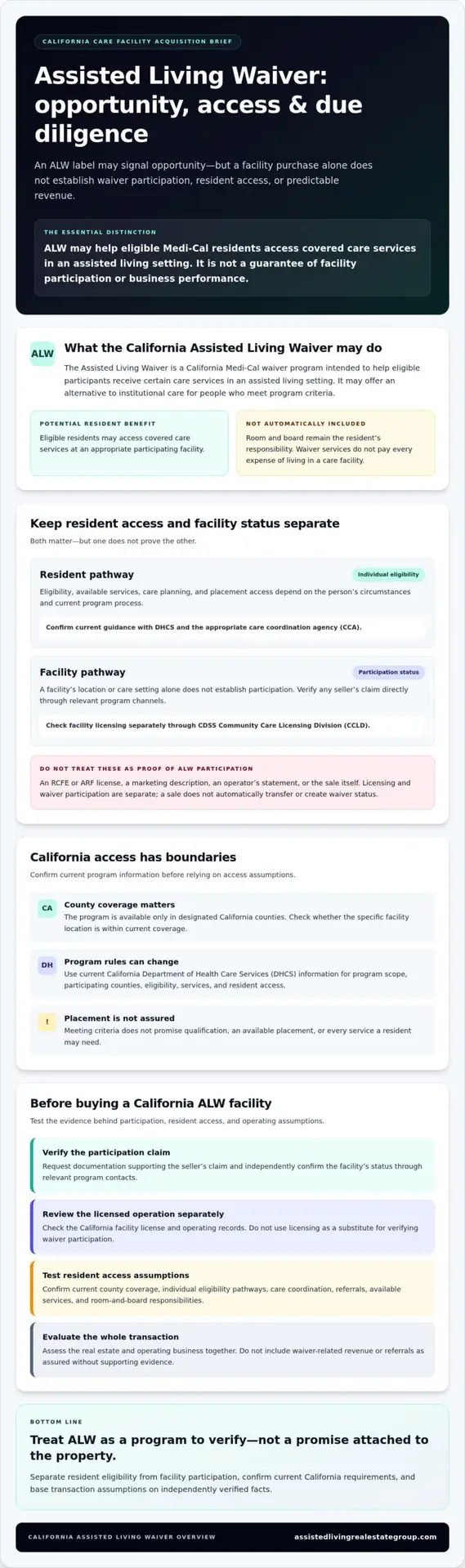
Buying an ALW facility California: questions to investigate
A seller’s description is a starting point, not proof. Before building an acquisition case around ALW, ask for facility-specific records and identify what each program-related claim means. A claim about a resident’s services, the facility’s participation, or projected business performance concerns a different matter and needs different evidence.
Which ALW-related claims should a buyer substantiate?
Request records behind statements about current participation, resident access, services, referrals, or ALW-related revenue. Confirm with the appropriate California program authority what the documentation establishes and whether it applies to the facility being sold. If the seller’s materials are incomplete, outdated, or unclear, treat the claim as unresolved until a qualified professional helps assess it.
Use these questions to focus the review:
- Program status: What facility-specific documentation supports the seller’s statement, and has the relevant program contact confirmed what it means?
- Resident access: Do occupancy or referral claims describe actual records, individual resident circumstances, or an assumption about future access?
- Services and operations: Which services are represented as available through the program, and what records substantiate how the facility has operated?
- Financial assumptions: Which figures in the seller’s projections depend on ALW-related activity, and can they be reconciled with operating records?
- Open issues: What remains unverified, and who is qualified to review it before you rely on it?
How to connect program research with facility due diligence
Assess the property and operating business as related but distinct parts of the transaction. The property review concerns the real estate and its records. The business review concerns operations and the assumptions behind performance. Program claims may affect those assumptions, but they should not replace a review of either element. Have qualified legal, licensing, financial, and program professionals review matters within their expertise.
Buyer checklist: What records support the claimed ALW status? What do those records actually confirm? Do the facility’s operating records support the related business assumptions?
For a wider view of transaction planning, consult this California RCFE acquisition guide. It can complement ALW-specific verification by helping buyers consider the broader purchase of a licensed facility and its operating business.
Buying an ALW facility California calls for disciplined verification, not reliance on a listing label. To discuss California care-facility acquisition opportunities and how the real estate and operating business fit into a transaction, contact a specialized care-facility brokerage.
Plan your next step with a California care-facility specialist
A sound acquisition process moves in sequence: understand ALW, verify program claims, assess the facility and operating business, then decide whether the opportunity fits your goals. This order helps keep a program label from overshadowing the facts that shape a transaction.
A specialized California brokerage can help buyers evaluate the real estate and operating business together, compare facility opportunities, and consider how stated assumptions fit the transaction. Brokerage guidance has limits. It does not replace legal, licensing, financial, or program-authority advice. Bring specialized questions to qualified professionals and the relevant California agencies.
When should a buyer involve a specialized California broker?
Consider speaking with a broker while comparing opportunities or assessing whether a facility fits your acquisition plans. Assisted Living Real Estate Group focuses on California RCFE and ARF transactions and reports more than 25 years of combined care-facility industry experience. That transaction perspective can help frame questions about the property and operating business, without guaranteeing an outcome or determining ALW status.
What to prepare before discussing an ALW facility opportunity
Arrive with a clear picture of your acquisition goals, relevant operating experience, and the type of California facility you are seeking. Note any seller statements about ALW participation, resident access, services, or revenue that still need confirmation. A concise list of verified facts and open questions makes an initial opportunity discussion more focused and helps identify where further professional review may be needed.
- Goals: What are you looking to acquire, and what role do you expect to take in the business?
- Facility fit: What facility profile aligns with your plans and experience?
- Program questions: Which ALW-related claims have documentation, and which still need independent verification?
For buyers buying an ALW facility California, the aim is not to force a fit. It is to connect verified program information with a realistic view of the facility and transaction, so the decision reflects both business fundamentals and the potential to support compassionate care.
If you are considering a California care-facility acquisition, you can discuss California facility opportunities with a specialized brokerage as you evaluate your next step.
Move forward with a verified California facility opportunity
An ALW-related opportunity deserves careful review, not assumptions. Eligible residents may benefit from access to covered care services, but individual eligibility, facility participation, and availability must be confirmed. A purchase does not automatically convey program status or assure occupancy, revenue, or returns.
For buyers buying an ALW facility California, keep the next steps clear: verify program claims with appropriate sources, review licensing separately, and assess the real estate and operating business using their own records and assumptions. Legal, licensing, financial, and program-specific questions may call for qualified professionals beyond a broker’s role.
Assisted Living Real Estate Group is a specialized California brokerage for RCFE and ARF transactions, with more than 25 years of combined care-facility industry experience. Its guidance considers both the real estate and underlying business, helping buyers frame the transaction with a broader view. To explore a potential fit, discuss California care-facility opportunities.
With disciplined diligence and the right expertise, you can pursue an opportunity grounded in verified facts and a thoughtful vision for care.
Frequently Asked Questions
What is the Assisted Living Waiver program in California?
The Assisted Living Waiver (ALW) is a California Medi-Cal program that may help eligible participants receive covered care services in an assisted living setting. It is intended to offer a community-based care option for people who meet program criteria. Availability is limited to participating California counties, including several in Southern California, such as Los Angeles, Orange, Riverside, San Bernardino, and San Diego. Confirm current program scope and county coverage with the California Department of Health Care Services (DHCS).
Who may qualify for California’s Assisted Living Waiver?
Eligibility depends on an individual’s circumstances and current California program criteria, so a general description cannot confirm that a specific person qualifies. Prospective participants should check current Medi-Cal and ALW requirements and contact a care coordination agency (CCA) for information about assessment and referral. A CCA can explain the applicable steps, but buyers should not assume that a facility’s location, license, or interest in serving a resident establishes that person’s eligibility.
Can buying an ALW facility transfer its program participation to a new owner?
No. Buying a facility associated with ALW does not by itself confirm that participation transfers to a new owner or that the buyer can participate. Before relying on the seller’s statement, request facility-specific documentation and confirm with the appropriate program contact what it establishes and whether it applies after the transaction. Treat participation as an item to verify, not an asset that automatically conveys with the real estate or operating business.
Does an RCFE need a separate license to participate in the Assisted Living Waiver?
An RCFE needs the applicable California operating license, but that license alone does not establish ALW participation. Waiver-related participation involves separate program requirements that buyers should confirm with DHCS. For a Southern California facility, verify its licensing status through the California Department of Social Services Community Care Licensing Division and separately check its claimed ALW status with the relevant program contact. Licensing and waiver participation are not interchangeable approvals.
What benefits can the Assisted Living Waiver provide to residents?
For a resident who meets program criteria, ALW may help cover certain care services in an assisted living setting. It does not mean every service or living expense is covered: residents remain responsible for room and board. Available services and a person’s eligibility must be confirmed through current California program guidance. A CCA can explain how the resident’s circumstances relate to assessment and referral, but cannot guarantee that a particular facility placement will be available.
Does ALW participation guarantee a facility occupancy or revenue?
No. ALW participation does not guarantee resident referrals, occupancy, revenue, profitability, or investment returns. Resident eligibility, service needs, program conditions, and access to placement are separate considerations. Buyers should assess operating records and financial assumptions independently, then identify which projections rely on ALW-related activity. Distinguish documented historical performance from forecasts about what may happen after closing. A waiver-related opportunity should inform due diligence, not replace it.
How can a buyer verify an assisted living facility’s ALW-related claims?
Request documents that support each specific claim, then confirm their meaning with the appropriate California program contact. Clarify whether the statement concerns facility participation, an individual resident’s eligibility, available services, referrals, or projected revenue. These are not interchangeable. For buyers buying an ALW facility California, compare claimed program activity with facility and operating records, and verify the license separately through California’s licensing agency. Refer unresolved legal, financial, licensing, or program questions to qualified professionals.