
While many see California’s aging population as a looming crisis, strategic professionals recognize it as an unparalleled opportunity for high-impact investment. The barrier to entry is intentionally steep. Mastering the rcfe application process california requires more than just filling out forms; it demands a sophisticated understanding of Title 22 regulations and a meticulous approach to business formation. You likely feel the weight of potential delays or the frustration of deciphering complex fire clearance requirements. It’s a common hurdle that stops many talented providers before they even begin.
We understand that your goal is to bridge the gap between financial success and compassionate care. This guide provides the definitive 2026 roadmap to securing your Permission to Operate without the typical 18-month headache. You’ll learn how to navigate the 80-hour Administrator Certification, manage the mandatory CDSS application fees, and meet the strict three-month operating expense reserve requirement. We’re breaking down every phase from initial orientation to the final pre-licensing inspection. This ensures you can launch your facility with the confidence of a seasoned operator and the precision of a market leader.
Key Takeaways
- Understand how Title 22, Division 6, Chapter 8 dictates every operational detail of your facility under the oversight of the Community Care Licensing Division.
- Complete the mandatory 80-hour Administrator Certification and pass the state exam with a 70% score before submitting your license application.
- Master the strategic synchronization required for the rcfe application process california by aligning your business entity with a comprehensive Plan of Operation.
- Distinguish between residential zoning for small 6-bed facilities and commercial requirements for larger operations to ensure your property is licensable.
- Prepare for the final pre-licensing inspection and Component III orientation to transform your investment into a compliant, operational care home.
Navigating the California RCFE Licensing Roadmap in 2026
The transition from a real estate investor to a licensed care provider begins with a deep dive into the state’s regulatory framework. A Residential Care Facility for the Elderly (RCFE) is defined by the California Department of Social Services (CDSS) as a non-medical assisted living environment for residents aged 60 and older. These facilities are strictly governed by the Community Care Licensing Division (CCLD). This division ensures that every operator provides a level of service that meets rigorous safety and wellness standards. Success in the rcfe application process california requires a strategic synchronization between your business goals and these state mandates.
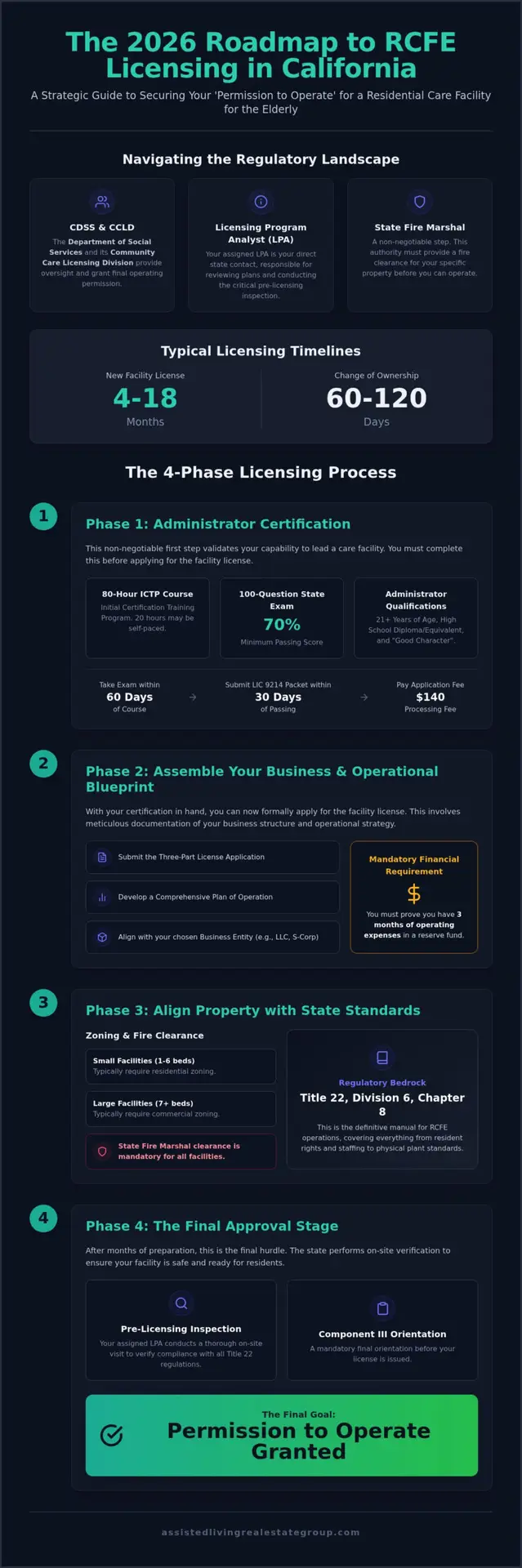
Your journey involves three critical stakeholders who hold the keys to your facility’s opening. The CDSS provides the administrative oversight and issues the final license. Your assigned Licensing Program Analyst (LPA) serves as your direct contact, conducting the pre-licensing inspection and reviewing your operational plans. Finally, the State Fire Marshal must provide a fire clearance for your specific property. Coordination with these entities is essential. While a change of ownership for an existing facility might take 60 to 120 days, you should prepare for a timeline of 4 to 18 months when applying for a brand-new license.
The Role of the Community Care Licensing Division
The CCLD manages regional offices throughout Southern California, providing localized oversight for facilities in markets like Los Angeles, Orange County, and San Diego. Their primary objective is to verify that you are capable of maintaining a safe environment before granting a ‘Permission to Operate.’ In 2026, the division has moved toward mandatory digital filing systems. This shift has streamlined the initial document submission process, reducing the time spent on clerical errors and mail delays. However, this digital efficiency puts more pressure on the applicant to provide perfect, high-resolution documentation from day one.
Title 22 Compliance: The Bedrock of Your Application
Title 22, Division 6, Chapter 8 of the California Code of Regulations is the definitive manual for your operation. It covers everything from resident rights to staff training requirements and physical plant standards. Many new applicants stumble by misinterpreting the definition of ‘Care and Supervision.’ This term includes assistance with activities of daily living (ADLs), such as dressing, bathing, and medication management. Failing to account for the staffing costs associated with these services can jeopardize your financial projections. Mastering these regulatory nuances is a core component of successful RCFE Licensing in California. You must treat Title 22 as a living document that guides every decision in your facility development.
Phase 1: Securing the RCFE Administrator Certification
The journey to becoming a licensed operator is a sequential discipline. It begins with the Initial Administrator Certification Program (ICTP). This 80-hour commitment is the intellectual bedrock of your future facility and a vital early step in the rcfe application process california. Of these 80 hours, 20 may be completed in a self-paced format, allowing busy professionals to maintain their current momentum. Once the course is finished, you have a 60-day window to take the state exam. This 100-question test requires a minimum score of 70%. It’s a rigorous gatekeeper designed to ensure only the most prepared leaders enter the market.
After passing the exam, you must submit the LIC 9214 application packet within 30 days. This includes a $140 processing fee. This phase is where many investors begin to realize the depth of the rcfe application process california. It isn’t merely about personal qualification; it’s about establishing a record of professional integrity with the state. You aren’t just getting a certificate. You’re proving your readiness to lead a high-stakes service environment.
Administrator Requirements and Qualifications
To qualify as an RCFE administrator in California, you must be at least 21 years of age and hold a high school diploma or equivalent. Beyond these basic metrics, the California Department of Social Services (CDSS) looks for “Good Character.” This is a qualitative assessment of your fitness to oversee vulnerable seniors. Identifying your administrator early is a tactical necessity. Whether you intend to serve in this role yourself or hire a seasoned professional, this individual’s credentials must be integrated into the initial application to avoid costly delays.
The Live Scan and Criminal Record Clearance
Integrity is verified through a mandatory Live Scan fingerprinting process. This involves background checks through both the Department of Justice (DOJ) and the FBI. Every person associated with the facility, from the owner to the direct-care staff, must obtain this clearance. Certain non-exemptible offenses can permanently disqualify an applicant. It’s vital to conduct your own due diligence before investing capital. Organizations like the 6Beds RCFE Association provide excellent advocacy and peer resources for those navigating these background check hurdles.
Managing the timeline between fingerprinting and final certification is a critical operational detail. Live Scan results can take several weeks to process. If you’re looking to bypass the lengthy startup phase, exploring turnkey business acquisitions can significantly accelerate your time to market. This allows you to step into an already compliant environment while you finalize your personal certifications. This strategic move often provides a faster path to operational revenue.
Phase 2: Preparing the Three-Part License Application
The rcfe application process california is a tripartite architecture designed to prove your operational readiness. It isn’t just a stack of forms. It’s a professional manifesto. By meticulously organizing your LIC 200, LIC 215, and LIC 308 forms, you demonstrate to the Community Care Licensing Division that your corporate or individual entity possesses the stability required for long-term service. This administrative component, known as Part A, establishes the legal foundation of your business. Whether you’re filing as a sole proprietor or a sophisticated LLC, this section must be flawless to avoid immediate rejection. For entrepreneurs who need a professional base to manage this complex paperwork, you can discover Citizens Business Center for flexible executive suites that provide the ideal administrative environment.
Part B and Part C move from the abstract to the tangible. Part B is your Operational Plan, the manual that dictates how your facility will breathe and function. Part C focuses on the Physical Plant, requiring proof of property ownership or a long-term lease. This section also triggers the fire clearance process. You’ll need to provide detailed sketches of the facility, proof of liability insurance, and comprehensive financial statements. Missing a single supporting document can stall your timeline by months. Precision is your greatest asset here.
Your Plan of Operation is the soul of your facility. It must clearly define your admission policies and the resident’s bill of rights, ensuring every senior receives dignified care. You must also specify your level of care. If you intend to offer specialized memory care or hospice waivers, your plan must reflect the staffing and safety protocols required for those high-barrier services. Additionally, your emergency disaster plan must meet updated 2026 California standards. It should outline specific evacuation routes and resource management during the state’s frequent climate events. This document proves you can handle a crisis before it ever happens.
Financial Solvency and the LIC 401 Form
The state’s primary concern is that your facility won’t fail financially, leaving residents in limbo. The LIC 401 form is where you prove your financial stewardship. You must demonstrate that you have at least three months of operating capital in reserve, strictly separate from your initial start-up costs. For a typical small facility, this often means having $30,000 to $75,000 in accessible funds. Proving this solvency is non-negotiable. Whether you’re a sole proprietor or a corporation, the CDSS requires a transparent look at your balance sheets. A strong financial showing prevents early denials and signals to the state that your business is built for longevity and social impact.
Aligning Real Estate with Title 22 Property Standards
Selecting the right property is where your investment moves from theory to a tangible asset. In the rcfe application process california, the real estate you choose dictates your operational capacity and your long-term overhead. You aren’t just looking for a residential home; you’re looking for a structure that can survive the scrutiny of Title 22 physical plant standards. Southern California’s competitive market requires a discerning eye to spot a property that is truly ‘licensable’ without requiring six figures in immediate retrofitting costs. Every square foot must serve both a human and a regulatory purpose.
Zoning and Local Ordinances in Southern California
California state law provides a powerful shield for small operators. Facilities with six beds or fewer are legally classified as residential. This means local municipalities cannot use zoning bans to block your facility in a standard neighborhood. However, the moment you move to seven beds or more, you enter the commercial sphere. This shift requires navigating Conditional Use Permits (CUP) and more stringent local ordinances. If you want to bypass the uncertainty of zoning approvals, browsing an established RCFE for Sale is often the most efficient path to market entry.
The Physical Plant Inspection Preparation
The physical plant inspection is where many applications stall. Common pitfalls include failing to secure pool areas or neglecting to calibrate hot water temperatures between 105 and 120 degrees Fahrenheit. You must also prepare a precise facility sketch using form LIC 999. This document requires accurate measurements of every room and outdoor space. ADA compliance is another non-negotiable factor. You need appropriate bedroom and bathroom ratios to ensure resident dignity and safety. Consulting with a business broker for assisted living saves months of property retrofitting by identifying assets that already meet these specific California standards.
Securing a fire clearance (STD 850) is the final, critical hurdle. Your local fire marshal will inspect for smoke detectors, fire sprinklers, and clear egress routes. This clearance is property-specific and must be obtained before the CDSS issues your license. Fire clearance fees in California typically range from $300 to $1,500 depending on your specific jurisdiction. If you’re ready to find a property that aligns with your vision and regulatory requirements, view our current Southern California inventory to find your next investment.
The Final Hurdle: Pre-Licensing Inspections and Approval
The culmination of the rcfe application process california is the pre-licensing inspection. This is the moment where your theoretical planning meets operational reality. After months of administrative preparation and property retrofitting, the California Department of Social Services will dispatch a Licensing Program Analyst (LPA) to your facility. This visit isn’t merely a formality; it’s a comprehensive audit of your readiness to protect and serve the elderly. You’ve already secured your fire clearance and submitted your three-part application. Now, you must prove that your facility can breathe according to the standards of Title 22.
During this visit, the LPA will conduct the ‘Component III’ orientation. This is a collaborative yet rigorous meeting where the analyst reviews your Plan of Operation and ensures you understand your legal obligations as a licensee. If the LPA identifies any physical or administrative gaps, they will issue a Plan of Correction. Don’t view this as a failure. It’s a structured path to compliance. Once these deficiencies are addressed, the state will issue your facility license number. This number is your legal mandate to finally admit residents and begin generating a return on your significant investment.
The LPA Walk-Through Checklist
The LPA’s walk-through is meticulous. They’ll verify that food storage meets sanitary requirements and that medication security protocols are impenetrable. Resident privacy is another high priority. Every bedroom and bathroom must align with the sketches you submitted in Part C of your application. The analyst will test your emergency call systems and ensure that every fire exit is accessible and clearly marked. Perhaps most importantly, they’ll audit your staffing files. Every employee must have a completed Live Scan clearance on record before the LPA steps foot on your property. A single uncleared staff member can stall your final approval.
Transitioning to Active Operations
Receiving your license number marks the shift from development to active management. You can now begin marketing your facility with the full weight of state approval behind you. The first 90 days are critical. Expect follow-up visits from licensing to ensure that your actual care delivery matches the promises made in your application. This is the stage where your operational systems are tested under real-world conditions. It’s also the time to begin thinking about your long-term legacy.
Strategic growth in this niche market requires a vision beyond a single location. Teri Szoke, drawing on over 25 years of industry experience, often advises investors to stabilize their first 6-bed facility before scaling into a larger portfolio. Mastering the rcfe application process california for one home creates a repeatable blueprint for success. By perfecting your model in a small-scale setting, you build the technical credibility needed to acquire larger facilities or expand into multiple Southern California markets. This methodical approach ensures that your financial returns are matched only by the quality of care you provide.
Launch Your Legacy in California’s Senior Care Market
Mastering the rcfe application process california is a high-stakes endeavor that requires meticulous coordination between administrator certification, Title 22 property compliance, and financial transparency. You’ve now seen how the three-part application and the final pre-licensing inspection serve as the ultimate gatekeepers to this exclusive market. Success in this niche requires more than just capital. It requires a mentor who understands the nuances of the Southern California regulatory landscape. This strategic approach transforms a complex legal journey into a predictable path toward operational excellence.
With over 25 years of specialized RCFE brokerage experience, we provide the confidential marketing and expert guidance needed for seamless turnkey business acquisitions. We help you bridge the gap between investment potential and compassionate service. Secure your California care facility investment with the Assisted Living Real Estate Group today. Your vision of achieving significant financial returns while making a tangible social impact is within reach. It’s time to turn your strategic goals into a licensed reality.
Frequently Asked Questions
How long does the RCFE application process take in California?
The rcfe application process california typically takes between 4 and 18 months for a brand-new facility. This timeline depends on the complexity of your property’s fire clearance and the responsiveness of your local Licensing Program Analyst. If you choose a change-of-ownership path for an existing facility in Southern California, the timeframe often shrinks to 60 or 120 days. This makes turnkey acquisitions a faster route for investors looking to launch operations quickly.
Can I apply for an RCFE license before I have a property?
You cannot complete the final licensing stages without a secured property. While you can finish your 80-hour Administrator Certification and initial business formation beforehand, Part C of the application requires a legal deed or a long-term lease agreement. The California Department of Social Services must also conduct a physical plant inspection and obtain a fire clearance for the specific address. We recommend identifying a licensable property early to avoid administrative stalls.
What is the total cost of the RCFE licensing application in 2026?
Total costs depend on your facility’s capacity. For 2026, the CDSS application fee for a 6-bed facility is $495, while 7 to 15 beds cost $990. Larger facilities with 50 or more beds require $4,950 or more. You must also budget for the Administrator Certification course, which ranges from $700 to $1,200, Live Scan fingerprinting at $100 to $200 per person, and fire clearance inspections. These figures don’t include the required three-month operating capital reserves.
Do I need to be a nurse to open an RCFE in California?
You don’t need a nursing degree or a medical background to own or operate an RCFE. The state requires that the designated administrator be at least 21 years old and hold a high school diploma or equivalent. The primary requirement is completing the 80-hour Initial Administrator Certification Program and passing the state exam. While medical expertise is helpful, the RCFE model focuses on non-medical care and supervision rather than clinical treatment or intensive nursing services.
What is the difference between an RCFE and an ARF license?
The primary distinction lies in the age and needs of the residents you serve. A Residential Care Facility for the Elderly (RCFE) serves seniors aged 60 and older who require varying levels of care and supervision. An Adult Residential Facility (ARF) focuses on individuals aged 18 to 59 with physical, mental, or developmental disabilities. Both license types require a rigorous rcfe application process california, but the operational regulations and Title 22 standards differ significantly between the two models.
Can I buy an existing RCFE and keep the same license?
Licenses are non-transferable in California. When you buy an existing business, you must apply for a new license under your own business entity. This is known as a change-of-ownership application. Although you can’t simply keep the seller’s license, purchasing an existing facility often allows you to operate under the seller’s license during the 60 to 120-day transition period. This ensures cash flow remains steady while your new application is processed by the state.
What are the staffing requirements for a new RCFE?
Staffing levels must be sufficient to meet the needs of your residents 24 hours a day. All direct-care staff must be at least 18 years old and pass a DOJ and FBI Live Scan background check. They must also complete 40 hours of mandatory training. Eight of these hours are required before they begin working with residents, and the remaining 32 hours must be finished within their first four weeks of employment in your Southern California facility.
What happens if my RCFE application is denied?
If your application is denied, the CDSS will provide a formal notice outlining the specific deficiencies. You generally have 15 days to file an appeal or request an informal meeting to contest the decision. Most denials stem from incomplete documentation or failed physical plant inspections. Addressing these issues through a formal Plan of Correction often allows you to resolve the state’s concerns and successfully move forward with your facility’s opening and resident admissions.