
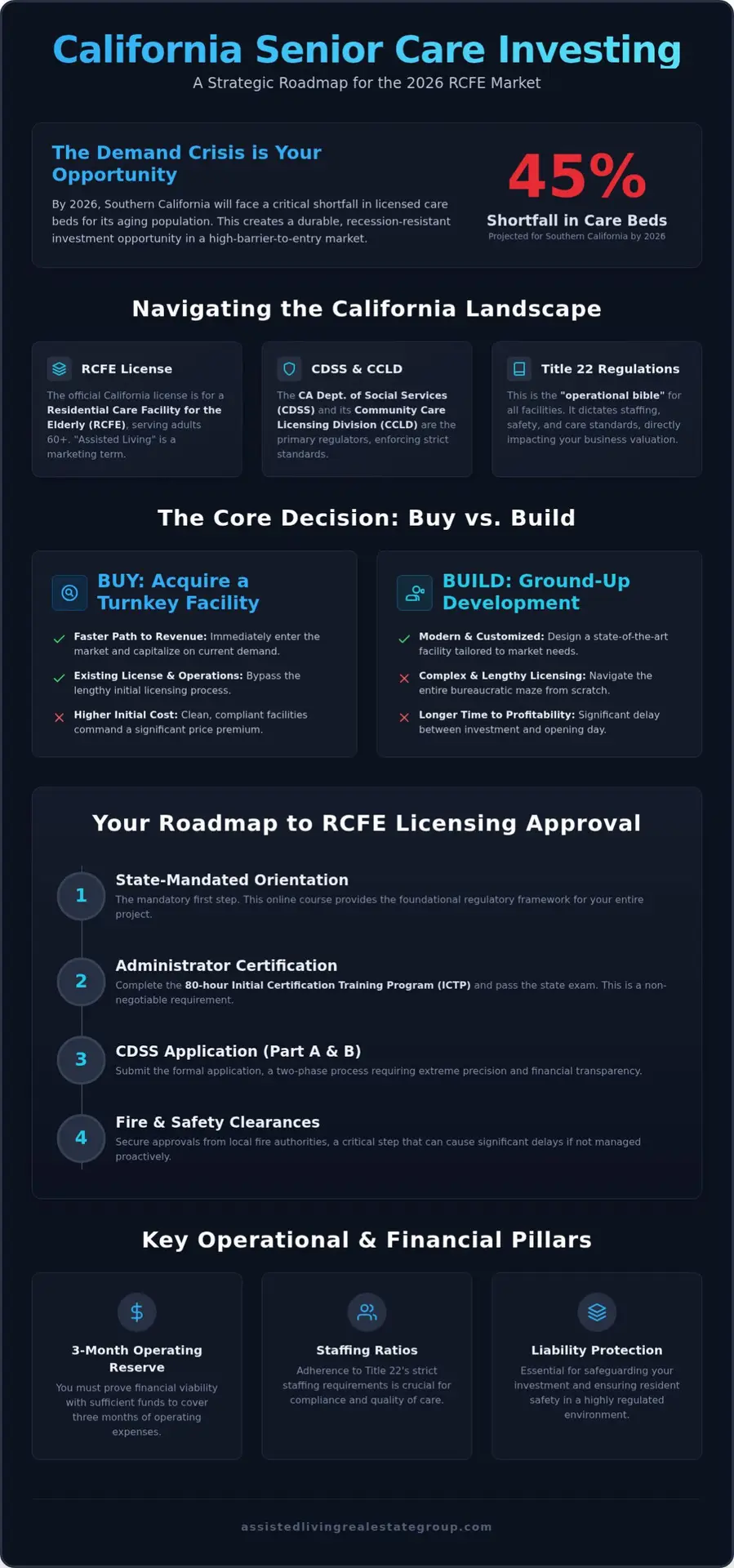
By the end of 2026, Southern California will face a staggering 45% shortfall in licensed care beds for the aging population. This isn’t a crisis for the strategic investor; it’s the most durable demand story in modern commercial real estate. While the opportunity is massive, the barrier to entry remains notoriously high due to the complex web of CDSS regulations and strict Title 22 compliance. You’re likely weighing the critical decision to buy vs build assisted living facility california assets to capture this market before the window of peak opportunity narrows.
We understand that navigating the Community Care Licensing Division (CCLD) and securing fire clearances can feel like a bureaucratic maze. You want to achieve significant financial returns while ensuring your facility provides the premium care residents deserve. This guide serves as your high-level mentor, bridging the gap between sophisticated financial investment and compassionate service. We’ll provide a professional roadmap through the RCFE licensing landscape, helping you determine whether a turnkey acquisition or a ground-up development aligns with your 2026 goals. From understanding the nuances of ARF licenses to mastering the three-month operating reserve requirement, you’ll gain the clarity needed to transform market potential into a legacy of social impact and profitability.
Key Takeaways
- Analyze why California’s demographic shifts create a recession-resistant opportunity for investors looking to enter the high-demand RCFE market.
- Compare the financial and operational implications of the buy vs build assisted living facility california decision to determine your most efficient path to revenue.
- Navigate the complex CDSS licensing roadmap, from securing a certified administrator to completing the state-mandated orientation process.
- Identify the core Title 22 compliance requirements, including staffing ratios and liability protections, essential for safeguarding your investment and resident care.
- Learn why partnering with a specialized broker is critical for executing confidential marketing strategies and securing exclusive turnkey acquisitions.
Understanding the California Senior Care Landscape in 2026
California is currently experiencing a structural demographic shift that transforms senior housing into a premier, recession-resistant asset class. By 2036, the state’s 65 and older population is projected to reach 10 million. This surge, frequently described as the Silver Tsunami, represents an unprecedented market potential for strategic professionals. For those looking to bridge the gap between high-level financial investment and compassionate care, the opportunity has never been more visible. However, success in this space requires more than just capital; it demands a deep understanding of the unique regulatory environment that defines the Golden State.
In California, the term “assisted living” is a marketing descriptor, not a legal one. The state officially licenses these operations as Residential Care Facilities for the Elderly (RCFEs). For a broader Assisted living overview, it’s helpful to recognize that California utilizes a social model of care rather than a purely clinical one. The California Department of Social Services (CDSS), through its Community Care Licensing Division (CCLD), acts as the primary gatekeeper. They enforce the rigorous standards that make California a high-barrier, high-reward market. This difficulty is exactly what protects your investment; the complexity of entry prevents the market saturation seen in less regulated states. Your ultimate decision to buy vs build assisted living facility california assets will be dictated by how quickly you intend to capture this growing demand while maintaining these strict standards.
RCFE vs. ARF: Which Model Fits Your Goals?
Choosing the right license type is the foundation of your investment strategy. An RCFE focuses on residents aged 60 and older who require varying levels of supervision or assistance with daily activities. Conversely, an Adult Residential Facility (ARF) serves adults aged 18 to 59 with various disabilities or mental health needs. In Southern California, the demand for RCFEs is particularly acute due to the aging affluent population in coastal pockets. Aligning your license type with these regional micro-trends is essential for long-term viability. You can explore these differences further in our guide on RCFE vs. ARF: Which California Facility is Right for You?
The Role of Title 22 Regulations
Title 22 of the California Code of Regulations is the operational bible for every facility owner. It dictates everything from staffing ratios to the temperature of the water in resident bathrooms. Compliance isn’t just about avoiding fines; it’s the primary driver of your business valuation. A facility with a clean “Type A” or “Type B” citation history commands a significantly higher premium during an acquisition. Title 22 is the comprehensive set of health and safety standards for RCFEs in California.
The Licensing Process: Your Roadmap to RCFE Approval
Securing a license in California is a rigorous exercise in precision. It separates the casual seeker from the strategic professional. To navigate California’s Senior Care Licensing Program successfully, you must first complete the state-mandated online orientation. This initial step provides the regulatory framework for your entire project. Approaching the CDSS with a combination of financial transparency and operational excellence is the only way to ensure your roadmap leads to a successful opening.
The Administrator Certification Requirement
Every RCFE must have a designated administrator who has completed a mandatory 80-hour Initial Certification Training Program (ICTP). This isn’t merely a checkbox; it’s a deep dive into Title 22 regulations. You’ll need to pass the state exam within 60 days of completing the course to secure your certification. Whether you choose to serve as the administrator yourself or hire a seasoned professional, having this expertise on your team early is non-negotiable. An experienced administrator anticipates regulatory friction, significantly reducing the delays that often stall new ventures.
Navigating the CDSS Application (Part A & B)
The formal application is split into two distinct phases known as Part A and Part B. Part A focuses on the applicant’s business structure and financial solvency. You’ll need to provide proof of a three-month operating reserve, which for a standard six-bed facility typically ranges from $65,000 to $85,000. Part B shifts the focus to your operational blueprint, including your disaster plan, sample menus, and staffing schedules. In Southern California, common pitfalls include incomplete fire clearances or inconsistent staffing plans, which can extend your wait time by months.
Following your submission, you’ll enter the Component meeting phase. These are structured sessions where CDSS analysts verify your understanding of resident rights and care standards. The process culminates in the pre-licensing inspection, where your physical property is scrutinized for safety and compliance. When considering the buy vs build assisted living facility california dilemma, remember that starting fresh can take 6 to 18 months. Conversely, acquiring an existing facility through a Change of Ownership (CHOW) can often be completed in 60 to 120 days. If you’re looking for a faster path to entry, exploring turnkey business acquisitions can bypass many of these initial development hurdles.
Buy vs. Build: Strategic Real Estate Decisions
Choosing between ground-up development and acquisition is the most consequential decision in your investment journey. Time is your most expensive asset. When analyzing the buy vs build assisted living facility california equation, you must weigh the allure of a custom-designed space against the reality of a 12 to 18-month development timeline. Constructing a new facility requires navigating architectural reviews, environmental permits, and sourcing the right location through platforms like BuyVacantLand.com, which can help identify potential development sites. For the strategic professional, this period represents a significant “burn phase” where capital is deployed without the offset of resident revenue.
For those seeking a more immediate impact, lease-to-own care home opportunities provide a viable alternative. This model allows operators with limited initial capital to secure a property and begin operations while building the equity necessary for an eventual purchase. It’s a pragmatic entry point into a high-barrier market, offering a balance between operational control and financial flexibility.
Buying an established RCFE allows for immediate cash flow from day one. You aren’t just acquiring a building; you’re inheriting a functioning ecosystem. This includes a trained care team, established vendor relationships, and, most importantly, a resident waitlist. The relicensing process for an acquisition is handled through a Change of Ownership (CHOW), which is notably more efficient than starting from scratch. To dive deeper into the nuances of acquisition, consult our resource on The Ultimate Guide to Buying an RCFE Facility in California. This path minimizes the buy vs build assisted living facility california friction by leveraging an existing business’s momentum.
Property Selection and Zoning Hurdles
Finding a compliant property in Southern California’s competitive market requires a specialized lens. You must understand the distinction between local municipal rules and state pre-emption. For facilities with six or fewer beds, California law often prevents local cities from imposing zoning requirements that differ from those of a single-family home. However, for larger facilities, you’ll need to navigate conditional use permits and local fire codes. The Fire Marshal pre-inspection is the most critical site visit you’ll schedule. Without a clear fire clearance, your licensing application cannot move forward. It’s the ultimate gatekeeper for your property’s viability.
Essential Operational Requirements for CA Facilities
Operational excellence transforms a licensed property into a high-impact investment. While the decision to buy vs build assisted living facility california assets focuses on the physical entry point, your long-term success depends on mastering Title 22 mandates. These regulations ensure resident safety and protect your business valuation from regulatory friction. Success in this sector requires a sophisticated balance between analytical financial management and the delivery of refined, compassionate care.
Staffing Your Care Team
Every employee and volunteer must pass a Live Scan background clearance before they step foot on the floor. This is non-negotiable. Beyond security, California requires staff to complete robust training modules to maintain compliance:
- First Aid and CPR certification
- Dementia-specific care techniques
- Resident rights and dignity protocols
- Emergency response and evacuation procedures
The staffing ratio is the number of caregivers required based on the acuity of resident needs. Maintaining these ratios isn’t just about compliance; it’s about the quality of life that justifies a premium price point. A well-trained team reduces turnover and enhances the resident experience, which are the dual pillars of operational stability.
Financial Management and ROI
Calculating your break-even occupancy rate is critical in the high-cost Southern California market. Most facilities need to maintain at least 85% occupancy to achieve significant financial returns. Diversifying your revenue streams between private pay and Long-Term Care Insurance (LTCI) provides a buffer against market fluctuations. Specialized care, such as memory care, allows for higher daily rates but requires more intensive staffing and specialized environmental design. This intersection of ethics and profitability is where the most successful investors thrive.
Protecting your investment in California’s litigious environment requires comprehensive liability insurance and bonding. These aren’t just administrative burdens; they are essential safeguards for your capital. At the heart of this protection is the resident care plan. These plans are the administrative soul of your RCFE, detailing every intervention and observation. Accurate documentation is your best defense against liability and the key to delivering refined service.
Building a reputation in your local community is the final piece of the operational puzzle. Occupancy isn’t just a metric; it’s a reflection of trust. Strategic professionals understand that a facility’s brand is its most valuable intangible asset. For investors who want to bypass the initial struggle of building a brand from scratch, exploring turnkey business acquisitions offers a significant advantage. This allows you to step into a facility with an existing reputation and a full roster of residents, ensuring immediate ROI and resolving the buy vs build assisted living facility california debate in favor of rapid market entry.
Partnering for Success: The Role of a Specialized Broker
The specialized nature of the RCFE and ARF sectors means that general real estate agents often lack the technical depth required to navigate a successful transaction. While a standard broker focuses on market comparables and escrow timelines, they rarely understand the nuances of Title 22 or the specific requirements of the Community Care Licensing Division. This knowledge gap can lead to catastrophic delays or failed closings. Partnering with a specialized consultancy like Assisted Living Real Estate Group (ALREG) ensures your investment is guided by 25 years of combined industry experience. We bridge the critical gap between real estate acquisition and regulatory compliance, positioning you as a high-level mentor in a high-barrier market.
When weighing whether to buy vs build assisted living facility california assets, you need an advocate who understands both the financial metrics and the moral compass of the industry. Our approach focuses on avoiding the common pitfalls that trap first-time owners. From verifying operating reserves to ensuring fire clearances are transferable, we provide the seasoned expertise necessary to achieve significant financial returns without sacrificing resident care. We don’t just sell property; we facilitate the transition of a mission-driven business.
Confidentiality and Continuity
Protecting the reputation of a facility during a transition is paramount. If news of a sale leaks prematurely, it can trigger resident flight and staff turnover, eroding the very value you’re trying to acquire or sell. ALREG utilizes a strict Confidential Marketing Strategy to protect the business’s current operations. We require comprehensive non-disclosure agreements (NDAs) and pre-qualify every buyer to ensure they have the financial capability and professional intent to maintain the facility’s standards. This exclusive process connects qualified investors with high-value listings while maintaining total operational continuity.
Consulting and Relicensing Support
The journey doesn’t end when the contract is signed. Navigating the change of ownership (CHOW) process with the CDSS requires a methodical approach to documentation and communication. We offer dedicated support for relicensing, ensuring the transition of the facility’s license is as seamless as possible. Our clients gain access to a refined network of Southern California vendors, including specialized appraisers, lenders familiar with the RCFE model, and compliance consultants. This ecosystem of support transforms a complex regulatory hurdle into a structured project development process.
Ready to start your journey? Explore our current RCFE listings in California.
Securing Your Position in California’s Senior Care Future
The Silver Tsunami is no longer a distant forecast; it’s a present reality that demands sophisticated, high-impact investment. By mastering the nuances of Title 22 compliance and the CDSS licensing roadmap, you position yourself at the intersection of significant financial returns and essential social contribution. Whether you choose to buy vs build assisted living facility california assets, your success hinges on precision, patience, and professional guidance. You’ve learned that while ground-up development offers a custom vision, turnkey acquisitions provide the momentum of immediate cash flow and established reputations.
Navigating this complex landscape requires a partner who understands that confidentiality and regulatory expertise are your greatest assets. With over 25 years of specialized experience, we offer the expert guidance on California Title 22 compliance and the confidential marketing strategies needed to protect your business value during every transition. Don’t leave your legacy to chance in this high-barrier market. Partner with California’s RCFE Experts to Find Your Turnkey Facility and transform demographic demand into a visionary success. Your journey toward becoming a leader in California’s care industry begins today.
Frequently Asked Questions
How much does it cost to open an assisted living facility in California?
Costs vary significantly based on your capacity and choice to buy vs build assisted living facility california assets. Initial application fees for an RCFE start at $495 for small facilities and scale to over $4,950 for larger centers. You must also prove a liquid operating reserve equivalent to three months of expenses, which typically ranges from $65,000 to $85,000 for a six-bed home. These figures don’t include real estate acquisition or construction costs.
How long does the RCFE licensing process take in CA?
The timeline depends largely on whether you’re launching a new facility or acquiring an existing business. A new RCFE application typically takes between 6 and 18 months from submission to final approval. However, a Change of Ownership (CHOW) for an established facility is often much faster, usually concluding within 60 to 120 days. Strategic investors often prefer turnkey acquisitions to bypass these lengthy development delays and reach revenue sooner.
Can I open an assisted living facility in a regular residential house?
You can absolutely operate a Residential Care Facility for the Elderly (RCFE) within a standard single-family home. In Southern California, six-bed residential care homes are a popular and highly effective model for providing personalized, high-quality care. State law provides specific protections for these smaller facilities, often preventing local municipalities from imposing restrictive zoning hurdles that differ from standard residential requirements. This model allows for a more intimate, home-like environment for residents.
Do I need a medical degree to own an RCFE in California?
You don’t need a medical degree or a background in healthcare to own an assisted living facility. California utilizes a social model of care for RCFEs rather than a clinical one. While you must designate a certified administrator who has completed the state-mandated 80-hour training and passed the exam, the owner’s role is often focused on strategic investment and business operations. Many successful owners partner with experienced administrators to handle daily Title 22 compliance.
What is the difference between an RCFE and a nursing home?
The primary distinction lies in the level of medical care provided. An RCFE is a non-medical facility focused on housing, supervision, and assistance with daily activities under a social model of care. Skilled Nursing Facilities (SNFs), or nursing homes, provide 24-hour medical care and are licensed by the Department of Public Health. Understanding this difference is crucial when deciding to buy vs build assisted living facility california properties, as the regulatory requirements vary significantly.
What are the fire safety requirements for an RCFE in CA?
Fire safety compliance is the ultimate gatekeeper for your licensing approval. Every facility must obtain a formal fire clearance from the local Fire Marshal, which involves a rigorous inspection of smoke alarms, sprinkler systems, and evacuation routes. Costs for these inspections in Southern California typically range from $300 to $1,500. For facilities serving non-ambulatory or bedridden residents, the requirements are even more stringent. We always recommend a pre-inspection site visit to identify necessary modifications early.
Can I buy an existing facility and keep the current license?
Licenses for care facilities in California are non-transferable. When you acquire an existing RCFE, you must apply for a new license through the Change of Ownership (CHOW) process. While you can’t simply keep the seller’s license, the CHOW process is generally more streamlined than a ground-up application. This allows you to maintain the facility’s operational continuity and resident roster while your own license application is processed by the Community Care Licensing Division.
What is a Component III meeting in the licensing process?
The Component III meeting is a vital stage in the CDSS licensing process where analysts evaluate your specific operational plans. During this session, you’ll demonstrate your mastery of Title 22 regulations, resident rights, and emergency procedures. It’s a structured opportunity for the state to verify that your business structure and care model align with California’s strict safety standards. Successfully completing this meeting moves you closer to the final pre-licensing inspection and opening.