
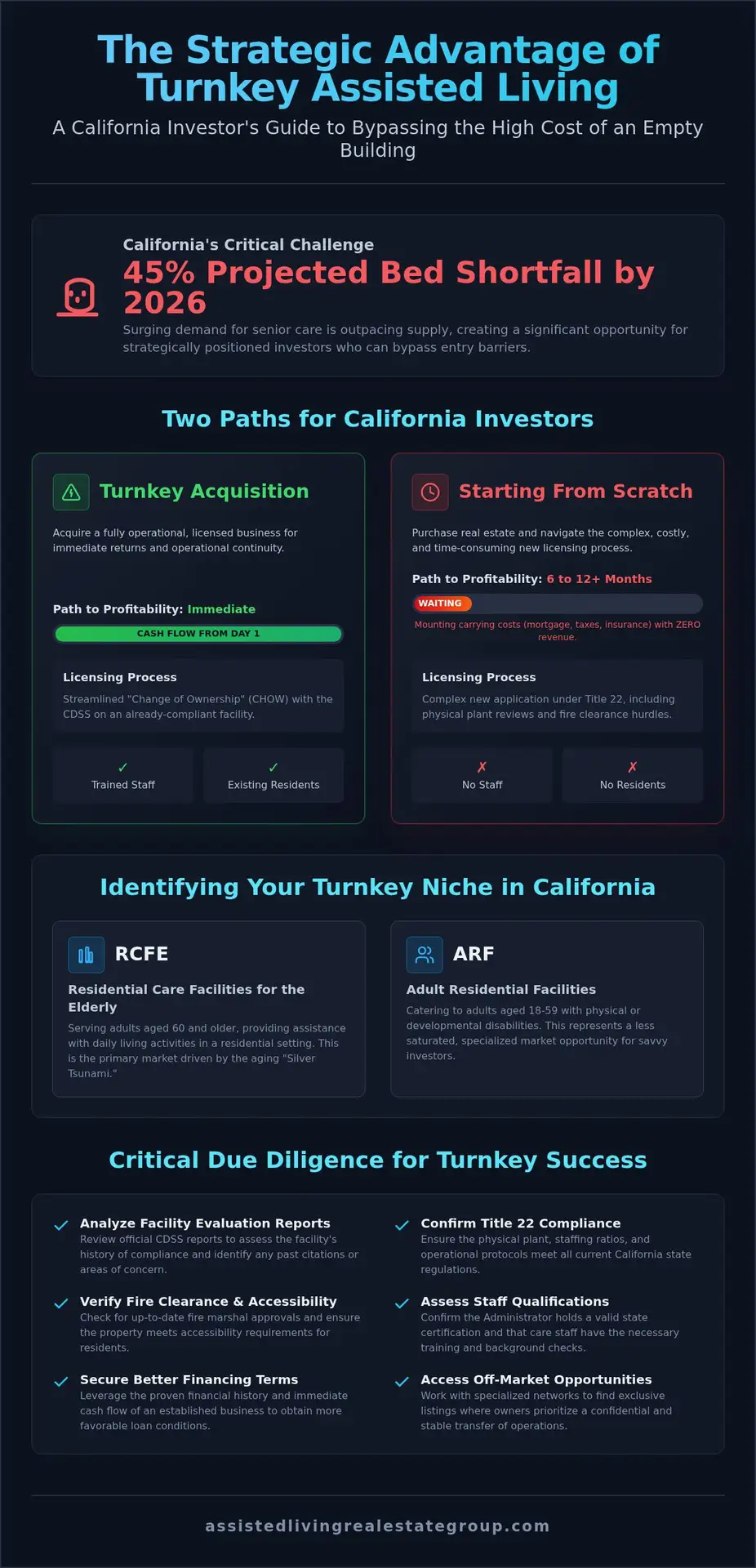
The most expensive mistake a California senior care investor can make isn’t overpaying for real estate. It’s underestimating the cost of an empty building. Waiting six to twelve months for the California Department of Social Services to approve a new license can drain capital faster than any renovation. You likely already know that the demand for care is surging, yet the red tape of Title 22 regulations often feels like an insurmountable wall. This leads many to ask: what is a turnkey assisted living business and why is it the preferred vehicle for strategic professionals? It’s the realization that time is your most finite asset in a market projected to face a 45% bed shortfall by 2026.
By choosing a turnkey acquisition, you aren’t just buying a property. You’re securing immediate cash flow, a trained staff, and an existing resident base from day one. This guide explores how bypassing the initial licensing lag allows you to focus on high-level operational excellence rather than administrative hurdles. We’ll examine the specific advantages of Residential Care Facilities for the Elderly (RCFE) and Adult Residential Facilities (ARF) within the California landscape. You’ll discover a roadmap to achieving significant financial returns while providing the premium, compassionate care that Southern California’s aging population desperately needs.
Key Takeaways
- Define what is a turnkey assisted living business by looking beyond the real estate to the value of an active, licensed “going concern” in California.
- Save months of carrying costs by bypassing the standard 6-12 month licensing delay that often stalls new facility startups.
- Master the due diligence process by analyzing Facility Evaluation Reports to confirm Title 22 compliance and operational health.
- Secure better financing terms by leveraging the proven history and immediate cash flow of an established RCFE or ARF.
- Access exclusive, off-market opportunities in Southern California through specialized networks that prioritize resident stability and confidential transfers.
What is a Turnkey Assisted Living Business?
Understanding what is a turnkey assisted living business requires looking beyond the physical structure of a property. In California, a turnkey facility is a fully operational “going concern.” This means you aren’t just purchasing a building; you’re acquiring a business that’s already navigated the intricate web of California Department of Social Services (CDSS) licensing. It’s the difference between buying an empty shell and walking into a functioning ecosystem. For sophisticated investors, this model is the gold standard. It eliminates the “red ink” phase where expenses mount while you wait for regulatory approval. The core promise is simple: you achieve operational continuity and revenue from day one of ownership.
The Essential Components of a Turnkey Facility
A true turnkey acquisition in Southern California must include several non-negotiable elements. First, the real estate must be optimized for senior safety and Title 22 compliance, featuring required fire clearance and accessibility modifications. Second, it includes an existing resident base. These residents provide the immediate monthly revenue necessary to cover debt service and operating costs. Finally, you acquire a trained staff. This includes a qualified Administrator who holds a valid state certification and a team of caregivers who understand the facility’s specific protocols. This established human capital is often more valuable than the real estate itself because it ensures the quality of care remains high during the transition of ownership.
RCFE vs. ARF: Identifying Your Turnkey Niche
Investors must choose between two primary paths within the California care sector. Residential Care Facilities for the Elderly (RCFE) are designed for those aged 60 and older. These facilities provide varying levels of assistance with daily living activities. If you want to understand the broad scope of what assisted living is, it typically encompasses the housing and care services found in these RCFEs. Alternatively, Adult Residential Facilities (ARF) serve adults aged 18 to 59 who have physical or developmental disabilities. While the RCFE market is driven by the aging “Silver Tsunami,” the ARF market offers a less saturated opportunity for those seeking a specific niche. Strategically identifying what is a turnkey assisted living business in your target market allows you to bypass the typical barriers to entry and secure a premium position in California’s care economy.
Turnkey Acquisition vs. Starting from Scratch in California
The most significant difference between a startup and a turnkey acquisition is the “Licensing Gap.” In California, securing a new Residential Care Facility for the Elderly (RCFE) license often takes 6 to 12 months. During this period, you’re responsible for mortgage payments, taxes, and insurance on a building that cannot legally generate a dime of revenue. This financial drain is the primary reason investors ask what is a turnkey assisted living business; they’re looking for a strategic shortcut to profitability. A turnkey facility is already generating cash flow, which drastically reduces the high failure rates associated with the “empty bed” phase of a startup.
Navigating California’s Regulatory Barriers
Adhering to California’s official regulations under Title 22 is a complex, multi-layered process. It involves rigorous physical plant requirements, mandatory fire clearances, and extensive administrator certification. When you start from scratch, you must navigate every one of these hurdles before admitting a single resident. In contrast, a turnkey acquisition involves a “Change of Ownership” (CHOW) process. While you still need to meet state standards, the facility itself already has a proven track record of compliance with the Community Care Licensing Division (CCLD). This history provides a level of regulatory certainty that a new build simply cannot offer. For those who value time and certainty, exploring turnkey business acquisitions is the most logical path to entry.
Operational Readiness and Staffing Continuity
Staffing is often the most difficult operational hurdle in the California market. Recruiting, background-checking, and training a full team of caregivers is a massive undertaking that takes months of trial and error. By acquiring an existing business, you inherit a team that’s already familiar with the residents’ care plans and the facility’s specific protocols. You’re buying an established culture rather than trying to build one from the ground up. This continuity is vital for maintaining resident stability and ensuring that the quality of care doesn’t dip during the transition. Sophisticated investors understand that paying a premium for an established, staffed facility is a small price for the immediate operational stability it provides. It allows you to step into the role of a strategic leader from day one, focusing on growth rather than basic recruitment.
Critical Due Diligence for Turnkey Care Homes
Success in this niche depends on the quality of your investigation. You aren’t just buying income; you’re buying a regulatory history. When evaluating what is a turnkey assisted living business, the most critical data points aren’t found on a standard balance sheet. They’re found in the “Facility Evaluation Reports” (FERs) issued by the California Department of Social Services. These documents reveal the true operational health of a facility, detailing every visit, citation, and plan of correction over the last several years. A history of recurring Title 22 violations is a red flag that no amount of monthly revenue can mask. You must verify that the current license is in good standing and that any physical plant deficiencies have been permanently resolved to meet evolving state safety standards.
Resident stability is your next priority. Analyze the tenure of the current population to ensure you aren’t walking into a high-turnover situation that will immediately spike your marketing costs. A stable, long-term resident base provides the predictable cash flow that makes these assets so attractive to strategic investors. You’re looking for a facility where the residents have called it home for years, suggesting a high level of satisfaction and a manageable care workload for your staff.
Financial Auditing for Senior Care Assets
Beyond general accounting, you must audit the specific “care-level” mix of the facility. In California, RCFEs often charge tiered fees based on the intensity of assistance required. A facility full of high-acuity residents may show impressive gross revenue, but the increased staffing hours and liability insurance premiums can quickly erode those margins. It’s essential to understand investing in residential assisted living from a granular operational perspective. You’ll need to verify that resident contracts are legally sound and that monthly service fees are aligned with the actual cost of care provided. Identifying hidden costs in staffing, such as overtime patterns or high turnover expenses, is vital before finalizing your valuation.
The Role of a Specialized RCFE Broker
General business brokers often overlook the nuances of care-specific regulations, which can lead to expensive post-closing surprises. A specialized mentor-broker understands the importance of confidential marketing for business sale to prevent resident flight or staff anxiety during the transition. Their expertise bridges the gap between a successful purchase and a stable operation. They don’t just find a building; they help you define what is a turnkey assisted living business in a way that protects both your capital and the vulnerable seniors under your care. This specialized guidance ensures that the “going concern” you buy today remains a thriving business tomorrow.
Financial and Operational Benefits of the Turnkey Model
Investing in a startup RCFE means accepting a period of high-burn capital. You’re paying for a building that can’t generate revenue while you wait for the state to approve your license. When asking what is a turnkey assisted living business, the answer lies in the total elimination of this “red ink” phase. By acquiring an established facility, you’re buying a business that’s already reached its break-even point. This immediate cash flow isn’t just a convenience; it’s a strategic shield that protects your capital during the critical first year of ownership. You step into a role where the primary focus is optimization rather than survival.
Financing is another area where the turnkey model outshines new construction. Lenders are fundamentally risk-averse. They prefer a business with a verifiable Profit and Loss (P&L) history over a pro-forma projection. When you acquire an established RCFE, you’re buying a proven revenue stream that satisfies the strict underwriting requirements of California financial institutions. This historical data makes the approval process smoother and often leads to more favorable loan terms. Once you’ve secured your first turnkey asset, it becomes the foundation for a multi-home portfolio, allowing you to scale your presence across Southern California with greater speed and efficiency.
Immediate ROI and Revenue Stability
The “Turnkey Premium” is the price you pay to bypass the 6 to 12 month licensing delay common in California. It’s a calculated trade-off that trades a higher purchase price for immediate, predictable returns. Existing occupancy is the ultimate risk mitigator for assisted living facility financing, as it proves the market demand for that specific location. Beyond the numbers, you’re also acquiring “Legacy Marketing.” This includes years of established relationships with hospital discharge planners, social workers, and local physicians. These referral networks are the lifeblood of a care home, and they take years of consistent service to build from scratch.
Strategic Impact and Compassionate Care
A turnkey acquisition represents the perfect intersection of high-level ethics and profitability. You aren’t just managing an asset; you’re ensuring the continuity of care for vulnerable seniors who already call your facility home. This model allows you to make a tangible social impact from day one. You’re providing a refined service in a market that’s projected to face a 45% bed shortfall by 2026. This sense of urgency makes the turnkey model more than just a financial play. It’s a path to a “socially significant” investment that offers both long-term significance and significant financial returns. Explore our current Turnkey Business Acquisitions to secure your entry into this premium market.
Securing Your Turnkey Investment in Southern California
Southern California represents one of the most competitive senior care markets in the nation. With land costs high and zoning laws strict, the barriers to entry for new construction are massive. This environment is exactly why savvy investors look for existing facilities. When you understand what is a turnkey assisted living business in this specific region, you realize it’s a gatekeeper to a high-demand, low-inventory asset class. Most high-performing RCFEs never reach public listing sites. Instead, they trade through specialized networks where confidentiality is paramount. A public sale can trigger anxiety among families and staff, leading to resident turnover that erodes the very value you’re trying to acquire.
Why Southern California is the Epicenter of RCFE Growth
The shift toward boutique, home-based care is accelerating across Los Angeles, Orange County, and San Diego. Families are increasingly rejecting large, institutional settings in favor of 6-bed residential care homes nestled in quiet neighborhoods. These smaller settings offer a higher quality of life and more personalized attention, which justifies premium monthly rates. By 2026, the projected shortfall in licensed beds will make these existing assets even more valuable. Strategically leveraging senior housing investment trends in this region requires a focus on these high-barrier neighborhoods where new licenses are difficult to obtain.
Partnering with Assisted Living Real Estate Group
Moving from a state of curiosity to a state of conviction requires a roadmap. We provide that specialized guidance by offering access to exclusive RCFE for sale listings that prioritize confidential transfers. Our role goes beyond the transaction; we act as a strategic partner who understands the granular details of the California re-licensing process. We mentor investors through the operational transition, ensuring you maintain Title 22 compliance while preserving the facility’s existing culture of care. This high-level mentorship is what defines what is a turnkey assisted living business in our portfolio. It’s about giving you the keys to a niche market with a professional roadmap already in place. Your next step is to transition from research to a strategic acquisition plan that secures your future in California’s care economy.
Mastering the California Senior Care Market
Navigating the “Silver Tsunami” requires more than just capital; it requires a strategic shortcut through California’s dense regulatory landscape. By understanding what is a turnkey assisted living business, you’ve identified the most efficient path to immediate profitability and operational stability. You’re bypassing the exhausting 6 to 12 month licensing wait times and stepping into a business with a proven history of Title 22 compliance. This model isn’t just an investment; it’s a commitment to high-level service in a market that rewards expertise.
With 25+ years of specialized California care facility experience, we provide the seasoned expertise needed to navigate Southern California RCFE and ARF markets. Our confidential brokerage ensures seamless ownership transitions that protect resident stability and staff morale. Don’t let regulatory red tape delay your financial impact or your social contribution. Explore Turnkey RCFE Opportunities in California and secure your position in this high-barrier, premium market. The opportunity is massive, and with the right roadmap, your success is inevitable.
Frequently Asked Questions
Is a turnkey assisted living business more expensive than starting a new one?
Defining what is a turnkey assisted living business requires looking at the total cost of entry. While these acquisitions typically require a higher initial investment than a startup, they’re often more cost-effective when accounting for the “Licensing Gap.” Starting from scratch involves 6 to 12 months of mortgage payments and overhead without revenue. When you calculate the carrying costs of an empty building, the premium for a turnkey model proves to be a financially sound decision.
How long does it take to transfer an RCFE license in California?
The California Department of Social Services typically processes a Change of Ownership (CHOW) application within 90 to 120 days. This is significantly faster than the 6 to 12 months required for a brand-new facility license. During this transition, the existing license often allows the facility to continue operations under the seller’s oversight. This ensures that resident care and revenue streams remain uninterrupted while the state reviews the buyer’s qualifications and background.
Do turnkey facilities come with the real estate or just the business?
Most turnkey opportunities in Southern California include both the real estate and the “going concern” business operations. This dual-asset structure is highly attractive to lenders and provides a foundation for long-term equity growth. However, some investors choose lease-to-own models or business-only acquisitions to reduce their initial capital outlay. It’s vital to clarify the structure early because it fundamentally changes the valuation and financing requirements for the care facility.
Can I change the staff or management after buying a turnkey facility?
You have the legal right to change staff or management after the acquisition is finalized. However, retaining the existing team is often the wisest move to preserve resident stability and operational continuity. Caregivers and Administrators who understand the specific needs of current residents are invaluable assets. If changes are necessary, it’s best to implement them gradually to ensure the facility remains in full compliance with Title 22 regulations during the transition.
What is the most common reason turnkey assisted living businesses are sold?
Retirement is the most frequent driver behind the sale of successful care facilities in California. Many owners have built their businesses over decades and are looking for a strategic professional to take over their legacy. Other common reasons include owner relocation or a shift in the seller’s investment portfolio. These legacy sales often present the best opportunities for new investors to acquire a facility with a stellar reputation and deep community roots.
Do I need a special license to own a turnkey RCFE in California?
To understand what is a turnkey assisted living business, you must distinguish between the facility license and the Administrator certificate. You need an RCFE license from the state to own and operate the business. Additionally, the facility must have a certified Administrator on staff. While the owner doesn’t necessarily need to be the certified Administrator, they must ensure the facility is managed by someone who has completed the state-mandated training and exam.
How do I find off-market turnkey care homes in Southern California?
Finding off-market opportunities requires partnering with a specialized brokerage that maintains deep roots in the Southern California care community. Most high-performing RCFEs are sold through confidential channels to prevent resident flight and staff anxiety. By working with an expert guide, you gain access to exclusive listings that never reach public platforms. This approach allows you to secure a premium asset without the intense competition found in the general real estate market.