
In 2026, the California recovery market has evolved into a sophisticated asset class where regulatory mastery separates the strategic visionaries from the sidelined. You recognize that the demand for high-quality care across Southern California is skyrocketing, yet the barriers to entry often feel like a fortress rather than a doorway. Navigating the labyrinth of California substance abuse treatment facility licensing requires more than just capital; it demands a roadmap that balances rigorous compliance with high-yield potential.
It’s frustrating to face local zoning hurdles or NIMBY resistance when you’re trying to provide essential services. This guide promises to demystify the 2026 landscape, teaching you how to distinguish between unlicensed sober living and DHCS-licensed treatment assets to ensure a secure investment. We’ll preview how to identify off-market opportunities in high-growth regions and explain why business valuation often outweighs simple real estate value. By the end of this analysis, you’ll possess the strategic clarity needed to execute a confidential exit or entry that honors your dual commitment to purpose and profit.
Key Takeaways
- Capitalize on the 2026 supply-demand imbalance in Southern California by transitioning from peer-run models to high-value, investor-backed recovery assets.
- Master the nuances of California substance abuse treatment facility licensing to distinguish between DHCS-licensed residential treatment and CCAPP-certified sober living homes.
- Gain a competitive edge through turnkey acquisitions that offer grandfathered zoning and established community relations, bypassing the risks of ground-up development.
- Target high-growth recovery hubs like San Diego County and the Coachella Valley, which remain premier destinations for exclusive, high-yield care models.
- Utilize confidential marketing strategies and specialized brokerage to secure off-market assets without disrupting existing operations or institutional stability.
Analyzing the 2026 California Recovery Housing Market Dynamics
The 2026 California recovery market has reached a critical inflection point. We’ve seen a decisive shift from the traditional, peer-run models toward sophisticated, investor-backed operations. This professionalization has transformed Sober living houses (SLHs) into high-value assets that require institutional-grade management and strategic oversight. In Southern California specifically, the supply-demand imbalance remains acute. While the need for quality beds continues to grow, the regulatory barriers and the complexities of California substance abuse treatment facility licensing keep new competition at bay, protecting the value of existing, licensed assets.
Investors aren’t just buying real estate anymore; they’re acquiring operational platforms with significant social impact. While Northern California offers some niche opportunities, Southern California remains the global epicenter for recovery services. The climate, established referral networks, and concentration of specialized talent create a market stability that NorCal often struggles to match. This geographic advantage makes the region a primary target for those looking to build a resilient, high-yield portfolio.
Economic Drivers of California Recovery Real Estate
State-funded recovery initiatives in 2026 have significantly bolstered occupancy rates across the state. These programs provide a stable floor for revenue, while the high-end private pay and insurance-reimbursed models offer the ceiling for significant financial returns. Recovery housing has proven to be a recession-resistant asset class. Even during economic downturns, the demand for substance abuse services doesn’t diminish; instead, it often intensifies. This unique dynamic allows owners to maintain consistent cash flow when traditional residential or commercial real estate markets falter. It’s a rare intersection where financial stability meets a mission-driven investment strategy.
Emerging Hotspots in Southern California
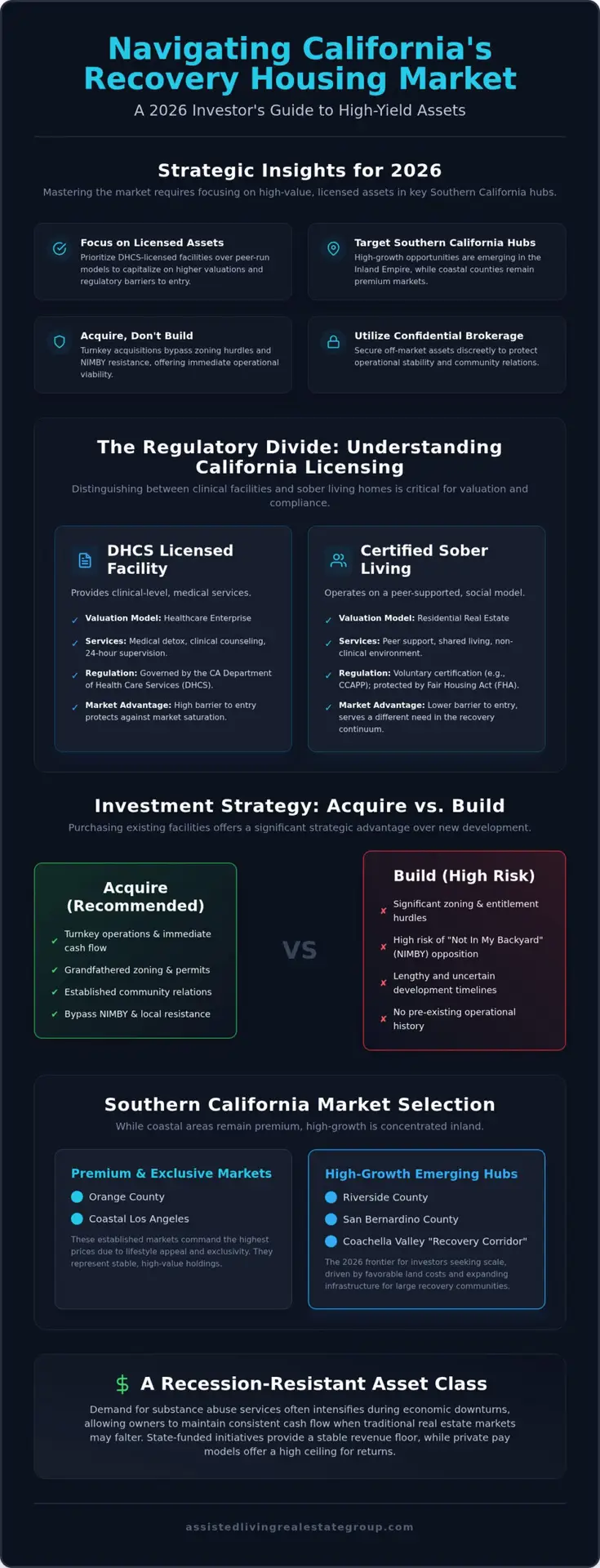
The geographic focus is shifting as the market matures. While Orange County and Coastal Los Angeles assets still command premium prices due to their exclusivity and lifestyle appeal, smart money is moving inland. Riverside and San Bernardino counties have emerged as high-growth hubs. These regions benefit from more favorable land costs and expanding infrastructure that supports large-scale recovery communities. The “Recovery Corridor” in the Coachella Valley and the broader Inland Empire represents the 2026 frontier for investors seeking to scale. Success in these high-barrier markets depends on mastering California substance abuse treatment facility licensing early in the acquisition process to ensure turnkey readiness and immediate operational viability.
Navigating California Licensing: DHCS Licensure vs. CCAPP Certification
Understanding the regulatory divide between a residence and a medical facility is the most critical step for any 2026 investor. In California, the Department of Health Care Services (DHCS) acts as the primary governing body for any program providing clinical care. If your operational model includes medical detox, chemical dependency counseling, or 24-hour supervision, you’re navigating California substance abuse treatment facility licensing. For those focused on the social model, the Fair Housing Act and the Americans with Disabilities Act provide vital legal protections. These federal laws prevent California cities from using discriminatory zoning to target recovery homes, provided the facility operates as a single-family household.
DHCS Licensure for Alcohol and Drug Recovery
Licensure isn’t just a hurdle; it’s a value multiplier. When a facility moves from a peer-led environment to a DHCS-licensed residential program, the property’s valuation shifts from residential real estate to a specialized healthcare enterprise. This transition requires strict adherence to fire safety codes, staffing ratios, and clinical documentation. While the compliance burden is heavy, it creates a formidable barrier to entry for amateur operators. This regulatory moat ensures that your investment remains protected from market saturation, making licensed assets the preferred choice for a strategic exit strategy.
Voluntary Certifications: CCAPP and Sober Living Network
Even for unlicensed sober living, voluntary oversight is no longer optional for serious players. Obtaining CCAPP Certification or NARR-compliant status through the Sober Living Network (SLN) is essential for securing high-quality referrals. In 2026, most insurance carriers and major California hospital systems require these credentials before they’ll even consider a partnership. Voluntary certification serves as the 2026 industry benchmark for operational excellence and referral security. If you want to bypass the multi-year wait times associated with new applications, you should consider turnkey business acquisitions that already possess these vital credentials. This approach allows you to step into a cash-flowing operation with an established reputation from day one.
Buying vs. Building: The Strategic Advantage of Care Facility Acquisition
The 2026 investment landscape offers two distinct paths: the slow, high-risk climb of ground-up development or the accelerated, strategic entry of turnkey acquisitions. While the allure of building a custom facility is strong, the reality of the current regulatory environment makes startups increasingly treacherous. New projects often face multi-year delays in California substance abuse treatment facility licensing, during which capital sits idle while overhead costs accumulate. Strategic investors increasingly favor acquiring existing operations because they offer immediate cash flow and a proven track record of compliance. You aren’t just buying a building; you’re securing a market position that has already survived the gauntlet of local and state approvals.
Valuing the Real Estate vs. the Business Entity
Successful acquisitions require a dual-valuation mindset. You must separate the “highest and best use” value of the residential real estate from the enterprise value of the recovery business. In 2026, premium California facilities are valued based on EBITDA multiples, reflecting the professionalization of the industry. A facility with a history of high occupancy and clean audits commands a significant premium over a vacant residential property. To maximize your return on investment, you must understand the interplay between these two asset classes. For a deeper dive into these metrics, we recommend reviewing our guide on How to Value Your Assisted Living Business, which applies many of the same financial principles to the recovery sector.
Navigating California Zoning and NIMBY Challenges
Zoning remains the primary battlefield for recovery housing in California. Local municipal friction, often fueled by NIMBY (Not In My Backyard) sentiment, can derail a new project before it even applies for state permits. Existing facilities offer the invaluable advantage of grandfathered zoning and established community relations. Under the California Health and Safety Code, the “6-bed rule” provides a vital shield, mandating that facilities for six or fewer residents be treated as single-family homes for zoning purposes. However, scaling beyond this limit requires expert site selection and a deep understanding of California DHCS Licensing Requirements. By acquiring an established asset, you bypass the most difficult startup hurdles, inheriting a facility that has already integrated into its neighborhood and secured its legal right to operate. This strategic shortcut allows you to focus on operational excellence rather than local political battles.
High-Growth Hubs: Southern California Market Selection for 2026
Southern California’s recovery market is a patchwork of high-barrier entries and untapped potential. For 2026, San Diego County remains a primary destination for investors due to its established medical infrastructure and consistent demand. Meanwhile, the Coachella Valley has matured into a dedicated “Recovery Corridor,” where lower land costs meet a growing population of individuals seeking desert-based serenity. Ventura County also presents a unique opportunity, offering a balance between manageable property costs and high-end private pay potential. Investors are also leveraging federal Opportunity Zones across these regions to maximize tax efficiencies while delivering essential community services.
Navigating California substance abuse treatment facility licensing in these diverse regions requires a granular understanding of local politics. While the state provides a unified licensing framework, municipal interpretation varies. Successful professionals target areas where the local economy supports premium service rates, ensuring that the high cost of entry is offset by superior operational margins. This geographic precision is what separates high-yield portfolios from underperforming assets.
The Los Angeles County Landscape
Los Angeles remains the largest market, but it’s also the most complex. In areas like Van Nuys and the San Fernando Valley, city-specific ordinances can complicate new developments. However, the South Bay and Long Beach markets are showing significant investment potential for 2026, particularly for those looking at turnkey acquisitions. If you’re considering expanding into broader care models, our guide on Investing in an Adult Residential Facility in California provides a detailed roadmap for the SoCal region. The 6-bed zoning protection is your most powerful tool here, allowing you to establish a presence in residential neighborhoods without the need for conditional use permits.
Orange County: The Gold Standard for Recovery
Orange County has emerged from a period of intense litigation as a more stable, professionalized market. Cities like Newport Beach and Costa Mesa have refined their oversight, creating a predictable environment for institutional-grade operators. The executive sober living niche is particularly lucrative here, with massive margins driven by a clientele that demands exclusivity and refined amenities. Orange County isn’t just a local hub; it’s the most resilient recovery market in the country. To secure a foothold in these competitive coastal enclaves, you need a partner who understands the nuances of California substance abuse treatment facility licensing and off-market deal flow. We invite you to explore our current Drug and Alcohol Recovery Facility Sales to find your next strategic acquisition.
Securing the Asset: Confidential Brokerage and the Path to Closing
The successful transfer of a recovery asset requires a surgical approach that general commercial realtors simply cannot provide. Selling a business that provides life-saving care is a delicate operation where the stakes extend far beyond the price per square foot. At Assisted Living Real Estate Group, we specialize in bridging the gap between high-stakes real estate and complex healthcare operations. Led by Teri Szoke, our team leverages 25 years of specialized experience in California care facility real estate to ensure your legacy is protected. We recognize that the true value of your enterprise is tied to the integrity of your California substance abuse treatment facility licensing and the continuity of your referral networks.
Preparing for a 2026 exit requires meticulous financial and regulatory hygiene. Buyers in the current market are sophisticated; they look for clean audits, transparent EBITDA reporting, and a robust compliance history. Our proprietary confidential marketing strategy allows you to test the market and identify qualified buyers without alerting competitors or disrupting your daily house operations. We act as your strategic partner, navigating the high-barrier California market to ensure you achieve a premium valuation that reflects both your real estate and your business entity.
Confidentiality: Protecting Your Patients and Your Profit
Public listings are often toxic for a sober living business. When a facility appears on a general real estate site, it can trigger staff anxiety and patient exodus, immediately devaluing the asset you’ve spent years building. We utilize a targeted vetting process, requiring strict non-disclosure agreements before any operational details are shared. This keeps your transition quiet and professional. For those looking to enter the market rather than exit, understanding these nuances is equally important. You can learn more about the complexities of care facility acquisitions in The Ultimate Guide to Buying an RCFE Facility in California, which outlines the rigorous standards required for success in the state.
Closing the Deal: From LOI to License Transfer
The path to closing involves more than just a title transfer. Managing the transition of California substance abuse treatment facility licensing through the DHCS is a methodical process that requires expert timing. We guide both buyers and sellers through the license transfer hurdles, ensuring that the facility remains operational and compliant throughout the handoff. In 2026, we’re seeing an increase in lease-to-own agreements for specialized recovery assets, providing a flexible entry point for investors while securing long-term value for sellers. Whether you’re negotiating a straight acquisition or a structured lease-to-own deal, our focus remains on a seamless transition that maintains the facility’s reputation and its cash-flowing potential.
Mastering the 2026 California Recovery Asset Class
The 2026 landscape for recovery housing in California represents a rare intersection of significant social contribution and sophisticated financial performance. Success in this high-barrier market isn’t found through general real estate tactics. It’s earned through a deep understanding of California substance abuse treatment facility licensing and a commitment to operational excellence. By prioritizing turnkey acquisitions in high-growth Southern California hubs, you bypass the friction of ground-up development and secure immediate cash flow from day one.
Navigating this complex environment requires more than just capital; it demands a partner with a proven, exclusive roadmap. As the Southern California market leader with over 25 years of specialized expertise, Assisted Living Real Estate Group provides the seasoned guidance and proprietary confidential marketing system you need to scale or exit with confidence. The opportunity to build a high-value portfolio while making a tangible social impact has never been more immediate. Your path to a strategic, high-yield investment starts with the right intelligence and the right partner.
Browse Current California Recovery Facility Listings
Frequently Asked Questions
Do sober living homes in California require a license from the DHCS?
No, sober living homes don’t require a DHCS license as long as they don’t provide clinical care or treatment. However, if the facility offers medical detox or counseling, it must obtain California substance abuse treatment facility licensing. Most sober living homes operate under the social model, which focuses on peer support and accountability rather than medical intervention. This distinction is vital for 2026 investors to understand when evaluating potential acquisitions.
What is the 6-bed rule for California sober living homes?
The 6-bed rule is a state mandate that requires cities to treat residential care facilities with six or fewer residents as single-family homes for zoning purposes. This protection prevents local municipalities from imposing special use permits or restrictive ordinances on small-scale recovery residences. It’s a cornerstone of the California Health and Safety Code. This rule allows investors to integrate facilities into residential neighborhoods without facing the same zoning battles as larger institutional centers.
How much is a sober living business worth in the 2026 California market?
Business valuation in 2026 is primarily driven by EBITDA multiples and the strength of referral networks. While real estate value provides a baseline, the enterprise value of a profitable, CCAPP-certified operation can be significantly higher. Factors like occupancy history, insurance contract stability, and location in high-growth hubs like Orange County influence the final price. Professional appraisals focus on the cash flow potential of the operational model rather than just the residential property value.
Can a city in California ban a sober living home from a residential neighborhood?
No, cities can’t outright ban sober living homes due to protections under the Fair Housing Act and the Americans with Disabilities Act. While some California municipalities have attempted to implement over-concentration ordinances, these are often legally challenged if they target recovery homes specifically. As long as the home operates as a single-family household and doesn’t provide medical services requiring California substance abuse treatment facility licensing, it has a protected right to exist.
What is the difference between a sober living home and an ARF in California?
The primary difference lies in the population served and the licensing body. A sober living home focuses on individuals recovering from substance use disorders and usually operates without a state license. An Adult Residential Facility (ARF) is licensed by the California Department of Social Services. ARFs provide non-medical care and supervision to adults with developmental disabilities or mental health disorders. While both utilize residential settings, their regulatory paths and operational mandates are distinct.
Is CCAPP certification mandatory for all recovery residences in California?
Certification isn’t legally mandatory for all residences, but it’s becoming an industry requirement for 2026 market viability. Most insurance carriers and hospital referral systems won’t partner with uncertified homes. Obtaining certification through the California Consortium of Addiction Programs and Professionals (CCAPP) signals to the market that your facility meets high standards for safety and ethics. It bridges the gap between being a simple rental and a professionalized recovery asset that attracts higher-quality residents.
How do I find off-market sober living homes for sale in Southern California?
Securing off-market opportunities requires partnering with a specialized brokerage that maintains a confidential network of sellers. Many high-value owners in regions like San Diego or the Coachella Valley won’t list publicly to avoid disrupting their residents. We use a proprietary confidential marketing strategy to connect qualified investors with these exclusive assets. This approach ensures you gain access to profitable, turnkey businesses that aren’t visible on general real estate platforms or traditional listing services.
Can I buy the sober living business without buying the real estate in California?
Yes, it’s possible to acquire the operational business through a lease-to-own agreement or a long-term commercial lease. This strategy allows investors to scale their operations without the heavy capital expenditure of a property purchase. In these deals, the buyer pays for the blue sky value, equipment, and referral contracts while leasing the physical facility. It’s a common entry point for strategic professionals looking to maximize their return on investment in the 2026 California market.