
In California’s high-stakes senior housing landscape, the most lucrative RCFE opportunities never reach a public listing. You’ve likely felt the frustration of being locked out of off-market deals. Perhaps you’ve felt overwhelmed by the shifting Title 22 licensing hurdles that reached full enforcement in 2026. It’s common for strategic professionals to feel isolated from the local Southern California operators who hold the keys to these confidential assets. This is why intentional networking for assisted living investors isn’t just a social exercise. It’s a critical deal-sourcing tactic required to penetrate a specialized, high-barrier market.
We’ll unlock the exact strategies you need to find off-market listings and build a reliable power team of California consultants. You’ll learn how to bridge the gap between financial investment and compassionate care while making direct connections to experienced RCFE operators. We are going to provide a roadmap for navigating the intersection of ethics and profitability in the state’s most exclusive care niches. This is your guide to securing high-level returns through strategic partnerships and local expertise.
Key Takeaways
- Discover why the most profitable California RCFEs never reach public listings and how to bypass the “invisible market” barriers.
- Master the art of networking for assisted living investors to gain exclusive access to off-market deals and high-performing Southern California assets.
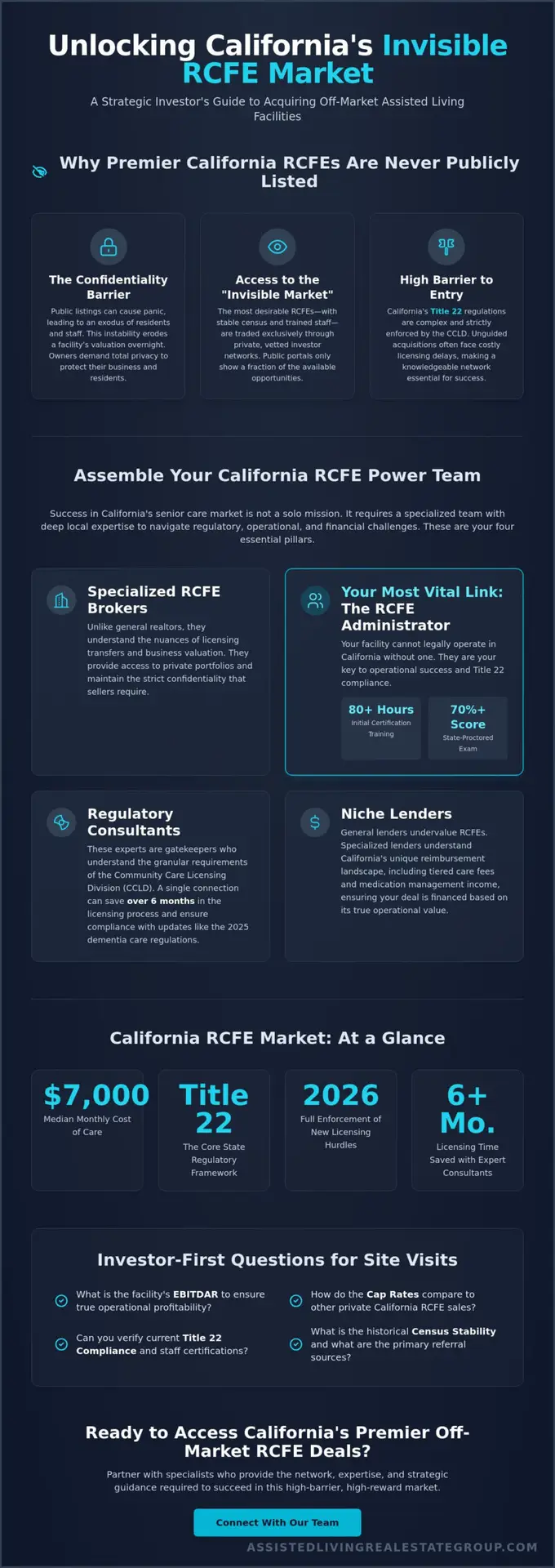
- Identify the four pillars of a specialized power team, including why the RCFE Administrator is your most critical operational link for Title 22 compliance.
- Learn the precise investor-first questions to ask during confidential site visits, focusing on EBITDAR and cap rates to ensure financial viability.
- Leverage a confidential marketing strategy to navigate high-barrier acquisitions and secure turnkey care home opportunities in a competitive landscape.
Why Networking is Mandatory for California RCFE Investors
Networking in the Residential Care Facility for the Elderly (RCFE) sector is not about collecting business cards at general real estate mixers. It’s a strategic entry point into a highly guarded asset class. In California, the most desirable facilities operate within what we call the “Invisible Market.” These assets represent established businesses with stable census numbers and trained staff that owners simply will not list on public commercial real estate portals. Successful networking for assisted living investors provides the exclusive access required to identify these opportunities before they are diluted by public exposure.
Sellers in this niche are notoriously protective. They only engage with vetted investor networks to ensure the continuity of care and the privacy of their residents. Beyond finding the deal, your professional circle serves as a safeguard against regulatory friction. Connecting with the right consultants can streamline interactions with the Community Care Licensing Division (CCLD) of the California Department of Social Services (CDSS). This proactive approach effectively reduces the risk of costly licensing delays or documentation errors that often plague unguided acquisitions. In a state where regulatory compliance is the foundation of profitability, your reputation is your most valuable currency.
The Confidential Marketing Barrier in California
Publicly listing an assisted living facility (ALF) can trigger a mass exodus of residents and staff. Families worry about ownership transitions; employees fear for their job security. This instability can erode the facility’s valuation overnight. Consequently, premier RCFE opportunities are traded through private channels. Networking provides the “key” to these restricted brokerage portfolios. It allows you to view financials and operational data while maintaining the total confidentiality that California owners demand to protect their business’s human value.
The ROI of a Specialized Power Team
General real estate networking fails here because it lacks the nuance of Title 22 compliance. A specialized power team provides more than just leads; they provide a shortcut through the state’s bureaucracy. A single connection to an experienced consultant can save six months in the licensing process. This efficiency directly impacts your internal rate of return. We focus on a philosophy of social contribution and financial gain. In this high-barrier market, networking for assisted living investors ensures you aren’t just buying property, you’re acquiring a legacy of care with a proven operational roadmap. Your team’s collective expertise transforms demographic shifts from a crisis into a strategic opportunity for significant financial returns.
Mapping the California Senior Care Ecosystem
Success in California’s RCFE market requires a specific architecture. It’s built on four pillars: specialized brokers, experienced operators, regulatory consultants, and niche lenders. This ecosystem is distinct from general multi-family or commercial real estate. According to the Housing America’s Older Adults 2023 report, the demand for specialized housing is surging, yet the California market remains notoriously difficult to navigate without local expertise. Effective networking for assisted living investors involves identifying these specific stakeholders early in the acquisition process to ensure every deal is backed by operational reality.
The RCFE Administrator is your most vital operational link. In California, these professionals must complete an 80-hour Initial Certification Training Program and pass a state-proctored exam with at least a 70% score. Without a qualified administrator, your facility cannot legally operate. Similarly, Title 22 consultants act as gatekeepers. They understand the granular requirements of the Community Care Licensing Division (CCLD), which enforces strict documentation standards. These consultants ensure that your investment remains compliant with the 2025 regulatory updates regarding facility-wide dementia care. Specialized lenders also play a critical role. They recognize California’s specific reimbursement landscape, where median monthly costs hit $7,000. These lenders account for tiered care fees and medication management income when calculating debt service coverage ratios, whereas general lenders often undervalue the business component.
Specialized RCFE Brokers vs. General Commercial Realtors
General commercial realtors often miss the nuances of California’s licensing transfers. They might treat an RCFE like a standard residential sale, ignoring the three-month operating cost reserve requirement. For a six-bed facility, this can range from $65,000 to $75,000 in liquid funds. Working with specialized experts like those at Assisted Living Real Estate Group ensures you are viewing assets vetted for both physical and operational integrity. Specialized brokers act as the hub of the networking wheel, connecting you to the other three pillars seamlessly.
Licensing Consultants and Regulatory Partners
Licensing consultants are essential for pre-purchase due diligence. They often include former CDSS inspectors who know exactly where to find hidden citations in a facility’s history. Networking for assisted living investors with these partners is more valuable than any manual. They provide real-time intelligence on current enforcement trends, such as the 40-hour training requirements for new staff. They help ensure resident reappraisals occur every 12 months as mandated, protecting your asset from heavy fines. This layer of protection is what separates a high-performing asset from a regulatory liability.
Institutional vs. Residential Networking: Where to Focus
Strategic capital often flows toward the most visible assets, yet the highest yields in 2026 are found within the residential niche. Effective networking for assisted living investors requires a clear distinction between institutional “Big Box” facilities and the boutique 6-bed RCFE model. While institutional assets offer scale, the residential sector provides a unique intersection of ethics and profitability that national data often overlooks. Investors must decide if they’re chasing the 30+ bed assisted living centers or the refined, high-service 6-bed homes that define the “Boutique Care” movement in Southern California. This shift toward smaller, more intimate settings isn’t just a trend. It’s a response to a market demanding dignity and personalized attention over institutional efficiency.
Local California associations provide the “boots on the ground” intelligence that national platforms lack. These grassroots networks are where you’ll find the most authentic operational data and the earliest warnings of regulatory shifts. Understanding the nuances of the 4,737 retirement community businesses currently operating in California requires more than a spreadsheet. It requires a presence in the rooms where local operators discuss their daily challenges. By focusing your networking efforts on these specialized circles, you gain a premium market position that justifies higher investment returns and ensures your portfolio remains resilient against shifting demographics.
National Investment Center (NIC) and Large-Scale Data
The NIC is an invaluable tool for high-level California market penetration rates. It provides the macro perspective needed to attract high-net-worth partners, such as the fact that national occupancy reached 87.2% in late 2025 with asking rents growing by 4.4%. However, these institutional insights have limitations when you’re evaluating a specific neighborhood in the Coachella Valley or coastal Orange County. Use NIC data to build your investment thesis, but don’t rely on it to source your next off-market RCFE deal.
California-Specific Trade Associations
Membership in Southern California residential care associations is mandatory for serious investors. These meetings are the primary source for identifying “tired” owners who are ready to exit the industry but haven’t yet listed their facilities. It’s also the best way to stay ahead of the latest enforcement trends from the CDSS. Referencing California RCFE Provider Resources during these association mixers establishes your technical credibility. It shows you’re not just a passive financier, but a strategic partner who understands the 2026 regulatory landscape and the critical importance of maintaining a vetted, mission-driven operational team.
Strategic Networking Tactics for Southern California Investors
Strategic networking for assisted living investors in Southern California requires moving beyond digital forums and into the private spaces where operators actually congregate. While public listings are scarce, confidential open houses offer a rare window into an RCFE’s operational health. These visits are strictly by invitation and usually require a signed non-disclosure agreement. During these walkthroughs, your focus must shift from aesthetics to technical metrics. You’re looking for EBITDAR stability and clear cap rate projections that account for California’s high labor costs. Asking about the licensing history is non-negotiable; you need to see the last three years of CDSS inspection reports to ensure there aren’t hidden compliance liabilities that could derail your acquisition.
Regional spotlights like Van Nuys or Fresno offer distinct opportunities. In Van Nuys, the high density of aging populations creates a premium on bed space, while Fresno represents a growing market for those looking to scale outside the immediate coastal saturated zones. Adopting a value-first approach involves positioning yourself as a solution provider for these operators. If you can help an operator navigate the 2026 dementia care standards or provide insights into resident reappraisal frequency, you become a trusted partner rather than just another buyer. This relationship-first model is how you secure the first right of refusal on high-performing assets.
Vetting Potential RCFE Partners
Due diligence isn’t just for the real estate; it’s for the people involved. Verify any potential partner’s track record by checking their history with the Community Care Licensing Division. Ask if their administrators have passed the 100-question state-proctored exam with the required 70% score. The confidential marketing vetting process requires investors to demonstrate financial liquidity and a commitment to operational continuity before accessing sensitive facility data. Ensuring your partners are as mission-driven as they are profit-focused is the only way to sustain long-term significance in this sector.
Digital vs. In-Person Networking in 2026
Digital communities, such as specialized investor “Skool” groups, are rising in popularity for sharing high-level trends. However, the handshake deal still dominates the Southern California RCFE market. Personal trust is the only currency that bypasses the need for public marketing. This is particularly true when Investing in an Adult Residential Facility in California, where the business-real estate hybrid requires a deep level of mutual confidence. To start building these high-level connections, you should consult with our specialized RCFE advisors to bridge the gap between your capital and the state’s most exclusive care home opportunities.
Partnering with Assisted Living Real Estate Group
Navigating the California care market requires more than just capital; it requires a legacy of trust. With 25 years of specialized experience, Assisted Living Real Estate Group acts as your primary networking bridge into the state’s most exclusive opportunities. We understand that the “invisible market” is governed by relationships, not public databases. Our team leverages a deep-seated reputation to connect you with sellers who demand total discretion. This ensures you aren’t just another bidder in a crowded room, but a vetted professional positioned to acquire high-performing RCFE and ARF assets.
Our confidential marketing strategy provides a distinct advantage for serious buyers. We manage the delicate balance between resident stability and investor transparency, ensuring that sensitive financial data is only shared with qualified individuals. This protection preserves the facility’s valuation and staff morale through the transition. We guide you through the entire acquisition journey, from the initial handshake to the final closing. By integrating our expertise into your strategy, networking for assisted living investors becomes a streamlined process of building a portfolio that delivers both financial significance and social impact.
Beyond the Listing: Our Strategic Partnership Model
We provide a comprehensive model that goes beyond simple brokerage. Our team excels at matching property owners with experienced RCFE tenants, creating turnkey business acquisitions that are ready for operational success. We also offer specialized consulting for facility setup and relicensing, ensuring your new asset meets the rigorous 2026 Title 22 standards from day one. This proactive approach minimizes the downtime between purchase and profitability. To understand the granular details of this process, you should consult The Ultimate Guide to Buying an RCFE in California for a step-by-step roadmap.
Join the Exclusive Network of CA Care Investors
Becoming a “qualified buyer” within our confidential system grants you priority access to a vetted list of California care home opportunities. This status signals to sellers that you are prepared to meet the state’s financial stability requirements, including the three-month operating reserve. We invite you to start your journey with a confidential valuation or a strategic consultation to define your investment goals. Don’t leave your entry into this high-barrier market to chance. You can Partner with Teri Szoke and the team today to secure your position in California’s premier senior housing ecosystem.
- Access Confidential Listings: View off-market RCFE and ARF opportunities before they reach the public.
- Vetted Operational Data: Review facilities that have been pre-screened for licensing compliance and financial health.
- Expert Acquisition Guidance: Benefit from a team that understands the intersection of ethics and profitability in the care sector.
Securing Your Legacy in California’s Specialized Care Sector
The 2026 market demand for refined, high-service RCFEs is undeniable. Success requires moving beyond public listings and into the confidential circles where the state’s most valuable assets are traded. By mastering the nuances of Title 22 compliance and building a specialized power team, you transition from a passive financier to a strategic partner. We’ve explored how networking for assisted living investors provides the essential roadmap to bypass high-barrier entry points and secure off-market deals in Southern California’s premier neighborhoods.
Don’t navigate this complex regulatory landscape in isolation. As Southern California market leaders and confidential marketing experts with 25+ years of specialized experience, we hold the keys to the invisible market. It’s time to align your capital with a mission-driven model that prioritizes both human dignity and significant financial returns. Connect with California’s Premier RCFE Brokerage to explore our vetted listings and begin your acquisition journey. The opportunity to make a tangible social impact while achieving long-term significance is waiting for those ready to take the next step.
Frequently Asked Questions
How do I find off-market RCFE deals in California?
Finding off-market RCFE deals in California requires building direct relationships with specialized brokerages that prioritize confidential marketing strategies. Most premier facilities never reach public platforms because owners want to protect resident stability and staff retention. By establishing yourself within a vetted network, you gain access to a private portfolio of assets where the business and real estate are sold as a hybrid turnkey opportunity.
What are the best networking groups for assisted living investors in Southern California?
The most effective networking for assisted living investors in Southern California occurs within regional trade associations and private investor circles. Look for groups specifically focused on the 6-bed residential model in coastal markets or inland hubs like Riverside and Van Nuys. These localized rooms are where you’ll meet experienced operators and stay ahead of the latest enforcement trends from the Community Care Licensing Division.
Is it better to network with institutional or residential care investors?
It depends on your scale, but residential care networking offers a more direct path to high-yield boutique assets in 2026. While institutional networks provide macro data, residential circles are where you’ll find the intimate, high-service homes that define the current boutique care movement. These connections are vital for investors who want to bridge the gap between significant financial returns and compassionate, human-centered service.
How can networking help me with the RCFE licensing process in CA?
Networking connects you with Title 22 consultants who can streamline the state’s rigorous application and relicensing process. These experts often include former inspectors who understand the granular requirements for the 2026 dementia care standards. A single introduction to a regulatory partner can prevent months of delays by ensuring your documentation and administrator certification are flawless before you submit them to the CDSS.
Do I need a specialized broker to network in the senior care industry?
A specialized broker is essential because they act as the central hub of the California care ecosystem. General real estate agents often lack the technical expertise to evaluate EBITDAR or verify if a facility meets the three-month operating cost reserve requirement. Specialized brokers ensure you’re networking for assisted living investors with serious professionals who understand the intersection of ethics and profitability in senior housing.
What questions should I ask when networking with RCFE operators?
You should focus on operational metrics such as EBITDAR, cap rates, and the facility’s specific licensing history. Ask about their staff training protocols, specifically if they’ve met the 40-hour requirement for new direct care workers within their first 30 days. Understanding the resident reappraisal frequency and tiered care fee structure is also critical for determining the true financial viability of a potential acquisition.
Can networking help me find financing for an assisted living facility?
Yes, networking introduces you to specialized lenders who recognize the unique value of the RCFE business model. These lenders are familiar with California’s $7,000 median monthly cost and are more likely to approve financing based on tiered care income. Connecting with a lender who understands the mission-driven nature of this sector is key to securing favorable terms for your turnkey business acquisition.
How does confidential marketing affect networking for buyers?
Confidential marketing creates a high barrier to entry that rewards vetted, strategic professionals. It ensures that sensitive operational data is only shared with qualified buyers who have demonstrated their financial readiness and liquid reserves. This approach protects the facility’s reputation while giving you an exclusive opportunity to review high-performing assets without the pressure of a public bidding war.