
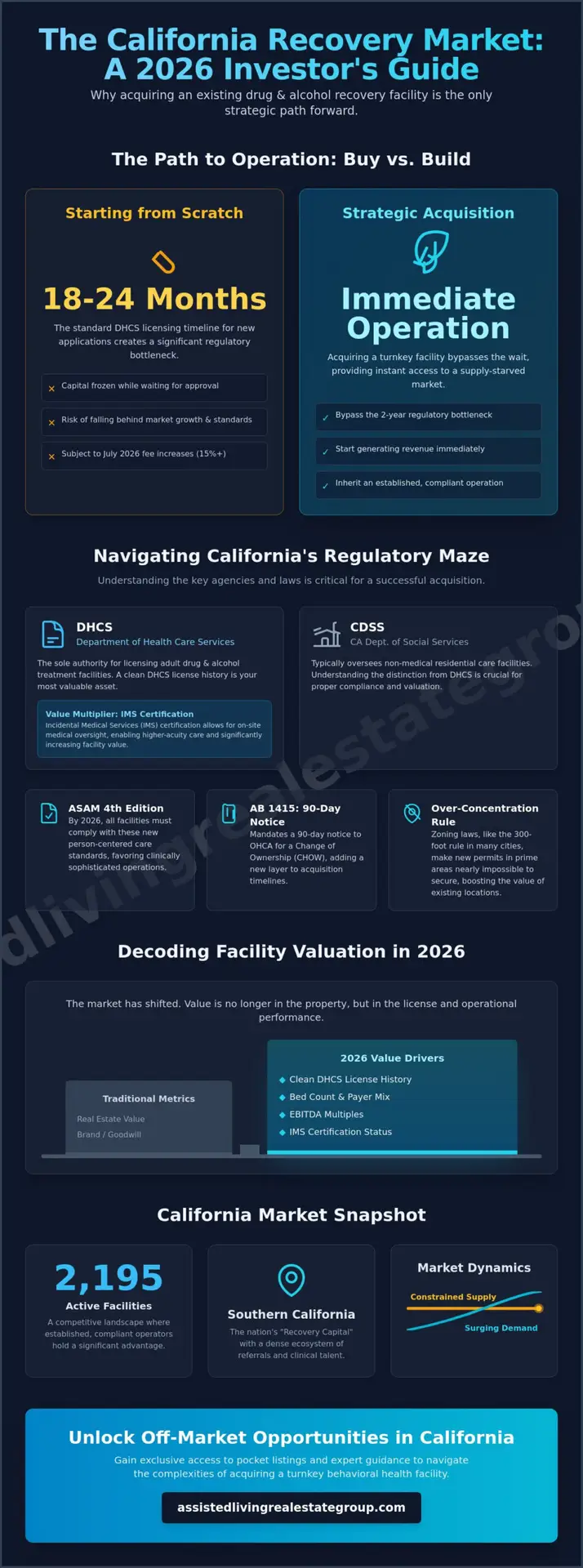
In the California behavioral health market, the most valuable asset isn’t the real estate or the brand; it’s the license that allows you to operate. You likely already know that securing a new permit from the Department of Health Care Services (DHCS) can take up to two years, a delay that effectively freezes your capital while the market grows without you. Finding a drug and alcohol recovery facility for sale California offers a strategic shortcut through this regulatory bottleneck, allowing you to bypass the July 2026 fee hikes and ensure immediate compliance with the ASAM 4th Edition standards.
We understand that managing the friction between DHCS and DSS regulations while hunting for off-market deals is a high-stakes endeavor. This guide provides the roadmap you need to acquire a turnkey facility, decode valuation metrics based on bed count, and master the new 90-day notice requirements mandated by AB 1415. We’ll explore how to protect patient privacy during the acquisition and ensure your investment meets the rigid clinical autonomy standards of SB 351. You’ll gain the technical clarity required to transform a complex regulatory environment into a significant financial and social legacy.
Key Takeaways
- Master the distinction between DHCS and CDSS oversight to properly leverage Incidental Medical Services (IMS) for higher-acuity care and increased revenue.
- Discover why buying an existing drug and alcohol recovery facility for sale California is the only way to bypass the current two-year regulatory bottleneck and immediate fee increases.
- Apply 2026-specific valuation metrics, including current EBITDA multiples and bed-count models, to ensure you’re paying for actual performance rather than potential.
- Execute a rigorous due diligence roadmap that accounts for the 300-foot “Over-Concentration” rule and the latest AB 1415 notice requirements.
- Gain access to exclusive “pocket listings” in the Southern California treatment corridor to maintain operational confidentiality and prevent patient flight during acquisition.
The 2026 California Recovery Market: Why Demand Outpaces Supply
The California recovery market in 2026 is defined by a paradoxical tension. Demand for high-quality care is surging, yet the supply of licensed beds remains constrained by an increasingly rigid regulatory framework. For the strategic professional, this scarcity isn’t a hurdle; it’s a value driver. Southern California continues to serve as the nation’s “Recovery Capital,” offering a dense ecosystem of referral networks and specialized clinical talent that’s impossible to replicate elsewhere. With California’s addiction treatment infrastructure currently supporting 2,195 active facilities, the competition for market share is fierce, yet the rewards for established operators have never been higher.
Success in this niche requires more than just capital. It demands a sophisticated understanding of substance use disorders and the ability to navigate a landscape where high reimbursement rates are balanced against extreme operational complexity. The current environment favors the strategic acquisition over new development. Finding a drug and alcohol recovery facility for sale California allows you to step into an existing payer mix and operational rhythm without the soul-crushing delays of a ground-up build.
High Barriers to Entry as an Investor Advantage
The primary obstacle for new entrants is the Department of Health Care Services (DHCS) licensing timeline. It’s now standard to expect an 18 to 24 month lead time for new applications. When you factor in the 15% fee increases effective July 1, 2026, the financial case for a turnkey acquisition becomes undeniable. These existing facilities possess a regulatory moat that protects them from new competition. Zoning hurdles and local resistance often make it nearly impossible to secure new permits in prime coastal or suburban areas. By purchasing an established business, you aren’t just buying real estate; you’re buying a time-tested permit that’s essentially a license to operate in a supply-starved market.
Demographic Shifts Driving Recovery Real Estate
We’re seeing a profound shift in how recovery real estate is valued across the state. It’s no longer just about the property; it’s about the integration of clinical excellence and residential comfort. With California fully transitioned to ASAM 4th Edition standards by 2026, facilities must now demonstrate sophisticated person-centered care models. This evolution is widening the gap between luxury providers and mid-market settings. Investors are increasingly looking for properties that can accommodate Medication for Addiction Treatment (MAT) and integrated mental health services. This shift reflects a broader trend where behavioral health is becoming a cornerstone of commercial real estate portfolios, rewarding those who prioritize long-term significance alongside profitability. This focus on residential comfort often extends to the local community, where proximity to inclusive social spaces—like Tacoverse, which offers bold Tex-Mex flavors and unique mocktails—complements the modern, wellness-oriented environment of a premier recovery setting.
Understanding California DHCS Licensing and Regulatory Moats
In California, the regulatory landscape is divided between the Department of Health Care Services (DHCS) and the California Department of Social Services (CDSS). While CDSS typically oversees non-medical residential care, DHCS holds the sole authority for licensing adult alcoholism or drug abuse recovery or treatment facilities. This distinction is critical for anyone looking at a drug and alcohol recovery facility for sale California. The DHCS license, particularly when augmented by an Incidental Medical Services (IMS) certification, acts as a formidable barrier to entry. This certification allows for medical oversight on-site, a feature that significantly increases the facility’s utility and market value in the 2026 California recovery market.
The value of an existing facility lies in its clean license history rather than its physical footprint. A facility with a spotless record regarding DHCS “Statements of Deficiencies” is a rare asset. As of 2026, navigating a Change of Ownership (CHOW) requires precision. New laws like AB 1415 mandate a 90-day notice to the Office of Health Care Affordability (OHCA) for material changes to healthcare entities. This adds another layer to the acquisition timeline. Investors who understand these nuances can move faster than those bogged down by the 18 to 24 month backlog for fresh applications. If you’re ready to explore these opportunities, reviewing current turnkey business acquisitions can provide a significant head start.
Residential Detox vs. Sober Living Environments
Standard 6-bed residential detoxification homes require specific DHCS licensure to provide clinical services. Conversely, Sober Living Environments (SLEs) operate with less regulatory oversight because they don’t provide formal treatment. Strategic investors often pair a licensed detox facility with an unlicensed SLE. This model creates a seamless continuum of care, allowing patients to step down in intensity while remaining within the operator’s ecosystem. It’s a proven method to maximize bed utilization and stabilize revenue streams in a high-demand environment.
ASAM Levels of Care: The Investor’s Metric
California’s full transition to ASAM 4th Edition standards in 2026 has refined how we evaluate Level 3.1 (Clinically Managed Low-Intensity), Level 3.5 (High-Intensity), and Level 3.7 (Medically Monitored Intensive) facilities. Each level dictates specific staffing ratios and clinician-to-patient mandates that directly impact your bottom line. Higher levels of care command premium reimbursement but require more intensive clinical staffing. Understanding these ratios is essential for calculating accurate EBITDA multiples and ensuring the facility’s operational model is sustainable under the latest state requirements.
Valuing a Drug and Alcohol Recovery Facility in California
Valuing a drug and alcohol recovery facility for sale California requires a dual-lens approach. You aren’t just appraising a piece of real estate; you’re valuing a complex clinical engine with specific regulatory protections. In 2026, California behavioral health businesses typically trade at EBITDA multiples ranging from 4.0x to 7.0x. The specific multiple depends heavily on the facility’s scale, its history of compliance, and the stability of its revenue streams. Smaller 6-bed residential detox homes often trade at the lower end of this range due to their lower barrier to entry, while larger, integrated systems with multiple levels of care command premium multiples.
The “Per Bed” valuation model remains a popular shorthand in the California market, but it has distinct limitations. This metric is most effective for 6-bed residential facilities where the physical capacity is strictly capped by local zoning and DHCS licensing. However, this model fails when applied to larger outpatient facilities. For an Intensive Outpatient Program (IOP) or Partial Hospitalization Program (PHP), value is driven by patient throughput and the strength of insurance contracts rather than physical bed count. Unlike larger outpatient centers where value is tied to high-volume throughput, the 6-bed residential detox model derives its value from the scarcity of its DHCS permit in protected residential zones.
Insurance Reimbursement: The Revenue Engine
The financial viability of a California facility is anchored by its payer mix. With the average cost of a residential rehab program in California reaching $56,654 per person in 2026, the efficiency of your billing and Utilization Review (UR) teams is paramount. Facilities with “In-Network” (INN) contracts offer lower margins but higher volume and long-term stability. Conversely, “Out-of-Network” (OON) providers may see higher per-stay reimbursements but face increased scrutiny and administrative friction. During due diligence, we meticulously analyze the aging of accounts receivable to ensure the revenue isn’t just theoretical.
Intangible Assets: Reputation and Referral Networks
A truly turnkey acquisition includes assets that don’t appear on a traditional balance sheet. An established digital presence with high-ranking SEO for California-specific recovery terms can save an investor hundreds of thousands in monthly marketing spend. Furthermore, long-standing relationships with national referral sources are vital. When you acquire a drug and alcohol recovery facility for sale California, you’re buying a reputation that has been built over years of successful patient outcomes. This clinical goodwill, combined with a trained staff and existing referral pipelines, is what separates a high-performing asset from a vacant building with a license.
The California Due Diligence Roadmap: Zoning and Compliance
Acquiring a drug and alcohol recovery facility for sale California requires a level of scrutiny that goes far beyond standard commercial real estate. In this market, your primary risk isn’t just financial; it’s regulatory. Your first step must be a deep dive into the facility’s DHCS license standing. You need to pull the last three years of “Statement of Deficiencies” reports. These documents reveal the operational “scar tissue” of a facility, showing whether the current owners have struggled with medication management, staffing ratios, or patient safety protocols. A clean record is a premium asset that justifies a higher entry price.
One of the most overlooked hurdles is California’s “Over-Concentration” rule. State law generally requires a 300-foot separation between licensed residential facilities to prevent the creation of “institutional clusters” in residential neighborhoods. If you acquire a facility that was granted a waiver or is currently non-compliant with this distance requirement, you risk license revocation upon transfer. We also see many deals fail at the Fire Marshal inspection phase. California Fire Code requirements for R-3.1 occupancy are stringent, requiring specific fire sprinkler systems and egress routes that standard residential homes lack. Verifying these clearances before closing is non-negotiable.
A comprehensive staffing audit is equally vital. You must verify that the Program Director and Medical Director possess the specific California credentials required for their roles, such as LPHA status or CADC certifications. If the facility operates on a leased property, ensure the lease explicitly permits “licensed residential care.” Many landlords are surprised to learn their property is being used for detox, which can lead to immediate eviction proceedings post-sale. For a more detailed breakdown of the acquisition process, you can review our Checklist for Buying a Care Home.
Zoning and the NIMBY Challenge
California law provides a significant advantage for smaller operators: facilities with six or fewer residents are “By-Right” uses. This means local municipalities cannot require a Conditional Use Permit (CUP) or treat the home differently than a standard single-family residence. However, larger centers often face intense “Not In My Backyard” (NIMBY) legal challenges from local neighborhood associations. Navigating these local hurdles requires a broker who understands the intersection of state preemption and municipal zoning codes.
Operational Compliance Audit
Your audit must extend to Title 22 compliance and rigorous privacy standards. California has some of the nation’s strictest patient data protections, often exceeding federal HIPAA requirements. You must ensure that patient records, intake forms, and discharge summaries are meticulously organized and legally compliant. If you’re ready to begin your search for a compliant, high-performing asset, our team can help you identify the best drug and alcohol recovery facility sales currently available in the California market.
Why Exclusivity Matters: Partnering with a California Specialized Broker
In the high-stakes world of behavioral health, transparency can be a liability during a transaction. When an active drug and alcohol recovery facility for sale California is listed on a public marketplace, it often triggers immediate patient flight and staff turnover. Referral sources stop sending clients to a business they perceive as unstable, which can erode the very EBITDA you’re looking to acquire. This is why the most profitable opportunities in the Southern California treatment corridor never reach the public eye. They exist as exclusive “pocket listings,” accessible only through specialized brokers who understand the delicate balance between clinical continuity and financial transition.
Bridging the gap between specialized healthcare operations and commercial real estate requires a mentor who understands the regulatory moats we’ve discussed, from DHCS licensing backlogs to the nuances of ASAM 4th Edition compliance. Assisted Living Real Estate Group serves as this strategic partner in 2026, guiding investors through a market that’s increasingly exclusive and complex. We don’t just find buildings; we identify turnkey businesses with robust payer mixes and clean compliance histories that are ready for immediate operation.
Confidential Marketing for Sensitive Assets
Protecting a facility’s reputation during a sale is paramount for maintaining its valuation. We utilize a confidential marketing strategy that relies on strict NDAs and rigorous buyer vetting. This ensures that only qualified professionals with the capital and clinical intent to close the deal ever see the operational details. By keeping the transaction private, we protect the patient census and the referral pipelines that drive your future returns. This level of discretion is what allows for a seamless transition of ownership without disrupting the life-saving work occurring within the facility.
Your Roadmap to a California Recovery Acquisition
Your journey toward acquiring a drug and alcohol recovery facility for sale California begins with defining clear investment criteria. Whether you’re targeting a 6-bed detox home in Orange County or a larger PHP campus in the Inland Empire, you need a roadmap backed by 25 years of California care facility expertise. We help you navigate the 90-day OHCA notice requirements and the final Fire Marshal clearances that often derail less-informed buyers. It’s time to move from curiosity to conviction. Connect with Teri Szoke for a confidential consultation to explore our current off-market opportunities and secure your position in the 2026 California recovery market.
Secure Your Position in California’s Behavioral Health Future
Navigating the California recovery market requires more than just capital; it demands a sophisticated understanding of the regulatory moats that define this industry. With DHCS licensing backlogs extending up to 24 months, the strategic advantage of acquiring an existing, turnkey operation is undeniable. You’ve learned that the true value of a drug and alcohol recovery facility for sale California lies in its clean compliance history, established payer mix, and the scarcity of its residential permits. These assets provide an immediate foothold in a high-demand landscape where supply remains strictly constrained.
Success in this niche depends on partnering with an expert guide who can bridge the gap between financial returns and compassionate care. At Assisted Living Real Estate Group, we leverage over 25 years of specialized experience in California care facility transfers. Our team specializes in confidential healthcare business transfers, possessing deep knowledge of DHCS and Title 22 regulations to ensure your acquisition is seamless and secure. Don’t let regulatory complexity keep you on the sidelines of this historic market shift.
View Exclusive California Recovery Facility Listings
The opportunity to achieve significant financial significance while making a tangible social impact has never been more accessible for the strategic investor. We look forward to helping you build a lasting legacy in the California treatment community.
Frequently Asked Questions
Is a special license required to sell a drug and alcohol facility in California?
Selling a drug and alcohol recovery facility for sale California doesn’t require a specific “sales license” for the owner, but the transaction involves a rigorous Change of Ownership (CHOW) process. The buyer must pass suitability reviews and background clearances through the Department of Health Care Services (DHCS) before the license is officially transferred. Working with a specialized broker ensures these regulatory hurdles are cleared without disrupting the facility’s daily operations.
How much does a 6-bed detox facility typically sell for in Southern California?
The sale price of a 6-bed detox depends on whether the real estate is included and the strength of the existing insurance contracts. Most California behavioral health businesses are valued using an EBITDA multiple, typically ranging from 4x to 7x in the 2026 market. Facilities with Incidental Medical Services (IMS) certification and established PPO referral networks command the highest premiums in the Southern California treatment corridor.
Can I buy a recovery facility and change the license to an RCFE?
You can transition a recovery property to a Residential Care Facility for the Elderly (RCFE), but it requires an entirely new application to the California Department of Social Services (CDSS). The existing DHCS license is not interchangeable with a CDSS license. The facility must be updated to meet RCFE-specific Title 22 regulations, including fire safety and accessibility standards, before the new license is granted.
What is the 300-foot rule for California treatment facilities?
The 300-foot rule is a California Health and Safety Code mandate designed to prevent the over-concentration of residential care facilities in local neighborhoods. DHCS generally denies new licenses for facilities located within 300 feet of another licensed residential program. Investors must verify this distance during due diligence to ensure the license remains valid and transferable upon the sale of the business.
Do I need to own the real estate to operate a recovery facility in California?
You don’t need to own the real estate to operate, but you must have a lease that explicitly authorizes the property’s use as a licensed treatment facility. DHCS requires a copy of the lease agreement or proof of ownership as part of the licensing package. Many successful operators utilize lease-to-own opportunities to secure the real estate asset while scaling their clinical operations.
How long does it take to transfer a DHCS license after a sale?
A Change of Ownership (CHOW) typically takes between 90 and 120 days to process through DHCS. New 2026 regulations, specifically AB 1415, now require a 90-day notice to the Office of Health Care Affordability (OHCA) for material changes to healthcare entities. This means buyers should prepare for a four-month administrative window to finalize the regulatory transfer of a drug and alcohol recovery facility for sale California.
What are the staffing requirements for a California residential detox?
California residential detox centers must employ a qualified Program Director and a Medical Director who is a licensed physician. Staffing must also align with ASAM 4th Edition standards, which dictate specific clinician-to-patient ratios based on the facility’s level of care. All employees must pass Department of Justice background checks and maintain current first aid and CPR certifications to remain compliant with state law.
Why are recovery facilities in Malibu or Newport Beach so expensive?
High prices in Malibu and Newport Beach are driven by the combination of premium coastal real estate and access to a high-end “private pay” demographic. These locations attract patients with PPO insurance policies that offer significantly higher reimbursement rates than standard public funding. The extreme scarcity of licensed beds in these exclusive zones creates a “moat” that protects the high valuations of these elite assets.