
An RCFE acquisition in California is rarely just a real estate transaction; it is a high-stakes regulatory audit disguised as a business deal. You likely recognize that the state’s shifting demographics represent a massive market opportunity, yet the fear of inheriting undisclosed DSS citations or mismanaged labor costs can stall even the most seasoned investor. It’s natural to feel anxious about strict staffing ratios and the rigorous enforcement of the 2025 Title 22 updates. This guide provides the precise questions to ask when buying an RCFE to ensure you are acquiring a healthy, compliant, and profitable asset rather than a liability.
You deserve to move from curiosity to conviction with a clear roadmap for California regulatory approval. We’ll show you how to master the art of due diligence by evaluating the financial, regulatory, and operational health of a facility. We will break down the essential inquiries regarding resident reappraisals, dementia care integration, and the specific documentation required to secure your position in this premium, high-barrier-to-entry market.
Key Takeaways
- Align your acquisition with long-term portfolio goals by uncovering the seller’s true motivation and identifying hidden operational liabilities early in the process.
- Master the nuances of financial due diligence by distinguishing between Private Pay revenue and government-funded sources to ensure sustainable, long-term profitability.
- Navigate California’s rigorous Title 22 compliance by mastering the specific questions to ask when buying an RCFE regarding past DSS inspection reports and public records.
- Evaluate the operational health of a facility by auditing caregiver tenure and staffing structures to prevent post-acquisition burnout and maintain high standards of care.
- Secure a seamless change of ownership through strategic communication plans that protect resident census and ensure all agreements meet the latest state standards.
Defining Your Investment Thesis: Initial Strategic Questions
Before you sign a Letter of Intent, you must define why a specific facility belongs in your portfolio. Successful investors don’t just look for immediate cash flow; they look for strategic alignment with long-term goals. California’s market is highly fragmented, meaning an RCFE in Orange County serves a different demographic and regulatory environment than one in Placer County. You need to determine if the facility’s current niche fits your operational expertise. Understanding Residential Care Models is the first step in deciding if you are buying a business you can actually scale or a limited asset that has already peaked.
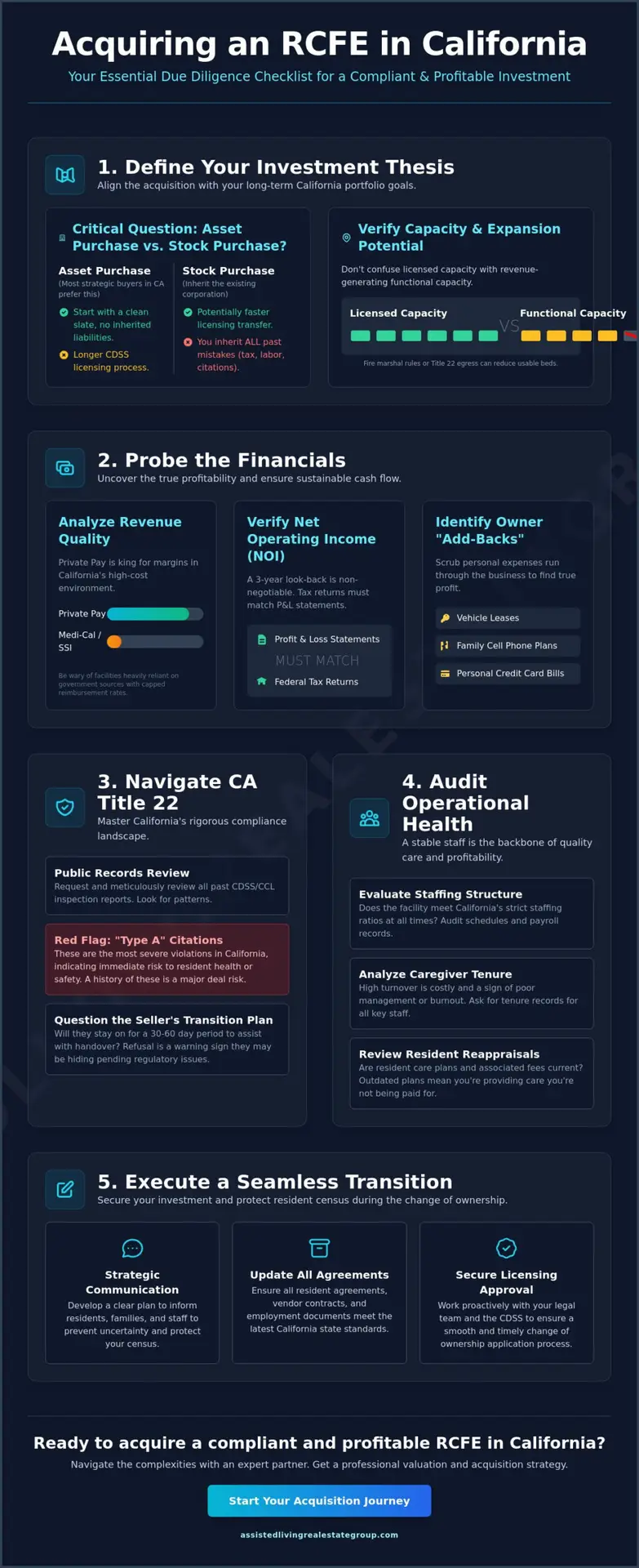
One of the most vital questions to ask when buying an RCFE involves the structure of the deal itself. Are you purchasing the corporate stock or just the assets? Buying the stock might accelerate the licensing transfer with the California Department of Social Services (CDSS), but it also means you inherit every past mistake. This includes historical tax liabilities and potential labor law violations. Most strategic buyers prefer asset purchases to start with a clean slate, even if the licensing process requires more patience. You’re not just buying a building; you’re acquiring a reputation and a regulatory history.
Probing the Motivation for Sale
Why is the owner walking away now? If a facility has been on the market for over six months in California’s high-demand environment, there’s usually a hidden friction point. You need to uncover if the seller is facing genuine operational burnout or if they’re fleeing a pending “Type A” citation from the Community Care Licensing Division. Ask if they’ll stay on for a 30 to 60-day transition period. A seller who refuses to stand behind their operational history or assist with the handover is a significant red flag for any serious investor.
Identifying Capacity and Expansion Potential
Don’t confuse licensed capacity with functional capacity. A home might be licensed for six residents, but if local fire marshal rules or specific Title 22 egress requirements restrict you to four beds based on current room configurations, your P&L will suffer. Look for properties with the physical footprint for future ADU additions. In California, leveraging recent housing laws to add beds on the same lot is a prime way to increase your internal rate of return. You must verify that the property’s zoning and current “Use Permit” allow for such expansions before finalizing your valuation.
Financial Due Diligence: Probing the Bottom Line
Financial clarity is the bridge between a speculative venture and a high-yield investment. When evaluating a facility, you must separate the real estate value from the operational cash flow. This distinction is vital because California’s property market often moves independently of the care industry’s margins. One of the most critical questions to ask when buying an RCFE is how the seller has calculated their Net Operating Income (NOI). You need a three-year look-back at Profit & Loss statements and federal tax returns to verify consistency. If the tax returns don’t match the internal P&L, you’re looking at a significant red flag that requires immediate scrutiny.
Analyze the quality of the revenue. Private pay residents offer the highest margins, especially in premium California markets where the cost of living is elevated. Conversely, residents on SSI or the Medi-Cal Assisted Living Waiver program have capped reimbursement rates that may not keep pace with California’s rising labor costs. Navigating California’s Title 22 Compliance requires a specific level of care that must be funded adequately; ensure the current rent roll reflects 2026 market rates rather than “legacy” pricing that hasn’t been adjusted in years. Identifying owner add-backs is also essential. Sellers often run personal expenses through the business, such as vehicle leases or family cell phone plans. Scrubbing these out reveals the true profitability of the operation.
Analyzing Revenue Streams and Occupancy
Distinguish between physical occupancy and economic occupancy. A facility might have every bed filled, but if two residents are months behind on payments, your cash flow is compromised. Ask for a history of rate increases over the last 24 months. In a high-inflation environment, a seller who hasn’t raised rates is leaving money on the table, but they’re also handing you the difficult task of implementing those hikes immediately after taking over. If you’re looking for a stabilized asset, reviewing turnkey business acquisitions can provide a clearer picture of optimized revenue models.
Evaluating Operational Expenses
California’s unique landscape brings specific cost pressures. Insurance premiums have spiked recently due to wildfire risks, particularly in “High Fire Hazard Severity Zones.” You must verify the current policy’s cost and coverage limits. Additionally, audit the utility expenses. Older facilities without energy-efficient upgrades can see massive spikes in cooling costs during California summers. Finally, check the percentage of the budget allocated to food and medical supplies to ensure the seller isn’t cutting corners on resident care to artificially inflate the NOI.
Regulatory Rigour: Navigating California’s Title 22 Compliance
Acquiring a care facility in the Golden State requires more than financial capital; it demands a mastery of the administrative codes that govern daily life. The RCFE licensing in California process is notoriously rigorous, and the 2025 updates to Title 22, now strictly enforced in 2026, have only raised the bar. You aren’t just buying a business; you’re inheriting a regulatory history. If the current owner has a pattern of non-compliance, you may find yourself battling the Department of Social Services (DSS) before you even welcome your first new resident. You must audit the last three years of inspection reports to identify recurring Type A or Type B citations and verify the completion of all Plans of Correction (POC).
One of the most vital questions to ask when buying an RCFE concerns the standing of the current Administrator. In California, an 80-hour Initial Certification Training Program (ICTP) is the baseline, but the Administrator’s track record with the Community Care Licensing Division (CCLD) is what truly matters. Ask if there have been recent management change notices or if the facility is currently under a “non-compliance” monitor. A facility with a clean public record is a premium asset that justifies a higher valuation because it represents Operational Excellence and a lower risk of license revocation during the transition.
Auditing the DSS Record and LPA Relationship
The relationship between a facility and its local Licensing Program Analyst (LPA) can make or break your acquisition. You need to know when the last unannounced visit occurred and exactly what the findings were. Substantiated complaints from the Ombudsman are significant red flags that suggest deep-seated operational friction. Ask the seller how they would describe their rapport with the LPA; a confrontational history can lead to increased scrutiny for the new owner, regardless of your personal expertise.
Assessing License Transferability
Confirm that the facility is currently in “Good Standing” with the CCLD. Some licenses may have “Non-Transferable” conditions if the facility is operating under a provisional status due to past violations. In 2026, the “Change of Ownership” (CHOW) process remains the most time-consuming phase of an acquisition. You must verify the current timeline for approval in your specific California county to ensure your financing remains secure throughout the transition. Establishing these facts early allows you to move from curiosity to conviction with strategic precision.
Operational Excellence: Questions Regarding Staffing and Infrastructure
Staffing is the heartbeat of any RCFE for sale you are considering. In California’s 2026 labor market, the ability to retain qualified caregivers is your most valuable operational asset. High turnover doesn’t just increase recruitment costs; it triggers regulatory red flags and erodes the quality of care that justifies premium resident rates. One of the most revealing questions to ask when buying an RCFE centers on the average length of tenure for the caregiving team. A facility where staff have been present for over three years suggests a stable culture and a manageable workload, which are essential for long-term profitability.
Infrastructure is the second pillar of operational excellence. You must look beyond the aesthetic appeal of the common areas to assess the skeletal health of the building. California’s strict building codes and ADA requirements mean that a “charming” older facility could actually be a financial sinkhole. Verify the age of the roof and the condition of the HVAC systems. If these components are nearing the end of their life cycle, you must factor those capital expenditures into your purchase price. A facility that fails to meet modern standards will struggle to pass a DSS pre-licensing inspection, delaying your ability to take over the operation.
Staffing Stability and Labor Compliance
California is aggressive about labor law enforcement. You must confirm whether staff are classified as W2 employees or 1099 independent contractors. Misclassification is a common trap that leads to massive back-tax liabilities and penalties. Inquire about any pending Workers’ Compensation claims or disputes currently before the labor board. Additionally, audit the night shift ratios. While Title 22 requires “sufficient” staffing, your own risk management strategy should ensure that the ratio of staff to residents remains safe during the most vulnerable hours of the day. If you are ready to evaluate a pre-vetted opportunity, explore our current RCFE sales to find a facility that meets these high operational standards.
Physical Plant and Maintenance Reserves
Recent California laws have mandated stricter safety protocols for residential care. Ensure the facility is equipped with a functioning, compliant fire sprinkler and alarm system that meets current local ordinances. One critical requirement is a reliable backup power source. California now requires facilities to have generators or battery backups capable of powering essential equipment, such as oxygen concentrators and medication refrigeration, during the state’s frequent public safety power shutoffs. Ask for a list of deferred maintenance items; anything that compromises resident safety will be an immediate hurdle during your licensing transition.
Executing the Transition: Final Questions for a Seamless Acquisition
The final phase of an acquisition is where the theoretical value of a facility meets the reality of human relationships. You’ve audited the P&L and verified the physical plant; now you must protect the “Goodwill” that justifies your investment. In the Southern California market, where competition for high-acuity residents is fierce, a facility’s reputation is its most fragile asset. One of the most vital questions to ask when buying an RCFE is how the current owner intends to introduce you to the families. A poorly handled announcement can trigger a wave of “move-outs,” instantly eroding the census you just paid to acquire.
You also need to examine the current resident agreements with a legal eye. California’s Title 22 standards were updated significantly in 2025, and these changes are being strictly enforced in 2026. If the contracts haven’t been updated to reflect new requirements for resident reappraisals or annual medical visits, you’ll be starting your ownership in a state of non-compliance. Ensure you understand the notice periods required for rate increases. California law is very specific about how and when you can adjust pricing, and failing to follow these protocols can lead to costly legal disputes with families.
Managing the Resident and Family Transition
Success in this niche requires understanding the “Lead-to-Lease” conversion rate. If the facility relies heavily on “Founder-Dependent” relationships, where the owner is the primary caregiver or salesperson, the business may struggle once they exit. Ask the seller how many of their current residents came through professional referrals versus personal ties. You want a business that stands on its own operational merits, not one that evaporates when the original owner retires. Understanding these dynamics helps you maintain a stable occupancy rate during the delicate first 90 days of ownership.
Leveraging Specialized Brokerage
Navigating the intersection of California healthcare regulations and commercial real estate requires a partner with deep, niche-specific expertise. You should only work with a broker who has at least 25 years of experience specifically within the California senior care sector. They should provide a confidential marketing plan that protects your facility’s daily operations while vetting potential buyers. A specialized broker acts as the essential conduit between complex healthcare regulations and commercial real estate valuation, ensuring that the clinical integrity of the facility remains intact during the financial transfer. If you’re ready to secure your next asset, consider our turnkey business acquisitions to ensure a professional, expertly managed transition.
Securing Your Strategic Position in California’s Senior Care Market
Mastering the art of due diligence allows you to transform a complex regulatory environment into a predictable, high-yield investment. By scrutinizing the operational “DNA” of a facility, you ensure that your portfolio reflects both financial strength and a commitment to quality care. You now have the framework to audit DSS records, evaluate labor compliance, and navigate the nuances of Title 22 with seasoned expertise. These precise questions to ask when buying an RCFE serve as your roadmap to avoiding undisclosed liabilities and securing a seamless change of ownership.
The opportunity in California’s shifting demographics is massive for strategic professionals who prioritize education and expert partnership. With over 25 years of specialized experience in the California care industry, we provide the confidential marketing strategies and regulatory guidance needed for high-value transactions. If you’re ready to achieve significant financial returns while making a tangible social impact, it’s time to take the next step. View Our Exclusive California RCFE Listings to find an asset that aligns with your vision. Your journey toward a successful acquisition begins with a single, well-vetted choice.
Frequently Asked Questions
Can I buy an RCFE in California without an administrator license?
Yes, you can own an RCFE without being a certified administrator. California law allows for a separation between ownership and daily operation, provided you hire a certified professional who has completed the state-mandated 80-hour Initial Certification Training Program. This structure allows investors to focus on strategic growth while the administrator handles the granular Title 22 compliance and resident care.
How much does a typical 6-bed RCFE cost in Southern California in 2026?
Purchase prices in Southern California are dictated by the underlying real estate value and the facility’s Net Operating Income (NOI). While the median monthly cost for assisted living in California ranges from $5,598 to $6,250 as of 2026, the acquisition cost of the business itself depends on location and facility condition. Premium markets like Orange County or San Diego often command higher valuations due to the scarcity of licensed beds and high private-pay demand.
What is the most common red flag to look for in RCFE financial statements?
Inconsistency between internal Profit & Loss statements and federal tax returns is the most frequent warning sign. If the seller’s internal books show significantly higher profits than what they report to the IRS, the valuation is likely inflated. This is one of the essential questions to ask when buying an RCFE to ensure you aren’t overpaying for “phantom” income that cannot be verified during due diligence.
How long does the California RCFE license transfer process take?
The Change of Ownership (CHOW) process typically takes between four and six months to complete. This timeline is heavily influenced by the workload of the local Licensing Program Analyst (LPA) and the accuracy of your application. You should ensure your purchase agreement includes enough time for the California Department of Social Services to conduct its pre-licensing inspection and review your financial stability.
What is the difference between an RCFE and an ARF when buying a facility?
The primary difference lies in the age and needs of the residents served. RCFEs are designed for seniors aged 60 and older who require varying levels of care and supervision. Adult Residential Facilities (ARFs) serve individuals aged 18 to 59 with physical or mental disabilities. Each model operates under a different set of Title 22 regulations, which impacts your staffing requirements and reimbursement structures.
Do I need to buy the real estate, or can I lease the RCFE facility?
You don’t need to own the property to operate a care business in California. Many investors start with lease-to-own care home opportunities, which allow them to control the operations while preserving capital for future expansion. The state requires that the licensee has legal control of the premises, which is easily established through a properly structured commercial lease agreement.
What happens if the DSS denies my license application after I buy the business?
A license denial can lead to a total loss of investment if your purchase agreement doesn’t include a licensing contingency. It’s standard practice in California to make the final close of escrow dependent on the issuance of at least an interim license. If the state denies the application due to the buyer’s background or financial standing, the contingency allows the buyer to withdraw from the deal without forfeiting their deposit.
Are staffing ratios in California different for dementia care facilities?
California doesn’t mandate a specific numerical ratio, but it requires “sufficient” staffing to meet the needs of residents. For dementia care, this standard is much higher due to the increased need for supervision and safety. One of the critical questions to ask when buying an RCFE is how the current owner adjusts staffing levels to comply with the 2025 regulatory updates that integrated dementia standards facility-wide.