
By 2030, California’s population of seniors aged 65 and older will increase by 2.1 million, creating a massive supply gap that traditional institutional facilities simply cannot fill. This demographic shift transforms the Silver Tsunami into a blue ocean of assisted living investment opportunities California offers to those ready to lead. You’ve likely noticed that the SoCal real estate market is getting tighter, making it harder to find assets that offer both stability and significant ROI. It’s a challenge to balance the strict requirements of Title 22 regulations with the need for a semi-passive business model that actually works.
This 2026 strategic guide shows you how to navigate these high barriers to achieve a legacy of Impact and Income. We’ll provide the clarity you need to move from curiosity to conviction. You’ll discover a clear roadmap for finding off-market deals in counties like Orange and Los Angeles, mastering the licensing process, and building a boutique RAL portfolio that outshines corporate nursing homes. We’re breaking down the exact steps to secure high-yield returns while providing the premium care California families are searching for.
Key Takeaways
- Capitalize on the “Silver Tsunami” by identifying high-demand hubs in Los Angeles, Orange County, and San Diego where senior housing demand is reaching an all-time high.
- Discover why the “luxury boutique” 6-bed RCFE model offers a superior competitive edge over institutional facilities by meeting the premium expectations of California families.
- Learn to navigate Title 22 regulations to build a protective market moat, ensuring you capture the most lucrative assisted living investment opportunities California has to offer.
- Master a rigorous due diligence framework to audit cap rates and Net Operating Income (NOI), securing your path to both significant impact and income.
- Access the strategic roadmap used by seasoned experts to streamline the relicensing process and transition from a curious investor to a successful care-home owner.
The 2026 ‘Silver Tsunami’ and Southern California’s Investment Landscape
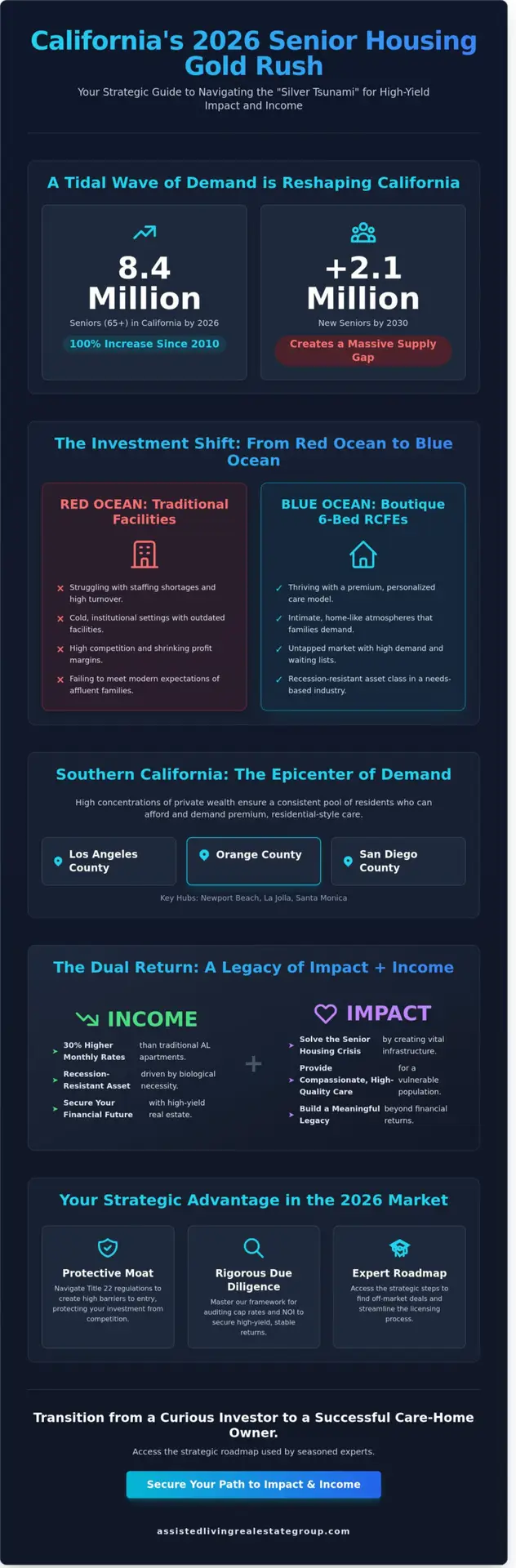
The “Silver Tsunami” has arrived. By 2026, California’s Department of Finance projects the population aged 65 and older will reach 8.4 million, representing a 100% increase since 2010. This demographic shift isn’t a distant forecast; it’s a current reality creating unprecedented demand for specialized housing. For savvy entrepreneurs, this surge represents the most significant assisted living investment opportunities California has ever seen. The market is shifting away from cold, institutional settings toward intimate, high-end care environments that mirror the lifestyles of affluent Californians.
We view this transition as a “blue ocean” opportunity. While massive institutional nursing homes struggle with staffing shortages and outdated facilities, boutique Residential Care Facilities for the Elderly (RCFEs) are thriving. These smaller, residential-style homes offer a premium experience that the “Red Ocean” of corporate facilities cannot replicate. Investors who enter this space now are positioning themselves at the forefront of a recession-resistant asset class that prioritizes quality of life over bed count. Because senior care is a needs-based service, it doesn’t suffer the same volatility as retail or office real estate.
Why Southern California is the Epicenter of Senior Housing Demand
Southern California remains the primary engine for high-end senior care demand. In coastal hubs like Newport Beach, La Jolla, and Santa Monica, the concentration of private wealth ensures a consistent pool of residents who can afford premium monthly rates. Data from the California Health Care Foundation indicates that nearly 20% of the state’s population will be over 65 by 2030, with the highest density of high-net-worth seniors residing in Los Angeles and Orange County. These families don’t want hospital-grade corridors. They demand “aging in place” solutions that feel like home yet provide 24/7 professional support. This preference for residential-style care makes the SoCal market exceptionally resilient, even when broader economic fluctuations impact other sectors.
The Concept of ‘Impact and Income’ in 2026
The 2026 investment landscape is defined by “Impact and Income,” a philosophy that bridges the gap between financial performance and social responsibility. High-quality RCFEs do more than generate high cap rates; they provide a vital solution to the California housing crisis for seniors. By converting existing residential properties into licensed care facilities, you’re creating essential infrastructure for a vulnerable population. This model allows you to build a legacy while securing your financial future. Impact and Income is the convergence of high-yield real estate and compassionate care.
- ROI Potential: Boutique RCFEs in San Diego and Los Angeles often command monthly rates 30% higher than traditional assisted living apartments.
- Market Stability: Senior housing demand is driven by biological necessity, making it immune to typical economic cycles.
- Strategic Advantage: Early entry into the 2026 market allows you to secure prime real estate before assisted living investment opportunities California become even more competitive due to tightening zoning and licensing barriers.
The Boutique Advantage: Why Residential Assisted Living (RAL) Wins in CA
Southern California’s real estate market is undergoing a fundamental shift. Savvy investors are moving away from massive, impersonal complexes toward intimate, high-end residential settings. This boutique approach represents one of the most lucrative assisted living investment opportunities California offers in 2026. While institutional facilities struggle with rising vacancy rates, 6-bed Residential Care Facilities for the Elderly (RCFE) often maintain waiting lists due to their personalized nature and home-like atmosphere.
Beyond senior care, there’s a growing need for specialized housing that caters to different age groups. Smart operators are investing in an adult residential facility in California to serve younger demographics with diverse needs, capturing a market segment that larger corporations often overlook. This agility allows boutique owners to pivot their services based on local demand faster than any corporate entity could.
RCFE vs. Institutional Nursing: The Shift in Consumer Preference
Families in affluent enclaves like Newport Beach or La Jolla are rejecting the sterile, clinical feel of traditional nursing homes. They want a home, not a hospital. Boutique facilities provide a 1:3 or 1:4 staff-to-resident ratio, which is a massive improvement over the 1:12 or 1:15 ratios frequently found in large centers. This intimacy creates a superior quality of life and allows for truly personalized care plans that focus on dignity rather than just task completion.
Staffing advantages extend to the business side as well. Smaller teams foster stronger loyalty, leading to significantly lower turnover rates compared to the industry average of 50 percent or higher in large institutions. Because these homes offer a premium experience, they command higher monthly rates, often exceeding $10,000 per resident in coastal Southern California markets. It’s a clear case of providing better care while securing a more robust bottom line.
The 6-Bed Model: A Scalable Investment Strategy
The 6-bed RCFE is the gold standard for agility in the current market. It’s much easier to acquire a $1.5 million luxury home and convert it into a licensed facility than it’s to develop a $50 million commercial complex. This model allows you to enter the market faster and with lower overhead. You don’t need a massive commercial kitchen or a fleet of shuttle buses; you need a high-quality residential property and a dedicated care team that understands the “Impact and Income” philosophy.
Scalability is the secret to building significant wealth in this niche. By developing a portfolio of three to five boutique homes within a single region, you can centralize your administrative costs while maintaining the intimacy that families pay a premium for. It’s about achieving consistent returns through a proven, repeatable roadmap. If you’re ready to start your journey, consider securing a high-performing property that meets California’s strict licensing standards to ensure long-term stability.
Navigating the Regulatory Moat: California Title 22 as an Investor Asset
Most investors view California’s strict regulatory environment as a hurdle. Savvy entrepreneurs recognize it as a massive competitive advantage. This “regulatory moat” ensures that only high-quality, dedicated operators enter the market, effectively shielding your assisted living investment opportunities California from low-tier competition. By the time you reach your 2026 operational goals, the barriers you overcame will be the very things that protect your market share.
The California Department of Social Services (CDSS) manages facility oversight through the Community Care Licensing Division. Their role is to enforce Title 22, the set of regulations that governs Residential Care Facilities for the Elderly (RCFE). While the manual is dense, it provides a clear blueprint for operational excellence. Achieving “Impact and Income” starts with mastering these standards to create a boutique environment that justifies premium private-pay rates.
Understanding Title 22 and the CDSS Framework
Title 22 compliance focuses on three pillars: staffing ratios, facility safety, and resident care standards. Investors must ensure their administrators hold a valid RCFE certificate, which requires 80 hours of initial training and passing a state exam. Maintaining a clean record with the CDSS isn’t just a legal requirement; it’s a value driver. Facilities with zero “Type A” deficiencies over a three-year period often command a 15% to 20% premium during a sale. A specialized broker uses these compliance reports to prove to buyers that the business is a “turn-key” asset with minimal risk. Securing RCFE licensing in California is the most critical step in your investment journey, as it transforms a residential property into a high-yield healthcare asset.
Zoning and Land Use in Southern California
Success in Los Angeles and Orange County depends on “Zoning for Success.” You don’t need to rezoning a property if you stay within specific limits. Under the California Health and Safety Code, an RCFE serving six or fewer residents is considered a residential use of property. This means local municipalities cannot require a Conditional Use Permit (CUP) that they wouldn’t require for a standard family home. This state-level protection allows investors to embed boutique RAL homes into high-end neighborhoods where the “Silver Tsunami” demand is highest.
- Los Angeles County: Focus on R-1 zones in areas like Encino or Pasadena where the Fair Housing Act protects your right to operate.
- Orange County: Look for properties with large floor plans in Newport Beach or Irvine that allow for easy ADA conversions.
- Operational Edge: Facilities that exceed minimum Title 22 safety standards, such as installing advanced fire suppression systems, often see lower insurance premiums.
Title 22 compliance is the ultimate insurance policy for a care facility’s valuation.
Evaluating Assisted Living Investment Opportunities: A Due Diligence Framework
Success in the Southern California senior care market isn’t found by accident; it’s engineered through rigorous, multi-layered scrutiny. To secure the most lucrative assisted living investment opportunities California offers, you need a framework that respects both the spreadsheet and the soul of the facility. We call this the path to “Impact and Income.” Investors who skip these steps risk falling into the regulatory gaps that define the high-barrier California market.
- Step 1: Financial Auditing. Analyze the Net Operating Income (NOI) with a focus on 2026 labor costs. Target facilities with a cap rate reflecting the local risk-adjusted return, typically 6% to 8% for stabilized assets in prime SoCal markets.
- Step 2: Operational Review. Evaluate current staffing ratios and resident retention. A facility with an occupancy rate below 85% suggests a reputation or management issue that requires immediate intervention.
- Step 3: Physical Inspection. California Title 22 compliance is non-negotiable. You must inspect the real estate for specific ADA accessibility requirements and fire safety clearances required by the California Department of Social Services (CDSS).
- Step 4: Market Analysis. Review the specific zip code data. If you’re looking at a boutique home in Newport Beach (92660), compare its monthly rates against the 2026 regional average of $6,800 to ensure competitive positioning.
- Step 5: Licensing Portability. Determine if the RCFE license is in good standing. While licenses don’t technically “transfer,” the ease of the change-of-ownership (CHOW) process determines how quickly you can start generating ROI.
Analyzing ROI and Cap Rates in the 2026 Market
The 2026 market presents a clear divide between value-add projects and a turnkey RCFE for sale. For many, the “Business + Real Estate” combo is the ultimate play. In California, these dual-asset appraisals often yield valuations 20% higher than residential properties alone. Savvy entrepreneurs look for undervalued homes where a “Boutique” renovation can justify a $2,000 increase in monthly resident fees. This is how you turn a standard investment into a high-yield legacy asset while riding the demographic wave of the Silver Tsunami.
The Secret to Finding Off-Market Opportunities
The most prestigious assisted living investment opportunities California has to offer rarely appear on public listing sites. Confidentiality is the currency of this industry. When a facility goes on the open market, it risks a 30% drop in occupancy as families and staff panic over the transition. We utilize specialized brokerage networks to manage “pocket listings.” These private deals protect the facility’s culture and ensure you’re stepping into a stable environment. Gaining access to these exclusive opportunities is the difference between chasing the market and leading it.
Partnering for Success: The Assisted Living Real Estate Group Advantage
Success in the California care market isn’t accidental; it’s engineered. For 25 years, Teri Szoke has led the Assisted Living Real Estate Group, transforming how entrepreneurs approach assisted living investment opportunities California offers. We don’t just list properties. We provide a comprehensive roadmap through the state’s complex regulatory environment. Our team leverages deep-rooted Southern California relationships to uncover off-market deal flow that institutional investors often miss. We act as your high-level mentor, ensuring you aren’t just buying real estate, but mastering the senior housing investment landscape to achieve both impact and income.
By framing the “Silver Tsunami” as a blue ocean opportunity, we guide you toward assets that promise significant financial returns. Our focus remains exclusively on California, where we’ve spent decades building a network of owners, operators, and regulators. This local expertise allows us to provide a distinct advantage in three key areas:
- Strategic site selection based on specific Southern California demographic shifts.
- Expert navigation of California Department of Social Services (CDSS) Title 22 regulations.
- Operational handoff strategies that prioritize resident care and staff retention.
Our Turnkey Acquisition and Consulting Services
Our model covers every phase of the investment lifecycle. From the initial search to the final relicensing with the CDSS, we manage the friction points. We specialize in facility setup and operational transitions, ensuring your Residential Assisted Living (RAL) home is ready for residents on day one. Our confidential marketing strategy protects the integrity of the business during a sale, maintaining staff stability and resident trust. We’ve helped clients scale from a single six-bed RCFE to regional portfolios worth millions by following our proven acquisition framework. This isn’t just about buying a building; it’s about acquiring a boutique, legacy-grade healthcare business.
Your Next Steps in the California Care Market
The 2026 market window is open, but high-quality inventory moves quickly. Whether you’re looking for a specialized Adult Residential Facility (ARF) or a luxury RCFE, the right data makes the difference. Schedule a confidential consultation to align your financial goals with our current off-market opportunities. We’ll review your cap rate targets and zoning requirements to find the perfect match in Southern California. Our inventory changes weekly as new boutique opportunities emerge across the Southland. Don’t wait for the market to become crowded; secure your position in the most resilient real estate sector in the state.
Seize Your Position in California’s Senior Living Blue Ocean
The 2026 Silver Tsunami isn’t a distant forecast. It’s a measurable reality for the Southern California real estate market. With the California Department of Aging projecting over 10.8 million residents aged 60 or older by 2030, the demand for boutique RAL environments has never been more urgent. You’ve seen how Title 22 compliance acts as a powerful regulatory moat, protecting sophisticated owners from amateur competition. Success in this niche requires a blend of clinical insight and real estate precision. By focusing on off-market RCFE and ARF assets, you can bypass the saturated institutional market and build a legacy defined by both impact and income. These assisted living investment opportunities California provides today represent a rare chance to solve a social crisis while securing high-yield returns. We’ve spent 25 years mastering this landscape so you don’t have to navigate it alone. It’s time to turn these demographic shifts into your strategic advantage.
Schedule a Confidential Investment Consultation with Our SoCal Experts
Your journey toward a high-impact, high-return portfolio in the Golden State starts with a single strategic step.
Frequently Asked Questions
Is assisted living a good investment in California in 2026?
Yes, California remains a premier market for assisted living investment opportunities California because of the 10.8 million residents who will be age 65 or older by 2030, according to the California Department of Aging. This demographic surge creates a blue ocean for boutique RAL owners who offer high-quality care. You aren’t just buying real estate; you’re securing a legacy asset that solves a massive societal need while generating premium returns.
What is the average ROI for a 6-bed RCFE in Southern California?
Cash-on-cash returns for a well-managed 6-bed Residential Care Facility for the Elderly (RCFE) in Southern California typically range from 15% to 25%. While traditional multi-family cap rates have compressed to 4% or 5%, the RAL model leverages the high demand for boutique care to drive superior net operating income. Your success depends on efficient staffing and a premium pricing strategy that reflects the luxury of a residential setting.
How much capital is required to invest in a California assisted living facility?
Investors generally need between $250,000 and $500,000 in liquid capital to acquire and launch a boutique RCFE in Southern California. This covers the 10% to 20% down payment on a $1.2 million to $2 million property, plus $50,000 for licensing fees, initial staffing, and ADA compliance renovations. Higher-tier markets like Santa Monica or Newport Beach will require more substantial capital due to elevated real estate valuations.
Can I buy an assisted living facility without a healthcare background?
You don’t need a medical degree to thrive in this niche, as California law allows owners to hire a certified RCFE Administrator to manage daily clinical operations. Your role is that of the visionary strategist and asset manager. By focusing on the business side of assisted living investment opportunities California, you can scale your portfolio while your licensed team ensures residents receive the highest standard of boutique care.
What is the difference between an RCFE and an ARF investment?
The primary difference lies in the population served: an RCFE (Residential Care Facility for the Elderly) serves seniors 60 and older, while an ARF (Adult Residential Facility) serves adults aged 18 to 59 with disabilities. From an investment standpoint, RCFEs often command higher private-pay rates in the luxury boutique market. ARFs often rely on state-regulated reimbursement rates, which can impact your overall cap rate and profit margins.
How long does the RCFE licensing process take in California?
The California Department of Social Services (CDSS) typically takes 6 to 12 months to process a new RCFE license application. This timeline includes the mandatory three-part orientation, the application review, and the final pre-licensing inspection. Savvy investors use this period to complete property renovations and build a waiting list of residents to ensure immediate occupancy once the license is issued.
Are there financing options available for assisted living real estate in CA?
Financing for RAL projects is robust, with SBA 7(a) and 504 loans serving as the most popular vehicles for California investors. These programs allow for down payments as low as 10% and offer 25-year fully amortized terms for owner-occupied healthcare real estate. Conventional commercial lenders also participate, though they often require a 25% to 30% down payment and look for a strong debt service coverage ratio.
How do I find off-market assisted living opportunities in Los Angeles?
Finding off-market RAL opportunities in Los Angeles requires a targeted approach that bypasses traditional listing services. We recommend networking with local estate attorneys and hospital discharge planners who see the aging demographic shifts firsthand. Direct mail campaigns targeting existing RCFE owners who have held their license for over 15 years often yield motivated sellers ready to transition their legacy to a new strategic partner.