
Why would you settle for a 4% cap rate on a standard apartment complex when the 2026 demographic shift in Southern California offers a blue ocean of high-yield boutique care? You’ve likely noticed that the barrier to entry for residential real estate in Los Angeles or Orange County has never felt higher. It’s frustrating to watch prime properties slip away because the capital requirements seem insurmountable. We understand that the complexity of securing SBA loans for RCFE acquisition often feels like a deterrent rather than a strategic tool for growth.
You don’t have to let capital constraints stall your vision for a boutique residential assisted living facility. It’s possible to secure 90% or even 100% financing to build a legacy of impact and income. This guide provides the strategic roadmap to master SBA 7(a) and 504 loan structures specifically for the California market. We’ll break down the exact steps to align your funding with California Title 22 licensing requirements so you don’t face costly funding delays. You’re about to learn how to navigate the technical hurdles of financing to acquire a high-ROI asset that serves your community and your portfolio.
Key Takeaways
- Understand how to leverage the “Silver Tsunami” by transforming Southern California residential properties into high-yield, “Impact and Income” boutique care facilities.
- Compare the strategic advantages of 7(a) and 504 financing to select the most effective SBA loans for RCFE acquisition when securing both business goodwill and real estate.
- Identify the specific California-based eligibility criteria and management expertise required to satisfy lender scrutiny for licensed healthcare assets.
- Follow a proven roadmap for the SoCal acquisition process, ensuring you navigate the transition from Letter of Intent to final closing with professional precision.
- Gain an exclusive advantage by learning how to access off-market opportunities and maintain facility reputation through specialized, confidential marketing strategies.
Understanding SBA Financing for Southern California RCFEs
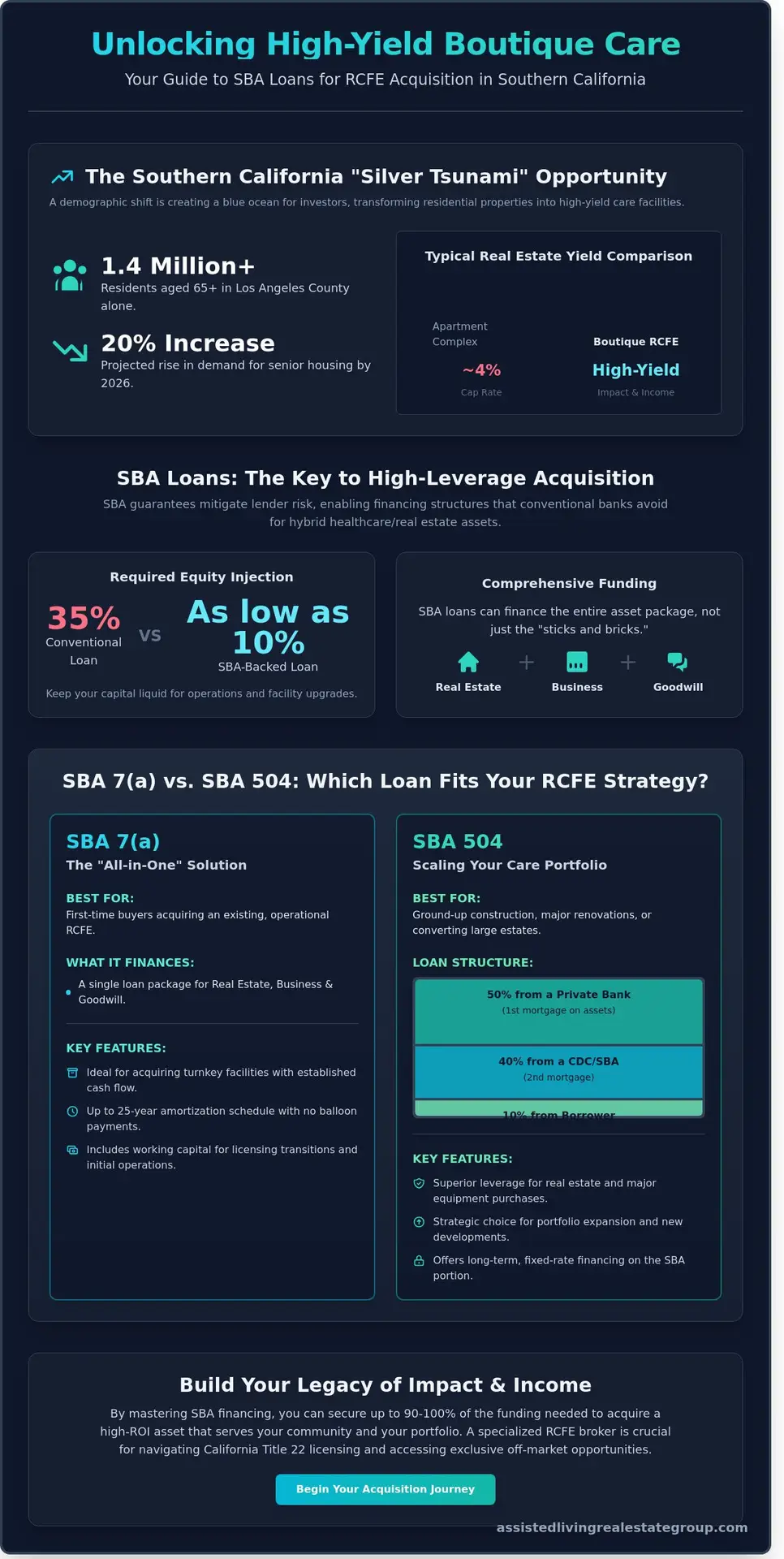
Southern California’s luxury real estate market meets a critical social need within the RCFE model. These facilities function as hybrid assets; they’re one part residential real estate and one part licensed healthcare business. Conventional lenders often hesitate to fund these projects because they don’t always grasp the complexity of California’s Title 22 regulations or the business enterprise value beyond the sticks and bricks. This hesitation creates a significant barrier to entry that directly benefits the prepared investor. By utilizing Small Business Administration (SBA) guarantees, regional banks across the Southland can mitigate their risk. This federal backing is the essential catalyst for securing SBA loans for RCFE acquisition, providing the high leverage necessary to compete in the 2026 market.
Our “Impact and Income” philosophy drives this specific investment class. You aren’t just purchasing a property; you’re building a legacy of compassionate care. While traditional commercial loans might require 35% down, SBA programs often allow for much lower equity injections. This keeps your capital liquid for operational excellence and facility upgrades. It’s a method of doing good while doing well, ensuring that your financial success is tied to the quality of life you provide for California’s seniors.
The “Silver Tsunami” Opportunity in SoCal
The demographic shift in Southern California is undeniable. Los Angeles, Orange County, and San Diego are home to some of the wealthiest aging populations in the nation, with Los Angeles County alone housing over 1.4 million residents aged 65 and older. By 2026, the demand for boutique senior care will outpace institutional supply by a significant margin. Framing your investment as a “blue ocean” strategy allows you to bypass the saturated institutional market. You can use SBA loans for RCFE acquisition to secure properties in high-value neighborhoods like Newport Beach or La Jolla where traditional entry costs are often prohibitive for new entrepreneurs.
Boutique Care vs. Institutional Facilities
The 6-bed residential model, frequently referred to as RAL (Residential Assisted Living), is the preferred entry point for savvy investors. Smaller settings allow for a higher caregiver-to-resident ratio, which justifies the premium private-pay rates common in Southern California. This boutique approach ensures that while you provide superior, intimate care, you also maximize your ROI through lower overhead compared to 100-bed institutional facilities. RCFE acquisition represents a strategic play for long-term equity growth by combining recession-proof healthcare demand with the historical appreciation of Southern California residential real estate.
SBA 7(a) vs. SBA 504: Which Loan Fits Your RCFE Strategy?
Choosing the right financing vehicle is the difference between a stalled project and a thriving legacy. In Southern California, where the “Silver Tsunami” creates a 20% increase in demand for senior housing by 2026, your funding strategy must be as precise as your care model. Investors typically weigh two primary options: the versatile 7(a) and the real estate-focused 504. Each serves a distinct phase of the RAL lifecycle. Selecting the wrong one can lock up your capital for years, while the right choice accelerates your ability to scale.
SBA 7(a): The “All-in-One” Solution for Boutique Homes
The SBA 7(a) loan program is the gold standard for first-time buyers acquiring an existing RCFE. It allows you to finance the real estate, the business operations, and the intangible “goodwill” of a licensed facility in a single package. For a 6-bed boutique home in Orange County, this prevents the need for multiple lenders. You’ll benefit from a 25-year amortization schedule with no balloon payments. This structure preserves your cash flow, ensuring you can focus on resident care rather than looming debt cliffs. It’s the most common path for SBA loans for RCFE acquisition because it covers working capital needed for those first six months of licensing transitions.
SBA 504: Scaling Your Care Home Portfolio
If your strategy involves ground-up construction or converting a large estate into a luxury boutique facility, the 504 program offers superior leverage. This loan uses a tiered structure: 50% from a private bank, 40% from a Certified Development Company (CDC), and a 10% equity contribution from you. In the fluctuating interest rate environment of 2026, the 504 provides long-term, fixed-rate stability that protects your ROI. It’s designed for heavy-lift projects where the real estate value exceeds $1.5 million. By utilizing this program, savvy entrepreneurs can scale their “Impact and Income” by upgrading properties to meet the high-end boutique standards that Southern California families demand.
Key differences to track for your 2026 acquisition include:
- 7(a) Maximum: $5 million total loan amount.
- 504 Maximum: Up to $5.5 million for the CDC portion alone, allowing for much larger projects.
- Use of Funds: 7(a) is flexible for inventory and debt refi; 504 is strictly for fixed assets and major renovations.
- Down Payments: Both start as low as 10%, but 504 may require 15% for “special-use” facilities if the lender deems the RCFE too specialized.
Before you commit to a specific lender, it’s vital to consult with a specialist who understands the California Department of Social Services (CDSS) licensing timeline. Proper SBA loans for RCFE acquisition require a roadmap that aligns your funding with the state’s rigorous regulatory hurdles.
Eligibility Requirements for California RCFE Loans
Securing capital for the Southern California “Silver Tsunami” requires more than just a vision; it demands a precise alignment with SBA standards. Lenders in the 2026 market look for a specific financial profile before they’ll back your boutique care project. Your business must meet the SBA’s small business size standards, which generally means a tangible net worth of less than $15 million and an average net income of $5 million or less after federal taxes for the previous two fiscal years. These thresholds ensure the program supports mid-sized entrepreneurs rather than institutional giants, keeping the “Impact and Income” potential within reach for private investors.
Creditworthiness remains a non-negotiable pillar of the application. Most preferred SBA lenders require a personal credit score of at least 680. If your history includes a bankruptcy, it isn’t an automatic disqualifier, but it does require a strategic explanation. A Chapter 7 bankruptcy typically requires a 10-year look-back period of clean credit, while a Chapter 13 requires at least three years of perfect payment history post-discharge. Lenders prioritize “character and capacity,” meaning they want to see that you’ve learned from past financial hurdles before they trust you with a multi-million dollar RCFE acquisition.
Experience Requirements for 100% Financing
The 100% financing model is the ultimate lever for scaling your RAL portfolio. To qualify for these high-leverage SBA loans for RCFE acquisition, lenders typically look for three years of direct operational experience in the senior care industry. If you’re an investor without a clinical background, you can bridge this gap by identifying “qualified management.” This involves hiring an administrator who holds a valid California RCFE Administrator Certificate and has a documented track record of maintaining Title 22 compliance. Your business plan must clearly articulate how this management structure will mitigate operational risks, turning a high-barrier-to-entry market into a predictable blue ocean opportunity.
Licensing and California Title 22 Compliance
California’s regulatory environment is rigorous, and the SBA won’t fund a loan if the facility can’t legally operate. You’ll need to navigate the Change of Ownership (CHOW) process through the California Department of Social Services (CDSS) during your escrow period. Lenders require proof that your license application is in process, often demanding a “comfort letter” or acknowledgement from the state before the final closing. This ensures the transition doesn’t disrupt the quality of life for residents. For a deeper dive into these regulatory hurdles, review our detailed guide on RCFE Licensing in California: The 2026 Investor’s Guide to Success. Mastering these compliance details early prevents the 60 to 90-day licensing delays that often kill promising deals.
The Step-by-Step RCFE Acquisition Process in SoCal
Securing a boutique care facility in Southern California follows a rigorous, high-stakes timeline. You can’t simply stumble into a successful closing; you need a roadmap that accounts for the state’s dense regulatory environment and the competitive nature of the 2026 real estate market. This process transforms a visionary investment into a tangible asset that generates both impact and income.
- Phase 1: Pre-qualification and Target Identification. Investors must verify their liquidity and creditworthiness before scouting properties in high-demand areas like Orange County or the Inland Empire. You need a lender’s preliminary nod to move at the speed of the SoCal market.
- Phase 2: The Letter of Intent (LOI). This document outlines your price and terms, initiating a typical 30 to 60 day due diligence window. It’s the moment your intent becomes a formal pursuit.
- Phase 3: The SBA Application and Appraisal. This is the technical heart of the journey. When applying for SBA loans for RCFE acquisition, lenders require a dual valuation. This process appraises the physical residential real estate alongside the specialized business operations to ensure the total loan-to-value ratio remains secure.
- Phase 4: Environmental and Zoning Verifications. California mandates strict Phase I Environmental Site Assessments. Simultaneously, you must verify that the specific SoCal municipality hasn’t enacted restrictive local ordinances that might conflict with state-mandated RCFE zoning protections.
- Phase 5: Licensing Verification and Funding. The California Department of Social Services (CDSS) must process the change of ownership (CHOW) or the new license application. Lenders generally won’t release the final capital until they have a clear path to licensure.
Finding the Right CDC and Lender in Southern California
Local expertise is your greatest hedge against risk. Working with a Southern California Certified Development Company (CDC) ensures your team understands the specific cap rates and property values inherent to the region. A specialized broker acts as your strategic partner, introducing you to “RCFE-friendly” banks that understand the nuances of SBA loans for RCFE acquisition. These lenders don’t shy away from the business-as-residence model; they recognize that the Silver Tsunami creates a blue ocean of opportunity for those with the right backing.
Due Diligence: More Than Just Real Estate
Your investigation must penetrate the operational history of the facility. You’ll need to review the last three years of profit and loss statements to ensure the business supports the debt service. Beyond the financial data, you must audit the facility’s Title 22 compliance record. Any outstanding citations from the Community Care Licensing Division can stall your loan approval or jeopardize your license transfer. For a comprehensive breakdown of what to look for during your inspection, read this RCFE for Sale: The Ultimate Guide to Buying a Care Facility in California.
Ready to build your legacy in the California care market? Connect with our specialized advisors today to review your acquisition strategy.
Maximizing ROI: Why Partner with a Specialized RCFE Broker?
Success in the competitive Southern California market requires more than just capital; it demands a strategic partner who understands that RCFEs are complex, living businesses. Specialized brokers offer access to off-market listings that never hit public sites like LoopNet or Zillow. These “quiet” listings often represent the highest-quality assets in premium neighborhoods like Newport Beach or Rancho Santa Fe. When you work with an expert, you gain a gatekeeper who filters out distressed properties and focuses on facilities with clean Title 22 compliance records.
Brokers play a critical role in deal structuring. They ensure the purchase price allocation between real estate and business goodwill aligns with current SBA 7(a) and 504 guidelines. This precision is vital when applying for SBA loans for RCFE acquisition. Without this specialized oversight, your loan might stall during the appraisal or environmental review phases. An expert broker ensures the facility’s cash flow is presented to the lender in a way that maximizes your borrowing power while maintaining a healthy debt service coverage ratio.
- Off-Market Advantage: Access to exclusive SoCal listings that protect the seller’s privacy and your future investment.
- SBA Alignment: Structuring the deal to meet the specific requirements of lenders who specialize in California healthcare real estate.
- Valuation Accuracy: Using historical data from regional sales to ensure you don’t overpay for goodwill or real estate.
Confidentiality and Continuity in Care
Standard residential agents often fail because they don’t respect the sensitivity of the RCFE industry. A “For Sale” sign on a six-bed facility in San Diego can cause immediate staff turnover and resident anxiety. Teri Szoke’s team acts as an expert guide, navigating these transitions with surgical precision. We maintain resident stability by keeping the sale confidential until the appropriate moment. This protects the facility’s reputation and ensures that the revenue stream remains intact during the transition. When you use SBA loans for RCFE acquisition, you’re buying a stable community, not a building in crisis.
Building Your Legacy in Senior Care
Scaling from a single-home operator to a multi-facility “Boutique” brand is the ultimate path to wealth in California. The “Silver Tsunami” isn’t a crisis; it’s a massive opportunity to provide high-level care while securing high-yield returns. By 2030, nearly 20% of Californians will be over the age of 65. This demographic shift makes the long-term equity play in California care facilities incredibly potent. You’re building a legacy of “Impact and Income” by creating premium environments that justify higher monthly rates. Ready to secure your position in this blue ocean market? Schedule a consultation with our Southern California RCFE experts today.
Seize Your Position in the 2026 Southern California Boutique Care Market
The Southern California senior housing landscape is shifting rapidly as the “Silver Tsunami” creates a massive blue ocean opportunity for savvy entrepreneurs. By 2026, the demand for intimate, high-quality residential care will outpace current supply; this makes it the ideal window to scale your portfolio. Utilizing SBA loans for RCFE acquisition provides the leverage needed to secure premium real estate while building a business focused on “Impact and Income.” It’s about more than just ROI. It’s about creating a lasting legacy through superior care.
Success in this high-barrier market requires a roadmap built on technical credibility and deep local insights. The Assisted Living Real Estate Group offers 25+ years of specialized RCFE brokerage experience with an exclusive focus on the Southern California boutique market. Our proven track record with SBA-backed acquisitions ensures you navigate licensing and zoning hurdles with total confidence. Don’t leave your entry into the RAL space to chance when you can partner with a strategic guide who understands the nuances of California’s regulatory environment.
Secure Your Southern California RCFE Financing Strategy
The opportunity to do well while doing good is waiting for you to take the first step toward a profitable future in boutique care.
Frequently Asked Questions
Can I get an SBA loan to buy an RCFE with no down payment?
You cannot obtain an SBA loan for RCFE acquisition with zero down payment; the SBA typically requires a minimum of 10 percent equity injection for a change of ownership. In the Southern California market, lenders often look for 15 percent to 20 percent down to offset the higher property values found in counties like Orange or San Diego. This ensures you have skin in the game while pursuing your goals of impact and income.
What is the maximum loan term for an SBA 7(a) care home loan?
The maximum term for an SBA 7(a) loan is 25 years when real estate is included in the acquisition. If you’re only purchasing the business and equipment, the term is usually limited to 10 years. This long-term amortization is a strategic advantage for RAL investors, as it lowers monthly debt service and maximizes cash flow during the ongoing silver tsunami. It’s a proven path to securing long-term wealth.
Does my Southern California facility need to be licensed before I apply for the loan?
You don’t need a current license to start the application, but the California Department of Social Services (CDSS) must issue a “Ready to Close” letter before the lender will fund the loan. Most Southern California lenders require proof that you’ve submitted your LIC 200 application to the Senior Care Program Office. Navigating this boutique market requires timing your licensing and financing in perfect synchronization to avoid costly delays.
How long does the SBA loan process take for an RCFE acquisition in California?
Expect the process to take between 60 and 90 days from the initial application to the final funding. California’s specific regulatory environment and the CDSS licensing backlog can sometimes extend this timeline beyond the 45 day national average. Successful entrepreneurs use this period to finalize their boutique care models and staff recruitment plans, ensuring they hit the ground running the moment the keys are in hand.
Can I use an SBA loan to renovate an existing residential care facility?
Yes, SBA 7(a) and 504 loans allow for significant capital to be used for renovations, expansions, and ADA compliance upgrades. Whether you’re converting a standard home into a boutique RAL environment or modernizing an older 6-bed facility, these funds cover construction costs and necessary equipment. This approach allows you to transform a distressed asset into a high-yield investment that serves the local Southern California community.
Is a 6-bed RCFE considered a commercial or residential property for an SBA loan?
For the purposes of SBA loans for RCFE acquisition, a 6-bed facility is treated as a commercial business operation despite being located in a residential neighborhood. Lenders evaluate the loan based on the business’s ability to generate income rather than just the residential appraisal value. This distinction is vital for investors who want to leverage residential real estate for high-level commercial returns in a blue ocean market.
What happens if my RCFE license application is delayed during the loan process?
A delay in your CDSS license application will likely push back your loan closing date because lenders won’t release funds without a valid license or a clear path to occupancy. Most purchase agreements in California include a licensing contingency to protect the buyer during these regulatory hurdles. We recommend working with a consultant to ensure your LIC 9000 and other forms are error-free to avoid these 30 to 60 day setbacks.
Are SBA loan interest rates fixed or variable for care facilities?
SBA 7(a) loans typically feature variable rates based on the Prime Rate plus a spread of 2.25 percent to 2.75 percent. However, the SBA 504 program offers fixed-rate options for the real estate portion of the project, which is often preferred by investors seeking long-term stability. Choosing the right structure depends on your exit strategy and your desire to capitalize on the massive demand for boutique senior housing in California.