
The path to generating both Impact and Income in California’s senior care market is often blocked by a wall of intimidating regulations and the immense risk of a ground-up development. Visionary investors see the opportunity in the Silver Tsunami but are stopped by the complexities of starting from scratch. The solution is clear: acquiring a turnkey RCFE business allows you to bypass these hurdles and step directly into a profitable, mission-driven enterprise that is already licensed, staffed, and generating immediate cash flow.
This comprehensive guide is your definitive roadmap. We will deconstruct the entire acquisition process, from identifying high-potential boutique facilities to performing the critical due diligence that separates a secure investment from a hidden liability. You will gain the strategic insights needed to confidently purchase an operational care home, ensuring your capital works to create both significant financial returns and a lasting legacy of quality care.
Key Takeaways
- Understand the primary advantage of a turnkey RCFE: the ability to generate immediate cash flow by bypassing the lengthy and complex initial licensing process.
- Learn the essential due diligence steps required to vet an operational facility, ensuring your investment is sound and free from hidden liabilities.
- Identify the critical red flags that differentiate a profitable turnkey RCFE business from a potential financial disaster before you invest.
- Discover why partnering with an RCFE acquisition specialist, not a generalist broker, is the key to navigating this highly regulated market successfully.
What is a Turnkey RCFE Business? Decoding the Opportunity
The term ‘turnkey’ is often used in real estate, but its meaning elevates entirely within the senior living sector. A turnkey RCFE business isn’t just a property with a new set of keys; it’s a fully operational, revenue-generating enterprise from the moment you take ownership. For the savvy investor looking to capitalize on the “Silver Tsunami,” this distinction is critical. It represents the most direct path to generating both Impact and Income.
Starting a Residential Care Facility for the Elderly (RCFE) from the ground up is a monumental task, fraught with licensing delays, construction hurdles, and the immense challenge of finding your first residents. A turnkey RCFE business circumvents this entire high-risk, zero-cash-flow period. You are acquiring a living, breathing operation with a proven track record, allowing you to focus on optimization and growth rather than creation and survival.
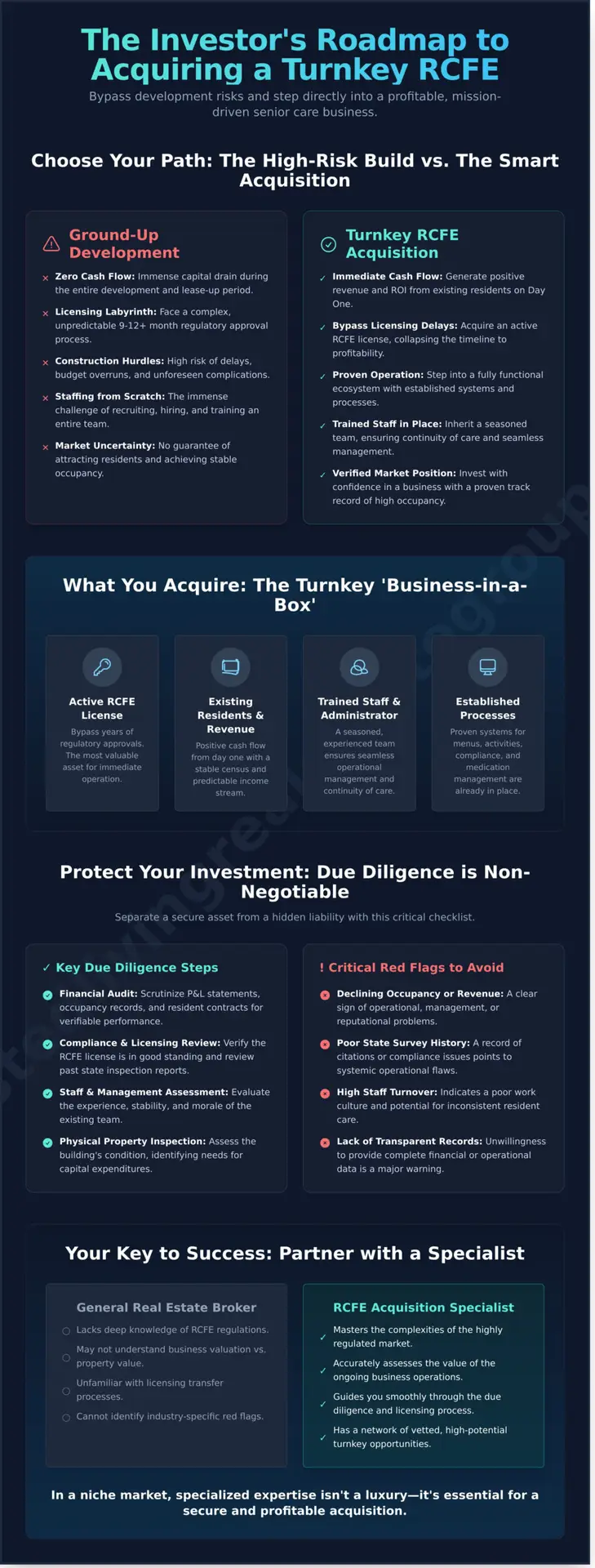
The ‘Business-in-a-Box’ Components
When you acquire a turnkey RCFE, you are purchasing a complete operational ecosystem. This is far more valuable than the sum of its parts, providing immediate stability and ROI. The core assets include:
- The Active RCFE License: This is arguably the most valuable component, allowing you to bypass months, or even years, of complex regulatory approvals and inspections.
- Existing Residents & Revenue: The business generates positive cash flow from day one. You inherit a stable census of residents paying monthly fees, eliminating the costly and uncertain lease-up phase.
- Trained Staff & Administrator: A seasoned team is already in place, ensuring continuity of care for residents and seamless operational management. This sidesteps the significant headache of recruiting, hiring, and training an entire staff.
- Established Processes: Proven systems for menus, activity schedules, medication management, and state compliance paperwork are already implemented and functioning, saving you from reinventing the wheel.
Real Estate vs. Business: Understanding What You’re Buying
It’s crucial to understand the structure of the deal. In some scenarios, an investor purchases both the real estate and the business entity together. In others, one might acquire the business operations while leasing the physical property from the owner. While leasing can lower the initial capital outlay, owning both the real estate and the business is the gold standard for long-term wealth creation. This model provides maximum control over your asset, protects you from lease escalations, and allows you to build equity in both a thriving business and a valuable piece of property-the ultimate foundation for a lasting legacy in senior care.
The Strategic Advantages: Why Investors Prioritize Turnkey RCFEs
The greatest challenge in residential assisted living isn’t a lack of demand; it’s the immense barrier to entry. The path from concept to a licensed, cash-flowing facility is fraught with regulatory delays, construction hurdles, and marketing uncertainty. This is precisely why savvy investors are increasingly bypassing the startup phase entirely, prioritizing the acquisition of a turnkey RCFE business. It’s a strategic decision to trade the risks of development for the certainty of a proven operation, accelerating the journey to both impact and income.
Financial Benefits: Immediate and Predictable ROI
Imagine generating significant revenue on day one. A turnkey RCFE delivers an immediate revenue stream from existing resident contracts, eliminating the costly “lease-up” period that drains capital in a new venture. You gain access to years of historical financial data, including P&L statements and occupancy records. This verifiable performance history transforms forecasting from guesswork into a data-driven strategy, making it far easier to secure favorable financing, such as SBA loans, from lenders who value proven cash flow over projections.
Operational Efficiency: Skip the Startup Chaos
The single most significant operational advantage is sidestepping the labyrinthine state licensing process, which can easily consume 9-12 months or more. Acquiring a turnkey RCFE business means you inherit an existing license that can be transferred, collapsing your timeline to profitability. Furthermore, you step into a fully functional ecosystem. This includes:
- A trained and experienced staff that understands the daily routines and unique needs of each resident.
- Established relationships with trusted vendors, from food suppliers to medical professionals.
- Polished operational systems for everything from billing to care planning.
Market Position and Stability
A facility with high occupancy is more than a building; it’s a proven market thesis. It confirms that the location, pricing, and level of care align perfectly with community needs, a critical factor when analyzing the complex RCFE Market Supply and Demand dynamics. You acquire an established reputation and a brand that local families and hospital discharge planners already know and trust. This market validation is an invaluable asset that takes years to build from scratch. See how our listings provide a clear path to impact and income.
While this article focuses on the California market, understanding the senior care landscape in other established markets can provide valuable context for investors. For instance, those looking to compare market saturation and provider types can use online resources to find care homes in UK and gain broader industry insights.
Due Diligence Checklist: How to Vet a Turnkey RCFE
The term ‘turnkey’ promises immediate cash flow, but it should never be mistaken for ‘risk-free.’ The most significant opportunities for both Impact and Income are often buried in the details. A rigorous due diligence process is not merely a suggestion; it is the strategic imperative that protects your capital, uncovers hidden liabilities, and ensures the seamless transition of a high-performing asset. This is where savvy investors separate themselves from the pack.
This disciplined approach to vetting is a universal principle for successful property investment, whether in specialized sectors or broader markets. For investors exploring different avenues, firms like PRG MFT offer guidance on navigating private real estate opportunities, underscoring the importance of rigorous evaluation to secure returns.
For those looking to build a comprehensive skill set in property analysis and connect with other professionals, you can discover Multifamily Intelligence, a platform offering specialized tools and education for investors.
To properly evaluate a turnkey RCFE business, your investigation must be methodical and exhaustive. We break it down into three critical pillars of analysis.
Financial Verification
Numbers tell a story, but you must verify every chapter. This is about confirming the seller’s claims and understanding the true economic engine of the facility. Your goal is to validate past performance and accurately project future profitability.
- Historical Financials: Demand and scrutinize at least three years of profit and loss (P&L) statements, balance sheets, and corresponding business tax returns.
- Rent Roll Analysis: Verify every resident’s monthly rate, care level, and any subsidies (e.g., Medi-Cal, VA). Are the rates at, above, or below market?
- Expense Scrutiny: Deep-dive into the largest operational costs-payroll, raw food, utilities, and insurance. Look for trends, anomalies, or areas for future optimization.
- SDE Confirmation: Validate the Seller’s Discretionary Earnings (SDE). Confirm that all claimed “add-backs” are legitimate and non-recurring expenses.
Operational & Staffing Analysis
A facility is only as strong as its team and its systems. Beyond the financials, you are acquiring a living, breathing operation that provides critical care. This analysis reveals the quality of that care and the stability of the business culture you will inherit.
- Staffing Records: Evaluate employee longevity, turnover rates, and compensation. Confirm all caregivers hold the required certifications and training. A stable, experienced team is a priceless asset.
- Resident Files: Review anonymized resident records to understand care plans, acuity levels, and incident report history. This provides a clear picture of the resident population and potential liability.
- Property Condition: Commission a thorough property inspection to identify deferred maintenance and capital expenditures. This also reveals opportunities for value-add upgrades to create a more boutique environment, which can involve sourcing modern elder care products from a comprehensive platform like FIVESTEP 五步健.
- Marketing & Occupancy: Understand the current resident acquisition process. Is occupancy driven by an established reputation, referral sources, or active marketing?
Regulatory & Licensing Compliance
In the highly regulated RCFE industry, compliance is the bedrock of your investment. A single unresolved citation can jeopardize your license and your entire operation. This step is non-negotiable and requires meticulous attention to detail.
- CDSS Public Record: Request and review the complete facility file from the California Department of Social Services (CDSS). This is the official history of the facility.
- Citation History: Look for any past Type A or Type B citations, complaints, or plans of correction. Understand the nature of any issues and how they were resolved.
- License Status: Confirm the RCFE license is in good standing, is transferable, and matches the facility’s current capacity and service level.
- Title 22 Adherence: Verify that the facility’s policies, procedures, and physical plant are in full compliance with California’s Title 22 regulations.
Red Flags and Pitfalls to Avoid in a Turnkey Sale
The allure of a ready-made operation is strong, but not all turnkey opportunities are created equal. A savvy investor knows that true value lies beneath the surface, and identifying warning signs early is the critical first step in protecting your capital and building a lasting legacy. A low price can often mask deep-seated issues, turning a dream investment into an operational nightmare. The seller’s reason for exiting is often the first clue-always dig deeper.
Signs of a Distressed Operation
A healthy RCFE is a stable ecosystem. Instability is your first major red flag. Look for operational cracks that suggest a business is struggling to maintain its quality of care and financial viability, which directly impacts your potential ROI and ability to provide a boutique care environment.
- High Staff Turnover: A revolving door of caregivers, and especially the facility administrator, signals poor management or low morale. This directly compromises the quality of life for residents.
- Declining Occupancy Rates: A steady drop in residents over the last 6-12 months is a clear indicator of a problem with reputation, marketing, or care quality.
- Recent, Serious Citations: Type A citations from state licensors are non-negotiable warnings of significant health and safety risks that can jeopardize the license itself.
- Significant Deferred Maintenance: Outdated facilities and neglected repairs represent hidden capital expenditures that will eat into your profits immediately after closing.
Financial ‘Creative Accounting’ to Watch For
The numbers must tell an honest story. Some sellers present a financial picture that is artificially enhanced to look more attractive than reality. Your due diligence must scrutinize every line item to uncover the true cash flow of the business. Be wary of financials that include unusually low expenses for staffing or food that don’t reflect market rates, pro-forma projections based on unrealistic occupancy jumps, or family members on the payroll without a clearly defined, essential role.
The ‘Goodwill’ Trap
Be cautious when a significant portion of the asking price is attributed to “goodwill.” While a strong reputation has value, a truly sustainable turnkey RCFE business is built on replicable systems, tangible assets, and consistent, verifiable cash flow-not just the personal relationships of the departing owner. If the business’s success is entirely dependent on the seller’s presence, it is not genuinely turnkey. The value disappears the moment they hand over the keys.
Navigating these complexities is where a strategic partner becomes invaluable. A misstep can be costly, but the right guidance ensures your investment delivers both Impact and Income. Learn more about our rigorous vetting process at assistedlivingrealestategroup.com.
Partnering with a Specialist: Your Key to a Successful Acquisition
Acquiring a turnkey RCFE business is not a standard real estate transaction. It’s a complex merger of business acquisition, real estate investment, and healthcare regulation. A general business broker or residential realtor, while skilled in their own domains, lacks the nuanced understanding required to navigate this high-stakes environment. They see a property; a specialist sees a living, breathing operation with intricate licensing, staffing, and financial structures.
The RCFE market is a niche with a high barrier to entry, governed by strict state and local regulations. A specialist broker doesn’t just find listings; they act as your strategic partner, guiding you from initial interest to a successful closing. They provide access to a pipeline of confidential, off-market opportunities-premium facilities that never hit the public market, reserved for serious, qualified investors.
Expert Valuation and Negotiation
An RCFE’s value extends far beyond its four walls. A specialist provides an accurate valuation based on critical industry metrics like Seller’s Discretionary Earnings (SDE) and EBITDA, not just property comps. They are masters of structuring the deal-from navigating the nuances of an asset versus a stock purchase agreement to negotiating crucial terms like seller financing and operator transition periods to ensure continuity of care and cash flow.
Navigating the Licensing Transfer
The single greatest hurdle in acquiring an RCFE is the licensing transfer. A specialist provides an indispensable roadmap through this complex process. They guide you step-by-step through the California Department of Social Services (CDSS) application, help you prepare for the mandatory licensor orientation and facility inspection, and coordinate directly with escrow to ensure a seamless business transition that protects both you and the residents.
Access to Vetted Opportunities
Why waste time on problematic listings? A specialist rigorously pre-screens every opportunity, weeding out facilities with compliance issues, financial red flags, or operational inefficiencies. This curated approach connects you directly to a network of motivated sellers and high-quality facilities. You gain the confidence that you are investing in a premier residential assisted living facility designed for both Impact and Income. Let our 25 years of experience guide your turnkey RCFE investment.
Secure Your Legacy: The Final Word on Turnkey RCFE Investing
The path to acquiring a high-performing residential care facility is clear. A turnkey RCFE business represents a powerful vehicle for generating immediate cash flow while meeting the profound demographic need for quality senior care. However, capitalizing on this opportunity requires more than just capital; it demands rigorous due diligence and a strategic understanding of the market’s unique complexities to avoid potential pitfalls.
Building a legacy through such strategic investments is a common goal. This pursuit of lasting value can extend beyond business to include tangible assets that carry a story of craftsmanship and heritage. For those who appreciate this form of enduring worth, it is possible to explore Fine Jewelry from artisans with a deep commitment to tradition.
This is where a strategic partner becomes your greatest asset. With over 25 years of specialized experience in California care facility sales, The Assisted Living Real Estate Group provides the expert guidance necessary to navigate the complex Title 22 licensing process. Our confidential marketing protects business value, ensuring you acquire a thriving operation poised for growth.
The right investment can define your future. Explore our exclusive listings of turnkey RCFE businesses in California and take the first step toward securing your legacy of impact and income.
Frequently Asked Questions About Turnkey RCFE Businesses
What is the difference between buying a turnkey RCFE and just the real estate?
Buying the real estate provides you with a physical asset, but it requires building the business from the ground up-licensing, staffing, and resident acquisition. A turnkey RCFE, however, is a fully operational enterprise. You acquire not just the property, but an active license, trained staff, current residents, and, most importantly, an immediate revenue stream. It is the strategic difference between buying an empty building and stepping into a proven, cash-flowing business primed for impact and income.
How is a turnkey assisted living facility valued for sale?
A turnkey facility is valued as a dual asset: the business operation and the real estate. The real estate is appraised based on comparable property sales and its highest and best use. The business value is calculated using a multiple of its Seller’s Discretionary Earnings (SDE) or EBITDA, which reflects its profitability. The final sale price is a strategic combination of these two valuations, capturing both the tangible property value and the intangible goodwill and cash flow of the established operation.
How long does it take to transfer the RCFE license to a new owner in California?
The RCFE license transfer process in California is a critical path item that demands precision. While timelines can vary based on the completeness of the application and the Community Care Licensing Division’s (CCLD) workload, a new owner should typically budget for a 60 to 120-day process. This involves a comprehensive application, background checks, and a pre-licensing inspection. Navigating this efficiently is key to a seamless transition and maintaining the continuity of high-quality care and revenue.
Can I use an SBA loan to finance the purchase of a turnkey RCFE business?
Absolutely. The Small Business Administration (SBA) views residential assisted living as a high-value, essential industry, making it an excellent candidate for financing. Both SBA 7(a) and 504 loans are commonly used to acquire a turnkey RCFE business, often covering the real estate, business goodwill, and working capital. These loans provide savvy investors with the leverage needed to enter this high-barrier-to-entry market and begin generating immediate returns while serving an important community need.
As the new owner, am I required to keep the existing staff?
While there is no legal requirement to retain existing staff, they are often one of the most valuable assets you acquire in the transaction. An established team provides critical continuity of care, maintains trusted relationships with residents, and ensures operational stability during the ownership transition. Evaluating the current staff’s performance and culture fit is a key part of due diligence, but retaining a competent, compassionate team is fundamental to protecting your investment and the residents’ quality of life.
What are the most important qualities to look for in a turnkey RCFE administrator?
An exceptional RCFE administrator is the cornerstone of a successful boutique care home. Beyond holding the required state certification, look for a leader who embodies a unique blend of compassionate care and sharp business acumen. They must demonstrate impeccable regulatory compliance knowledge, strong financial management skills, and the ability to inspire a dedicated care team. This individual is your operational leader, directly responsible for maintaining an excellent quality of life for residents while driving profitability and growth.