
The opportunity is clear: California’s “Silver Tsunami” presents a blue ocean for entrepreneurs ready to provide exceptional boutique senior care. Yet, a formidable barrier stands between your vision and reality: the notoriously complex RCFE application process California requires. The official CDSS website is dense, the forms are unforgiving, and a single mistake can derail your timeline by months, costing you significant capital and momentum. This is where most aspiring operators get stuck, lost in a sea of regulations and uncertainty.
This strategic guide changes that. We are transforming the state’s licensing journey from a daunting checklist into a manageable, strategic project. Inside, you will find a phase-by-phase breakdown of every requirement, a transparent look at the true costs and timelines, and expert insights to avoid common pitfalls. Consider this your definitive 2026 roadmap to achieving both Impact and Income, launching your licensed California Residential Care Facility for the Elderly with confidence and precision.
Key Takeaways
- Shift your mindset from a bureaucratic task to a strategic business launch, understanding the distinct roles of the CDSS, CCLD, and Fire Marshal from day one.
- Master the meticulous details required by the Centralized Application Bureau to successfully navigate the rcfe application process california and pass the critical Component II inspection without setbacks.
- Gain a realistic timeline for the state’s “Inspection Gauntlet” and Component III training, allowing you to manage capital and plan your launch with precision.
- Uncover the critical operational steps to take the moment your license is issued, transforming your new facility from a licensed property into a profitable, resident-ready boutique care home.
Phase 1: Pre-Application Strategy & Foundation
Success in this industry is not an accident; it is a meticulously executed strategy. The most common mistake savvy entrepreneurs make is viewing the rcfe application process california as a mere form to be completed. It is a comprehensive business project where 90% of your success is determined before you even submit Part A. This is the foundation upon which your legacy of impact and income will be built. Your key partners in this venture are the California Department of Social Services (CDSS), its Community Care Licensing Division (CCLD), and your local Fire Marshal. Whether you are launching a new boutique care facility or acquiring an existing one, mastering this preparatory phase is non-negotiable. If you’re just entering this blue ocean opportunity, it’s vital to understand what an RCFE is and the powerful role it plays in senior living.
Secure Your RCFE Administrator Certification
Your first actionable step is securing your RCFE Administrator Certificate. This is not optional; California law mandates that every facility has a certified administrator. This involves completing an intensive 80-hour Initial Certification Training Program (ICTP) from a CDSS-approved vendor. Upon completion, you have a 60-day window to pass the state examination. Consider this your license to lead, a critical credential that establishes your authority and operational competence from day one.
Complete the CDSS Online Orientation
Think of the mandatory CDSS Online Orientation as the official gateway to the entire RCFE application process in California. This multi-module course is designed to immerse you in the operational and regulatory framework of Title 22, the rulebook for all RCFEs. It covers everything from resident rights to medication management. Pay close attention; the certificate of completion you receive is a required component of your formal application packet and proves you understand the state’s expectations.
Financial Planning: Budgeting for the Application Journey
A solid pro forma is the bedrock of any successful real estate investment, and licensing is a significant line item. Your initial budget must account for more than just the property itself. Plan strategically for these critical expenses:
- Regulatory Fees: This includes the CDSS application fee, orientation fee, and the essential pre-inspection fee paid to the local Fire Marshal.
- Professional Services: Allocate funds for an RCFE consultant, an architect for any necessary modifications, and a legal review of your documents. Investing in expertise upfront mitigates costly errors later.
- Property Modifications: Budget a contingency for potential upgrades required to meet strict Title 22 health and safety standards, such as grab bars, ramps, or fire safety systems.
Phase 2: Assembling a Bulletproof Application Packet
After completing the orientation, you enter the most critical stage of the rcfe application process california: compiling the application packet. This isn’t mere paperwork; it’s the business plan for your legacy. All documents are submitted to the California Department of Social Services (CDSS) Centralized Application Bureau (CAB), the single gatekeeper for all RCFE applications. One mistake, one missing signature, can send you back to the starting line, costing you months of momentum. Success here demands absolute precision.
Core Application Forms and Documentation
The cornerstone of your packet is the LIC 200, the primary application form. But the true heart of your submission is your Plan of Operation. This is where you articulate the vision for your boutique care model, detailing everything from staffing patterns to resident admission procedures. You must also include all personnel documents, including proof of criminal record clearance (Live Scan) and health screenings for the administrator and any staff, proving your commitment to resident safety from day one.
Demonstrating Financial Viability
Your passion for care must be backed by a solid financial foundation. The CDSS requires you to prove financial viability by showing you have at least three months of operating capital in reserve. This is demonstrated through a suite of documents, including a projected operating budget, a current balance sheet (LIC 403), and evidence of funds. Present this not just as a requirement, but as proof of your strategic planning and the stability of your investment-the foundation for achieving both Impact and Income.
Property and Safety Documentation
Your physical property is the vessel for your vision, and the state needs assurance it’s safe and compliant. A pre-inspection and clearance from the local fire marshal is non-negotiable. Furthermore, you must submit a comprehensive Infection Control Plan (LIC 9282), a critical component in today’s health-conscious market. These documents, along with proof of property control (like a deed or lease agreement) and local zoning clearance, complete your packet. For a detailed checklist, the CDSS provides a guide to the official application process, which every serious investor should treat as their roadmap.
Phase 3: The Inspection Gauntlet & Component II Interview
This is where your vision meets reality. After months of paperwork, the California Department of Social Services (CDSS) now moves to verify every claim you’ve made. This critical phase of the rcfe application process california assigns a Licensing Program Analyst (LPA) to your file, who becomes your primary point of contact and the ultimate gatekeeper to licensure. Be prepared for a meticulous review; this stage is not a sprint and can often take several months to navigate successfully. The two primary hurdles you must clear are the Component II interview and the on-site facility inspection.
Preparing for the Component II Interview
Think of the Component II interview as a professional examination. It is a one-on-one meeting where your assigned LPA dissects your application, focusing intensely on your Plan of Operation. They need to see that you are not just an investor, but a competent future operator. Expect detailed questions like, “How will you manage medication for a resident with dementia?” or “Walk me through your staff’s emergency response protocol.” Demonstrating a deep, practical understanding of the governing Title 22 regulations is the key to proving your capability and building the LPA’s confidence in your project.
Mastering the Pre-Licensing Facility Inspection
Your property must be more than beautiful; it must be compliant. The LPA will conduct a thorough on-site inspection to ensure the physical environment is safe, accessible, and ready to serve seniors. Addressing any cited deficiencies promptly with a formal Plan of Correction is crucial to keep the rcfe application process california moving forward. The LPA will meticulously check every detail, including:
- Resident Safety: Functioning smoke detectors, carbon monoxide alarms, properly serviced fire extinguishers, and secured grab bars in all bathrooms.
- Living Quarters: Appropriate room dimensions, adequate lighting, accessible closets, and required furniture for each resident.
- Common Areas: Unobstructed hallways, safe flooring, and properly posted emergency evacuation plans.
- Kitchen & Food Service: Compliance with health and safety codes, proper food storage, and a posted weekly menu.
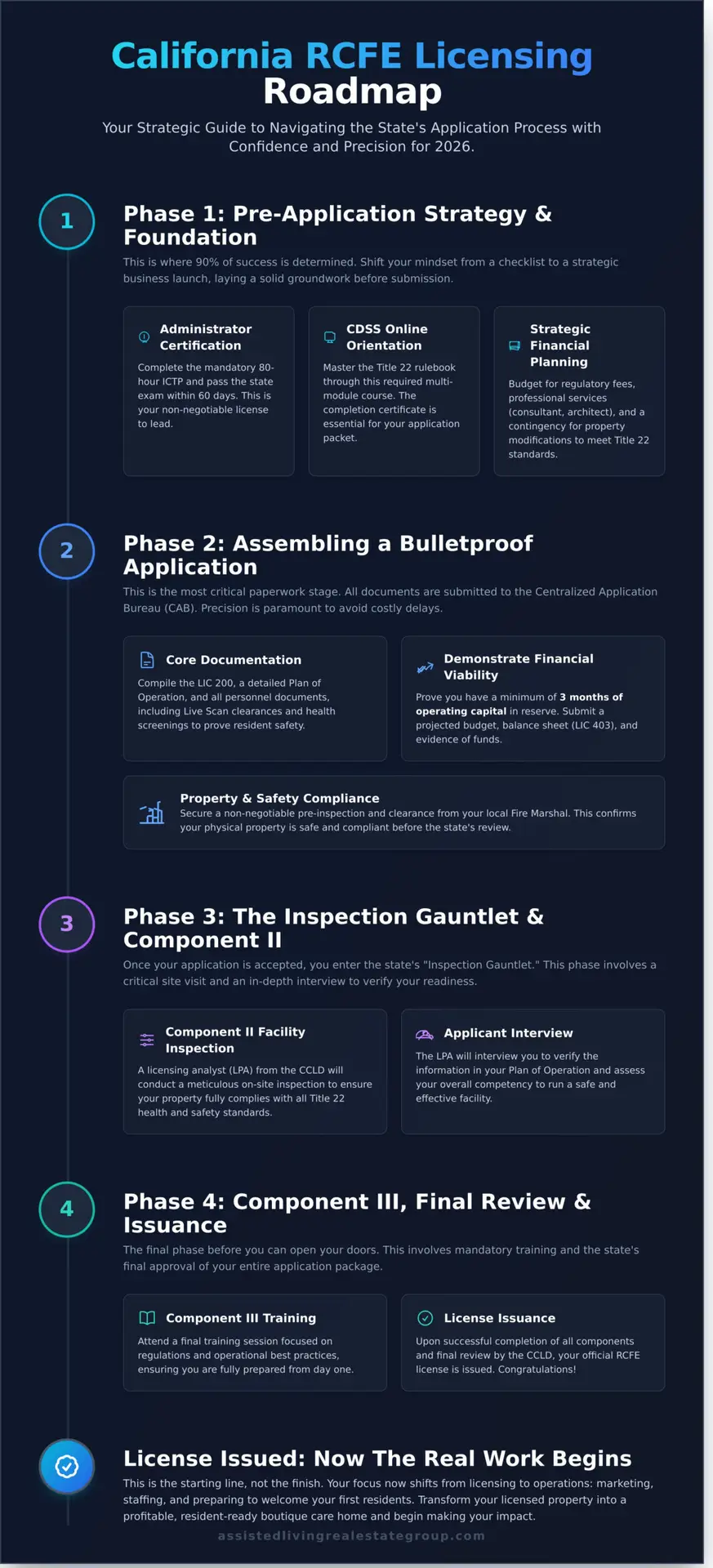
Phase 4: Component III, Final Review, and License Issuance
You have reached the final ascent. After navigating the intricate demands of applications, inspections, and corrections, this last phase is where your vision of a boutique residential assisted living (RAL) home transforms into a licensed, operational reality. This is the culmination of your efforts, the final checkpoint before you can open your doors and begin generating both impact and income.
Completing Component III Training
Before the California Department of Social Services (CDSS) grants you a license, they make one final investment in your operational success: Component III training. This mandatory module moves beyond the theoretical and into the practical, ensuring you are fully prepared for day-to-day management. Key topics include:
- Medication Management: Procedures for safely storing, assisting with, and documenting resident medications per Title 22 regulations.
- Resident Rights: Upholding the dignity, autonomy, and legal rights of every individual in your care.
- Mandated Reporting: Understanding your legal obligations for reporting suspected abuse or neglect.
Think of this not as a final exam, but as the state’s final confirmation that your facility will be a safe, compliant, and high-quality environment for California’s seniors.
The Final Analyst Review
Once your property has passed its final inspection, all deficiencies are cleared, and your Component III certificate is submitted, your Licensing Program Analyst (LPA) compiles your entire file. This comprehensive package-containing every application form, report, and certificate-is forwarded to a supervising analyst for the ultimate sign-off. The entire rcfe application process california hinges on this review.
Be prepared for potential last-minute requests for clarification. A supervisor may have a question about a specific policy or a detail from the inspection. Your key to success here is prompt and professional communication. Responding swiftly to your LPA’s inquiries during this stage prevents unnecessary delays and demonstrates your readiness to operate.
Receiving your official RCFE facility license number is the moment your real estate asset is officially activated. It is no longer just a property; it is a high-value, income-producing business poised to serve the booming senior care market. You have successfully navigated a high-barrier-to-entry process and are now positioned to build a legacy of compassionate care and significant financial returns. For expert guidance on scaling your new venture, explore the advanced strategies at assistedlivingrealestategroup.com.
Your License is Issued: Now The Real Work Begins
Securing your license marks the successful completion of the demanding rcfe application process california requires. But this isn’t the finish line; it’s the starting gun. You have officially transitioned from applicant to operator. Now, the focus shifts from paperwork and plans to people and performance. This is where your vision for providing exceptional boutique care meets the day-to-day reality of running a high-stakes, high-reward business.
The first few months are critical for establishing a foundation of excellence. You must move with precision to prepare your facility for residents while ensuring every operational detail complies with California’s stringent regulations. The goal is to be inspection-ready from day one, not just when the CDSS analyst is scheduled to arrive.
From Application to Operation: Your First 90 Days
Your immediate priority is to activate your operational plan. This period demands a strategic and organized approach to transform an empty, licensed building into a thriving home. Key action items include:
- Staffing & Training: Recruit, hire, and onboard your administrator and caregivers, ensuring all training meets California Title 22 requirements.
- Insurance & Legal: Finalize liability insurance policies and have resident admission agreements reviewed by legal counsel.
- Marketing & Outreach: Launch your marketing strategy to build a waitlist. Connect with local hospitals, senior placement agents, and community groups.
- Systems & Supplies: Implement software for managing resident records and billing. Establish relationships with vendors for food, medical supplies, and maintenance.
Building robust systems from the outset is non-negotiable for long-term success and profitability. For investors looking to accelerate this timeline, a powerful alternative exists. Let us help you find a turnkey RCFE and streamline your path to ownership.
Partnering with an RCFE Real Estate Specialist
Why navigate the complex rcfe application process california from scratch when you can acquire a facility that is already licensed and operational? A specialized real estate partner does more than find a property; we identify opportunities. Acquiring an existing RCFE allows you to bypass months of uncertainty and begin generating revenue almost immediately.
We help savvy investors locate turnkey properties, navigate the license transfer process, and step into a business poised for growth. This is the most direct path to achieving your goals of both Impact and Income, allowing you to focus on enhancing care and quality of life for your residents, rather than on construction and initial licensing hurdles. Partner with the experts at Assisted Living Real Estate Group to find your place in California’s booming senior care market.
Your Blueprint for Success in California’s RCFE Market
Navigating the path to licensure is a formidable journey, but one filled with immense opportunity for both impact and income. As we’ve detailed, success hinges on meticulous preparation through every phase-from strategic planning to assembling a flawless application packet and conquering the final inspections. Mastering the intricate rcfe application process california is the critical first step toward building a legacy of compassionate, high-quality boutique care that thrives in a demanding market.
You don’t have to navigate this high-barrier-to-entry landscape alone. With over 25 years of specialized experience, our team offers unparalleled expertise in both California real estate transactions and CDSS licensing navigation. We provide confidential marketing for sellers and curated opportunities for buyers, ensuring you are positioned for success from day one. Ready to transform your vision into a thriving reality?
Start your RCFE journey with an expert guide. Explore our listings.
Frequently Asked Questions About the RCFE Application Process
How much does it cost to get an RCFE license in California?
The initial investment for a California RCFE license is significant. The base application fee set by the CDSS can be several thousand dollars, varying by facility capacity. Beyond this, you must budget for administrator certification courses, fire safety clearance, liability insurance, and any property renovations required to meet Title 22 regulations. These are not just costs; they are foundational investments in building a high-quality, profitable boutique care home that delivers both impact and income.
How long does the RCFE application process take in California?
Navigating the RCFE licensing timeline requires strategic patience. A realistic forecast is between 6 to 12 months from submission to final approval. This duration depends heavily on the completeness of your initial application package, the current workload of your assigned Licensing Program Analyst (LPA), and the scheduling of the required pre-licensing inspection. A meticulously prepared application is the most powerful tool you have to accelerate this process and get your investment operational sooner.
Can I apply for an RCFE license without being a certified administrator?
Yes, you can apply as the licensee without personally holding the RCFE Administrator Certificate. However, your application is considered incomplete until you hire and designate a certified administrator for your facility. For many investors focused on the real estate and business strategy, hiring an experienced administrator is a strategic move that ensures regulatory compliance and allows you to focus on scaling your portfolio for maximum returns and resident quality of life.
What are the most common reasons for RCFE application delays in California?
Delays are the enemy of ROI. The most common setbacks in the rcfe application process california stem from incomplete or inaccurate paperwork. This includes missing financial verification documents, an insufficient plan of operation, or failing to secure a fire safety clearance in a timely manner. Another major hurdle is a property that fails the initial inspection due to non-compliance with Title 22 regulations. Meticulous preparation is paramount to avoiding these costly delays.
Do I need a consultant to help with my RCFE application?
While not mandated by the CDSS, engaging an experienced RCFE consultant is a high-leverage strategic decision. The licensing landscape is complex, and a single mistake can lead to months of delays and lost revenue. A seasoned consultant acts as your expert guide, helping you navigate regulations, perfect your application package, and prepare for the site inspection. This investment often pays for itself by accelerating your path to profitability and ensuring a smooth, successful launch.
What is the difference between an RCFE and an ARF license?
Understanding your target demographic is key. An RCFE (Residential Care Facility for the Elderly) license in California is specifically for serving seniors aged 60 and over. In contrast, an ARF (Adult Residential Facility) license is for adults aged 18 to 59, who may have physical, developmental, or mental health disabilities. While both operate in a residential setting, the regulations, care needs, and operational models are distinctly different, impacting your investment strategy and market positioning.
Can I operate an RCFE from a home I am leasing?
Yes, you can operate an RCFE in a leased property, but it requires absolute clarity and legal documentation. You must obtain explicit, written permission from the property owner, and your lease agreement must unequivocally permit the operation of a residential care facility. The CDSS will require proof of this agreement as part of your application. This strategy can lower initial capital outlay, but securing a long-term lease with a cooperative landlord is critical for business stability.
What kind of financial documentation does the CDSS require?
The CDSS requires absolute proof of your financial viability to protect future residents. You must provide a detailed balance sheet (Form LIC 401) and demonstrate sufficient liquid assets to cover at least three months of operating expenses without any initial resident income. This can be shown through bank statements or a confirmed line of credit. This isn’t just a regulatory hurdle; it’s a responsible business practice that builds a foundation for a sustainable, high-performing asset.