
The most profitable real estate investment in Southern California isn’t a beachfront mansion in Malibu; it’s a six-bed recovery home in the San Fernando Valley. It’s true that the high entry costs and opaque DHCS regulations can feel overwhelming. Many would-be investors see the regulatory hurdles in markets like Thousand Oaks and turn away, believing the path to profitability is simply too complex and the risks are too high.
This guide provides the strategic roadmap to cut through that complexity. We’ll show you precisely how to identify high-cap-rate properties and master the “Impact and Income” model that defines the lucrative sober living homes California market. You’re about to discover the exact steps for securing a turnkey or relicensable facility that generates a legacy of both significant financial returns and essential community support.
Key Takeaways
- Understand the market forces creating a “blue ocean” opportunity for boutique recovery housing investment across Southern California.
- Master the key differences between DHCS licensing and local SoCal zoning laws to de-risk your investment and ensure compliance.
- Uncover the revenue models and operational expense advantages that drive high ROI in the sober living homes California market, achieving both impact and income.
- Learn the criteria for a perfect recovery property and the strategy for sourcing off-market deals in high-demand California neighborhoods.
The 2026 Sober Living Homes California Market: A “Blue Ocean” for Southern California Investors
The year is 2026, and the investment landscape has shifted. For savvy real estate investors, the traditional path of residential rentals in California is fraught with compressed margins and regulatory hurdles. Yet, a powerful and underserved niche is generating unprecedented returns: the sober living homes California market. We aren’t just seeing a trend; we are witnessing the behavioral health equivalent of the “Silver Tsunami”-a massive, non-discretionary need for structured, quality recovery housing that far outstrips the current supply.
Southern California, long recognized as the global epicenter for addiction treatment and wellness, is ground zero for this opportunity. The region’s dense network of clinical services, coupled with a culture that champions recovery, creates a perpetual demand pipeline. However, the old model of institutional, “big-box” facilities is failing. Today’s market demands a more intimate, effective, and dignified alternative. The future of recovery real estate isn’t in sprawling complexes; it’s in high-end, professionally managed residential homes. It’s the “Boutique” model.
Market Drivers in Southern California
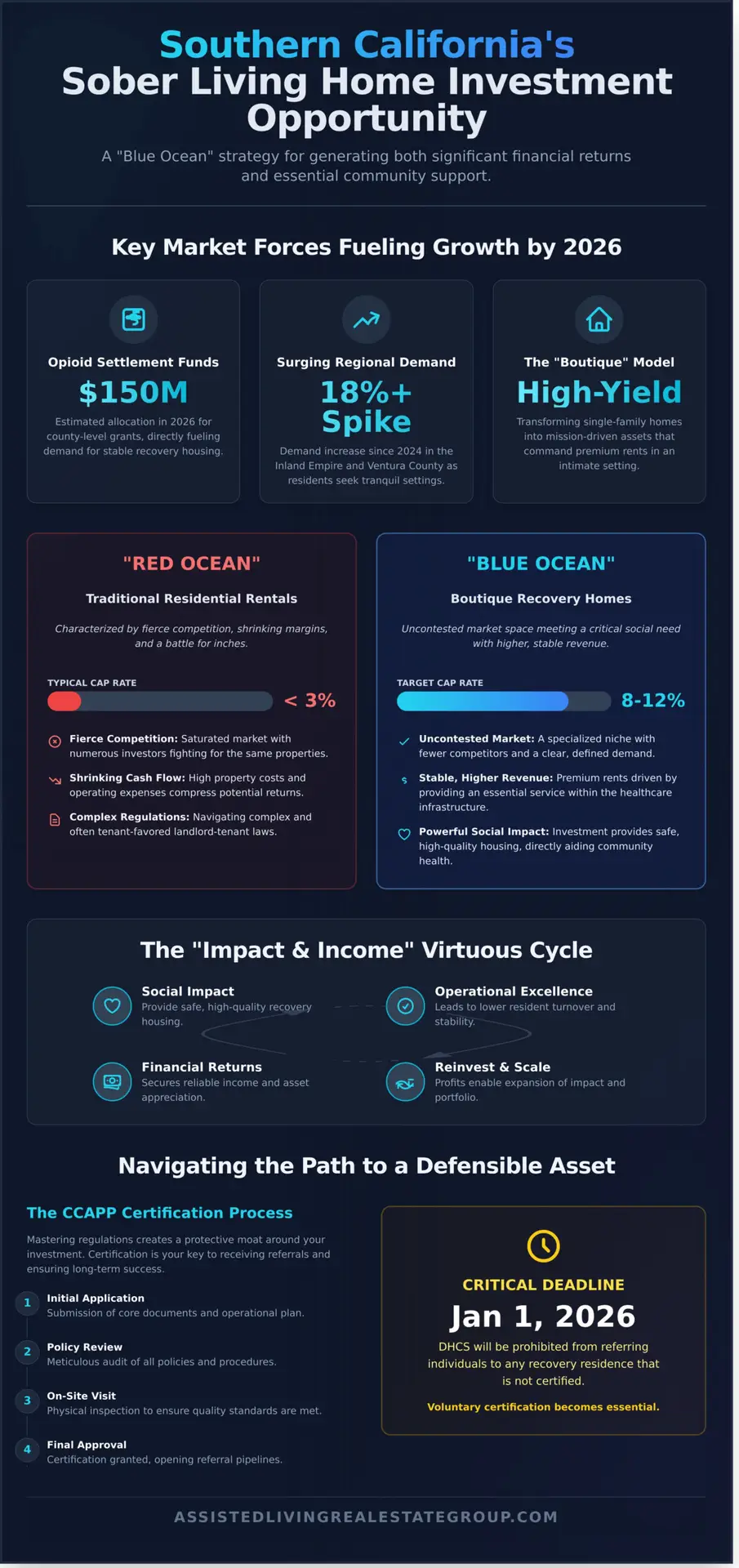
Three powerful forces are converging to create this surge. First, the distribution of California’s Opioid Settlement funds is now directly fueling housing solutions, with an estimated $150 million allocated in 2026 for county-level grants to secure stable housing for individuals in recovery. Second, while Los Angeles and Orange County remain core markets, the Inland Empire and Ventura County are experiencing demand spikes exceeding 18% since 2024 as residents seek more affordable, tranquil recovery settings. The Boutique Recovery model transforms a single-family residence into a high-yield, mission-driven asset that commands premium rents by offering a superior, intimate recovery environment.
The “Blue Ocean” vs. Red Ocean Strategy
Traditional residential rentals have become a “Red Ocean.” They are characterized by fierce competition, shrinking cash flow due to sub-3% cap rates in major metros, and complex landlord-tenant laws. This is a battle for inches. In stark contrast, specialized real estate offers a “Blue Ocean” of uncontested market space. By converting a property for use by licensed operators, investors can achieve cap rates between 8-12%. Unlike standard rentals, professionally managed Sober living houses (SLHs) operate in a less crowded space, meeting a critical social need that commands higher, more stable revenue streams. This is where our “Impact and Income” philosophy creates lasting value. The social impact of providing a safe, high-quality home directly correlates to lower resident turnover and operational excellence, which in turn secures reliable income and drives long-term asset appreciation. You’re not just a landlord; you are a key part of the healthcare infrastructure.
Navigating California’s Regulatory Framework: Licensing, DHCS, and SoCal Zoning Laws
Success in this sector isn’t accidental. It’s strategic. The regulatory environment for sober living homes in California is a complex tapestry of state oversight, voluntary certifications, and hyper-local zoning laws. While many investors see a barrier, we see a moat. Mastering these regulations is the key to unlocking the full potential of the sober living homes California market and building a defensible, high-impact asset.
First, a critical distinction: sober living homes are not state-licensed residential treatment centers. They provide a supportive, substance-free environment, not clinical or medical services. This legal separation means they fall outside the direct licensing purview of the California Department of Health Care Services (DHCS). However, DHCS is tightening its influence. A major legislative shift is coming: starting January 1, 2026, DHCS will be prohibited from referring individuals to any recovery residence that is not certified, making voluntary certification an essential requirement for sustained success.
DHCS vs. CCAPP: Understanding the Certification Path
Your path to legitimacy runs through certification. While DHCS sets the high-level policy, the California Consortium of Addiction Programs and Professionals (CCAPP) is the state-approved entity that provides the crucial “Recovery Residence” certification. This isn’t just a piece of paper; it’s your ticket to receiving referrals from state-funded programs, courts, and, increasingly, private insurance networks. Without it, your resident pipeline is severely restricted. The application process is methodical and designed to ensure quality:
- Initial Application: Submission of your organization’s core documents and operational plan.
- Policy Review: CCAPP auditors meticulously review your policies, procedures, and resident agreements for compliance.
- On-Site Inspection: An in-person visit to verify your facility meets health, safety, and operational standards.
- Certification Award: Upon successful completion, your home is listed on the state-recognized registry.
Zoning and the Fair Housing Act in Southern California
The most intense battles are often fought at the local level. NIMBY (Not In My Backyard) opposition in Southern California can manifest as restrictive municipal codes aimed at limiting group homes. This is where federal law provides a powerful shield. Under the federal Fair Housing Act and the Americans with Disabilities Act, individuals recovering from substance use disorder are legally classified as “handicapped,” granting them protected status and requiring cities to make “reasonable accommodations” in zoning rules for group homes. This protection is not theoretical; it has been tested and upheld repeatedly in California courts.
Cities like Thousand Oaks, with its Ordinance No. 1653-NS attempting to enforce a 1,000-foot separation between homes, and Carson, which has tried to use business licensing to regulate sober living, consistently face legal challenges based on these federal protections. Effectively countering these local efforts requires a proactive strategy, often involving community outreach and presenting a clear cost-benefit analysis that showcases your home’s positive contribution to community wellness and safety. Navigating these municipal-level hurdles requires a specialized roadmap; our team specializes in de-risking these exact zoning challenges for investors across the state.
Calculating ROI: Profitability and the “Impact and Income” Philosophy
True wealth isn’t just measured in dollars. It’s measured in impact. For investors in the sober living homes California market, the return on investment transcends traditional metrics, blending substantial financial returns with profound social good. This is the “Impact and Income” philosophy in action, where spreadsheets and stories of recovery are given equal weight. The financial model is robust, but the mission is what creates a lasting, defensible legacy.
Unlike traditional RCFE facilities, which carry the heavy operational burden of 24/7 medical staffing, specialized insurance, and intensive state licensing, sober living homes operate on a leaner model. Their primary focus is providing a safe, structured, and supportive environment, not clinical care. This distinction dramatically reduces operating expenses (OpEx), particularly in payroll and liability, paving the way for healthier profit margins without sacrificing quality of life for residents. The key is to run a disciplined operation that prioritizes resident success, as this directly fuels financial stability.
Discerning investors create “Boutique” environments that command a 20-30% premium on monthly fees. These aren’t just properties; they are curated communities offering superior amenities, lower resident-to-house-manager ratios, and a culture of accountability and growth. This premium positioning attracts residents who are deeply committed to their recovery, leading to lower turnover and a more stable revenue stream.
Revenue Modeling for SoCal Recovery Homes
Your pro forma is the blueprint for success. In Southern California, revenue potential varies significantly by location. By 2026, we project average monthly bed rates for a shared room in a desirable Van Nuys neighborhood to be between $2,200 and $2,800. In contrast, a similar quality home in Fresno might command $1,100 to $1,600. The key is achieving a stabilized occupancy rate of 90%. This figure represents the sweet spot, maximizing revenue while maintaining enough operational flexibility to manage resident transitions effectively. For new operators, the “Lease-to-Own” model offers a powerful entry strategy, allowing you to build a track record of operational excellence and positive cash flow before committing to a full acquisition.
Operating Margins and Wealth Creation
The goal is clear: achieve net operating margins of 25-35%. This is not a distant dream; it’s the benchmark for well-managed sober living homes in California. This is achieved through strategic expense management and by maximizing the premium associated with a boutique care model. While OpEx is lower than in clinical facilities, navigating local ordinances is critical. A detailed California Research Bureau report on sober living home regulations provides essential context on the zoning and fair housing laws that successful operators must master. Beyond cash flow, you are creating long-term wealth. A single-family home converted to a licensed, cash-flowing specialized-use property often appreciates at a higher rate than the general residential market. It becomes a valuable commercial asset, not just a house. This is the “Legacy” aspect of the investment: you are building a business that saves lives while simultaneously building generational equity.
Acquisition Strategy: Finding Boutique Recovery Properties in Thousand Oaks, Van Nuys, and Beyond
Success in the sober living homes California market isn’t found on the MLS. It’s secured through private channels. The most valuable opportunities are “off-market” deals, transactions handled with the discretion required to protect the staff, residents, and legacy of an existing operation. Public listings can disrupt the fragile ecosystem of recovery, making confidential, network-driven acquisitions the only viable path for serious investors seeking to generate both impact and income.
The perfect property isn’t just about location; it’s about structure. The asset must be optimized for a boutique care model, which means moving beyond simple bed count. We use a strict set of criteria:
- Bedroom-to-Bathroom Ratio: A 2:1 ratio is the absolute minimum. For a premium, private-pay facility, a 1.5:1 ratio is the target, allowing for en-suite or semi-private bathrooms that justify higher monthly rates and provide the dignity residents deserve.
- Functional Common Space: A home needs more than bedrooms. A minimum of 500 square feet of dedicated common space for group meetings, dining, and quiet reflection is critical for fostering community and delivering a comprehensive recovery program.
Identifying these assets requires a focused, data-driven approach. For 2026, our analysis points to two key zones ripe for investment: Thousand Oaks and Van Nuys.
The Thousand Oaks and Ventura County Opportunity
This is a market defined by affluence and need. With a median household income exceeding $125,400, Thousand Oaks families are actively seeking high-end, local recovery options for their loved ones. They don’t want to send them across the state; they want premium care in their own backyard. Certain unincorporated pockets of Ventura County offer zoning advantages, where larger residential parcels (over 15,000 sq ft) provide the space and privacy essential for a serene, boutique environment. While the Central Valley presents its own unique opportunities, as seen in our analysis of RCFEs for sale in Fresno, the Ventura County market targets a distinct, high-net-worth clientele ready to invest in quality outcomes.
Van Nuys and the San Fernando Valley Market
The San Fernando Valley offers a powerful density advantage. The sheer concentration of population creates a consistent demand stream, supported by a robust healthcare infrastructure. An ideal property here is located within a 10-minute drive of major medical centers like Valley Presbyterian Hospital or Cedars-Sinai Tarzana Medical Center, ensuring a steady flow of referrals from detox and psychiatric units. The renovation strategy here focuses on converting sprawling 1960s single-story ranch homes into modern, luxury facilities. Proximity to outpatient (OP) and intensive outpatient (IOP) services is a non-negotiable acquisition filter; residents must have seamless access to their continuing care providers, which directly impacts program success and length of stay.
Whether acquiring a turnkey business or a property for conversion, discretion is paramount. A “For Sale” sign is a non-starter. We utilize a “Confidential Marketing” process, engaging a curated list of qualified buyers under strict non-disclosure agreements. This protects the business’s goodwill, ensures staff and resident stability, and allows for a smooth transition of ownership. It’s the only way to transact in this sensitive and lucrative niche of the sober living homes California market.
To gain access to our portfolio of off-market sober living opportunities in these target zones, schedule a confidential consultation with our acquisition specialists today.
Scaling Your Portfolio: Why Specialized Brokerage is Key to California Market Entry
The opportunity within California’s sober living sector is undeniable. But the path to entry is littered with costly mistakes, often starting with the choice of a real estate agent. Treating the acquisition of a licensed care facility like a standard residential home purchase is the fastest way to jeopardize your investment before it even begins. A general realtor sees a 4-bedroom house; a specialist sees a licensed, revenue-generating asset with specific zoning requirements and operational value.
You can’t afford that disconnect. The nuances of California’s Department of Health Care Services (DHCS) certification, county-specific zoning ordinances, and the valuation of a business’s goodwill are entirely outside the scope of traditional real estate. This is where investors lose time, capital, and opportunity. They buy the wrong property, misunderstand the licensing process, or overpay for a business with a weak operational history.
Why a Specialized Broker Matters
Don’t risk your capital on a generalist. With over 25 years of experience focused exclusively on California care facilities, our team navigates these complexities with precision. We provide access to exclusive, off-market “Turnkey” acquisitions where the business, the real estate, and the license are all part of a single, seamless transaction. This isn’t just about finding a property; it’s about acquiring a fully operational, cash-flowing asset from day one. The principles of specialized representation are crucial across the care industry. You can learn more about this vital distinction here: Why Partner With a Specialized RCFE Broker?.
Our role is to be your strategic partner, bridging the critical gap between real estate acquisition and operational success. We analyze not just the property’s cap rate, but the business’s EBITDA, its census history, and its potential for growth. We are the expert guides who hold the map to Southern California’s high-barrier-to-entry landscape, from San Diego’s unique zoning overlays to Orange County’s competitive private-pay demographic.
Your Roadmap to Impact and Income
Your journey into the thriving sober living homes California market begins with a confidential consultation. This is where we align your financial goals with our market intelligence. We help you define a “Boutique” brand position, creating a premium care environment that attracts discerning clients and commands higher rates. This strategy transforms your facility from a simple service into a high-demand, high-impact investment. Our proven process includes:
- Confidential Consultation: A deep dive into your investment criteria and our exclusive market opportunities.
- Strategic Acquisition: Identifying and securing turnkey facilities that align with your portfolio goals.
- Due Diligence & Licensing: Expert guidance through the complexities of financial review and DHCS licensing transfer.
- Seamless Closing: A coordinated closing process that ensures a smooth transition of both real estate and business operations.
The demand for quality sober living environments in California is growing every day. This is your moment to build a legacy of both profound social impact and significant financial return. Achieve Impact and Income with our Southern California listings.
Build Your Legacy in California’s Recovery Housing Market
The opportunity is clear. Southern California’s demand for quality recovery housing is projected to outpace supply through 2026, creating a significant investment window. Success, however, requires more than just capital; it demands expert navigation of California’s DHCS regulations and a precise strategy for acquiring boutique properties in prime communities like Thousand Oaks and Van Nuys. The sober living homes California market is complex, but the potential for both significant ROI and profound social impact is undeniable. Don’t navigate this high-barrier-to-entry landscape alone. With over 25 years of specialized experience, our team provides the proven “Impact and Income” framework and exclusive access to confidential, off-market SoCal listings. Your moment to build a portfolio that matters is now.
Secure your position in the Southern California recovery market-View our exclusive listings today.
Frequently Asked Questions: Sober Living Homes California Market
Is a license required to operate a sober living home in California in 2026?
No, a state license is not required to operate a sober living home in California if it doesn’t provide treatment or recovery services. However, due to Assembly Bill 368, by January 1, 2025, homes must obtain voluntary certification from an approved body to receive referrals from state or local agencies. This certification is becoming the gold standard for quality and is essential for investors seeking to partner with healthcare systems, making it a non-negotiable for serious operators in 2026.
What is the average profit margin for a recovery home in Southern California?
A well-managed recovery home in Southern California can achieve a net profit margin between 25% and 40%. This figure depends heavily on the operational model, with boutique homes in affluent areas like Orange County or West Los Angeles commanding higher private-pay rates. Efficient management, high occupancy, and premium service offerings are the key drivers that push returns to the higher end of this range, creating a powerful vehicle for both impact and income for discerning investors.
Can local cities in Southern California ban sober living homes in residential neighborhoods?
No, cities cannot issue an outright ban on sober living homes in residential areas. Residents of these homes are protected as a disabled class under the federal Fair Housing Act (FHA) and the Americans with Disabilities Act (ADA). While cities can enforce reasonable, non-discriminatory zoning ordinances like capacity limits that apply to all residents, they cannot single out or prohibit recovery residences. Navigating these regulations requires strategic legal and real estate expertise.
How much capital is typically required to buy a sober living property in Thousand Oaks or Van Nuys?
Acquiring a suitable property requires significant capital, varying by location. In Van Nuys, investors should budget between $1.1 to $1.4 million, which covers a property purchase price around $950,000 plus startup costs. For a more premium market like Thousand Oaks, the total capital required increases to $1.5 to $2.0 million. This accounts for higher property values exceeding $1.3 million and the necessary funds for renovations, licensing consultation, and initial operating expenses.
What is the difference between a sober living home and an ARF (Adult Residential Facility) in California?
The primary difference is licensing and the level of care provided. An ARF is licensed by the California Department of Social Services to provide 24-hour non-medical care and supervision to adults. In contrast, a sober living home’s main purpose is to provide a supportive, substance-free environment. It is typically unlicensed unless it also offers clinical treatment services, focusing on peer support and structure rather than direct care, which defines its unique real estate and operational model.
How does the 2026 Opioid Settlement funding affect private sober living investors?
The multi-billion dollar Opioid Settlement funding, allocated to California counties, indirectly creates a massive opportunity for private investors. While funds don’t go directly to private homes, they vastly expand public treatment and recovery programs. This surge in publicly-funded treatment creates unprecedented demand for certified, high-quality sober living environments. Savvy investors who position their properties to meet this demand will capture a significant and stable revenue stream backed by state initiatives.
Why is “Boutique” recovery housing more profitable than institutional models?
Boutique recovery housing generates a higher ROI because it caters to a private-pay clientele willing to pay a premium for superior quality of life. Unlike institutional models that rely on lower insurance reimbursements, boutique homes offer private rooms, desirable amenities, and a low resident-to-staff ratio. This creates a more effective and appealing recovery environment, which in turn justifies rental rates 50-100% higher than standard models, directly boosting your bottom line.
How do I find off-market sober living facilities for sale in Southern California?
Finding off-market deals requires an insider’s approach. The most effective method is to partner with a specialized real estate brokerage that focuses exclusively on the sober living homes California market. These experts have established networks with current owners, industry associations, and attorneys who handle probate or partnership dissolutions. They can identify opportunities from retiring operators or distressed owners before they ever hit the public market, providing a significant competitive advantage.