
Senior-housing prices and home sizes can vary by community, property type, and features across Sonoma County. A listing price is only one part of the decision.
Community rules, resale conditions, and the difference between a private residence and an operating care facility can shape what fits your goals. Start by understanding what each property includes and how it may be used.
This guide explains how to assess listing prices and home sizes, evaluate age-restricted properties, and consider resale and investment factors in Sonoma Valley. It also clarifies the different paths available to homebuyers and care-facility investors working with Assisted Living Real Estate Group.
Key Takeaways
- Compare asking prices alongside bedroom and bathroom counts, living area, and community location to understand what a listing offers.
- Distinguish age-restricted communities from other senior housing, and understand how occupancy and community rules shape ownership.
- Use days on market and local listing patterns to assess resale conditions, while weighing property type and operating considerations before investing.
- Explore Sonoma Valley’s mix of senior-community homes and care-facility opportunities to identify which property path best fits your goals.
Listing prices and home sizes
The market for senior housing for sale Sonoma County includes a wide range of asking prices. These figures offer context, not a standard price for every home. A specific listing’s value depends on its size, condition, community, and features.
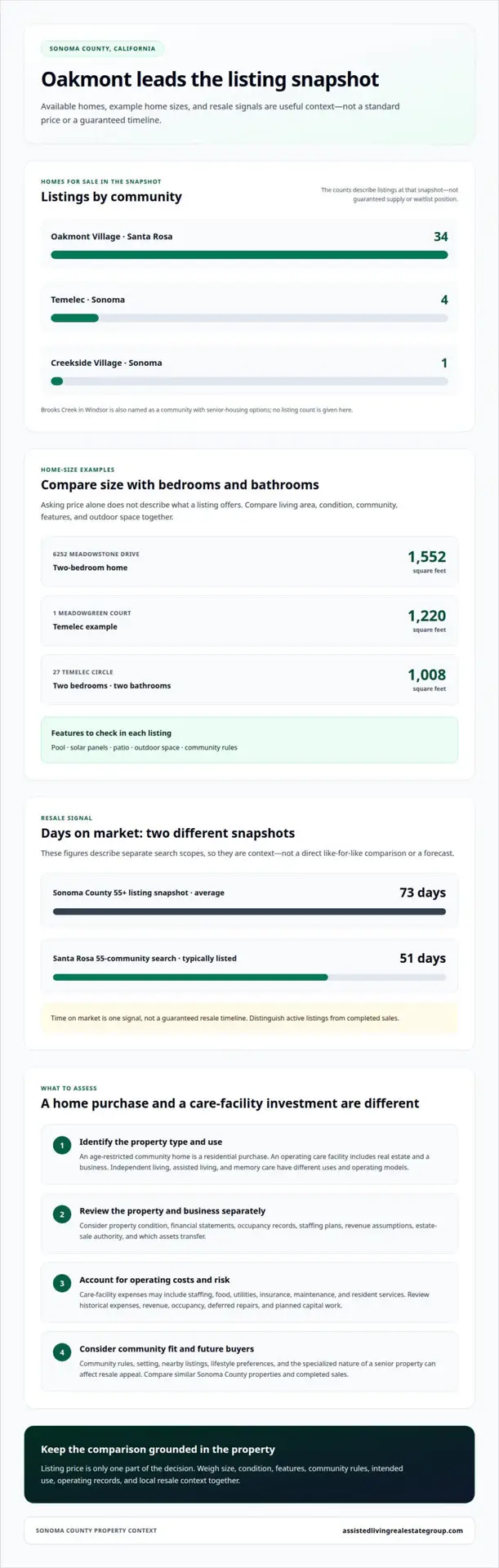
For buyers comparing senior housing for sale Sonoma County listings, Temelec and Oakmont provide distinct examples. A two-bedroom home at 6252 Meadowstone Drive had 1,552 square feet; 1 Meadowgreen Court had 1,220 square feet.
Senior housing for sale Sonoma County includes options in communities such as Santa Rosa’s Oakmont Village, Sonoma’s Temelec and Creekside Village, and Brooks Creek in Windsor. The snapshot showed 34 Oakmont homes for sale, four in Temelec, and one in Creekside Village. These counts describe listings at that snapshot, not a guaranteed supply or waitlist position.
Compare bedrooms, bathrooms, living area, and outdoor space together. For instance, a two-bedroom, two-bath Temelec home at 27 Temelec Circle measured 1,008 square feet. Review each property’s description for features such as a pool, solar panels, or a patio. Consider whether these amenities support your retirement lifestyle and justify the asking price.
A home for sale and a community waitlist are different routes to availability. A listing identifies a specific property on the market, while a waitlist concerns future access. Compare the home’s size and features with the community’s rules and current options to determine whether it suits your plans for independent living or retirement.
Senior-restricted housing properties
Southern California buyers will find homes designed for older residents as well as facilities operating senior-care businesses. Distinguishing a residence from a care operation is essential because each involves different occupancy, management, and investment considerations.
Available Senior Housing Property Types
Independent living generally describes housing for older adults without on-site personal care as part of the residence. Assisted living facilities combine housing with support services, while memory-care properties serve residents who need specialized dementia-related support. Before assessing a Southern California property’s suitability or investment potential, identify its actual use and operating model.
Distinguish age-restricted residential communities from licensed care facilities. Buying a home in a retirement community is a residential purchase; acquiring an operating care facility involves both real estate and a business. That difference shapes which records, operations, and property features matter during evaluation.
Financing Senior Housing Purchases
Financing depends on whether you are buying a residence, facility real estate, or an operating senior-care business. Specialized financing is available for RCFE and senior-living acquisitions in California. Define which assets the purchase includes, then consider the property and business components together when planning funding.
Planning a purchase of an operating facility means considering the real estate and underlying business, rather than treating the transaction as a standard home sale. The facility’s condition, operating records, and intended use inform the financial review. This distinction helps Southern California buyers understand the asset they plan to own.
Examples include 809 Oregon Street in Sonoma with 34 units, and 18 Clark Avenue in Cloverdale with 34 units, designated for seniors age 62 and older or people with disabilities.
Resale demand and investment considerations
Resale timing offers one signal, not a complete investment forecast. A Sonoma County 55+ listing snapshot averaged 73 days on market, while Santa Rosa homes matching a 55-community search typically stayed listed 51 days.
Buyer Due Diligence
Before buying, review the real estate and operating business separately. Examine the property’s condition, financial statements, occupancy records, staffing plans, and revenue assumptions. For an estate sale, confirm who can authorize the transaction and which assets transfer. These steps help you assess whether the asking price aligns with the property and its operations.
Assess demand at the community level. Oakmont Village and Temelec offer different settings and appeal to different buyers, so nearby listings, community rules, and lifestyle preferences can influence resale appeal. In wine country, access to friends, vineyards, and local amenities may matter to some residents, but those features do not replace financial analysis.
A broker can help organize comparable sales and transaction details. Ask how the analysis accounts for property condition, business performance, and likely buyer demand. Distinguish active listings from completed sales; the Santa Rosa 51-day figure describes time on market, not a guaranteed resale timeline.
Risks and Operating Costs
Operating costs vary by property and business model. A care facility may involve staffing, food, utilities, insurance, maintenance, and resident services; independent-living properties have a different cost profile. Review historical expenses alongside revenue, occupancy, deferred repairs, and planned capital work. Each item affects cash flow and the resources needed after closing.
Consider whether the facility’s layout supports its intended use and whether staffing and services fit its operating plan. In Sonoma County, changes in occupancy or repair needs can affect revenue even as fixed expenses continue. Build projections from documented records, then assess how lower occupancy or higher maintenance needs could affect returns and the resident experience.
Resale planning should account for future buyer fit. A specialized senior property may attract a narrower buyer pool than conventional real estate. Compare its operating records, condition, and setting with similar Sonoma County properties before weighing potential appreciation.
Senior housing in Sonoma Valley
Sonoma Valley includes both age-restricted neighborhoods and senior housing properties. Temelec and Creekside Village serve different residential needs, so distinguish community homes from properties intended for senior housing operations when searching locally.
Temelec has approximately 600 residents, while Creekside Village has 313 homes. Those figures illustrate different ways to assess scale: resident population describes the community, while home count indicates its housing inventory. Neither figure alone reveals whether a specific property is available or suited to a buyer’s plans.
For independent living, focus on the home and its community: layout, access, shared amenities, and occupancy rules. In Sonoma Valley, these details help distinguish a personal retirement residence from an investment in senior housing. A community’s name or age restrictions alone do not indicate that care services are provided.
Buyers considering an operating care property should assess a different set of fundamentals. Review the property’s intended use, physical layout, operating records, and fit with the surrounding community. A home in Temelec and a senior-care facility may both serve older adults, but they involve different real estate and operating decisions.
Sonoma Valley’s appeal includes its setting and proximity to local vineyards. Consider these lifestyle qualities as part of the location assessment, not as a substitute for evaluating property condition, occupancy, and operating plans. In Sonoma, the central question is whether the specific asset fits the buyer’s purpose.
Use a focused comparison: decide whether you want an independent residence or an operating care property, then assess the asset, community terms, and financial records accordingly. This makes Sonoma Valley options easier to compare without confusing a home listing with a business acquisition.
For buyers pursuing a senior-care business in the valley, explore senior care acquisition opportunities as a next step. A clear distinction between residential living and facility operations helps shape a more informed property search.
Assisted Living Real Estate Group
Assisted Living Real Estate Group helps buyers and sellers assess senior-care facility opportunities in California. If your plans extend beyond purchasing an age-restricted home to acquiring or selling an operating care business, its specialized focus can help clarify the real estate and business considerations involved.
Services include RCFE sales, ARF sales, turnkey business acquisitions, and confidential marketing for sellers seeking discretion. These options support different transaction goals, from evaluating a facility acquisition to bringing an operating property to market while protecting business confidentiality.
When you are ready to discuss a senior-care facility transaction or determine which acquisition or sale path fits your goals, contact Assisted Living Real Estate Group to start the conversation.
Turn Your Research Into a Clear Next Step
If you are evaluating senior housing for sale in Sonoma County, first define the role you want the property to play. A personal residence, a real estate investment, and an operating care business call for different priorities. Clarifying your objective helps focus discussions, financial analysis, and decisions about the property’s future.
For a care-facility transaction, bring your goals and key questions to a focused discussion about the opportunity. Consider how the property’s operations, physical setting, and long-term purpose fit together. A thoughtful review keeps business performance and quality of care in view as you assess the path ahead.
Contact Assisted Living Real Estate Group to discuss your senior-care property goals and possible next steps. With a clear direction, you can move forward with greater purpose and build toward an opportunity that aligns with your investment aims and the community it serves.
Frequently Asked Questions
What senior housing communities are for sale in Sonoma County, California?
Listings generally involve individual homes within age-restricted communities, not entire communities for sale. Sonoma County communities to explore include Temelec and Creekside Village in Sonoma, Oakmont Village in Santa Rosa, Brooks Creek in Windsor, and River’s Bend in Healdsburg. Compare each property’s age rules, ownership structure, and community requirements. A community name alone does not establish whether a particular home is available.
What are current prices for senior housing properties in Sonoma County?
Asking prices vary by community and property. These figures describe community home prices, not operating care-business acquisitions. Before interpreting an asking price, compare the specific home’s condition, size, ownership terms, and included amenities.
Are any senior living facilities or retirement communities listed for sale in Sonoma County?
Homes within Sonoma County retirement communities appear as residential listings, while an operating senior living facility is a separate business and real estate transaction. A home listing doesn’t necessarily include a care business, operating license, or facility equipment. Buyers interested in an operating care facility should distinguish that acquisition from purchasing a residence in a 55+ community and assess the property and business components separately.
What zoning, licensing, and transfer rules apply to buying a senior care facility in Sonoma County?
Requirements depend on the facility’s intended use, location, and whether the transaction includes an operating business. Treat zoning compatibility, facility licensing, and ownership or operator changes as separate parts of due diligence. A real estate closing alone does not establish operating approval. Review the property’s permitted use, existing facility status, and steps required for the incoming operator, without assuming approvals transfer automatically.