
What if the 24/7 operational burnout you’re feeling isn’t a sign to simply walk away, but a catalyst to evolve your investment into a passive powerhouse? You’ve built a boutique care environment in Southern California, yet the prospect of navigating the state’s complex regulatory landscape and the 13.3% top marginal tax rate on capital gains often makes retirement feel like a looming financial hurdle rather than a reward. Strategic retirement planning for RCFE owners requires more than just a listing; it demands a sophisticated roadmap that balances your moral compass with your cap rate goals.
We recognize that your facility represents a lifetime of heart-centered service and significant equity. You deserve a clean exit that protects your residents from displacement while ensuring you don’t lose your hard-earned gains to the Franchise Tax Board. This guide will show you exactly how to maximize your financial return and secure a lasting legacy through innovative leasing and tax-deferral models. We’ll explore the specific steps to transition from an active operator to a savvy real estate investor, turning your expertise into a consistent stream of impact and income.
Key Takeaways
- Capitalize on the “Silver Tsunami” sweeping Southern California by transforming your exit into a “blue ocean” opportunity for maximum financial return.
- Learn how to decouple your real estate assets from business operations to capture the true value of both your property and your boutique care goodwill.
- Master the essential 24-month preparation runway for retirement planning for RCFE owners to ensure your financial records are transparent and audit-ready.
- Evaluate the strategic advantages of a full turnkey sale versus a long-term lease to secure your legacy while maintaining a steady stream of passive income.
- Discover why specialized California RCFE brokerage expertise is vital for maintaining confidentiality and protecting your residents and staff during the transition.
The RCFE Owner’s Retirement Dilemma in Southern California
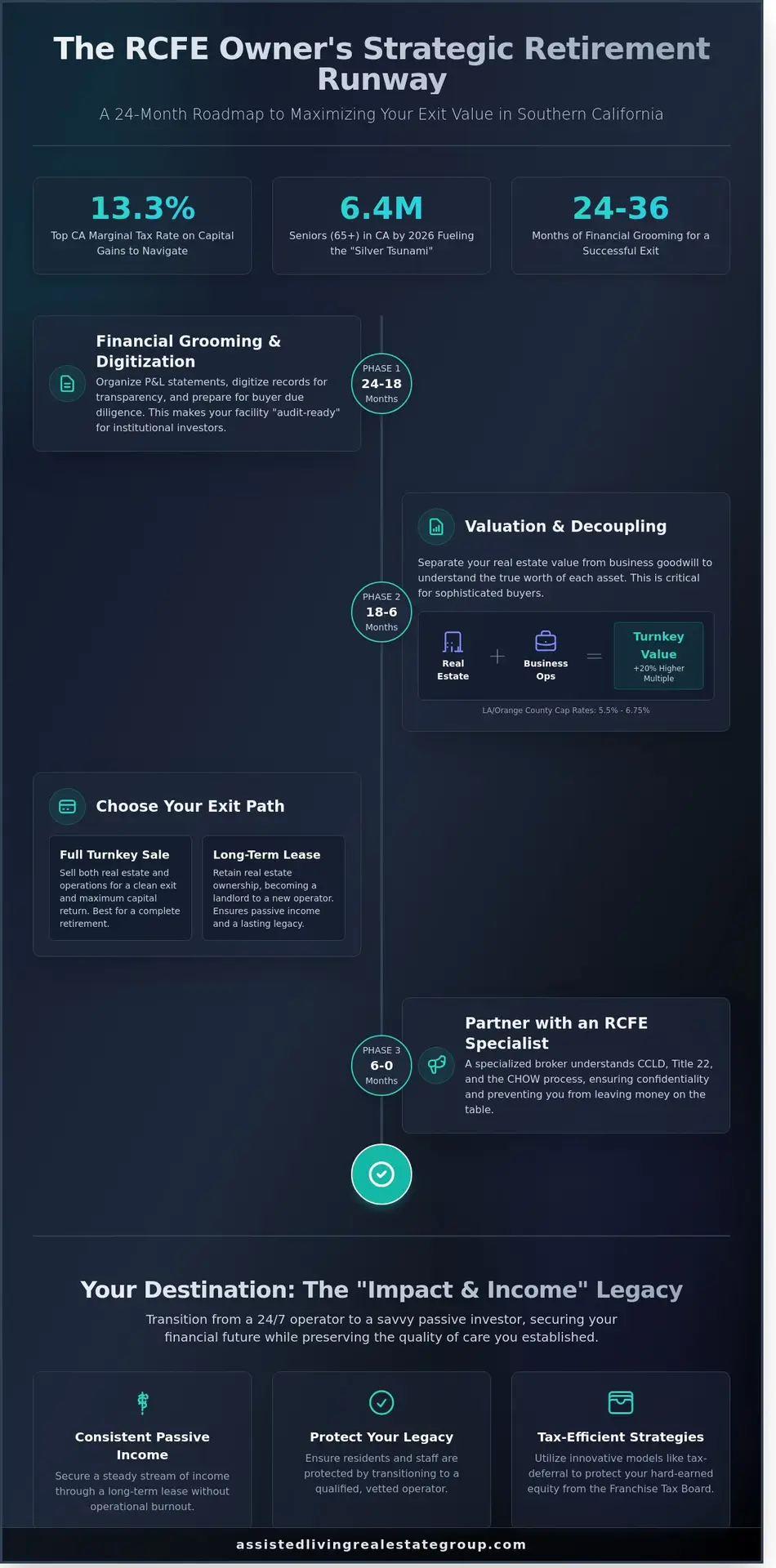
For most Residential Care Facility for the Elderly (RCFE) operators in California, your business is your life’s work. It’s a delicate balance of clinical excellence and operational grit. Effective retirement planning for RCFE owners requires a strategy that transcends a simple real estate transaction. You aren’t just selling a building; you’re transferring a license, a reputation, and a legacy of care. Many owners wait too long, failing to realize that a successful exit takes 24 to 36 months of financial grooming to maximize the final valuation.
The “Silver Tsunami” is no longer a distant forecast. By 2026, the California Department of Aging projects the population of residents aged 65 and older will reach 6.4 million. This demographic shift transforms the current market into a “blue ocean” for sellers who possess high-quality, licensed assets. Demand is outstripping supply. However, the emotional weight of exiting often paralyzes owners. You worry about your residents’ stability and your staff’s future. Balancing these heart-centered concerns with aggressive financial goals is the primary hurdle of any Southern California exit strategy.
Generic real estate brokers often fail here. They don’t understand the Community Care Licensing Division (CCLD) nuances or the intricacies of Title 22. A standard agent might miss the fact that your facility’s scarcity value is tied to its specific licensing capacity and local fire clearances. Without this technical expertise, you risk leaving hundreds of thousands of dollars on the table during the Change of Ownership (CHOW) process.
The “Impact and Income” Legacy
Your facility’s reputation in the local community directly dictates your cap rate. In the current SoCal market, “Boutique” 6-bed facilities are seeing a surge in value because they offer the intimacy that institutional facilities lack. Transitioning from an active operator to a passive investor allows you to maintain your retirement planning for RCFE owners goals while securing your financial future. You’ve done the “good” by providing care; now it’s time to ensure you “do well” by capturing the equity you’ve built.
Market Realities: From San Jacinto to Thousand Oaks
Regional demand shifts are reshaping the California landscape. In areas like San Jacinto, lower entry costs are attracting aggressive portfolio buyers. Meanwhile, in Thousand Oaks, high barriers to entry and strict zoning caps have made existing RCFEs incredibly scarce. This scarcity drives up the price-per-bed. As we approach 2026, interest rate stabilization is expected to bring a new wave of institutional buyers into the RAL (Residential Assisted Living) space, favoring sellers who have digitized their records and optimized their P&L statements today.
Valuing Your RCFE: Decoupling Real Estate from Business Operations
Retiring from the RCFE industry requires a calculated shift in perspective. You aren’t just selling a building; you’re harvesting a legacy built on years of service. Successful retirement planning for RCFE owners hinges on the concept of “decoupling.” This is the strategic process of separating your physical real estate value from your operational business goodwill. In the competitive Southern California landscape, sophisticated buyers evaluate these as two distinct assets that, when combined correctly, create a high-value “turnkey” opportunity.
Valuation isn’t a guessing game. It’s a formula. Investors focus on three primary metrics: Cap Rates, Net Operating Income (NOI), and EBITDAR (Earnings Before Interest, Taxes, Depreciation, Amortization, and Rent). In Los Angeles and Orange Counties, stabilized RCFEs currently see Cap Rates between 5.5% and 6.75%. By isolating your EBITDAR, you show a buyer the true “Impact and Income” potential of the operation without the noise of your specific debt service or tax structure. A “turnkey” facility, one that’s fully staffed and compliant, often commands a multiple 20% higher than a vacant or distressed property.
Maintaining confidentiality during this valuation phase is vital. If news of a sale leaks prematurely, you risk losing key staff members or causing anxiety among resident families. A confidential, professional valuation protects your current operations while you prepare for the next chapter. You can request a strategic valuation to understand your current market position without alerting your competitors.
The Real Estate Play
In high-demand zones like Van Nuys or Carson, your property is a premium commercial asset. The physical real estate value is driven by “highest and best use” principles. For example, a facility that has invested $50,000 in fire sprinkler systems and ADA-compliant expansions can see a 15% to 22% increase in underlying property value compared to standard residential homes. Smart owners leverage California senior housing investment trends to time their exit when inventory is low and demand for boutique care environments is peaking.
The Business Entity Value
Your RCFE license is a massive barrier to entry that carries its own price tag. In California, securing a new license through the Department of Social Services can take 8 to 12 months. An active, compliant license allows a buyer to generate cash flow on day one, which is a significant “goldmine” for investors. Value drivers for the business entity include:
- Staffing Stability: A caregiver retention rate above 80% reduces the buyer’s perceived risk.
- Resident Mix: Facilities with a 90% or higher private-pay ratio command the highest multiples.
- Compliance History: A clean record with Community Care Licensing (CCL) over the last 36 months is a non-negotiable for premium pricing.
Strategic Exit Options: Sell, Lease, or Hold?
Effective retirement planning for RCFE owners involves a fundamental shift from operational management to strategic asset optimization. You’ve spent decades building a legacy of care in Southern California’s competitive market; now your exit strategy must protect that equity. The “Silver Tsunami” isn’t a distant threat; it’s a blue ocean opportunity for owners ready to capitalize on the 10,000 Americans turning 65 every day. In California, your exit typically follows one of three sophisticated paths: the clean break of a turnkey sale, the steady cash flow of a lease, or a structured lease-to-own bridge.
- Full Turnkey Sale: This path offers maximum liquidity and a total release of liability. It’s ideal for those seeking a definitive start to their retirement.
- Retaining Real Estate: You sell the business operations but keep the deed. This creates a dual-stream wealth strategy where you benefit from property appreciation while collecting rent.
- Lease-to-Own: This model acts as a bridge for high-performing administrators who have the talent but lack the immediate capital to purchase a multi-million dollar California facility.
The Passive Income Path: Leasing Your Facility
Transforming your RCFE into a passive income engine allows you to achieve both impact and income without the 2:00 AM staffing calls. By becoming the landlord, you leverage California’s high barriers to entry to secure premium rents. Successful owners utilize specialized networks to find qualified ARF or RCFE tenants who understand Title 22 compliance. It’s vital to structure your lease with specific legal protections. A standard commercial lease won’t suffice; you need clauses addressing license maintenance, Department of Social Services (DSS) inspections, and facility maintenance to ensure your asset’s value doesn’t degrade under third-party management.
The Clean Break: Full Turnkey Sale
A turnkey sale is the fastest route to immediate liquidity for your Southern California lifestyle. When you sell the business and the real estate together, you’re often targeting two distinct buyer profiles. Individual “Mom and Pop” buyers look for boutique environments with established reputations, while institutional investors seek “RAL” portfolios with high cap rates and scalable systems. To maximize your price, you must document your systems and demonstrate consistent occupancy rates above 90%. You can find more details on preparing your documentation by learning more about selling your California care facility. This approach ensures your retirement planning for RCFE owners culminates in a significant financial reward that reflects the true value of the “boutique” care model you’ve perfected.
The 24-Month Retirement Runway: Actionable Guidance
Selling your facility is a marathon, not a sprint. Proper retirement planning for RCFE owners requires a minimum 24-month preparation window to capture the highest possible valuation. A rushed exit often leads to a 20% to 30% discount on the sale price because buyers perceive higher risk in unorganized operations. You’ve spent years building a legacy; your exit strategy must reflect that excellence. This runway allows you to “season” your financials and prove that your boutique facility is a turnkey engine of both impact and income.
Phase 1: Financial and Regulatory Cleanup
Investors and lenders in the Southern California market demand three years of pristine, transparent financial records. If your personal expenses are intertwined with your business accounts, you must separate them immediately. A “clean” P&L allows a buyer to see the true Net Operating Income (NOI) without the noise of non-business costs like personal auto leases or home utilities. This transparency is what secures favorable cap rates in a competitive market.
Regulatory standing is equally critical. Conduct a mock Title 22 compliance audit to identify potential red flags before a buyer’s inspector finds them. In 2024, the California Department of Social Services (CDSS) has intensified focus on staffing ratios and emergency preparedness. You don’t want an outstanding citation to stall your escrow. Ensure all employment contracts comply with California’s complex labor laws; non-compliance is a massive liability that savvy investors will use to negotiate your price downward.
Phase 2: Physical and Operational Optimization
Your facility must look the part of a premium boutique care home. Strategic curb appeal isn’t just about fresh paint; it’s about signaling a high level of care. Spend the next 12 months upgrading interior finishes or landscaping to justify top-tier resident rates. Higher rates directly increase your valuation. In the RAL space, the difference between a dated facility and a modern boutique environment can mean hundreds of thousands of dollars in equity.
Standardizing your Operating Procedures (SOPs) transforms your RCFE from an owner-dependent job into a scalable investment. Train a capable “Number Two” or a qualified Administrator who can manage daily operations without your presence. This operational continuity is a primary value driver for investors seeking a “blue ocean” opportunity without the headache of daily management. To ensure you’re fully prepared for the scrutiny of a sophisticated buyer, review our due diligence checklist for care home sales.
Effective retirement planning for RCFE owners bridges the gap between today’s hard work and tomorrow’s financial freedom. Don’t leave your legacy to chance.
Partnering with a Specialized RCFE Broker for Your Exit
Selling a six-bed boutique care home in Orange County or a 50-unit facility in San Diego requires more than a standard real estate license. It demands a deep understanding of the California Department of Social Services (CDSS) protocols. General residential agents often fail to grasp the complexities of Title 22 regulations. They might suggest public listings that inadvertently signal instability to your residents and their families. Effective retirement planning for RCFE owners depends on a broker who recognizes that you’re selling a specialized business enterprise, not just a structure with bedrooms. This transition involves a Change of Ownership (CHOW) process that typically spans 120 to 180 days in California. Navigating these timelines requires a strategic partner who can manage the bureaucratic hurdles while you focus on maintaining your standard of care.
The Assisted Living Real Estate Group leverages 25 years of Southern California expertise to position your facility as a premium asset. We don’t see the aging demographic as a crisis. We view the “Silver Tsunami” as a blue ocean opportunity for the next generation of compassionate investors. Our approach bridges the gap between cold financial metrics and heart-centered legacy. We analyze your cap rates and zoning advantages to ensure your exit reflects the true value of the impact you’ve made. You’ve spent years doing good while doing well; your exit strategy should honor that commitment with a significant financial return.
Confidentiality as a Value Protector
Discretion is your most powerful tool for maintaining asset value during a sale. A “For Sale” sign on a licensed care facility is often a death knell for occupancy and staff morale. If families suspect a transition is handled poorly, they may move their loved ones, causing census numbers to drop by 15% or more in a single month. We protect your “Impact and Income” through a strictly confidential marketing process. This means vetting every potential buyer for financial capability and RCFE experience before they ever see your address. We ensure that only serious, high-level investors who respect the boutique environment you’ve cultivated are allowed to tour the property. This keeps your operations stable and your valuation high.
Your Next Steps to Retirement
Securing your future starts with an accurate baseline. Retirement planning for RCFE owners isn’t a one-size-fits-all process. It requires a custom roadmap tailored to the specific real estate climate of the Inland Empire, Los Angeles, or coastal California. We begin with a confidential valuation that looks beyond the real estate to the operational ROI. This roadmap identifies the ideal timing for your exit to maximize tax advantages and personal liquidity. Don’t leave your legacy to chance or an inexperienced agent. Contact Teri Szoke today to start your RCFE exit journey and transition into your next chapter with confidence.
Secure Your Southern California Legacy
Your life’s work in the California care industry deserves a reward that reflects its true value. Navigating the exit from a boutique facility isn’t just about finding a buyer. It’s about maximizing your cap rate and protecting the legacy of care you’ve built. We’ve detailed how decoupling your business operations from your property assets often yields the highest ROI. Success hinges on a disciplined 24-month preparation timeline to ensure your licensing and financials are pristine for the next operator.
Request Your Confidential RCFE Valuation & Retirement Roadmap
Frequently Asked Questions
How much is my 6-bed RCFE in California actually worth for retirement?
A high-performing 6-bed facility in Southern California typically commands a valuation between $1.2 million and $2.5 million based on recent 2023 market data. This figure combines the fair market value of the real estate with a business multiple that usually ranges from 2 to 3 times your annual EBITDA. Boutique facilities in premium zip codes like Newport Beach or Pasadena often see higher returns due to higher private pay rates.
What are the tax implications of selling my RCFE property and business?
Selling your facility triggers capital gains taxes on the real estate appreciation and potentially ordinary income tax on the business goodwill. California’s 13.3 percent top marginal tax rate can significantly impact your net proceeds. Many owners utilize a 1031 Exchange to defer taxes by reinvesting the real estate portion of the sale into a passive triple-net lease property to secure their retirement income.
Can I sell my RCFE business but keep the real estate as a rental?
You can definitely sell the operations and licensing while retaining ownership of the physical property. This strategy allows you to transition from an active operator to a landlord, collecting monthly rent that often ranges from $7,000 to $15,000 for a California 6-bed home. It’s a popular choice for retirement planning for RCFE owners who want to maintain a steady cash flow without the daily stress of care management.
How long does the Change of Ownership (CHOW) process take in California?
The Change of Ownership process with the California Department of Social Services usually takes between 120 and 180 days to complete. You’re required to submit the LIC 200 application packet at least 60 days before the planned closing date. Delays often happen if the buyer hasn’t completed their Component II training or if fingerprint clearances from the Caregiver Background Check Bureau take longer than the standard 30-day window.
Will my residents have to move if I sell my facility to a new owner?
Residents don’t need to relocate when you sell to a buyer who intends to continue the care mission. Under California Health and Safety Code 1569.191, the new licensee assumes responsibility for existing residents under the same care terms. Maintaining a seamless transition protects your residents’ well-being and preserves the “Impact and Income” value that makes your boutique RAL facility attractive to high-level investors.
What is the “Silver Tsunami” and how does it affect my facility’s value in 2026?
The “Silver Tsunami” refers to the 73 million Baby Boomers who’ll all be over age 65 by 2030, creating a massive surge in demand for senior housing. In California, the population of seniors aged 85 and older is projected to grow by 150 percent by 2030. This demographic shift makes your RCFE a “blue ocean” asset, likely driving up cap rates and property values as we approach 2026.
Do I need to be present for facility tours during the selling process?
You don’t have to be present for every tour, and we often recommend “blind” tours to maintain operational stability. Statistics show that 85 percent of successful RCFE sales in California involve initial walkthroughs where the buyer poses as a consultant or family member to avoid alarming staff or residents. This professional approach ensures you don’t disrupt the boutique environment that defines your facility’s premium market position.
How do I find a qualified buyer who will maintain my care standards?
Finding the right buyer requires looking beyond the general residential MLS to a specialized network of RAL investors and healthcare entrepreneurs. We vet potential buyers for financial liquidity and their commitment to California Title 22 regulations to ensure your legacy remains intact. This targeted approach is a critical component of retirement planning for RCFE owners who want to exit with both financial security and peace of mind.