
You’ve secured the investment and identified a prime RCFE opportunity-a chance to build a legacy of both Impact and Income. Yet, one significant hurdle stands between you and opening your doors: the labyrinth of California’s licensing bureaucracy. The fear of a misstep on an application or a failed inspection can feel paralyzing, threatening to turn your “blue ocean” opportunity into a sea of red tape and costly delays. This is precisely where savvy investors get stuck, but it doesn’t have to be your story.
Mastering the process of relicensing an RCFE is the critical final step in your acquisition, and this guide is your definitive roadmap. We will provide a clear, step-by-step checklist designed to demystify the CDSS requirements, prepare you for a successful site visit, and empower you to take operational control with confidence and speed. Consider this your strategic partner in transforming a complex regulatory challenge into a smooth, successful launch of your new boutique care facility.
Key Takeaways
- Recognize the #1 rule of RCFE acquisitions: California licenses are non-transferable, requiring a completely new application process for every new owner.
- A successful operational takeover begins long before the application is submitted; assemble your expert legal and operational team to build a strategic foundation.
- Master the three core components of the application package to streamline the process of relicensing an RCFE and avoid common submission errors.
- Learn to identify and sidestep the most common application pitfalls that can derail your timeline and jeopardize your investment from the start.
First Principles: Why Relicensing an RCFE is a Critical Step
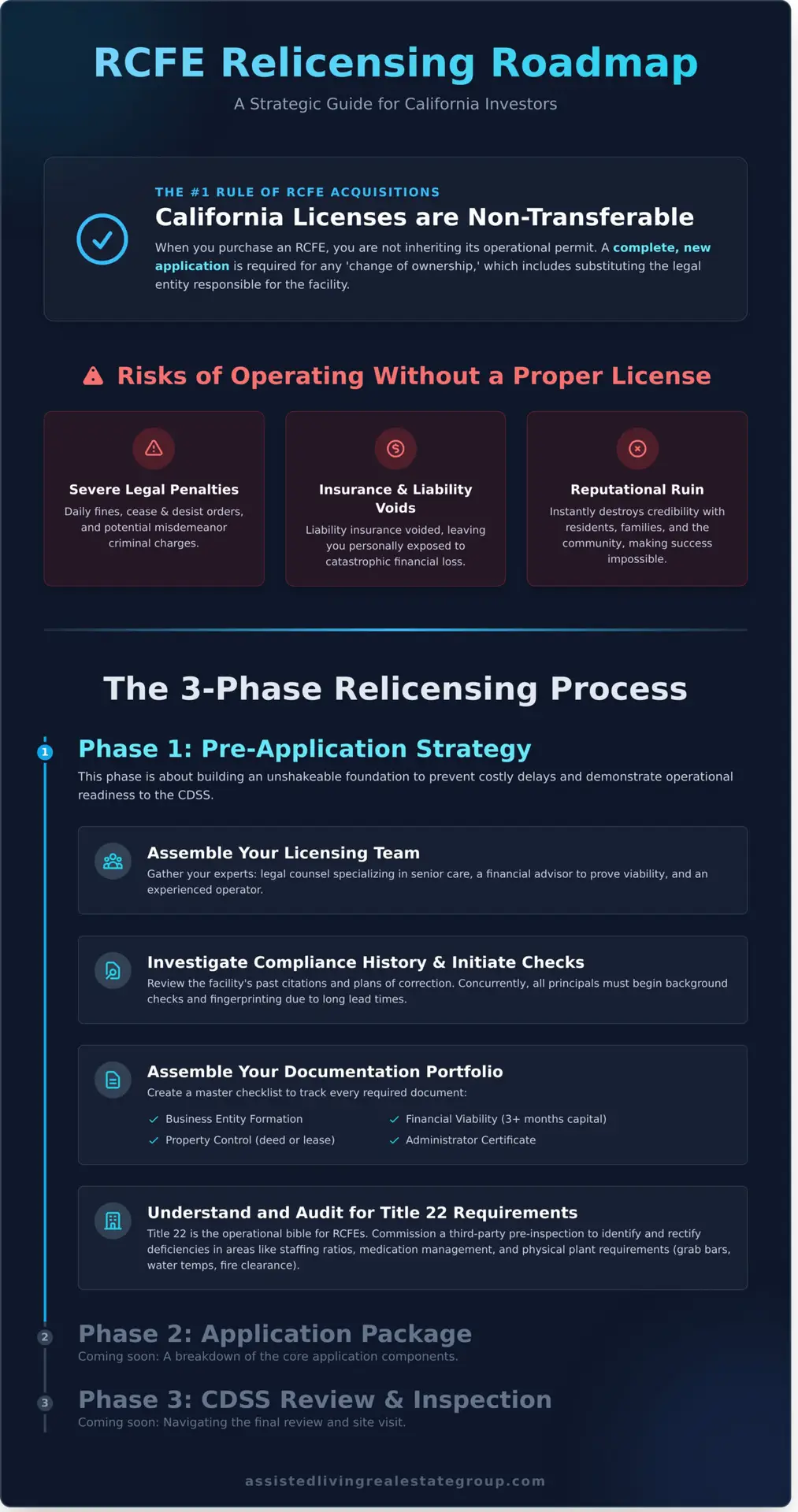
In the high-stakes world of Residential Assisted Living (RAL) investment, overlooking regulatory details can derail even the most promising acquisition. The most critical, and often misunderstood, step after purchasing a facility is the license. Let’s be clear: in California, a Residential Care Facility for the Elderly (RCFE) license is non-transferable. When you buy the business, you do not inherit its operational permit. Instead, you must begin a full, new application process from scratch.
This isn’t a simple update of information; it’s a complete re-evaluation by the state. The process of relicensing an RCFE is triggered primarily by a change of ownership. While other events, such as changing your facility’s location or altering your business entity structure (e.g., from a sole proprietorship to an LLC), also require a new license, the purchase of an existing facility is the most common and comprehensive trigger you will face as an investor.
The ‘Change of Ownership’ Trigger Explained
The California Department of Social Services (CDSS) defines a ‘change of ownership’ as any substitution of the legal entity responsible for the facility. The state’s logic is sound: the license is tied to the operator’s qualifications, character, and financial stability-not the physical building. This rigorous review ensures every new owner is vetted to provide safe, high-quality care, protecting both the residents and the integrity of the Assisted Living industry.
Risks of Operating Without a Proper License
Attempting to bypass the relicensing process is not a shortcut; it’s a direct path to financial and operational disaster. The consequences are severe and multifaceted, jeopardizing your entire investment and the well-being of your residents. The risks include:
- Severe Legal Penalties: The CDSS can impose daily fines of hundreds of dollars, issue cease and desist orders, and pursue misdemeanor criminal charges.
- Insurance and Liability Voids: Your liability insurance will almost certainly be voided if you operate without a valid license, leaving you personally exposed to catastrophic financial loss in the event of an incident.
- Reputational Ruin: An unlicensed operation will instantly destroy your credibility with residents, their families, and the community, making it impossible to build a successful, legacy-focused business.
Securing a new license isn’t just a regulatory hurdle; it’s the foundational step to protecting your capital and building a business that delivers both Impact and Income.
Phase 1: The Pre-Application Strategy for a Seamless Process
The journey of relicensing an RCFE is won or lost in the preparation. This initial phase is not about paperwork; it’s about building an unshakeable foundation to prevent costly delays and demonstrate your operational readiness to the California Department of Social Services (CDSS). Before a single form is filed, savvy investors assemble their ‘licensing team’-legal counsel specializing in senior care, a financial advisor to prove viability, and an experienced operator. A critical first step is a deep dive into the facility’s compliance history. Uncovering past citations or plans of correction provides a roadmap of potential challenges and allows you to proactively address them. Concurrently, all principals must initiate their background checks and fingerprinting, as this process often has the longest lead time.
Assembling Your Documentation
Organization is the bedrock of a smooth application. The CDSS requires a mountain of evidence proving your legitimacy and preparedness. Start by creating a master checklist to track every document, ensuring nothing falls through the cracks. Your initial documentation portfolio must include:
- Business Entity Formation: Articles of incorporation, LLC operating agreements, or partnership documents.
- Property Control: A copy of the grant deed or a fully executed lease agreement.
- Financial Viability: Detailed financial statements, balance sheets, and proof of at least three months of operating capital.
- Administrator Certification: A copy of the RCFE Administrator’s certificate for your designated leader.
Understanding Title 22 Requirements
Title 22 of the California Code of Regulations is the operational bible for any RCFE. It dictates everything from staffing ratios and medication management to the physical environment of the facility. As the new owner, you inherit the responsibility for full compliance. Pay special attention to physical plant requirements-such as grab bar placements, water temperature settings, and fire clearance-as these can require capital investment. We strongly advise commissioning a third-party pre-inspection audit to identify and rectify any Title 22 deficiencies before the CDSS licensing analyst ever steps foot on the property.
Initial Consultation with the CDSS
Don’t wait for the state to contact you. Proactively reaching out to your local Community Care Licensing Division (CCLD) regional office demonstrates professionalism and initiative. You can schedule an orientation or speak with a duty officer to clarify any questions specific to your facility or business structure. This is especially vital now that the state has streamlined submissions through a Centralized Applications Unit, a procedural shift detailed in a key CDSS official notice that all new owners should review. This early dialogue builds rapport and turns a potential adversary into a resource for your success.
Phase 2: A Step-by-Step Breakdown of the Application Package
The state application is where your vision meets regulatory reality. It’s a daunting stack of paperwork, but viewing it as three distinct components makes the process manageable and strategic. Successfully navigating the forms required by the CDSS Centralized Applications Bureau is the most critical step in relicensing an RCFE. Inaccuracies don’t just cause delays; they can trigger outright rejection, setting your timeline and ROI back significantly. Let’s deconstruct the package.
Component 1: The Applicant & Principals
This section is about you. The state needs to verify who is behind the operation, confirming your qualifications and financial solvency. Key forms include the LIC 215 (Applicant Information), which establishes your entity, the LIC 401 (Financial Verification) to prove you have the required capital, and the LIC 508 (Personnel Report), which initiates mandatory background checks for all principals and staff. This is your opportunity to build trust and demonstrate professional credibility from the outset.
Component 2: The Facility & Operations
Here, the focus shifts from the operator to the physical asset. You must provide concrete details about the building that will house your residents. The core document is the LIC 200 (Application for a Community Care Facility License), which details capacity and services. This must be accompanied by detailed sketches of the property layout, including all rooms, exits, and outdoor areas. Crucially, you will also need to submit proof of a passed fire safety inspection, a non-negotiable requirement for ensuring resident safety.
Component 3: The Plan of Operation
This is the heart of your application and the blueprint for your business. The Plan of Operation is a comprehensive document that details exactly how you will run your boutique RCFE to provide exceptional care while maintaining compliance. It’s the most intensive part of the relicensing an RCFE process and where most applications fall short. Your plan must meticulously cover:
- Staffing plans, including roles, qualifications, and schedules
- Resident admission criteria and care protocols
- Daily activity schedules and meal plans
- Emergency and disaster preparedness procedures, which must include staff certified in first aid and CPR through a recognized training partner like Aspire First Aid Guide Training Corp.
A vague plan guarantees a denial. Your submission must be a precise, actionable guide that proves you are prepared to deliver on your promise of both Impact and Income.
Need help crafting a compliant Plan of Operation? Our experts can assist.
Phase 3: Navigating the CDSS Review and Facility Inspection
This is where your investment vision meets operational reality. Once you submit your application, the California Department of Social Services (CDSS) will assign a Licensing Program Analyst (LPA) to your file. This individual becomes your primary point of contact and the gatekeeper to your license. Their role is to verify that your application is flawless and that your facility is a safe, compliant, and high-quality environment for future residents. Successfully navigating this phase is the most critical hurdle in the journey of relicensing an RCFE.
The Application Review Process
Your assigned LPA will meticulously review every document you submitted. They are searching for completeness, accuracy, and compliance with Title 22 regulations. If any information is missing or unclear, you will receive a “deficiency letter.” Do not view this as a setback; see it as a request for clarification. Responding promptly and thoroughly is paramount, as delays here directly impact your timeline for opening and generating revenue.
Preparing for the Site Visit
The facility inspection is your opportunity to demonstrate your commitment to providing boutique care. Before the LPA arrives, conduct a rigorous mock inspection. This is more than a simple cleaning; it’s about presenting a turnkey operation ready to deliver exceptional quality of life. The LPA will be assessing:
- Safety & Environment: Functioning smoke detectors, charged fire extinguishers, clear exit paths, and overall state of good repair.
- Documentation: All required postings (resident rights, menus, emergency plans) must be visible and current.
- Record Readiness: Have organized binders for resident and staff files ready for review, even if they are currently empty.
- Operational Compliance: Proper food storage, medication management protocols, and sanitation standards.
After the Inspection: Next Steps
Following the visit, one of two things will happen. Ideally, the LPA will approve your facility on the spot. More commonly, you will be issued a Plan of Correction (POC) detailing any required changes. This is simply a to-do list to achieve full compliance. Complete the POC, submit proof to your LPA, and await the final sign-off. Once approved, you will pay the final licensing fee and receive your official RCFE license certificate, unlocking the door to generating both impact and income.
This intricate process demands precision. To ensure you navigate every step flawlessly, connect with the experts at the Assisted Living Real Estate Group.
Common Relicensing Pitfalls and How to Avoid Them
After guiding countless investors through the acquisition and licensing process, we’ve identified the critical chokepoints where promising ventures stall. The journey of relicensing an RCFE is not a sprint; it’s a meticulous process where foresight and preparation are your greatest assets. Avoiding these common pitfalls is the first step toward securing your legacy and generating both Impact and Income.
Many new owners stumble on what appear to be minor hurdles, but these can quickly escalate into significant delays that impact your timeline and bottom line. The most frequent missteps include:
- Incomplete or Inaccurate Application Forms: The state licensing agency demands perfection. A single missing signature or incorrect address can send your entire packet back to square one.
- Underestimating the Timeframe: Optimism is an entrepreneurial virtue, but it can be a liability here. Assuming a best-case scenario for licensing can lead to costly operational commitments made too soon.
- Failing the Facility Inspection: The final inspection is not a formality. Simple oversights like missing fire extinguishers, incorrect water temperature settings, or inadequate resident record security can result in a failed inspection and further delays.
- A Vague Plan of Operation: This document is your operational blueprint. If it’s not detailed, compliant, and reflective of a high-quality care model, the state will see a significant red flag.
Avoiding Paperwork Errors
Your application is the foundation of your entire licensing effort. Treat it with the gravity it deserves. We advise clients to double-check every field on every form. Better yet, have a qualified second party-a partner or a consultant-review the entire package before submission. A simple clerical error can cost you weeks, if not months, of progress.
Setting Realistic Timelines
While every situation is unique, a realistic timeframe for the entire relicensing process is typically three to six months from submission to approval. This can be influenced by the workload of your local Community Care Licensing Division (CCLD) office and the complexity of your application. Do not hire a full staff or accept resident deposits based on an optimistic closing date. Build a buffer into your financial projections to account for the state’s timeline, not your own.
Streamlining Your Path to Licensure
The key to navigating the complexities of relicensing an RCFE is proactive, expert-led preparation. This is where a strategic partner provides an almost unfair advantage. A specialist who understands the nuances of the CCLD can foresee potential issues with your application, your Plan of Operation, or your facility itself long before they become major problems. This foresight transforms a reactive, stressful process into a predictable, streamlined path to opening your doors. Partner with us to ensure your relicensing journey is smooth and successful.
Your Path to Impact and Income Starts Here
As we’ve detailed, navigating the transfer of ownership for a Residential Care Facility for the Elderly is more than a simple transaction-it’s a meticulous process that safeguards your investment and the well-being of future residents. Success in relicensing an RCFE hinges not just on completing the application, but on strategic preparation and a deep understanding of the regulatory landscape to avoid common delays.
The path is complex, but you don’t have to walk it alone. With over 25 years of specialized experience, Assisted Living Real Estate Group offers expert guidance on CDSS regulations, ensuring a seamless transition. Our proven track record of successful transactions means your investment is in the hands of a strategic partner dedicated to your success. Ready to invest? Let us guide you through the purchase and relicensing of your California RCFE.
The opportunity to generate both significant returns and profound social impact is within your reach. Let’s build your legacy together.
Frequently Asked Questions About Relicensing an RCFE
How long does the RCFE relicensing process typically take in California?
Timing is a critical component of your investment strategy. In California, the relicensing process managed by the Department of Social Services (CDSS) typically takes between 90 to 180 days. The final timeline depends heavily on the completeness of your application packet and the regional office’s current workload. Proactive and meticulous preparation is the key to compressing this timeline, ensuring your path to generating both impact and income is not unnecessarily delayed by administrative hurdles.
Can I operate the RCFE using the previous owner’s license while I wait for my own?
The answer is an unequivocal no. An RCFE license is non-transferable; it is tied directly to the specific owner or entity, not the physical property. Attempting to operate under the seller’s license post-closing is a serious compliance violation that puts your entire investment at risk. A strategic transition plan, often involving a temporary management agreement, is essential to ensure seamless operational continuity while your own license is pending, protecting residents and your future ROI.
What are the main differences between an initial license application and a relicensing application?
While both processes demand meticulous documentation, a relicensing application offers a strategic advantage. The primary focus shifts from the physical facility-which is already approved-to the new owner’s qualifications, financial viability, and operational plan. This presents a “blue ocean” opportunity for savvy investors. Acquiring an existing, compliant facility significantly lowers the barrier to entry and accelerates your timeline to profitability compared to navigating the zoning and construction hurdles of a new build.
How much does it cost to relicense an RCFE?
The direct application fee paid to the CDSS is determined by the facility’s licensed capacity, typically ranging from a few thousand to several thousand dollars. However, the true cost of relicensing an RCFE must also account for associated professional services, such as legal and consulting fees. Sophisticated investors view these expenses not as a cost, but as a crucial investment in expertise to ensure a flawless application, de-risk the transaction, and secure a high-value, income-producing asset.
What is the role of the facility Administrator in the relicensing process?
Your facility Administrator is your key operational partner in the licensing transition. They are responsible for preparing critical documents, such as the plan of operation, and demonstrating day-to-day compliance to the state licensing analyst. A certified, experienced Administrator is non-negotiable; their competence and direct involvement in the application process provide the CDSS with the confidence that your facility will continue to provide the highest standard of boutique care and quality of life for residents.
What happens if my application for relicensing is denied?
A license denial is a significant setback, but it is a preventable risk and not necessarily the end of the road. The CDSS will provide a formal “Statement of Issues” outlining the specific reasons for the denial, and you have the right to an administrative appeal. This outcome underscores the critical importance of submitting a meticulously prepared, comprehensive application from the outset. Partnering with seasoned experts minimizes this risk, protecting your capital and your vision.