
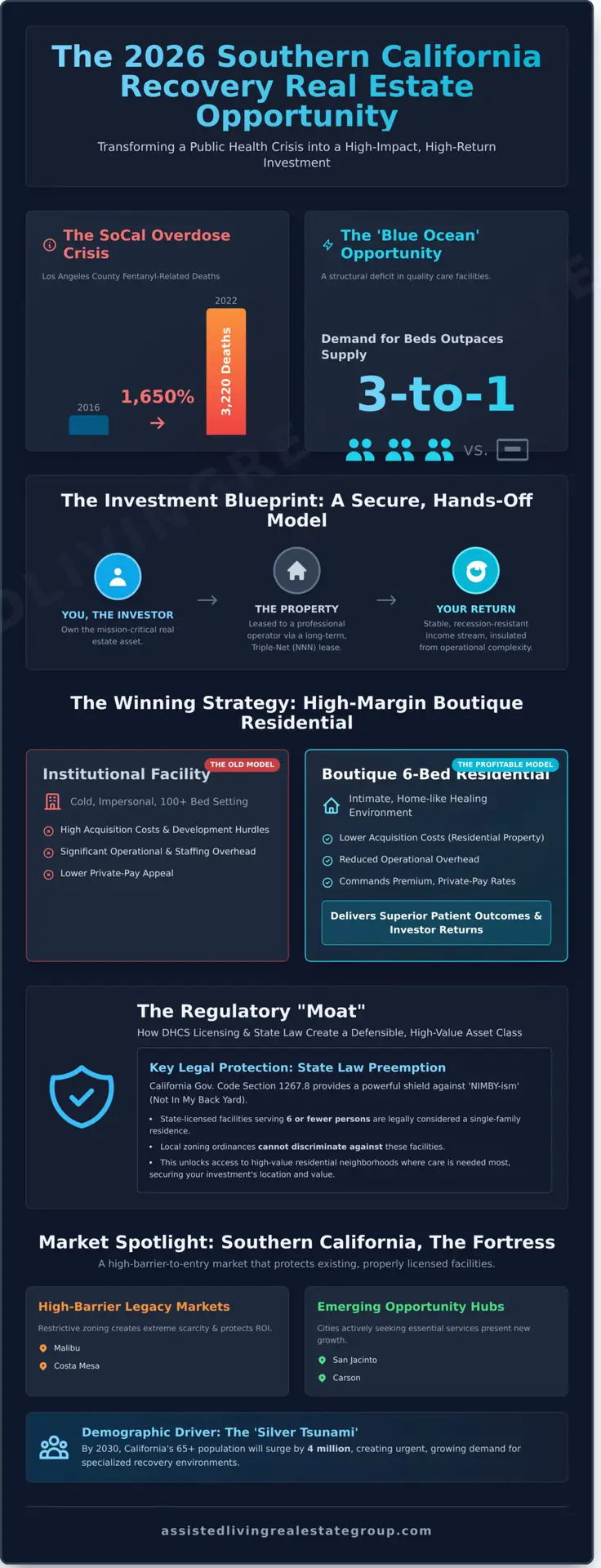
In 2022, Los Angeles County recorded 3,220 fentanyl-related overdose deaths, a staggering 1,650% increase from just six years prior. This isn’t just a statistic; it’s a signal of a profound and unmet need for quality care facilities across Southern California.
You’ve likely seen the headlines and understand the immense operational hurdles. It’s true that navigating the labyrinth of California’s DHCS licensing, securing correctly zoned properties from San Diego to Santa Barbara, and balancing financial returns against fierce ‘NIMBY’ opposition presents a formidable barrier to entry. Most investors stop right there.
But for the visionary entrepreneur, these barriers create a moat around a true blue ocean opportunity. This is your definitive 2026 guide to recovery center real estate investing, designed to transform those challenges into your competitive advantage. We will show you how to build a portfolio that delivers both elite-level financial returns and a lasting legacy of healing, achieving the ultimate goal of impact and income.
Inside, you’ll discover a clear roadmap for property acquisition, a financial breakdown of the high-margin ‘Boutique’ model, and the key to finding a strategic partner who can navigate the Southern California market with you.
Key Takeaways
- Learn how California’s DHCS licensing requirements create a protective “moat” that secures your investment against less-prepared competition.
- Discover the unique framework for Southern California site selection, balancing the critical needs for patient accessibility and restorative privacy.
- Master the financial model for successful recovery center real estate investing by evaluating both the triple-net (NNN) lease potential and the underlying business value.
- Understand why the most profitable healthcare assets are secured through confidential, off-market channels, not the public MLS.
What is Recovery Center Real Estate Investing in 2026?
What is recovery center real estate investing in 2026? It’s not about running a clinic. It’s about owning the mission-critical real estate that makes healing possible. This asset class involves acquiring, developing, or leasing residential and commercial properties specifically designed and zoned for addiction treatment services, from detoxification centers to sober living houses. In a market defined by overwhelming need, you provide the essential physical foundation for operators to deliver life-changing care.
The opportunity is a true ‘Blue Ocean’. In Southern California, the demand for quality behavioral health beds is outpacing supply by a factor of nearly 3-to-1, according to 2025 market analysis from the California Health Care Foundation. This isn’t a temporary gap; it’s a structural deficit fueled by powerful demographic and social tailwinds. For the astute investor, this imbalance creates a landscape ripe for generating both significant income and lasting impact.
A critical distinction is separating the real estate (the ‘shell’) from the business operations (the ‘license’). As the property owner, you aren’t involved in patient care. Instead, you secure a long-term, triple-net (NNN) lease with a professional, licensed treatment provider. This structure insulates you from operational complexities while providing a stable, recession-resistant income stream tied to an essential healthcare service.
This demand is powerfully accelerated by the ‘Silver Tsunami’. The California Department of Finance projects that by 2030, the state’s 65-and-over population will surge by 4 million. This demographic is facing a hidden crisis of substance use disorders, creating an urgent and growing need for specialized recovery environments. This is where smart capital meets profound social need, defining the next frontier of purpose-driven real estate.
The Shift Toward Boutique Residential Recovery
The era of the cold, 100-bed institutional facility is ending. In Southern California, the intimate 6-bed residential model is consistently outperforming its larger counterparts. The advantages are clear: lower acquisition costs, reduced operational overhead, and a home-like setting that fosters deeper connection and commands premium, private-pay rates. Boutique Recovery is a high-margin residential asset class that delivers both superior patient outcomes and investor returns.
Why Southern California is the Epicenter
Southern California has long been the ‘Recovery Capital’ of the world, but by 2026, it has become a fortress. Decades of NIMBYism and restrictive municipal zoning in coastal cities like Malibu and Costa Mesa have created an incredibly high-barrier-to-entry market. This regulatory moat, while challenging to navigate, protects the ROI of existing, properly licensed facilities. This scarcity is now forcing innovation, with forward-thinking developers targeting emerging hubs like San Jacinto and Carson, where city planning is actively seeking these essential services.
The Regulatory Moat: Navigating DHCS and Title 22
Most investors see regulation and run. We see a competitive advantage. In California, the Department of Health Care Services (DHCS) isn’t a roadblock; it’s a moat that protects professional investors from a saturated market. This complex regulatory environment, governed by Title 22 of the California Code of Regulations, is precisely what creates scarcity and drives value in recovery center real estate investing. It ensures that only the most dedicated and well-capitalized players can enter, preserving asset integrity and long-term profitability.
So, let’s address the primary objection directly: Is the regulatory risk in California too high? Absolutely not, for the prepared. For the novice investor attempting to go it alone, the risk is immense. For the strategic partner with a proven roadmap, these regulations are the blueprint for creating a defensible, high-impact asset class. The rules don’t just dictate operations; they secure your investment’s very foundation.
Licensing vs. Zoning: The Southern California Puzzle
Local opposition, often called ‘NIMBY-ism’ (Not In My Back Yard), can derail projects before they begin. California state law, however, provides a powerful shield. Under Government Code Section 1267.8, any state-licensed residential recovery facility serving six or fewer persons is considered a single-family residence and cannot be discriminated against by local zoning ordinances. This state-level preemption is your legal backstop, allowing boutique care models to flourish in high-value residential neighborhoods where they are needed most.
While zoning is simplified, physical plant compliance is not. Title 22, Division 5 dictates strict health and safety standards. During acquisition due diligence, your focus must be on:
- Fire Marshal Clearance: This is a non-negotiable prerequisite. A pre-existing clearance from the local fire authority, confirmed to be up to date with the latest 2022 California Fire Code, can save you tens of thousands in unforeseen retrofitting costs.
- Physical Plant Integrity: Verifying adequate bedroom square footage per resident, proper egress routes, and functional smoke and carbon monoxide detection systems are critical steps before closing.
The Relicensing Strategy for Turnkey Acquisitions
Why build when you can buy better? Acquiring an existing, licensed facility is the most efficient path to market. It sidesteps the 18-to-24-month timeline often required for new construction entitlements and build-outs. We call this the ‘Succession’ opportunity, targeting dedicated operators, often in communities like Van Nuys or across the San Fernando Valley, who have built a legacy of care but are now ready for retirement. These “tired landlords” offer a prime opportunity to acquire a proven asset and infuse it with modern operational excellence.
This turnkey approach streamlines the most difficult part of the process: the licensing itself. The average timeline for a complete DHCS license transfer for an existing facility is projected to be between 90 and 120 days in 2026. This accelerated timeline is a core advantage of a strategic acquisition. Navigating this transfer requires precision and expertise, but it’s a defined process. Understanding these nuances is the first step; executing them flawlessly requires a partner who has mastered the DHCS licensing and acquisition process.
Strategic Location Analysis: Southern California Market Spotlight
Success in recovery center real estate investing hinges on one factor above all others: location. But the calculus is fundamentally different from traditional residential or commercial properties. You are not simply buying square footage; you are acquiring an environment for healing. This requires a delicate balance between practical accessibility for staff and clinical partners and the profound need for resident privacy and tranquility. A property must be a sanctuary, removed from past triggers, yet integrated enough to support a structured path to sobriety.
Evaluating market saturation is critical. While coastal hubs like Orange County and Malibu became synonymous with recovery in the early 2000s, by 2024 they are dense, competitive markets with staggering acquisition costs. The real opportunity for impact and income now lies in underserved regions. Projections for 2026 show a widening gap between the demand for substance abuse treatment and the supply of quality beds in California’s inland population centers. This creates ‘Blue Ocean’ pockets for savvy investors in areas like the Inland Empire and the Central Valley, where need is high and competition is comparatively low.
Fresno and the Central Valley: The New Frontier
The numbers don’t lie. The Central Valley represents a massive, underserved population with a critical need for quality care. For investors, this translates to a significantly lower cost of entry compared to coastal markets, often with acquisition prices 40-50% lower than in Los Angeles County. This isn’t just about affordability; it’s about scalability. Furthermore, municipalities like Fresno are updating zoning codes to encourage the development of residential care, recognizing the urgent community need. These streamlined pathways, often similar to those for elder care, are opening doors for new facilities. If you are exploring this emerging market, viewing an active RCFE for sale Fresno can provide a tangible blueprint for what’s possible in the region.
Thousand Oaks and Van Nuys: Premium Boutique Markets
Southern California’s diverse economy creates distinct opportunities at both ends of the market spectrum. Van Nuys, at the heart of the San Fernando Valley, is a high-density demand center for accessible, insurance-based recovery services. Its proximity to a dense network of sober living homes and outpatient clinics makes it a strategic hub. In contrast, Thousand Oaks offers a completely different model: the luxury ‘Boutique’ recovery center. Here, investors can acquire large, private estates to serve high-net-worth clientele seeking discretion and premium amenities. The entire strategy behind this type of recovery center real estate investing is built on providing an exclusive, high-touch experience.
This strategic divergence is clearly reflected in their financial profiles:
- Van Nuys: Properties here often yield higher capitalization rates, typically in the 6.5% to 7.5% range, driven by lower acquisition costs and relentless demand that keeps beds full.
- Thousand Oaks: The initial investment is substantially higher, leading to tighter cap rates, often between 5.0% and 6.0%. However, the ROI is driven by premium, private-pay revenue per bed that can be two to three times higher than in insurance-based models.
Choosing between these markets depends entirely on your capital strategy and operational focus. One offers volume and accessibility; the other offers exclusivity and premium service.
Calculating ROI: The ‘Impact and Income’ Framework
True wealth isn’t just measured in dollars; it’s measured in purpose. The most sophisticated investors in California understand that the greatest returns come from assets that serve a fundamental human need. This is the core of our ‘Impact and Income’ philosophy, a disciplined framework for evaluating opportunities in recovery center real estate investing that balances robust financial performance with profound social contribution.
Conventional real estate analysis falls short here. It can’t properly value the regulatory moats and non-cyclical demand inherent in this asset class. Our five-step framework provides the clarity you need to underwrite these deals with confidence.
- Step 1: Analyzing the Triple-Net (NNN) Lease. Your goal is passive income, not operational management. A properly structured NNN lease with a proven recovery operator places the responsibility for property taxes, insurance, and maintenance squarely on the tenant. This transforms the asset into a hands-off investment vehicle, delivering predictable cash flow directly to you.
- Step 2: Evaluating ‘Business Value’ vs. ‘Real Estate Value’. Don’t confuse the operator’s business with your asset. A successful recovery center might be valued at $5 million, but $2 million of that could be the operational business (goodwill, staff, contracts) while $3 million is the underlying real estate. We focus on securing the tangible asset, ensuring your investment is backed by prime California property, not just a business plan.
- Step 3: Factoring in the ‘Regulatory Premium’. Gaining licensure from California’s Department of Health Care Services (DHCS) and navigating local zoning for a recovery facility is a complex, high-barrier process. This complexity is your competitive advantage. It limits new supply, creating a “regulatory premium” that justifies higher rental rates and, consequently, a more attractive capitalization rate for you.
- Step 4: Assessing Social Impact as a Hedge. The need for addiction recovery services doesn’t follow economic cycles. While office and retail vacancies fluctuate with the market, the demand for quality care remains constant and is growing. This provides a powerful hedge against market volatility, making your investment uniquely resilient.
- Step 5: Stress-Testing for 2026. Prudence demands preparation. We model every investment against future economic scenarios, including the Congressional Budget Office’s February 2024 projection for higher capital costs. By stress-testing your potential returns against a financing environment with interest rates 100-150 basis points higher than today, we ensure your asset is built to perform for the long term.
Cap Rates and Cash Flow in Recovery Real Estate
Why does this niche outperform? Specialized-use properties like recovery centers command higher returns due to the operational expertise required of the tenant. This translates into capitalization rates that are often 200 to 300 basis points higher than standard multi-family assets. For experienced operators, a ‘Lease-to-Own’ structure can be a powerful incentive, giving them a pathway to ownership while providing you a secure lease and a pre-defined, profitable exit. While Q4 2023 reports from Colliers show average Southern California multi-family cap rates hovering around 4.75%, well-located recovery centers leased to strong operators frequently trade at cap rates between 7% and 9%, generating significantly stronger risk-adjusted returns.
The Social Impact Dividend
This is where you do well by doing good. The ‘Impact and Income’ philosophy is more than a tagline; it’s a magnet for stable, long-term capital from family offices and funds that prioritize purpose alongside profit. Investing in recovery center real estate investing isn’t just a transaction. It’s about building a legacy of healing in communities, creating boutique environments that provide dignity and hope, and constructing a portfolio that reflects your highest values. Explore our portfolio to see how we structure deals that deliver both financial and social dividends.
Securing Your Investment: Why a Specialized Broker is Essential
You wouldn’t ask a general practitioner to perform heart surgery. So why would you trust a general real estate agent with a highly specialized healthcare asset? The truth is, the most common and costly mistakes in this sector are made by investors who fail to recognize that they aren’t just buying property; they’re acquiring a complex, licensed business operation.
A generalist broker sees square footage and cap rates. They don’t understand the intricacies of Department of Health Care Services (DHCS) licensing, the nuances of patient privacy that dictate marketing, or the specific zoning laws in California that can make or break a facility. This knowledge gap is a direct threat to your ROI. The most profitable recovery centers are almost never found on the public MLS. Selling owners require absolute confidentiality to protect their staff, their clients, and their community reputation. They sell through private networks, accessible only to brokers who live and breathe this specific market.
This is the gap Teri Szoke and the Assisted Living Real Estate Group were created to fill. We are not just real estate agents; we are strategic partners in your mission to achieve both impact and income. We provide the map, the key, and the expert guidance to navigate the exclusive world of off-market healthcare facilities, turning a complex challenge into a streamlined acquisition.
The Value of 25 Years of California Expertise
California’s regulatory environment is notoriously complex. Our 25 years of focused experience means we don’t just understand the state’s real estate laws; we have mastered the specific codes governing licensed care facilities. We provide insider access to off-market listings in high-demand areas like Thousand Oaks, Carson, and throughout Southern California. We also consult on structuring ‘Success Fees’ and lease agreements that protect you by tying compensation to the successful transfer of the business and its operating license, not just the deed.
Your Roadmap to a Recovery Center Acquisition
Our process is designed for clarity and confidence, transforming your interest in recovery center real estate investing into tangible ownership. It begins with a deep-dive consultation to define your financial goals and your vision for impact. From there, we execute a meticulous, multi-stage plan.
- The Initial Consultation: We align on your investment criteria, from desired ROI and facility size to the level of care and your long-term legacy goals.
- Off-Market Sourcing: Leveraging our private network, we present you with vetted, confidential opportunities that match your specific mandate.
- Specialized Due Diligence: This is where our expertise becomes critical. Our checklist goes far beyond a standard property inspection, verifying:
- Current DHCS license status and any past violations.
- Compliance with local zoning and fire codes for congregate living.
- Financial audits of the existing business operation.
- Staffing records and operational protocols.
- Closing and Transition: We guide you through every step of the acquisition, from negotiation to the seamless transfer of the license, ensuring you acquire a turnkey, income-producing asset from day one.
Your journey into this rewarding market begins with a single conversation. Take the first step toward building a portfolio that matters. Contact the Assisted Living Real Estate Group for a confidential consultation.
Seize Your Blue Ocean Opportunity in Southern California
The path forward is clear. The demand for high-quality recovery centers across Southern California by 2026 presents a generational investment opportunity, yet it’s guarded by the complex regulatory moat of DHCS and Title 22 compliance. This high barrier to entry is precisely what protects your investment and ensures premium returns. Successful recovery center real estate investing isn’t about finding a property; it’s about executing a specialized, compliant strategy from day one.
That’s why a strategic partner is non-negotiable. With over 25 years of combined experience in California care facilities, our team offers unmatched expertise in DHCS and Title 22 regulations and provides access to exclusive, confidential Southern California listings. We don’t just find buildings; we engineer successful care facility investments designed for both impact and income.
Secure your Southern California recovery center investment with an Expert Guide.
The moment to build a lasting legacy while achieving significant financial returns is now. Let’s get started.
Frequently Asked Questions: Investing in California Recovery Centers
Is a recovery center a better investment than a standard RCFE in California?
A recovery center can yield a higher return on investment, but it also presents greater operational hurdles than a Residential Care Facility for the Elderly (RCFE). Well-managed California recovery centers can target cap rates of 9% to 11%, driven by robust insurance reimbursements. In contrast, RCFEs typically offer more stable, predictable returns around 6% to 8%, backed by the reliable “Silver Tsunami” demographic. Your choice depends on your risk tolerance and your desired blend of impact and income.
What are the specific zoning requirements for a recovery center in Southern California?
In Southern California, facilities with six or fewer residents are protected by the California Fair Employment and Housing Act (FEHA), which requires cities to treat them as a standard single-family home. This means cities like Los Angeles or San Diego cannot use zoning to prohibit them in residential areas. However, facilities with seven or more residents almost always require a Conditional Use Permit (CUP), a public process that scrutinizes parking, neighborhood impact, and operational plans.
How much does it cost to license a new recovery facility with the DHCS?
The initial state-mandated fees to license a new facility with California’s Department of Health Care Services (DHCS) total $5,807 as of 2024. This consists of a $2,323 non-refundable application fee and a $3,484 initial licensure fee. This figure doesn’t account for other critical costs like hiring a licensing consultant, architectural plan reviews, or local fire authority clearances, which can significantly increase the total startup capital required to become fully operational and compliant.
Can I convert a standard residential home into a recovery center?
Yes, converting a standard California home into a “boutique” six-bed recovery center is a highly effective investment strategy. The key is ensuring the property can meet stringent state and local codes. This includes DHCS requirements for resident bedroom space, ADA accessibility features like ramps and modified bathrooms, and critical fire safety upgrades such as commercial-grade fire alarm systems and potentially sprinkler installations. A strategic conversion creates a high-value asset in a high-demand market.
What is the average cap rate for addiction treatment real estate in 2026?
While any 2026 forecast is predictive, current market velocity and demand for mental health services suggest that premium California addiction treatment real estate could trade at cap rates between 8.5% and 10.5%. This is a significant premium over the average 5.5% cap rate for stabilized NNN retail properties in California during Q4 2023. The higher rate reflects the specialized use, operational intensity, and massive revenue potential of these mission-driven assets.
What happens if a recovery center operator loses their license?
If an operator loses their DHCS license, the real estate investor faces an immediate and critical vacancy, as the property can no longer legally operate. This is a primary risk that must be mitigated from day one. The solution is a meticulously crafted triple-net (NNN) lease with a well-capitalized, experienced operator. The lease must contain clauses that protect the landlord and facilitate a swift transition to a new, licensed tenant, thereby preserving the property’s cash flow and value.
How do I find off-market recovery center listings in Los Angeles or Fresno?
Securing off-market recovery center deals in competitive markets like Los Angeles or Fresno requires moving beyond the MLS and tapping into a specialized professional network. The best opportunities are sourced through our established relationships with healthcare M&A advisors, bankruptcy attorneys handling distressed assets, and existing operators seeking a discreet exit. This insider access allows our clients to acquire premier properties before they are ever offered to the general public, providing a distinct competitive advantage.
Is financing different for a recovery center compared to a regular commercial property?
Yes, financing a recovery center is a specialized process that most conventional lenders avoid. Lenders view this asset class as a combination of real estate and a business operation. They will rigorously underwrite the operator’s experience, financials, and DHCS track record just as heavily as the property’s physical characteristics. Success in recovery center real estate investing requires a strategic partner with direct access to niche lenders who understand this unique intersection of healthcare and property.