
You see the opportunity-the demographic wave demanding quality care in California. Yet, you’re faced with a critical, multi-million dollar decision that hinges on a confusing set of acronyms. The RCFE vs ARF debate is more than a simple comparison of resident age; it’s a strategic choice that dictates your operational model, market positioning, and ultimate ROI. This isn’t just about choosing a license; it’s about defining your investment thesis and the legacy you intend to build.
In this definitive guide, we move beyond the regulatory jargon to give you a clear, actionable framework. We will dissect the critical differences in staffing, market demand, and potential for creating a high-return “boutique” care environment. You will gain the confidence to select the license that secures your vision for both Impact and Income, transforming a complex choice into a powerful competitive advantage for 2026 and beyond.
Key Takeaways
- Pinpoint the distinct resident demographics each license serves to strategically target a specific market niche for maximum impact and income.
- Understand how the core RCFE vs ARF distinction directly impacts your revenue model, from private pay potential to regional center funding.
- Discover the critical operational nuances dictated by Title 22 regulations that can make or break your facility’s profitability and compliance.
- Align your investment strategy by evaluating whether your goals are better suited for the high-demand senior market or the specialized adult care sector.
RCFE vs. ARF: The Fundamental Differences at a Glance
For savvy investors navigating the residential care landscape, understanding the critical distinction in the RCFE vs ARF debate is the first step toward strategic success. While both models offer incredible opportunities for both impact and income, they serve fundamentally different populations, each with unique operational requirements and market demands.
At its simplest, the difference is age and need:
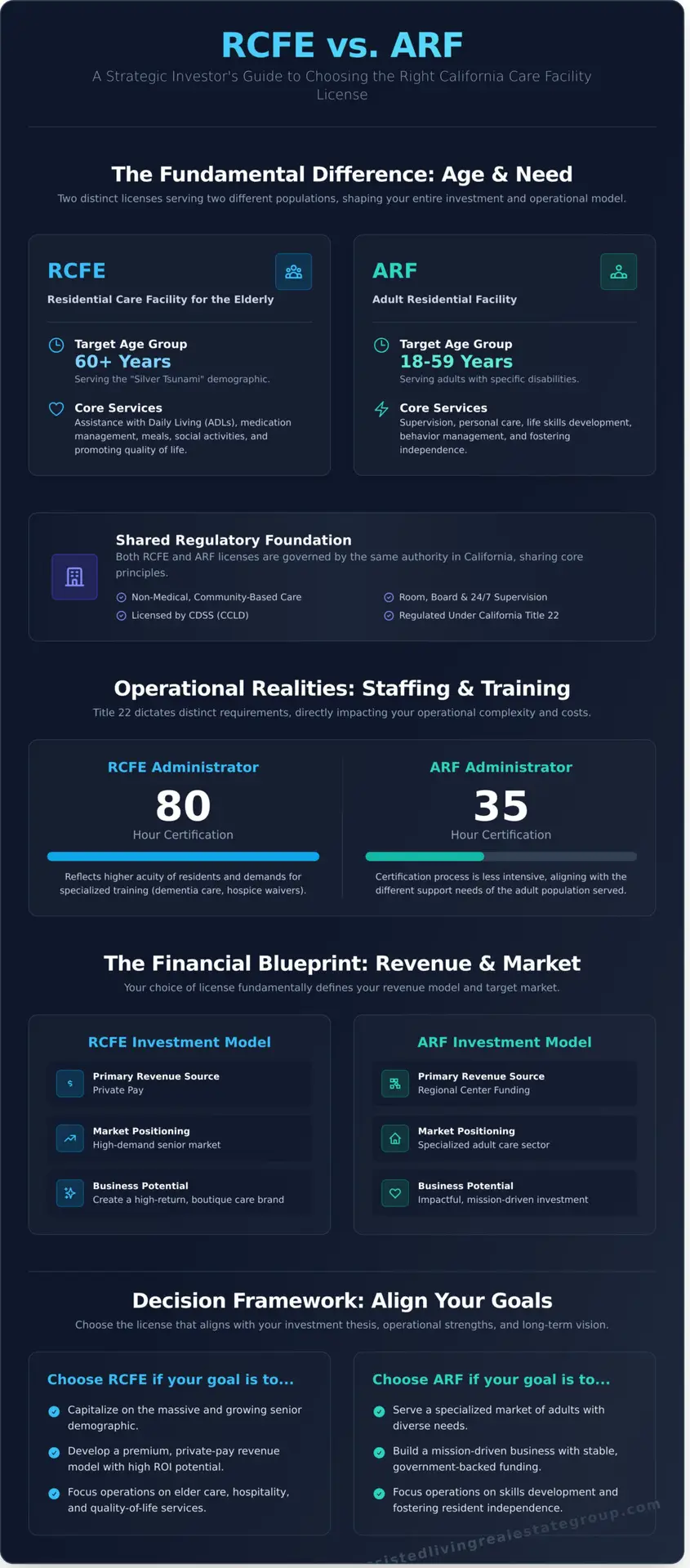
- A Residential Care Facility for the Elderly (RCFE) is licensed to provide care and supervision for seniors aged 60 and over.
- An Adult Residential Facility (ARF) is licensed to serve a younger demographic of adults, typically aged 18 to 59, who have specific mental, developmental, or physical disabilities.
Though their target residents differ, both facility types operate on a shared foundation. They are non-medical, community-based homes providing essential room, board, and 24-hour supervision. They fall under the broader category of residential care, a concept often explained by the question What is Assisted Living, but their licensing and operational focus create two distinct investment pathways. In California, both are licensed and regulated by the same entity: the Community Care Licensing Division (CCLD) of the Department of Social Services (CDSS).
| Feature | RCFE (Residential Care Facility for the Elderly) | ARF (Adult Residential Facility) |
|---|---|---|
| Target Population | Seniors, aged 60 and over | Adults, aged 18-59, with specific disabilities |
| Core Services | Assistance with daily living (ADLs), medication management, meals, social activities | Supervision, personal care, skills development, behavior management |
| Licensing Body | California Department of Social Services (CDSS) | California Department of Social Services (CDSS) |
Who Lives in an RCFE?
The residents of an RCFE represent the “Silver Tsunami”-the rapidly expanding demographic of seniors seeking a supportive, non-institutional home. These individuals typically require assistance with Activities of Daily Living (ADLs) like medication reminders, meal preparation, mobility, and personal care. It’s vital for owners to understand that an RCFE is not a skilled nursing facility (SNF); it’s a boutique care environment focused on quality of life, not round-the-clock medical treatment.
Who Lives in an ARF?
An ARF serves a diverse population of adults who may have developmental disabilities, physical challenges, or mental health needs. The operational focus here shifts from elder care to fostering independence and life skills within a structured, supportive community. Care plans are highly individualized to empower residents and improve their quality of life. For an owner, this represents a different but equally rewarding mission-driven investment opportunity.
Operational Realities: A Look Inside California’s Title 22
For savvy investors, the difference between success and failure often lies in the operational details. In California, the playbook for both RCFEs and ARFs is written in the same language: the California Code of Regulations, Title 22. While both license types operate under this code, understanding their distinct chapters is crucial. The Community Care Licensing Division (CCLD) acts as the regulatory body, enforcing these rules. Mastering these operational mandates isn’t just about compliance; it’s about engineering a business model for maximum profitability and impact. The complete California’s Title 22 Regulations provide the definitive blueprint every serious owner must know.
Staffing and Training Requirements
Your team is your greatest asset, and Title 22 dictates its composition. The distinction in the RCFE vs ARF comparison starts at the top: an RCFE Administrator requires a rigorous 80-hour certification process, while an ARF Administrator certification is 35 hours. This reflects the higher acuity of RCFE residents. Staffing ratios aren’t a simple headcount; they are based on the specific needs of your residents. RCFEs often demand more robust staffing, especially those with memory care endorsements, which mandate specialized training in dementia care, hospice waivers, and medication management-creating a higher barrier to entry but also a premium service model.
Levels of Care and Prohibited Conditions
Your license directly defines your target market. RCFEs are licensed to serve seniors and can accommodate a wide spectrum of care needs, allowing residents to “age in place.” This model is built for non-medical, long-term care, including assistance with daily living activities and memory care. However, RCFEs have “prohibited health conditions” and cannot admit residents who require 24-hour skilled nursing. An ARF, serving adults with mental or developmental disabilities, has its own set of restrictions. When a resident’s needs escalate beyond what your license permits, you must have a clear, compassionate, and legally sound process for transitioning them to a higher level of care. This is a critical operational reality that protects both the resident and your investment.
The Financial Blueprint: Comparing RCFE and ARF Investment Models
Your choice between an RCFE and an ARF is more than a licensing decision; it’s a strategic move that defines your investment thesis. This is where you align your financial goals with your vision for community impact. The RCFE vs ARF debate boils down to two distinct market opportunities, each with a unique path to achieving our signature goal: generating both Impact and Income.
Market Demand and Revenue Streams
An RCFE allows you to tap into the massive, ever-expanding “Silver Tsunami.” This is a blue ocean opportunity driven by the senior demographic, with revenue primarily coming from private-pay clients and their families. This model offers significant upside potential, allowing you to create a boutique care experience that commands premium rates. Conversely, an ARF serves a consistent, recession-resistant need for adults with developmental disabilities. The revenue stream here is incredibly stable, often funded through predictable, long-term contracts with California’s Regional Centers. Your choice is between the high-growth potential of private-pay senior care and the reliable, government-backed income of specialized adult services.
Typical ROI and Valuation Factors
How your facility is valued depends directly on its license. An RCFE’s valuation is a powerful combination of its real estate value and the strength of its business operations (EBITDA). A well-run RCFE in a prime California market can see impressive cap rates and a strong ROI. An ARF’s value is often anchored in the consistency of its contracts and the real estate itself. For both models, three factors are paramount for driving valuation and ensuring a successful exit strategy:
- Location: Proximity to target demographics, hospitals, and community amenities.
- Occupancy & Reputation: A proven track record of high occupancy and positive community standing.
- Regulatory Compliance: Impeccable operational records and strict adherence to California’s Title 22 Regulations are non-negotiable and directly impact business value.
Ultimately, a higher valuation is the direct result of operational excellence, which translates into a legacy of quality care and a powerful return on investment.
Decision Framework: Which Facility Aligns with Your Goals?
The choice is more than a line item on a pro-forma. It’s a declaration of your mission. The RCFE vs ARF decision defines not only your financial trajectory but also the legacy you build. This framework is designed to move you from analysis to action, helping you align your capital with your core objectives. The right answer lies at the intersection of your personal mission and your financial model.
Use these questions as a strategic filter to clarify which path-serving our aging population or supporting adults with specific needs-is your “blue ocean” opportunity.
Questions for the Mission-Driven Investor
Your passion is a powerful asset. Answering these questions will reveal the operational model that best suits your vision for creating both Impact and Income.
- Which population do you feel called to serve? Are you driven to provide dignity and boutique care for the elderly in their golden years (RCFE), or to create a stable, supportive home for adults with developmental disabilities (ARF)?
- What kind of community impact do you want to make? Do you envision a high-touch, private-pay model that sets a new standard for senior living, or a facility that provides essential, government-supported stability for a vulnerable population?
- How hands-on do you plan to be? An RCFE often demands a high degree of involvement to maintain its premium service level, while an ARF, once stabilized with regional center contracts, can offer a more passive management experience.
Questions for the Financially-Focused Investor
A successful investment is built on a clear-eyed assessment of risk, reward, and market reality. Your financial goals will heavily influence the RCFE vs ARF calculation.
- Are you seeking stable cash flow or higher growth potential? ARFs, with their government-backed funding, typically offer predictable, recession-resistant income. RCFEs, particularly in the luxury market, present a higher ceiling for revenue growth and property appreciation.
- What is your risk tolerance? An ARF’s primary risk lies in changes to regional center funding policies. An RCFE is more exposed to market competition and economic downturns affecting private-pay clients.
- Does your target market have a clear need? In affluent Southern California regions like Newport Beach or La Jolla, demand for premium RCFEs is surging. In contrast, areas of the Inland Empire and San Fernando Valley show a deep, underserved need for quality ARF housing, creating a different but equally compelling opportunity.
Navigating these local nuances is where a strategic partner becomes invaluable. To find out which model is best suited for your target acquisition area, explore how we identify prime opportunities that align with your unique investor profile.
Navigating Your Acquisition with an Expert Partner
Understanding the operational and regulatory differences between an RCFE and an ARF is the critical first step. Now, it’s time to translate that knowledge into a tangible, high-performing asset. The transition from analysis to acquisition is where the real complexities arise, and navigating this landscape without a strategic guide is a significant risk. This is not a standard real estate transaction; it is the acquisition of a highly regulated business where mistakes can cost you your investment and your license.
The path to owning a licensed care facility is layered with unique challenges, from rigorous due diligence and CCLD licensing hurdles to the necessity of confidential marketing that protects the privacy and stability of current residents and staff. The debate of RCFE vs ARF is just the beginning; executing the purchase successfully requires a specialized skill set that a general commercial broker simply does not possess.
Why a Specialized Broker is Non-Negotiable
In this high-stakes market, a specialized broker is your greatest asset. They provide an indispensable roadmap through a complex industry, ensuring you not only find the right facility but also secure it on the best possible terms. Key advantages include:
- Regulatory Mastery: Deep, practical knowledge of Title 22 regulations and the Community Care Licensing Division (CCLD) process, protecting you from costly compliance missteps that can derail a transaction.
- Exclusive Access: A private network of qualified sellers and confidential, off-market listings, giving you access to premier “boutique” opportunities others will never see.
- Financial Acumen: Expertise in the unique valuation models for care facilities and connections to lenders who understand and specialize in financing them.
Your Next Steps to Facility Ownership
Transforming your vision of generating both impact and income into a reality is a methodical process. We’ve refined it into a clear, strategic path to guide you from ambition to ownership.
- Step 1: A Confidential Consultation. We begin by defining your specific investment goals, risk tolerance, and desired legacy to finalize your choice in the RCFE vs ARF model.
- Step 2: Access Curated Listings. Gain entry to our exclusive portfolio of vetted facilities that align with your chosen model and our high standards for ROI and quality of care.
- Step 3: Guided Support Through Closing. Our team provides expert, hands-on support through every phase-from offer and due diligence to the licensing transfer-ensuring a seamless transition.
The Silver Tsunami presents a blue ocean opportunity for savvy investors ready to act. Begin your confidential consultation with our expert team today.
Your Next Move: Turning Analysis into Action
Choosing between these two powerful investment models comes down to a clear understanding of your goals. An RCFE offers a pathway to providing higher-acuity care with potentially greater returns, while an ARF presents a focused opportunity to serve adults with specific needs under a different operational framework. Ultimately, the RCFE vs ARF decision is a strategic choice that defines your portfolio’s blend of impact and income, guided by the nuanced requirements of California’s Title 22.
Navigating this decision is the first step; executing it is what builds your legacy. With over 25 years of specialized experience, unmatched expertise in California’s Title 22 regulations, and a proven process for confidential marketing that ensures seamless transactions, The Assisted Living Real Estate Group is the strategic partner you need. We transform complexity into opportunity.
Take the definitive next step toward securing your future in this blue ocean market. View active RCFE and ARF listings in California.
Frequently Asked Questions: RCFE vs ARF
What is the main difference between an RCFE and an ARF in California?
The core difference is the resident population they are licensed to serve. A Residential Care Facility for the Elderly (RCFE) is designated for seniors aged 60 and older. In contrast, an Adult Residential Facility (ARF) serves adults aged 18-59, who may have developmental, mental, or physical disabilities. Understanding the RCFE vs ARF distinction is the first critical step for an investor aiming to capitalize on a specific demographic’s needs.
Is it more profitable to own an RCFE or an ARF?
Profitability hinges on market demand and operational excellence. While a well-run ARF can be successful, RCFEs are uniquely positioned to leverage the “Silver Tsunami”-the massive, growing demographic of aging baby boomers. This creates a powerful and sustained demand for high-quality, boutique senior care. For investors seeking both impact and income, the RCFE model often presents a clearer path to premium rates and long-term financial growth.
Can an RCFE be converted into an ARF, or vice versa?
Yes, but it is not a simple administrative change. Converting a facility requires submitting a brand-new license application to the state’s licensing agency. The property itself may need significant physical modifications to comply with the different Title 22 regulations governing the new resident population. This strategic pivot requires a complete overhaul of your business plan, staffing model, and marketing to attract the new target demographic successfully.
What California agency licenses RCFEs and ARFs?
Both facility types fall under the jurisdiction of the same state authority. In California, RCFEs and ARFs are licensed and overseen by the Department of Social Services (DSS), specifically through its Community Care Licensing Division (CCLD). While the agency is the same, the specific regulations, staffing requirements, and physical plant codes differ significantly between the two license types, making expert guidance essential for compliance and operational success.
Do I need a medical background to own an RCFE or ARF?
No, a medical degree is not a prerequisite for ownership. Your role as the investor is to own the real estate and the business entity, focusing on the strategic vision. The state requires that you hire a qualified and certified Administrator who is responsible for the day-to-day operations, resident care, and regulatory compliance. This structure allows you to build a legacy in care without being a healthcare practitioner yourself.
What is a ‘6-pack’ facility in the context of RCFEs?
A ‘6-pack’ is industry terminology for a Residential Assisted Living (RAL) home licensed for a maximum of six residents. This boutique model, often established in a converted single-family home, is the foundation of a high-impact, high-return investment. It rejects the institutional feel of larger facilities, allowing you to provide a premium, home-like environment that commands higher fees and delivers a superior quality of life for residents.
How does financing differ for buying an RCFE versus an ARF?
Financing for either facility is treated as a commercial business loan, not a standard residential mortgage. Lenders will scrutinize the business’s cash flow, operational history, and your detailed business plan. The process often involves leveraging SBA loan programs like the 7(a) or 504. While the loan products are similar for both, the underwriting will focus heavily on the specific market demand and revenue potential unique to either the senior or adult care model.