
A signed RCFE purchase contract doesn’t always mean the buyer must close: RCFE purchase contract contingencies can provide a way to respond when agreed conditions aren’t met. In California, contingencies under the standard agreement don’t automatically disappear when a deadline passes; the buyer must affirmatively remove them. If a seller issues a Notice to Buyer to Perform, the buyer typically has about 48 hours to act before the seller may cancel the agreement.
That distinction matters in an RCFE acquisition, where the property, business operations, financing, staffing, compliance records, and licensing all affect the decision to proceed. A license contingency deserves particular attention because it can make closing conditional on the buyer obtaining the required license.
This article explains what may happen when a contingency is not satisfied and how contract wording and deadlines shape the available choices. It also explains how clear conditions for property and business due diligence help buyers assess an opportunity before committing to operate a California care facility.
Key Takeaways
- Align financing conditions with the terms the acquisition actually requires, and make timely access to financial, compliance, and staffing records part of due diligence.
- Use the property investigation period to assess whether the building’s condition and intended use support the RCFE business, then determine how inspection findings affect your decision.
- Address the buyer’s licensing condition explicitly so the contract accounts for what happens if approval is not in place by the planned closing.
- Evaluate local zoning and land-use approvals alongside the property and business terms, since they can affect whether the facility can operate as intended.
Financial, compliance, and staffing due diligence
In a California RCFE transaction, financing approval and access to reliable business records affect whether the buyer can proceed. Contract clauses should link loan terms to timely seller disclosures and a clearly defined review period.
Financing Contingency
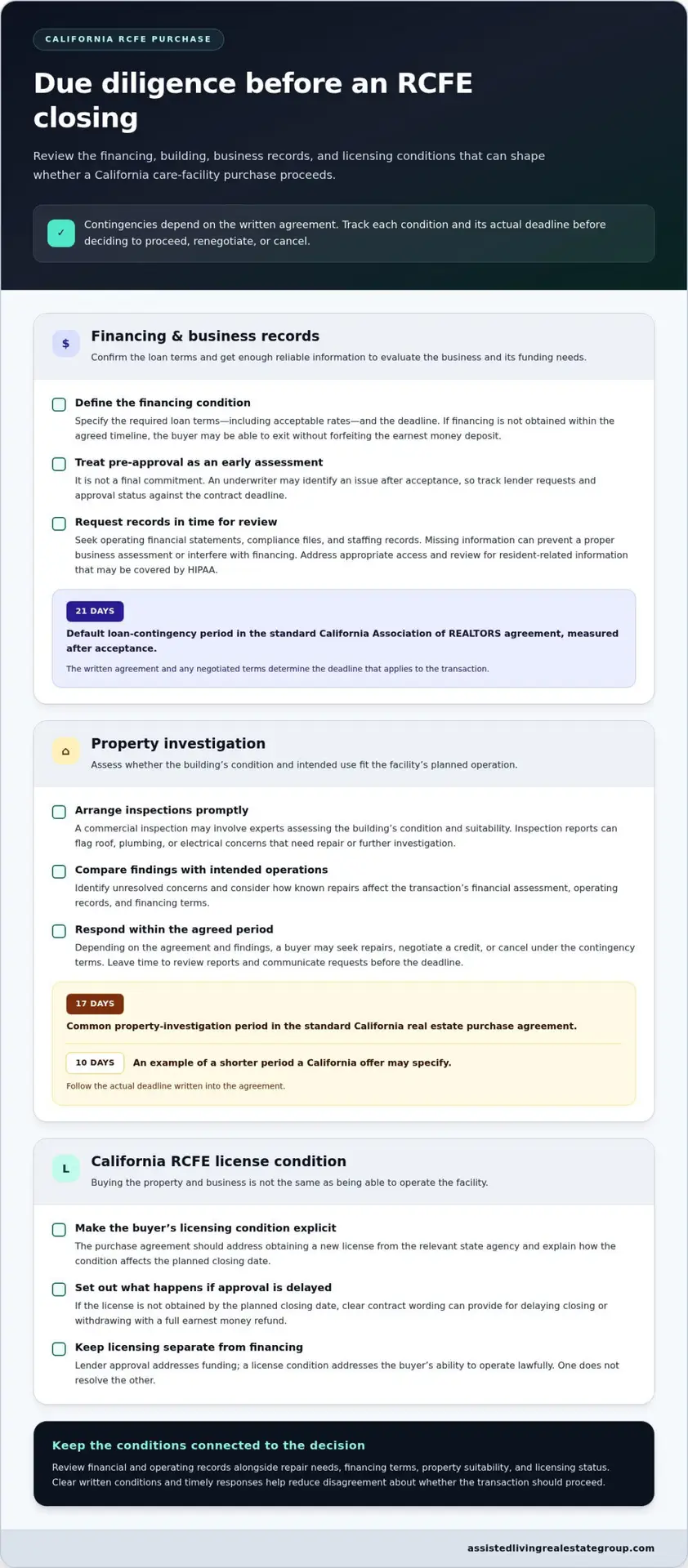
A financing contingency makes the purchase conditional on obtaining the agreed loan, protecting a buyer if financing falls through within the contract timeline. The standard California Association of REALTORS agreement sets a default loan contingency period of 21 days after acceptance. A commercial clause can identify required financing terms, including acceptable rates, rather than leaving the buyer bound to an unreasonable mortgage offer. If financing isn’t obtained within the agreed timeline, the buyer may exit without forfeiting the earnest money deposit.
Loan Approval
Loan approval is the lender’s decision to fund the mortgage after reviewing the buyer and transaction. Pre-approval is an early assessment, not a final commitment: an underwriter may identify an issue after the offer is accepted. Spell out the financing terms and deadline in the contract, then track lender requests and approval status against them. Do not treat initial approval as proof that closing funds are secured.
Financing depends on more than the buyer’s application. A lender may assess the RCFE business, its financial records, and the transaction terms. If a loan is available only on terms the buyer cannot accept, a specific financing clause can define whether those terms satisfy the contingency. Without clear wording, buyer and seller may disagree about whether the condition has been met.
Require timely, complete delivery of financial, compliance, and staffing records. Request operating financial statements, compliance files, and staffing records for review during due diligence. If the seller withholds requested information, the buyer may be unable to evaluate the business or secure financing. Resident-related information may be covered by HIPAA, so contract terms should address appropriate access and review.
Also document known repairs and how they affect the transaction’s financial assessment. Compare repair needs with operating records and financing terms before deciding whether to proceed, renegotiate, or cancel under an available contingency. A missed deadline or removed contingency can change the buyer’s options, so track each written condition through closing.
Why Is the Property Investigation Contingency Important?
A property investigation contingency gives California buyers time to assess the building before closing. Inspection findings can help determine whether to proceed, negotiate repairs, or cancel under the agreement.
Property Inspection Contingency
This contingency makes the purchase conditional on the buyer’s inspection and review of the property. It matters because an RCFE building must suit the buyer’s intended use, not simply look acceptable during a viewing. A commercial inspection can involve experts who assess the building’s condition and suitability. If significant problems emerge, California buyers may request repairs, negotiate credits, or cancel within the agreed contingency terms.
Inspection Periods
An inspection period is the contractually agreed window for investigating the property and responding to findings. The standard California real estate purchase agreement commonly allows 17 days for property investigation. A California offer may instead specify a shorter negotiated period, such as ten days. Buyers should track the agreement’s actual deadline, schedule inspections promptly, and leave time to review reports before making a decision.
Home Inspections
A home inspection assesses the building’s condition and identifies issues that may require repair or further investigation. For example, a report may flag roof, plumbing, or electrical concerns. Buyers can use the findings to assess the property’s suitability and decide whether to seek repairs, request a credit, or cancel under the contingency. The real estate agent can coordinate access, while escrow keeps the transaction moving under the signed agreement.
Don’t treat inspection approval as a formality. Compare each report with the facility’s intended operation, identify unresolved concerns, and communicate any requests within the contingency period. That gives buyers a clearer basis for deciding whether the property is a sound opportunity or whether the contract’s cancellation option matters more. Buyers assessing a facility purchase can also review California RCFE acquisition opportunities in the context of the property findings.
Assisted living license contingency
A California RCFE purchase involves more than acquiring real estate and taking ownership of a business. The buyer’s ability to operate depends on licensing, so the purchase agreement should make the acquisition conditional on obtaining a new license from the relevant state agency. This links closing to the buyer’s ability to run the facility lawfully.
Set out the license condition in the written contract, including how it affects the planned closing date. If the license is not obtained by that date, the agreement can give the buyer the right to delay closing or withdraw and receive a full earnest money refund. Without clear wording, buyer and seller may disagree about whether the transaction should proceed while approval remains unresolved.
Keep this condition separate from a financing contingency. A lender’s approval addresses funding; a license contingency addresses whether the buyer can operate the RCFE. A buyer could secure financing and still face an obstacle if licensing approval has not arrived. Treating the conditions separately clarifies which unmet requirement affects the purchase and what the contract permits next.
The license contingency also needs to match the intended operating plan. For example, if the buyer plans to take over an existing facility, the agreement should make clear that the buyer’s own licensing approval is part of the transaction, rather than assuming the seller’s status automatically covers new ownership. An assisted living business cannot legally operate without a license.
Do not rely on an informal promise to bridge a licensing gap. Temporary operation under a seller’s license may be allowed in some states with the seller’s permission, but buyers should not assume that applies to a California purchase. The contract should state the parties’ plan and the consequences if the buyer’s license is not ready. A defined delay or exit right helps protect the buyer from closing on an operation they cannot lawfully run.
The practical takeaway is straightforward: make licensing a written condition of closing, tie it to the buyer’s planned operating timeline, and spell out what happens to earnest money if approval is delayed. This keeps the purchase decision grounded in both property ownership and operational readiness.
What RCFE purchase contract contingencies are specific to California counties or local zoning rules?
In Southern California, an RCFE buyer should make the intended facility use central to local land-use review. A purchase agreement can condition closing on receiving the zoning or land-use approvals needed for that use. Buying a building does not, by itself, establish that its location supports the buyer’s proposed operation. The contract should connect the approval condition to the specific property and planned use.
Write the approval condition in practical terms. Identify the land-use approvals needed, set a deadline for resolving them, and state what happens if an approval is denied or remains pending. For example, the agreement might allow the parties to extend the closing date or let the buyer withdraw if a required approval is not obtained. Clear language defines how an unresolved local condition affects the transaction.
Keep local-use review separate from the building inspection. An inspection considers physical condition; a zoning contingency considers whether the intended RCFE use can proceed at the site. A property may appear suitable during a walkthrough, yet the buyer may still need local approval for the planned operation. Separate contract conditions clarify which concern remains unresolved and what decision follows.
Review title materials for recorded restrictions that could affect the intended use or planned property changes. For example, a recorded covenant may limit alterations the buyer expects to make. The purchase agreement can provide time to review title information and explain how a relevant restriction affects the buyer’s obligation to close. This links the property’s ownership record to its planned operation.
Keep the decision grounded in written terms rather than assumptions about a county or neighborhood. Consider the intended use, required land-use approvals, title materials, and any relevant restrictions together. If a local approval is essential, make receiving it an express closing condition. Explore California RCFE acquisition opportunities with local land-use considerations in view.
Assisted Living Real Estate Group: RCFE Sales (Residential Care Facilities for the Elderly)
Assisted Living Real Estate Group helps buyers and sellers navigate California RCFE sales, including the business and property considerations behind an acquisition. When licensing, financing, or local-use conditions affect your purchase decision, its specialized focus can help you assess an RCFE opportunity as a complete business transaction.
For buyers seeking an operating facility, Turnkey Business Acquisitions may suit the goal of acquiring an established care business alongside the real estate transaction. Sellers can use the Confidential Marketing Strategy to protect business privacy while pursuing a sale. The right path depends on whether you are buying, selling, or evaluating an acquisition that combines operational and property considerations.
Explore your California RCFE transaction with Assisted Living Real Estate Group. Visit assistedlivingrealestategroup.com to start a conversation.
Move Forward With a Clear Acquisition Strategy
Your next step is to turn the purchase decision into a coordinated plan. Before committing, map each contract condition to the decision it protects, the information needed to resolve it, and the action required if it remains unmet. This keeps the transaction focused on whether the facility fits your operational goals, not simply whether the property can change hands.
Use RCFE purchase contract contingencies as part of a broader acquisition strategy. Align your review of the business, site, and operating requirements so deadlines and decisions work together. A well-considered purchase can support both a sustainable investment and a meaningful role in California’s senior care community.
For guidance on a California facility acquisition, contact Assisted Living Real Estate Group to discuss your next step. Approach the opportunity with clarity, purpose, and confidence.
Frequently Asked Questions
What happens when a contingency isn’t met?
If a condition isn’t met, the written contract determines whether the buyer can cancel, renegotiate, or must continue. In California, standard agreement contingencies don’t lapse automatically; the buyer must affirmatively remove them. If a deadline passes without removal, the seller generally must first issue a Notice to Buyer to Perform. That notice typically gives the buyer about 48 hours to act before the seller may cancel. Keep notice dates and written responses together because the response window can affect the right to proceed or exit.
How Does California Law Handle the Earnest Money Deposit?
Earnest money is generally placed with neutral third-party escrow when escrow opens, rather than paid directly to the seller. A valid contingency may allow a buyer to recover the deposit after cancellation. For an owner-occupied California residence of one to four units, California Civil Code Section 1675 caps breach liquidated damages at 3% of the purchase price. The California Legislature says deposits above 3% are generally presumed invalid unless the seller proves otherwise. That cap isn’t a blanket rule for an RCFE business acquisition.
How Long Does the Loan Contingency Last in California?
Under the standard California Association of REALTORS agreement, the default loan contingency period is 21 days after acceptance. The signed contract controls if the parties negotiate a different period. Use that window to submit lender-requested materials, review final loan terms, and address underwriting conditions before the deadline. Pre-approval alone doesn’t settle underwriting, so calendar lender requests alongside contract dates and respond promptly if approval remains unresolved.
What Does the Appraisal Contingency Protect Against?
An appraisal contingency protects the buyer if the lender’s valuation falls below the contract price and affects financing. The buyer may seek a price renegotiation, pay the gap in cash, or withdraw if the agreement allows. In a standard California real estate purchase agreement, this contingency often runs about 17 days. The signed terms determine the deadline and available response.
Why Must You Review the Title Contingency Carefully?
Review the title contingency carefully because a preliminary title report can reveal claims that affect ownership or property use. In California, buyers typically have 17 days to object to conditions in that report. For an RCFE site, review recorded easements, liens, encumbrances, and disputes alongside the intended use. If an issue can’t be resolved, the written contingency may provide an exit path before closing.
What is an RCFE purchase contract and what contingencies are commonly included?
An RCFE purchase contract is the written agreement for acquiring a residential care facility and setting related business terms. RCFE purchase contract contingencies commonly address financing, property investigation, title review, licensing, and local land-use approval. For example, a buyer may condition closing on reviewing the building and securing approval for the intended RCFE use, rather than treating the real estate alone as the acquisition.