
Fire clearance is a condition of admission, not a detail to leave until later. Facilities planning to admit older adults should check fire-clearance requirements before accepting residents. California’s RCFE fire clearance requirements also call for facilities to secure and maintain approved clearance.
That approval is only part of the picture. If a facility uses a secured perimeter, additional fire-clearance requirements apply to California Adult Residential Facilities and Group Homes. Understanding which requirements govern the setting is essential. This guide explains when clearance is needed, how it is obtained and maintained, and what secured-perimeter rules mean in practice. It also shows how fire-safety responsibilities relate to operating or acquiring a care facility, so you can plan with resident safety and regulatory readiness in mind.
Key Takeaways
- Plan fire-clearance steps before changing whom the facility admits, since resident needs can affect the approval required.
- Understand how the licensing agency and local fire authority fit into securing and maintaining clearance.
- Identify the additional fire-safety considerations that apply when an adult residential facility or group home uses a secured perimeter.
- See how California regulations shape operational readiness, and when a facility acquisition or sale may be the next strategic step.
1. Clearance before admitting adults age 65 and older
A facility may need to notify its licensing agency before accepting certain prospective residents so that appropriate fire clearance can be obtained. The agency can then obtain the appropriate fire clearance for those prospective residents. For an operator, the sequence matters: notification and clearance come before admission, not after a resident moves in. Buyers should account for this step when assessing a facility’s intended population and transition plans.
Age is an important trigger, but it is not the only admission consideration. A proposed resident’s mobility and the facility’s existing clearance can also affect whether an admission fits the approved operating conditions. For example, a buyer planning to shift from serving younger adults to older adults should treat the required licensing notification as a pre-admission step. Including it in transition planning helps align resident intake with the clearance process.
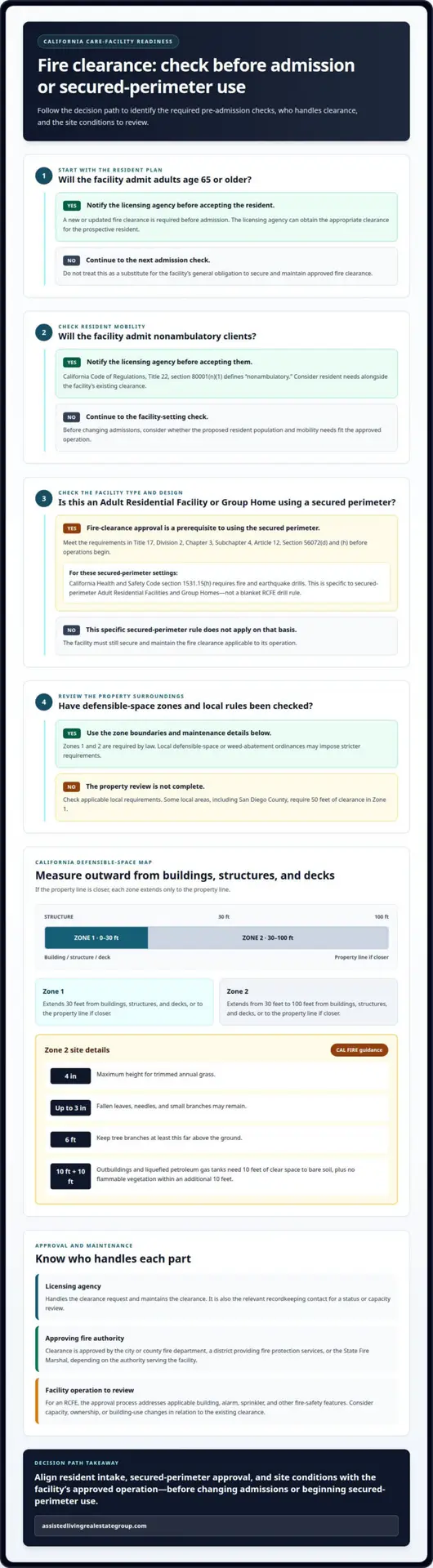
Fire readiness also involves the property’s surroundings. According to the California Department of Forestry and Fire Protection, Zone 2 defensible space extends from 30 feet to 100 feet from buildings, structures, and decks, or to the property line if it is closer. For a prospective buyer, this defines the area to consider when reviewing the site’s fire-prevention context. It does not replace the separate licensing-agency notification required before admitting older adults.
A practical sequence is to define the intended resident population, identify whether adults age 65 and older will be admitted, and notify the licensing agency before accepting them. Then incorporate the clearance process into the facility’s operational transition rather than treating it as a later administrative task. A property review can also distinguish admission-related requirements from defensible-space considerations, including the Zone 2 boundary. These steps give buyers a clearer view of what must be addressed before resident intake begins.
2. Fire clearance approval and maintenance
California community care facilities must secure and maintain fire clearance approved by a city or county fire department, a district providing fire protection services, or the State Fire Marshal. The licensing agency handles the clearance request and maintains it. For an RCFE, the applicable building, alarm, sprinkler, and other fire-safety features are addressed through the approval process; the approving fire authority grants clearance.
A new or updated clearance is specifically required before admitting adults age 65 and older, after notifying the licensing agency. Facilities planning to admit nonambulatory clients must also notify the agency before accepting them; California Code of Regulations, title 22, section 80001(n)(1) defines nonambulatory. Capacity, ownership, or building-use changes should be considered in relation to the facility’s clearance, rather than assumed to leave its approval unaffected.
For secured-perimeter Adult Residential Facilities and Group Homes, California Health and Safety Code section 1531.15(h) requires fire and earthquake drills. That requirement is specific to those settings; it should not be presented as a blanket RCFE drill rule. Emergency procedures and evacuation planning should reflect the facility’s approved operation and the fire authority’s clearance conditions.
If a facility lacks required clearance, it has not met the obligation to secure and maintain approval. The applicable correction or enforcement response depends on the licensing and fire authorities involved. California does not have one fee or processing time stated here; the request moves through the licensing agency and the approving fire authority. Local review is conducted by the city or county fire department, fire-protection district, or State Fire Marshal, depending on the authority serving the facility. For a status or capacity review, the licensing agency is the relevant recordkeeping contact. Buyers assessing an operation can include clearance status among the issues in California care-facility acquisition planning.
3. Secured-perimeter fire-clearance requirements
Before using secured perimeters, California Adult Residential Facilities and Group Homes must meet fire-clearance approval requirements in Title 17, Division 2, Chapter 3, Subchapter 4, Article 12, Section 56072(d) and (h). This requirement makes approval a prerequisite, not an adjustment to postpone until after operations begin. Buyers assessing a secured-perimeter setting should treat the clearance as part of operational readiness.
There is no universal clearance level for every resident capacity or evacuation need. The appropriate clearance must reflect the facility’s approved operation. Address changes to resident needs or planned capacity through the licensing agency’s clearance process before changing admissions.
Defensible-space Zones 1 and 2 are required by law. Zone 1 extends 30 feet from buildings, structures, and decks, or to the property line if closer. Zone 2 extends from 30 feet to 100 feet from those structures, or to the property line if closer. Local defensible-space or weed-abatement ordinances may impose stricter requirements, so a property’s location can affect its obligations.
In Zone 2, the California Department of Forestry and Fire Protection says annual grass should be trimmed to a maximum height of 4 inches. Up to 3 inches of fallen leaves, needles, and small branches may remain. Keep tree branches at least 6 feet above the ground. Outbuildings and liquefied petroleum gas tanks need 10 feet of clear space to bare soil, plus no flammable vegetation within an additional 10 feet.
These site conditions matter alongside the secured-perimeter clearance itself. For example, an approved fire-clearance arrangement does not remove the need to maintain required defensible space around buildings and structures. Some local areas, including San Diego County, require 50 feet of clearance in Zone 1. That difference illustrates why facility buyers must account for local rules when evaluating the land surrounding an RCFE, Adult Residential Facility, or Group Home. The property boundary can also limit the measured zone where it lies closer than the stated distance.
4. What California laws and regulations govern RCFE fire clearance requirements?
California’s fire-clearance framework connects the Health and Safety Code with the California Code of Regulations. Title 22, section 80020 is authorized by Health and Safety Code sections 1530 and 1531.15. It also references sections 1501, 1520, 1528, 1531, and 1531.15. These provisions establish the statutory and regulatory context for community care facility oversight. The RCFE fire clearance requirements California facilities must understand are shaped by this framework.
Section 80020 is a key regulation when evaluating fire clearance. Its history includes amendments and corrections over time, so buyers should focus on the current operative text rather than treating an older filing as the complete rule. Its connection to multiple Health and Safety Code sections also shows why clearance belongs within the facility’s broader licensing review. Buyers examining RCFE fire clearance requirements California law governs should distinguish the applicable provisions from a regulation’s amendment history.
Secured-perimeter rules add another layer. California Health and Safety Code section 1531.15(h) requires Adult Residential Facilities and Group Homes using secured perimeters to conduct fire and earthquake drills. This applies to those facility types and circumstances, not every RCFE. The specific secured-perimeter fire-clearance provisions appear in Title 17, Division 2, Chapter 3, Subchapter 4, Article 12, Section 56072(d) and (h).
These citations serve different purposes. Title 22, section 80020 anchors community care facility fire-clearance regulation, while section 1531.15(h) addresses drills for specified secured-perimeter settings. Section 56072(d) and (h) sets approval requirements before those settings use secured perimeters. Buyers can identify the facility type and planned perimeter arrangement, then map each requirement to its governing code provision. This keeps RCFE review distinct from rules specific to Adult Residential Facilities or Group Homes.
Operational fire-safety planning can also include vegetation management: trees in Zone 1 should be regularly trimmed to maintain a 10-foot gap from other trees. The amendment record for section 80020 includes the 1987 emergency amendment’s certificate, transmitted on 4-28-88 and filed on May 31, 1988. A subsection (b)(2) change without regulatory effect was filed on 6-8-90 and became operative on July 8, 1990; a lettering and cross-reference correction was filed on 5-18-91. For the February 9, 2017 order, the compliance certificate was transmitted to OAL on 8-3-2017 and filed on September 15, 2017.
Assisted Living Real Estate Group: RCFE Sales (Residential Care Facilities for the Elderly)
Assisted Living Real Estate Group helps buyers and sellers navigate California RCFE transactions. If fire-clearance findings affect your acquisition plans, include the facility’s operating requirements in the broader business decision, alongside its fit with your ownership strategy.
For buyers seeking an operating care business, Turnkey Business Acquisitions can connect the real estate and business sides of an opportunity. Sellers considering a transition can use a Confidential Marketing Strategy designed to protect the reputation and operations of the facility while connecting with qualified buyers. ARF Sales is also available for Adult Residential Facility transactions.
Discuss your California care-facility buying or selling goals with Assisted Living Real Estate Group.
Make fire readiness part of your ownership strategy
A care facility’s safety framework is more than an operational detail. It affects how you plan admissions, maintain continuity, and prepare for a change in ownership. Consider RCFE fire-clearance requirements in California early in your investment planning to keep resident welfare and business decisions aligned.
When assessing a purchase or preparing a facility for transition, consider how its operating model fits your goals and the responsibilities of ownership. A thoughtful plan connects the property, the business, and the standard of care the facility is intended to provide. This perspective supports informed decisions while keeping residents in focus.
If you’re weighing a California care-facility transaction, contact Assisted Living Real Estate Group to discuss your goals and potential next steps. A clear strategy can help you move forward with purpose and build a future where responsible investment and compassionate care advance together.
Frequently Asked Questions
How does an RCFE apply for fire clearance, and what are the steps and required documents?
An RCFE begins by notifying its licensing agency, which makes and maintains the fire-clearance request. The appropriate city or county fire department, fire-protection district, or State Fire Marshal approves the clearance. Provide the facility and proposed-operation details requested through the licensing agency’s process. Before admitting older adults or nonambulatory clients, make the required notification. Do not assume an existing clearance automatically covers a planned change.
What fire clearance level is required for California RCFE resident capacity and evacuation needs?
There is no universal clearance level for every resident capacity or evacuation need. Clearance must reflect the facility’s approved operation. Route changes to resident needs or planned capacity through the licensing agency before changing admissions.