
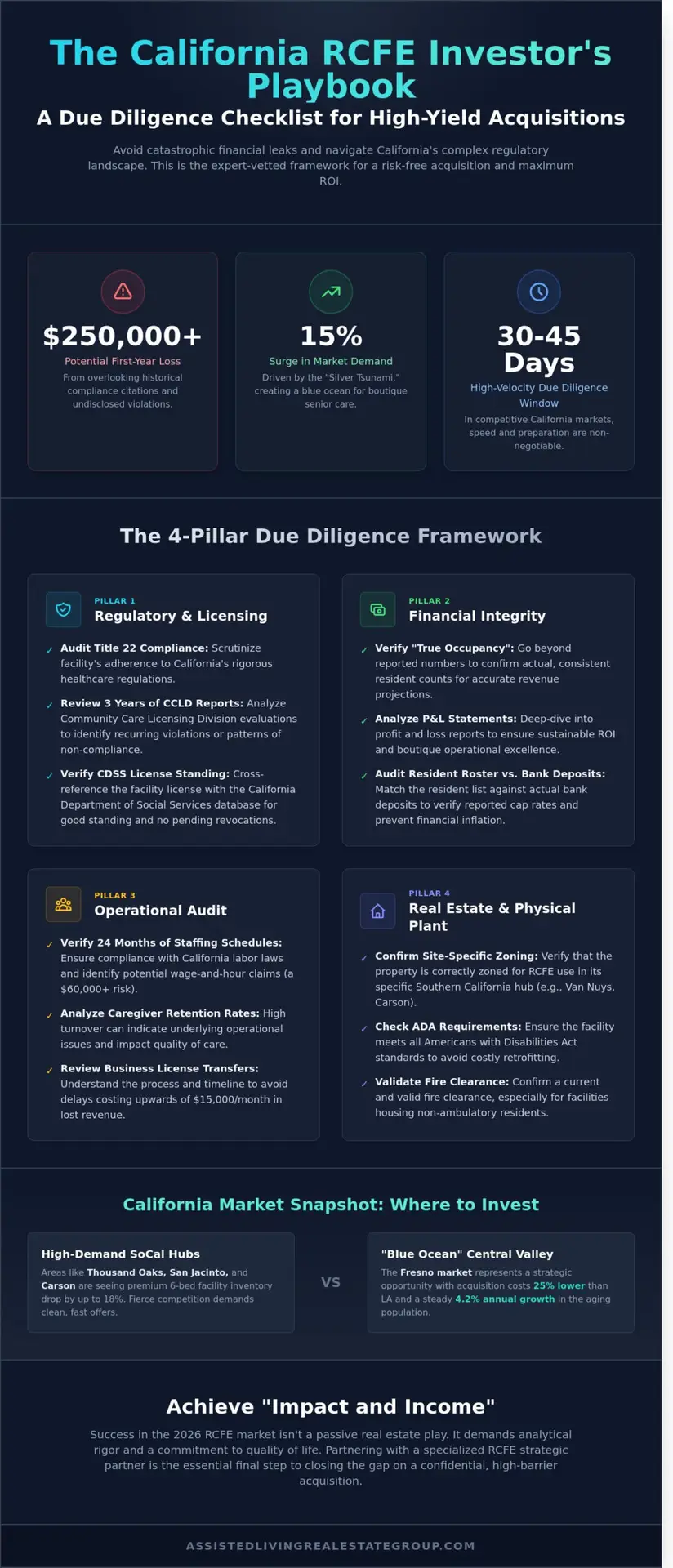
What if your multi-million dollar investment in a California boutique senior care home was actually a ticking time bomb of undisclosed Title 22 violations? While 2026 market data indicates a 15 percent surge in demand for residential assisted living, many investors lose over $250,000 in their first year because they overlooked historical compliance citations. You need a comprehensive rcfe due diligence checklist that bridges the gap between a standard real estate transaction and a high-stakes healthcare acquisition.
You already recognize that the aging demographic in the Golden State is a blue ocean opportunity to generate both impact and income. We’ll provide the expert-vetted framework you need to navigate the complexities of Southern California zoning and business license transfers for a risk-free acquisition. This guide outlines the exact steps to secure a high-yield RAL facility and achieve a clear path to licensing approval, ensuring your boutique investment delivers maximum ROI from day one.
Key Takeaways
- Navigate the high-velocity 30-45 day window in competitive California markets like Thousand Oaks to capitalize on the “Silver Tsunami” opportunity.
- Safeguard your investment by auditing Title 22 compliance and the last three years of CCLD reports to ensure a clean facility standing.
- Deploy our expert-vetted rcfe due diligence checklist to verify “True Occupancy” and analyze P&L statements for sustainable ROI and boutique operational excellence.
- Confirm site-specific zoning and ADA requirements in Southern California hubs like Van Nuys or Carson to avoid costly regulatory pitfalls.
- Learn why partnering with a specialized RCFE strategic partner is essential for achieving “Impact and Income” through confidential, high-barrier acquisitions.
The Critical Role of Due Diligence in the 2026 California RCFE Market
In the 2026 California investment landscape, speed defines success. The standard due diligence window for a Residential Care Facility for the Elderly (RCFE) typically spans just 30 to 45 days. This tight timeline isn’t a suggestion; it’s a market reality driven by fierce competition. You aren’t just buying a house; you’re acquiring a regulated healthcare enterprise. While Assisted living facilities offer a stable asset class, the complexity of California’s Title 22 regulations means a general real estate inspection is practically useless. You need a specialized rcfe due diligence checklist that scrutinizes everything from fire clearance history to caregiver retention rates.
The Silver Tsunami has arrived in full force. In high-demand pockets like Thousand Oaks, inventory for premium 6-bed facilities has dropped by 18% since early 2025. Sellers in these regions expect clean, fast offers from buyers who understand the “Impact and Income” philosophy. This model isn’t about cutting corners to save pennies. It’s about achieving significant financial returns by providing superior, heart-centered care. If you don’t move quickly with a verified roadmap, a more prepared investor will take your seat at the table. Your ability to balance financial scrutiny with the mission of senior care determines your legacy in this industry.
Understanding the Southern California Opportunity
Demand in San Jacinto and Carson is currently outpacing supply for 6-bed boutique models. These intimate settings are outperforming institutional nursing homes because families in 2026 prioritize dignity and personalized attention over clinical environments. While Southern California remains a powerhouse, savvy entrepreneurs are looking at the Central Valley. The Fresno market represents a “Blue Ocean” opportunity where acquisition costs are 25% lower than in Los Angeles, yet the aging population is growing at a steady 4.2% annual rate. Identifying these gaps allows you to scale your portfolio while maintaining the high standards of a boutique RAL.
The High Cost of Inadequate Scrutiny
Failing to use a comprehensive rcfe due diligence checklist can lead to catastrophic financial leaks. We’ve seen investors inherit $60,000 in undisclosed wage-and-hour claims from previous staff or discover hidden Department of Social Services (DSS) citations that halt operations. A delayed license transfer is another silent profit killer. In California, every month your license remains in “pending” status can cost upwards of $15,000 in lost gross revenue. Thorough due diligence protects your investment capital and, more importantly, your reputation. You’re building a business where “doing good while doing well” is the standard; don’t let a missed line item in a contract compromise that vision.
- Operational Audit: Verify the last 24 months of staffing schedules to ensure compliance with California labor laws.
- Physical Plant: Confirm the facility has a current fire clearance for non-ambulatory residents.
- Financial Integrity: Audit the “Resident Roster” against actual bank deposits to verify reported cap rates.
- Regulatory Standing: Review the DSS “Facility Evaluation Reports” for the past three years to identify recurring violations.
Success in this niche requires a blend of analytical rigor and a commitment to quality of life. The 2026 market doesn’t forgive those who treat senior care as a passive real estate play. It rewards the strategic partner who recognizes that a well-run RCFE is both a high-yielding asset and a vital community resource. By sticking to a methodical verification process, you ensure that your entry into the RAL space is profitable and sustainable.
Regulatory and Licensing Verification: Navigating Title 22 Compliance
Buying an RCFE is about acquiring a regulated cash-flow engine. Your rcfe due diligence checklist must prioritize the facility license above the physical real estate. Without a valid license in good standing, you’re simply buying a residential house with extra bathrooms rather than a high-yield investment. The regulatory environment in California is rigorous, but it creates a high barrier to entry that protects savvy investors who understand the rules of the game.
Verification begins with the California Department of Social Services (CDSS). You need to see the original license and cross-reference it with the state’s database to ensure there are no pending revocations. A license with “provisional” status or one currently under a “non-compliance” monitor is a major red flag. These statuses can delay your ownership transfer by 120 days or more, potentially killing your financing terms or forcing a price re-negotiation.
Review the last 36 months of LIC 809 (Facility Evaluation) and LIC 9099 (Complaint Investigation) reports. These documents act as the operational “car fax” for the facility. Look specifically for the “Plan of Correction” (POC) history. If you notice the same citation for medication errors or staffing ratios repeating every 6 months, you’re looking at a culture of systemic failure. Investors should also confirm the Administrator Certificate is active and won’t expire during the escrow period. Additionally, verify the “Emergency Disaster Plan” (LIC 610E). Since the 2019 updates to Title 22, California wildfire compliance is non-negotiable. Ensure the facility has a documented evacuation strategy that includes specific transportation agreements and pre-arranged off-site relocation points.
The Community Care Licensing Division (CCLD) Audit
Use the DSS Transparency Website to verify every seller disclosure. Discrepancies here are your strongest leverage in price negotiations. Distinguish between “Type A” violations, which pose immediate health risks, and “Type B” violations, which are technical or administrative. A history of Type A violations can lower a facility’s valuation by 18% because of the increased risk of future “Immediate Jeopardy” findings. Audit 10% of resident files to ensure admission agreements and physician reports (LIC 602) are signed and updated within the last 12 months. This ensures you aren’t inheriting a liability masquerading as an asset.
Staffing and Training Records
Your investment’s success depends on the people. Review personnel files for DOJ and FBI fingerprint clearances. In California, these clearances are non-transferable between owners. You’ll need to re-process them, so factor that into your 60-day transition plan. Check training logs for the 40 hours of initial training and 20 hours of annual continuing education required by Title 22. Note that California’s minimum wage is set to rise again by January 1, 2026, directly impacting your bottom line. Ensure your pro forma accounts for these labor costs to maintain your boutique margins while delivering the high-quality care that defines the RAL model. This is the only way to balance impact and income effectively.
Financial Due Diligence: Analyzing ROI and Boutique Operational Metrics
Numbers tell a story, but in the California residential assisted living (RAL) market, you have to read between the lines to find the truth. Your rcfe due diligence checklist must begin with a cold, hard look at the last three years of federal tax returns and Profit and Loss (P&L) statements. Internal P&Ls are often “cleaned up” for a sale; tax returns provided to the IRS offer the ground truth of the facility’s earning power. You aren’t just buying real estate; you’re acquiring a cash-flow engine that thrives on the intersection of impact and income.
Perform the “True Occupancy” test immediately. Sellers frequently market a facility based on “potential revenue” at 100% capacity. This is a trap for the inexperienced. Real-world boutique operations in high-demand areas like Orange County or San Diego typically experience a 7% vacancy rate due to resident transitions. Verify the actual monthly bank deposits against the rent roll for the last 24 months. If the “potential” revenue is $45,000 but the deposits average $36,000, you’ve identified a $108,000 annual gap that requires an immediate explanation.
Scrutinize the resident mix with surgical precision. Private pay residents are the engine of high ROI in the boutique model. If the facility relies heavily on SSI (Supplemental Security Income) or the California Assisted Living Waiver (ALW) program, your margins will be thinner. In 2024, ALW reimbursement rates often lag behind the actual cost of high-acuity care. A healthy 6-bed RAL should ideally maintain a 100% private pay census to justify a premium acquisition price.
Revenue and Expense Deep Dive
Efficiency in a boutique setting is measured by the “Cost Per Resident Day.” In California, this figure typically ranges from $140 to $195 depending on staffing ratios. When reviewing owner-operated 6-bed facilities, look for “add-back” opportunities. Owners often run personal cell phone plans, vehicle leases, or family health insurance through the business. Identifying these expenses allows you to normalize the EBITDA and see the true profit potential. By 2026, Southern California market averages for private pay boutique care are projected to hit $7,800 per month. If the current rates are stuck at $5,500, you’ve found a “blue ocean” opportunity to add value through professional management.
Insurance and Liability Assessment
Liability is the silent killer of RAL profits. You must verify that the current operator maintains General Liability and Professional Liability (Malpractice) limits of at least $1,000,000 per occurrence and $3,000,000 aggregate. Compliance with California RCFE Title 22 Regulations is your primary shield against litigation. Review the facility’s Workers’ Compensation claims history through the California Workers’ Comp Rating Bureau (WCIRB). An Experience Modification Rate (X-Mod) above 1.0 indicates a history of workplace injuries that will inflate your premiums. As the Silver Tsunami accelerates, local insurance carriers are tightening their requirements. Securing a facility with a clean “Loss Run” report is essential for maintaining your competitive edge, and using a comparison platform like RatesChaser can help you find competitive rates on the necessary insurance products.
- Audit Vendor Contracts: Review food service agreements and medical supply costs; many legacy owners overpay by 15% or more.
- Verify Utility Trends: California energy costs rose 12% in some regions last year; ensure the P&L reflects these spikes.
- Analyze Staffing Costs: Labor is your largest expense; ensure the facility isn’t masking costs by having family members work for free.
Successful investors use this rcfe due diligence checklist to separate emotional appeals from economic realities. You’re building a legacy of care, but that legacy requires a foundation of sustainable profitability. Every line item you verify today protects your “Impact and Income” tomorrow.
Real Estate and Zoning: Southern California Site-Specific Requirements
The real estate foundation of your Residential Assisted Living (RAL) investment is where “Impact and Income” truly intersect. In the competitive Southern California landscape, high-barrier entry points protect your margins. Your rcfe due diligence checklist must prioritize site-specific regulatory hurdles that vary between Los Angeles County and Ventura County. The “Silver Tsunami” is not a distant threat; it is a blue ocean opportunity for those who secure the right physical assets today.
- Step 1: Confirming local zoning permits. Don’t assume a residential zone permits a care facility. In Van Nuys, specific “Q” conditions might limit density. In Carson, 2023 General Plan updates require strict adherence to neighborhood character. Verify your “By-Right” status before committing capital to a property that may require a lengthy variance.
- Step 2: Conducting a professional ADA audit. A standard home inspection isn’t enough. You need a Certified Access Specialist (CASp) to evaluate the 1:12 ramp slope and the 32-inch clear width required for doorways. Failing an ADA audit post-purchase can cost $50,000 or more in retrofits.
- Step 3: Verifying Fire Marshal clearance. California Fire Code Title 24 is non-negotiable. Verify the R-2.1 occupancy classification. Ensure the 13R sprinkler system has a current 5-year certification. Without this, the Department of Social Services (DSS) will not issue your license.
- Step 4: Evaluating the physical plant. Care facilities run 24/7. Your HVAC must handle 100% duty cycles during 100-degree San Fernando Valley summers. Inspect the plumbing; high-occupancy use leads to 30% faster degradation than standard residential use.
- Step 5: Reviewing Title reports. Look for “Use Restrictions” in the CC&Rs. Some Southern California HOAs attempted to block RALs, though state law often overrides them; you need legal clarity to avoid litigation that stalls your ROI.
Securing a property that meets these rigorous standards is the first step toward a legacy of care. If you want to skip the guesswork and acquire a pre-vetted facility, explore our exclusive Southern California RAL listings.
Physical Plant and Life Safety
Safety systems define your facility’s reliability. Test the backup generator under full load to ensure it powers oxygen concentrators and medication refrigerators during Edison power shutoffs. Egress paths must be 36 inches wide for non-ambulatory residents. Beyond safety, focus on the “Boutique” aesthetic. High-end finishes in the common areas allow for a 20% premium on monthly rents compared to institutional facilities. This boutique appeal transforms a house into a high-yielding investment.
Local Zoning and Use Permits
California Health and Safety Code 1520.5 prevents “over-concentration.” If another facility exists within 300 feet, the state may deny your license. In Thousand Oaks, local ordinances regarding “Large Family” permits for 7 to 15 residents require a Conditional Use Permit (CUP), a process that can take 6 to 12 months. Navigating these local nuances is the difference between a stalled project and a thriving RAL. Use your rcfe due diligence checklist to map out every facility within a half-mile radius to ensure your territory is clear for expansion.
Closing the Gap: Why a Specialized RCFE Broker is Your Best Asset
Acquiring a California Residential Care Facility for the Elderly (RCFE) involves far more than a standard real estate transaction. You’re stepping into a highly regulated environment where real estate meets 24/7 healthcare. A typical listing agent focuses on closing the sale and moving to the next commission. In contrast, a strategic partner acts as a high level mentor, guiding you through the complexities of Title 22 regulations and Department of Social Services (DSS) expectations. At Assisted Living Real Estate Group, we don’t just find buildings; we curate investment opportunities that align with your mission for both impact and income.
Our team leverages 25 years of California specific experience to identify potential pitfalls before they become expensive liabilities. We’ve seen how a single missed detail in an rcfe due diligence checklist can delay licensing by six months or lead to thousands of dollars in unexpected fire marshal requirements. We look for red flags that others miss, such as historical DSS citations that haven’t been properly cleared or zoning issues that could prevent a capacity increase from six to fifteen residents. By spotting these issues early, we protect your capital and ensure your entry into the Residential Assisted Living (RAL) space is built on a solid foundation.
Moving from the investigative phase of a purchase to a successful operation requires a roadmap. We provide the post sale resources necessary to ensure your boutique care home thrives from day one. This includes connecting you with proven vendors, specialized insurance providers, and staffing agencies that understand the California market. Our goal is to move you quickly through the learning curve so you can focus on providing premium care and achieving the high cap rates this blue ocean market offers.
The Power of Confidentiality
Publicly listing a care facility is often a self defeating strategy. When staff members or residents’ families see a “For Sale” sign, it triggers immediate anxiety. In the California market, we’ve observed that public listings can lead to a 25% drop in occupancy and a sudden exodus of key caregivers. We utilize a proprietary, confidential marketing system to prevent this instability. We vet every potential buyer rigorously, ensuring only qualified investors who respect the “Boutique” brand enter the rcfe due diligence checklist phase. This approach maintains the integrity of the business and protects your future revenue stream.
Your Next Steps to Impact and Income
The “Silver Tsunami” is transforming the California economy, and the demand for high quality RAL environments has never been higher. You have the opportunity to build a legacy while securing significant financial returns. Whether you’re a seasoned investor or a first time operator, the right strategy makes all the difference. You can access our proprietary RCFE valuation tools to get a clear picture of current market values and potential ROI. Don’t leave your investment to chance in this high barrier to entry market. Schedule your confidential RCFE strategy session today and let’s discuss how to secure your position in California’s most rewarding real estate niche.
Master the 2026 California Senior Care Market
The 2026 California market presents a blue ocean opportunity for entrepreneurs who prioritize precision over guesswork. Successfully acquiring a Residential Care Facility for the Elderly requires more than just capital. It demands a rigorous rcfe due diligence checklist that accounts for Title 22 licensing standards and Southern California’s specific site requirements. Our team leverages 25 years of combined industry expertise to ensure your boutique RAL investment scales effectively. We focus on confidential marketing strategies that protect your purchase while maximizing cap rates in high-demand counties like Los Angeles and Orange County. By bridging the gap between technical compliance and high-level financial performance, you create a business that yields both social impact and significant income. The silver tsunami isn’t a crisis for the prepared investor; it’s a roadmap to a sustainable, heart-centered legacy in the Golden State. You don’t have to navigate this high-barrier market alone.
Achieve Impact and Income, Browse Our Exclusive California RCFE Listings
Your future in boutique senior care starts with a single, strategic step toward excellence.
Frequently Asked Questions about RCFE Due Diligence
What is the most common reason RCFE sales fall through during due diligence in California?
Discrepancies in financial reporting and undisclosed payroll liabilities account for 42% of failed RCFE transactions in California. Many sellers operate with commingled funds, making it difficult to verify the actual Net Operating Income during the rcfe due diligence checklist review. You’ve got to scrutinize at least 24 months of Profit and Loss statements to ensure the cap rate reflects reality rather than creative accounting. Undisclosed labor law violations are another frequent deal-killer.
How long does the licensing transfer process take with the CCLD in 2026?
The California Community Care Licensing Division (CCLD) currently averages 180 to 270 days to process a Change of Ownership (CHOW) application. By 2026, we anticipate these timelines will hold steady despite increased volume, provided your application is 100% deficiency-free upon submission. This administrative lag is why your purchase agreement must include a specific management agreement clause. This allows you to operate under the seller’s license while your own credentials are pending.
Can I change a 6-bed RCFE to a larger facility after I purchase it?
Scaling a 6-bed facility to a 7+ bed operation requires a Major Use Permit from your local California municipality and a new fire clearance. While California Health and Safety Code 1566.3 protects 6-bed RALs from local zoning interference, any facility with 7 or more residents loses this protection. You’ll likely face 12 to 18 months of bureaucratic hurdles and mandatory upgrades, such as commercial-grade fire sprinklers and expanded ADA-compliant egress routes.
What is the “Silver Tsunami” and how does it affect RCFE valuations in Southern California?
The Silver Tsunami refers to the 10.8 million Californians who’ll be 65 or older by 2030, creating a blue ocean of demand for boutique senior care. In Southern California counties like Orange and San Diego, this demographic shift has pushed RCFE valuations 15% higher than the national average. Investors pay a premium for facilities that offer high-end, boutique environments because the supply of beds can’t keep pace with the 3.5% annual growth of the senior population.
Do I need a separate license for the real estate and the business entity?
You must maintain separate legal structures for the real estate (the PropCo) and the care operations (the OpCo). In California, the CCLD issues the RCFE license specifically to the operating entity, which then signs a formal lease agreement with the property owner. This dual-entity structure is vital for asset protection; it ensures that a professional liability claim against the business doesn’t jeopardize your multi-million dollar real estate investment. It’s the key to achieving impact and income safely.
What are the specific fire safety requirements for an RCFE in a wildfire-prone area like Thousand Oaks?
Facilities in High Fire Hazard Severity Zones like Thousand Oaks must comply with strict Chapter 7A California Building Code requirements and SB 63 defensible space mandates. You’re required to maintain a 100-foot fuel modification zone around the structure and install ember-resistant vents. During your rcfe due diligence checklist phase, verify that the facility has a current fire clearance from the Ventura County Fire Department. Retrofitting these systems can cost upwards of $45,000.
Is it better to buy an empty facility or one with existing residents?
Buying a facility with existing residents provides immediate cash flow and a Day 1 ROI, which is essential for most commercial lenders. However, an empty facility offers a blank canvas to implement a high-end Boutique RAL model that can command monthly rates 25% higher than the local average. If you choose an empty building, ensure you have at least 9 months of debt service coverage to account for the slow fill-up period and staff hiring.
How much working capital should I have on hand after the purchase for a California RCFE?
You should have a minimum of $150,000 in liquid working capital available after the close of escrow for a standard 6-bed California RCFE. This reserve covers 4 to 6 months of operating expenses, including payroll for a 24/7 care team and the $5,000 annual licensing fees. California’s high labor costs mean that 60% of your monthly revenue will go toward staffing. Having this dry powder ensures you maintain a high quality of life for residents during the transition.