
What if a busy California RCFE is worth less than its occupancy suggests? Strong demand matters, but a buyer will also look for dependable earnings, staffing continuity, sound operations, and a clear picture of what is included in the sale. An RCFE business valuation California owners can use for planning needs to be grounded in evidence, not a single headline number.
It’s understandable to be unsure which records matter most, whether licensing or compliance questions could affect a buyer’s review, and how to distinguish the property from the operating business. A valuation is an informed assessment, not a guaranteed sale price. Its usefulness depends on the information available, the scope of the review, and the assumptions applied.
This checklist explains the financial, operational, property, and California-specific factors that shape an RCFE valuation. You’ll learn how documented earnings, occupancy, staffing, licensing history, and real estate may inform a review, and which records to organize before speaking with a qualified professional. Whether you operate in Southern California or elsewhere in the state, a clear evidence base can help you prepare for a potential transaction.
Key Takeaways
- An RCFE business valuation California owners can use for planning depends on defining what’s being assessed: the operating business, the property, or both.
- Consistent financial records help clarify revenue, expenses, occupancy patterns, and owner compensation without relying on unsupported benchmarks.
- Income, asset, and comparable-transaction approaches offer different perspectives; the right context depends on the records and transaction scope.
- Organize financial, occupancy, staffing, property, and licensing documents to make a valuation review more focused and credible.
- Ask a California care-facility specialist about assumptions, evidence, scope, and confidentiality before deciding on next steps.
What Does an RCFE Business Valuation in California Actually Measure?
A valuation is an informed estimate based on available evidence and stated assumptions, not a guaranteed sale price. It can help an owner understand potential value and prepare for a transaction. The final price depends on the deal, due diligence, and what a buyer is willing to pay.
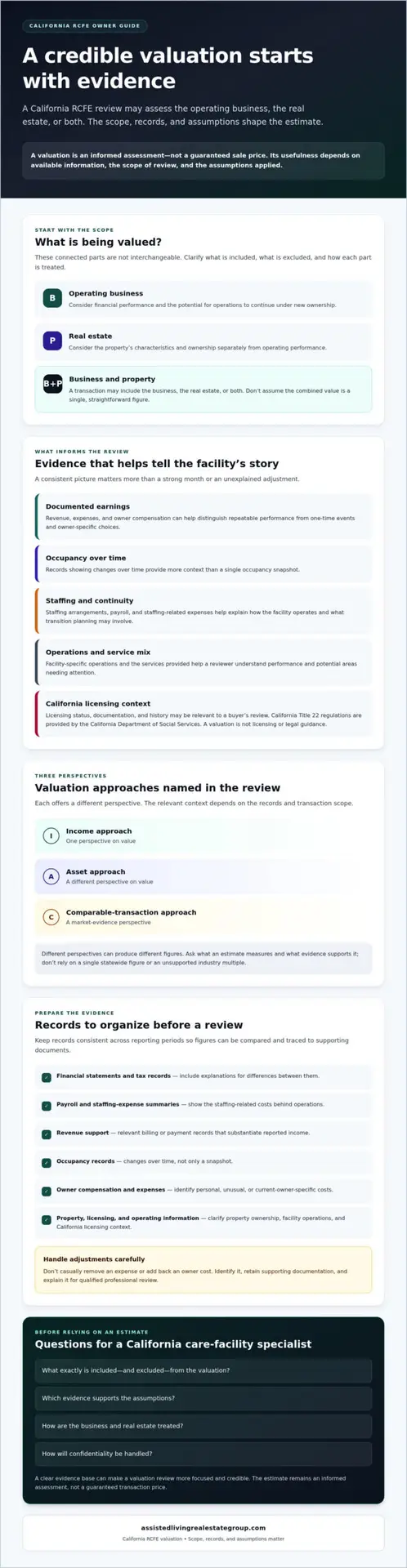
In California, an RCFE business valuation is an evidence-based assessment of an elderly care facility’s operating business, its real estate, or both, considered in the context of a potential transaction. These are related assets, but they aren’t interchangeable. A useful review spells out what’s included, what’s excluded, and which assumptions inform the estimate.
An owner may focus on years of work invested or the facility’s potential; a buyer may emphasize documented earnings, continuity, and risk; a broker’s estimate may reflect transaction experience and available market evidence. Different perspectives can produce different figures, so ask what each estimate measures and what supports it. California’s licensing framework is also part of the facility’s operating context. The California Department of Social Services provides its California Title 22 regulations for reference. A valuation is not a substitute for licensing or legal guidance.
Business value and real estate value are related, but not identical
The operating business is assessed through its financial performance and the potential for operations to continue under new ownership. The property is considered separately, with attention to its characteristics and ownership. Depending on the transaction, the sale may involve the business, the real estate, or both. Clarify the proposed scope and how each component is treated rather than assuming the facility’s combined value is a single, straightforward figure. If ownership or transaction boundaries are unclear, seek qualified professional review before relying on an estimate.
Why an RCFE needs a facility-specific valuation
An RCFE isn’t interchangeable with a generic residential property. Buyers may examine occupancy patterns, the service mix, staffing arrangements, and earnings supported by records. Together, these details help show how the facility performs, what may need attention, and what transition planning could involve.
California licensing status and documentation may also be relevant to a buyer’s review. A facility-specific assessment should consider the actual business, property, and transaction rather than rely on a single statewide figure or an unsupported industry multiple.
That distinction sets up the next step: identifying which financial and operating evidence can support a credible review.
Which Financial and California Operating Factors Can Influence RCFE Value?
A credible RCFE business valuation California buyers and owners can assess starts with records that tell a consistent story. Revenue, expenses, occupancy, staffing, and owner compensation help explain how the facility operates and whether its financial performance is supportable. A strong month on its own, or an unexplained adjustment, won’t show the full picture.
Documented, normalized operating results help valuation professionals distinguish a facility’s repeatable performance from one-time events and owner-specific choices. “Normalized” doesn’t mean changing figures to make results look stronger. It means identifying proposed adjustments, providing evidence, and letting a qualified professional assess whether they’re appropriate.
Financial records that help substantiate an RCFE valuation
Organize records consistently across reporting periods so a reviewer can compare performance and trace figures to supporting documents. Useful materials may include:
- Profit-and-loss statements and tax records, with explanations for differences between them.
- Payroll records and summaries of staffing-related expenses.
- Revenue documentation that supports reported income, such as relevant billing or payment records.
- Occupancy records showing changes over time, rather than only a snapshot.
- Details of owner compensation and expenses that may be personal, unusual, or specific to the current owner.
Don’t casually remove an expense or add back an owner cost because it seems nonrecurring. Identify it, retain supporting documentation, and explain the circumstances. Note material changes in revenue, expenses, or occupancy so a reviewer can understand what changed and why.
Operational and licensing factors buyers may examine
Financial statements need operating context. A buyer may review occupancy history, service mix, staffing stability, and how dependent day-to-day operations are on the current owner. For example, occupancy records can help distinguish a sustained pattern from a temporary fluctuation, while staffing information can clarify continuity and operating costs. These are review topics, not automatic formulas for changing value.
California licensing status and compliance documentation also warrant careful diligence. Gather relevant licensing records and correspondence for qualified review, and consult the California Department of Social Services’ California’s Title 22 Regulations as a starting point for regulatory reference. Verify current requirements with authoritative sources. A valuation review isn’t legal advice or a substitute for licensing guidance.
An unresolved compliance question is a diligence issue to investigate, not an automatic value deduction. Its significance depends on the facts, documentation, and potential operational impact. California-focused brokerage experience can help owners understand how business operations and property considerations meet in a transaction. For context on that transaction perspective, explore California RCFE sales guidance.
How Should Owners Compare Valuation Approaches and Separate Property From Business?
No single method answers every question. An RCFE business valuation California owners can use to inform planning should explain which valuation perspectives were considered, what evidence supports them, and whether the estimate covers the operating business, real estate, or both. The right approach depends on the available records, ownership structure, and potential transaction.
What different valuation perspectives can and cannot tell you
Each approach offers a different lens. None should be treated as conclusive without considering the facility’s specific facts and the quality of the evidence.
| Perspective | What it examines | Key limitation |
|---|---|---|
| Income-based | Supportable business earnings and assumptions about ongoing operations. | Results depend on reliable financial records and defensible assumptions about future performance. |
| Asset-based | Relevant business assets and liabilities. | It doesn’t, by itself, explain the earning capacity or continuity of the operating business. |
| Comparable transactions | Evidence from potentially similar California transactions. | Differences in property, operations, transaction scope, and evidence quality can make comparisons imperfect. |
A comparable sale is informative only when its details are sufficiently verified and relevant. A transaction involving a different facility size, operating profile, property arrangement, or sale structure may not be a sound direct comparison. Ask what is known about each comparison and which differences the analysis accounts for. If transaction details aren’t available or verifiable, treat the comparison cautiously.
How real estate and business value interact in a transaction
Start with ownership and scope. An owner may hold the property and operating business together, own the business while leasing the premises, or consider a transaction focused on the business alone. Each structure affects what a buyer is evaluating. For a leased facility, lease terms may shape operating costs and continuity; for an owned property, its condition and property-specific characteristics need separate consideration.
Keep the components clear. A property assessment and an operating-business analysis answer different questions, even when a transaction may involve both. Don’t simply add figures together unless the scope, assumptions, and treatment of shared costs are explained. Otherwise, the combined estimate could misstate what’s included or count an element twice.
When ownership, lease arrangements, property condition, or transaction boundaries are unclear, ask the relevant valuation, real estate, and financial professionals to review those details. A California care-facility specialist can help frame how the operating business and property relate in a transaction, while the appropriate professionals verify the assumptions and evidence behind each estimate.
What Should You Gather Before Requesting an RCFE Valuation?
A focused valuation discussion starts with clear scope and organized evidence. There isn’t one universal document package for every California RCFE: what’s relevant depends on whether you’re assessing the operating business, the property, or a possible transaction involving both. Use this sequence to prepare, then confirm with the valuation professional which records are useful for your situation.
A practical document checklist for California RCFE owners
First, state what you want reviewed and identify who owns the business and the property. Then collect available records in a consistent, easy-to-follow format:
- Financial: Profit-and-loss statements, tax records, payroll information, and documents supporting reported revenue. Flag unusual expenses, proposed adjustments, and material changes, with a written explanation and supporting records.
- Occupancy and operations: Occupancy history, staffing information, and a concise description of the services provided and any changes in operations.
- Property: Available ownership or lease documents, property records, and information about the facility’s condition. If the premises are leased, include the lease and note terms that may affect continuity or costs.
- California licensing and compliance: Relevant licensing materials, correspondence, and records related to known or pending questions. A qualified professional can help identify what needs further verification.
- Admission agreements: Review available agreements for consistency in described services, fees, and operational commitments. Direct questions about legal interpretation to California counsel.
Completeness matters, but clarity matters too. If figures differ across records or a significant change needs context, explain it in writing rather than leaving a reviewer to guess.
How to make the valuation discussion more useful
Prepare a brief written overview that states the requested scope, summarizes major operational changes, and identifies unusual expenses, known constraints, or pending issues. Note assumptions you’re making, such as whether the property is included or whether current operations are expected to continue. This helps the professional distinguish documented facts from items that still need verification.
Share sensitive financial, staffing, and facility information through a process that addresses confidentiality. Before providing records, clarify who will receive them, how they’ll be used, and what protections apply. An RCFE business valuation California review is easier to discuss when the scope, supporting documents, and open questions are organized from the start.
If you’re considering an RCFE transaction, discuss California RCFE sale planning with a brokerage that works with both facility operations and real estate.
How Can a California RCFE Owner Take the Next Step With Confidence?
A valuation becomes more useful when you understand its scope, evidence, and limitations. A specialist familiar with California care-facility transactions can help interpret how the RCFE’s operations, property arrangement, and potential transaction fit together. That perspective can inform planning, but it isn’t a substitute for legal, tax, accounting, or formal appraisal advice.
- Scope: Is the review focused on the operating business, the real estate, or a possible combined transaction?
- Evidence: Which financial, operational, property, and California transaction records will inform the discussion?
- Assumptions: How will adjustments, comparable evidence, and limitations be explained?
- Confidentiality: Who may receive sensitive facility information, how will it be handled, and what protections apply?
- Next steps: What additional review may be needed from an appraiser, accountant, tax professional, or California counsel?
These questions help distinguish preliminary brokerage or valuation guidance from a formal opinion prepared for a specific purpose. An RCFE business valuation California owners use to explore a potential sale should make its assumptions visible, rather than present an estimate as a guaranteed transaction price.
When a specialized California RCFE broker may help
RCFE transactions involve more than a property or a set of financial statements. A broker with care-facility transaction experience can help owners consider operating-business factors alongside real estate and transaction context. Assisted Living Real Estate Group represents California RCFE buyers and sellers and reports more than 25 years of combined care-facility industry experience. That background can provide relevant perspective as you organize questions and consider whether a transaction may make sense.
For owners exploring a sale, the company offers confidential marketing strategy. Ask directly how information would be handled and what the process involves; confidentiality shouldn’t be assumed to mean that disclosure is impossible in every circumstance.
If you’re ready to discuss your facility’s circumstances and potential transaction scope, contact Assisted Living Real Estate Group about a California RCFE sale. Bring questions about the business, property, evidence, and next steps. A clear conversation can help you decide which professional reviews are appropriate, without treating an early estimate as a promised sale outcome.
Prepare for Your Next RCFE Valuation Step
A credible RCFE business valuation California owners can use for planning starts with a clear scope: operating business, real estate, or both. It also depends on consistent records that explain earnings, occupancy, staffing, and the facility’s operating context. Treat the result as an informed estimate, not a guaranteed sale price, and ask how the evidence and assumptions support it.
Organizing financial, operational, property, and licensing materials can make the review more focused. So can identifying open questions and clarifying what professional input you may need before making transaction decisions. Each step brings greater clarity to a process where care operations and property value intersect.
Assisted Living Real Estate Group represents California RCFE and ARF transactions, considers both facility operations and real estate, and offers confidential marketing strategy for care-facility sellers. The company reports more than 25 years of combined care-facility industry experience. Discuss a confidential California RCFE valuation with our team and explore your next steps with a clearer view of the evidence and transaction scope. Careful preparation can help you move forward with purpose.
Frequently Asked Questions
How is an RCFE business valued in California?
An RCFE valuation considers evidence about the facility’s operations, finances, property, and potential transaction. A review may examine documented earnings, occupancy, expenses, staffing, property interests, and whether the business, real estate, or both are included. For owners researching “RCFE business valuation California,” the key is to ask which California-specific records and market evidence support the estimate. Its assumptions and limitations should be clear, since an estimate isn’t a guaranteed sale price.
What factors affect the value of a California RCFE?
Potential factors include documented financial performance, occupancy history, service mix, staffing stability, property condition, and whether the facility is owned or leased. California licensing and compliance records may also be part of buyer diligence. Their significance varies by facility and transaction, so no one factor automatically determines value. Organize supporting evidence, explain material changes, and have California licensing questions reviewed by an appropriate professional rather than relying on broad industry claims.
Is an RCFE’s real estate value the same as its business value?
No. The operating business and the underlying property are separate valuation considerations, even if a transaction may include both. Business analysis may focus on supported operating results, while property analysis considers the real estate and its circumstances. Before comparing estimates, confirm whether each covers the business, owned property, a leasehold interest, or a combined transaction. Clear scope helps prevent confusion about what is included or whether assumptions overlap.
How much is my RCFE worth in California?
There’s no reliable single figure without reviewing the specific facility, its records, operations, property situation, and transaction scope. An unsupported statewide average or multiple can’t establish what an individual RCFE is worth. A useful estimate explains its assumptions, evidence, and limitations, including whether relevant California transaction comparisons are available. Gather current records and tell a qualified professional what you need the valuation for, such as planning or considering a possible sale.
Do admission agreements affect an RCFE business valuation?
Admission agreements may inform operational diligence because they document aspects of resident services and financial arrangements. Their relevance depends on the agreements, facility practices, and transaction being considered. Owners can organize agreements for appropriate review, but a valuation checklist isn’t legal advice. Ask California counsel to interpret legal questions or obligations. Protect confidential resident information when sharing records, and confirm how sensitive materials will be handled before providing them.
What records should I prepare before requesting an RCFE valuation?
Start with available financial statements, tax records, payroll information, revenue support, occupancy history, staffing records, property documents, and relevant California licensing materials. Organize admission agreements for appropriate operational review, and direct legal questions to California counsel. Include written explanations of unusual expenses, material changes, and known open issues. The valuation professional can identify additional records based on whether your request concerns the operating business, real estate, or both.
Can a broker provide an RCFE valuation, or do I need an appraiser?
It depends on the valuation’s purpose and whether it concerns the operating business, real estate, or both. A specialized California RCFE broker may provide transaction-oriented guidance informed by care-facility business and property experience. A formal appraisal or legal, tax, and accounting analysis may require other qualified professionals. Ask what type of analysis is being provided, how it may be used, and what assumptions or limitations apply before relying on it.