
What will earn your partners’ confidence in a California RCFE opportunity: an attractive forecast, or a balanced case that makes the responsibilities just as clear? Presenting an RCFE investment to partners means showing more than potential upside. An RCFE combines a facility, a regulated care business, and day-to-day operations, so each needs to be addressed separately.
Partners need clear numbers, defined roles, and a realistic view of what could affect performance. Projections are more useful when their assumptions are visible and the presentation explains who will oversee operations, how licensing and compliance fit into the plan, and what due diligence remains.
This guide will help you organize a California-focused investment case that partners can assess without overstating the opportunity. Separate the property, business, and operating considerations; show financial assumptions alongside risks and responsibilities; and set practical next steps for evaluation. The aim isn’t to promise a return. It’s to give partners a transparent basis for deciding whether to evaluate the opportunity together.
Key Takeaways
- Define whether the California proposal covers the facility, the operating business, or both before partners assess the opportunity.
- Organize facility facts, transaction terms, operating assumptions, and open diligence items. Include a source and date for each material figure.
- Compare buying and leasing pathways, then clarify partner roles, decision rights, capital responsibilities, and operating involvement.
- Make presenting an RCFE investment to partners easier to follow with a one-page summary supported by schedules and source documents.
- Turn discussion into agreed information requests, assigned responsibilities, and evaluation milestones. Specialist transaction support can help with valuation, due diligence, negotiations, financing, closing, and management transition.
Start with the California RCFE opportunity partners are being asked to evaluate
Begin with a decision, not a sales pitch: should the partners evaluate this specific California Residential Care Facility for the Elderly (RCFE) opportunity further? That question gives the discussion a practical purpose and keeps an early presentation from treating a promising concept as a completed investment case.
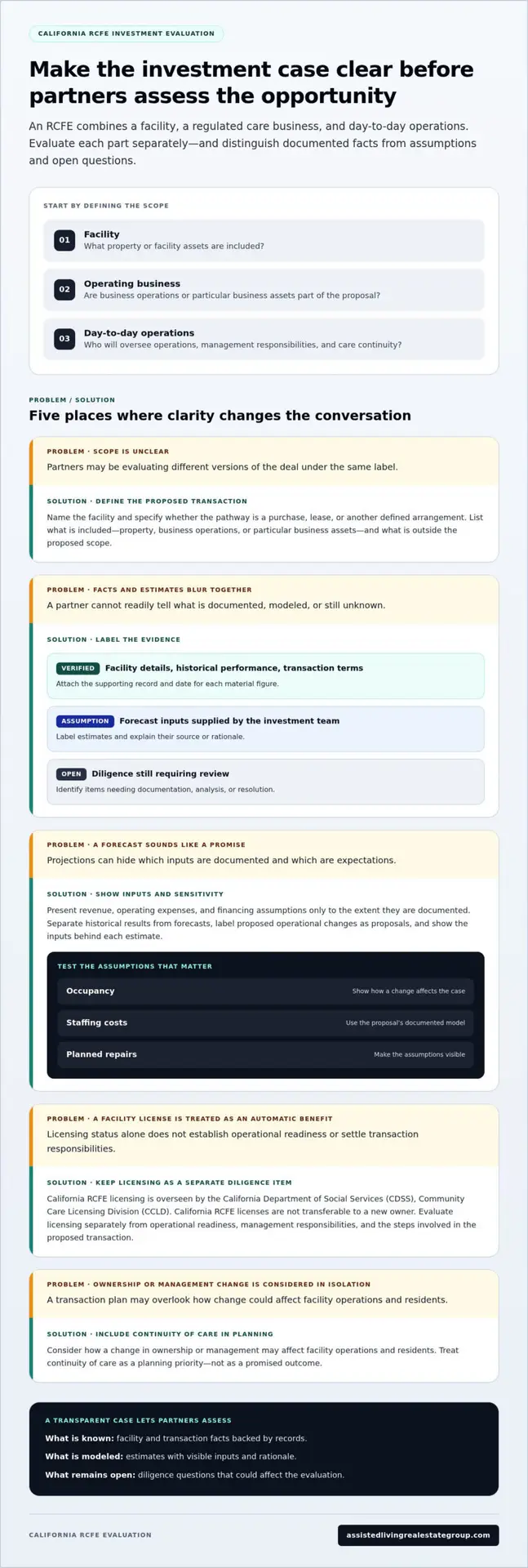
Define what the opportunity includes. It may involve the real estate, an operating care business, or both. Those components have different assets, obligations, and evaluation questions. The investment rationale should also account for continuity of care: a transaction plan needs to consider how a change in ownership or management may affect facility operations and residents. Treat this as a planning priority, not a promised outcome.
Make the evidence easy to interpret. Separate verified facility and transaction facts from projections, working assumptions, and unanswered questions. For example, state whether occupancy information comes from facility records or is an assumption in a forecast. Clear labels help partners distinguish what is known, what they are being asked to assume, and what needs further review.
Define the proposed RCFE investment and its scope
Name the facility and describe the proposed pathway: purchase, lease, or another clearly defined arrangement. Specify which assets are included, such as the property, business operations, or particular business assets, and identify what is outside the proposed scope. In presenting an RCFE investment to partners, this precision helps prevent people from evaluating different deals under the same label.
Distinguish the facility’s licensing status from the broader operating plan. California RCFE licensing is overseen by the California Department of Social Services (CDSS), Community Care Licensing Division (CCLD). A license is not a substitute for evaluating operational readiness, management responsibilities, and the steps involved in a proposed transaction. California RCFE licenses are not transferable to a new owner, so treat licensing as a separate diligence consideration rather than an automatic benefit of acquiring a facility.
Set a California-specific context without overstating the case
California context belongs in the presentation because the proposed facility operates within the state’s licensing and oversight framework. Use facility-specific information to explain the opportunity, and keep broader California market context separate from evidence about the particular business. For an opportunity in Southern California, focus on relevant local considerations instead of relying on statewide generalities.
A Senior Housing Investment in Southern California discussion can provide regional context, but it should complement, not replace, facility-level diligence. Explain why the opportunity merits examination while identifying the assumptions and operational questions that remain open.
Build a credible RCFE investment case with evidence and transparent assumptions
A persuasive RCFE proposal doesn’t need to claim certainty where none exists. It needs a traceable basis for each important statement. Organize the evidence so partners can distinguish documented facility and transaction information from the investment team’s expectations and items that still need review. For every material figure, include its source and date, such as a facility record, transaction document, or financial statement.
A simple evidence summary makes those distinctions clear:
- Verified information: Facility details, documented historical performance, and stated transaction terms, with the supporting record and date.
- Assumptions: Forecast inputs supplied by the investment team, labeled as estimates and accompanied by their source or rationale.
- Open diligence: Items that could affect the evaluation but still require documentation, analysis, or resolution.
Keep this framework alongside the financial narrative. Partners can then test the case instead of having to guess which numbers are facts and which are estimates.
Present financial assumptions without promising a return
Show revenue, operating expenses, and financing assumptions only to the extent they’re documented. Separate historical results from forecasts, and label proposed operational changes as proposals, not established performance. Explain the inputs behind each estimate, including the records or working assumptions used, rather than presenting a forecast as a guaranteed result.
Show how changes to key inputs could affect the case. If a projection depends on occupancy, staffing costs, or planned repairs, use the proposal’s documented model to illustrate what happens when those assumptions change. Don’t add unsupported industry benchmarks. This sensitivity view helps partners identify which inputs matter most and where additional evidence could change their assessment.
Connect property and business information to partner questions
Describe the facility’s documented status, the assets included, and the proposed transaction scope in terms partners can compare with the financial case. Then identify diligence topics relevant to the proposal, such as the basis for revenue records, operating expenses, financing assumptions, physical condition, and responsibilities after a transaction. A focused review of The Ultimate Guide to Buying an RCFE Facility in California can help frame acquisition questions, while conclusions in the presentation should remain tied to this specific opportunity.
For partners, the practical test is whether each material claim can be traced to evidence or clearly labeled as an estimate. That discipline builds confidence without overstating the opportunity. Assisted Living Real Estate Group (ALREG) provides specialized California RCFE transaction support, including valuation, due diligence, negotiations, financing, closing, and management transition. Explore California RCFE transaction guidance as you shape the evaluation.
Compare partnership roles, transaction pathways, and material risks
A strong partnership proposal makes the structure visible before anyone commits capital. Compare the pathways relevant to the deal, then explain how funding, authority, and operating involvement would work under each. Buying a property and operating business together may bring both real estate and business considerations into the investment case. Leasing an RCFE may involve a different allocation of property responsibilities and business obligations. The actual terms depend on the proposed transaction, so describe what the deal documents say rather than assuming a standard arrangement.
Use a simple comparison to guide the discussion:
- Purchase: Identify which property and business assets are included, how partner capital is expected to be allocated, and who will oversee the acquired operation.
- Lease: State what the proposed lease covers, which party is responsible for each stated obligation, and how the operating business fits into the arrangement.
- Both pathways: Clarify decision rights, approval processes, capital commitments, and who is responsible for day-to-day facility operations.
Resolve these questions against the specific proposal instead of filling gaps with generic terms. If a partner’s role, contribution, or authority remains undecided, mark it as open. In presenting an RCFE investment to partners, clear boundaries distinguish investment oversight from hands-on facility management.
Make partner responsibilities explicit
Set out who is expected to fund the transaction, manage the business, oversee performance, and make key decisions. Name the proposed person or role for operational leadership, and distinguish that responsibility from an investor’s governance or financial oversight. If the partners haven’t established who approves major expenses, handles operating decisions, or addresses disagreements, flag those points for resolution rather than implying agreement.
Partnership documents, legal structure, and tax treatment can affect how responsibilities and economics are recorded. Those questions call for review by appropriately qualified legal and tax professionals. A transaction presentation can identify decisions to make, but it shouldn’t substitute for that professional review.
Present risk scenarios alongside the opportunity
Show material uncertainties as scenarios, not predictions. For example, explain how lower occupancy, higher operating costs, changed financing assumptions, or a longer transition period could affect the proposal using its documented figures. If the model doesn’t support a scenario, identify the missing information instead of adding an invented benchmark. Partners can then see which assumptions deserve closer attention.
Include licensing, facility condition, financing, and transition considerations in the risk discussion. Their relevance and potential effect depend on the transaction and available documentation. Financing Your RCFE Purchase: A Buyer’s Guide can inform discussion of acquisition pathways; financing support is a resource for evaluation, not a promise of approval or terms. A balanced comparison lets partners weigh the opportunity alongside the responsibilities involved.
Prepare a partner presentation that answers questions in a logical sequence
A clear presentation takes partners from the opportunity to a decision about next steps. Keep the main deck focused on what they need to evaluate, and put supporting detail in accompanying materials. A one-page summary should state the proposal, transaction pathway, central assumptions, main unresolved issues, and decision requested. In presenting an RCFE investment to partners, a logical structure helps them assess the opportunity without mistaking a persuasive narrative for evidence.
Use a consistent sequence so each section builds on the last:
- Opportunity: State why this California RCFE merits evaluation and what decision partners are being asked to make.
- Facility facts: Summarize documented information relevant to the proposed transaction.
- Transaction structure: Explain what is being acquired or leased and the scope of the arrangement.
- Assumptions: Show the basis for projections and identify estimates clearly.
- Risks: Address material uncertainties, including licensing context, financing, facility condition, and transition considerations.
- Next steps: Request a defined action, such as approval to continue evaluating the opportunity and gather specific information.
This order keeps the presentation purposeful and gives partners a clear point to ask about evidence, operating responsibilities, or the assumptions behind a forecast.
Choose supporting materials that make the case easy to review
Support the main presentation with a facility summary, documented financial information, and a transaction outline. Organize source documents and schedules so partners can trace important claims to their evidence. Mark confidential materials clearly and share them only through appropriate channels with the people involved. ALREG specializes in California RCFE transactions and supports valuation, due diligence, negotiations, financing, closing, and management transition.
Consistency matters. If a supporting schedule changes an assumption, update the presentation or explain the difference. Check that labels, dates, and figures align across the summary, financial materials, and transaction outline. This reduces confusion and lets partners focus on evaluating the deal instead of reconciling conflicting versions.
Handle partner objections with direct, evidence-led answers
Not every question will have an immediate answer. State what’s known, identify what remains uncertain, and name the information that could resolve the gap. If a partner challenges an occupancy or expense assumption, return to the underlying record or model. If evidence isn’t available, record the question as a diligence item rather than defending an unsupported estimate.
Address downside scenarios as carefully as the upside. Explain what documented information shows, what remains a scenario, and how the issue could affect the evaluation. If partners disagree about roles or assumptions, record the points of difference and assign a next step. For help organizing a California RCFE transaction evaluation, discuss your RCFE transaction.
Move from partner discussion to a structured California RCFE evaluation
Partner interest becomes useful when it leads to defined actions. Before ending the discussion, capture the information the group needs, who will obtain it, and which decision depends on it. One partner might coordinate a review of transaction documents while another examines operating assumptions. Assign unresolved questions for follow-up instead of leaving them as general concerns.
Set evaluation milestones around the deal’s actual requirements. These might include receiving specified records, reviewing facility and transaction information, discussing financing assumptions, and reconvening to decide whether to advance. A discussion does not commit anyone to invest. Its purpose is to determine whether the opportunity merits further evaluation, with responsibilities and decision points understood by all partners.
Set practical next steps after the presentation
Record partner questions, assigned follow-ups, and outstanding decisions in a shared action log. For each item, include the information needed, the person responsible for obtaining it, and when partners will review the response. Control confidential facility information during further discussions, sharing sensitive materials only with appropriate participants through suitable channels.
Treat licensing questions as part of the California evaluation, not as settled assumptions. The article RCFE Licensing in California: The 2026 Investor’s Guide to Success can inform that discussion; transaction-specific questions should remain tied to the facility and proposed pathway under review.
Show where a specialist can support the transaction
Assisted Living Real Estate Group (ALREG) specializes in California RCFE transactions. Its BUY RCFE, SELL RCFE, LEASE RCFE, and FINANCING services help partners evaluate acquisition and leasing pathways. ALREG also supports valuation, due diligence, contract negotiations, closing, and management transition. With over 25 years of combined experience in opening, owning, selling, and buying care facilities and agencies, the team brings a focused perspective to organizing the evaluation, without guaranteeing a transaction outcome.
For a privately marketed opportunity, confidential marketing helps protect the seller’s reputation and operations while connecting with qualified buyers. Keep that separate from the investment merits: confidentiality supports a controlled discussion, while partners still need to assess the facility, transaction terms, assumptions, and responsibilities using the available evidence.
Presenting an RCFE investment to partners is a request to evaluate a specific opportunity with discipline, not a promise of performance. If your group is ready to define the information needed and the transaction pathway to examine, discuss your California RCFE opportunity.
Turn partner alignment into a clear next move
The next step is not simply to keep discussing the opportunity. Agree on what would justify moving forward, what findings would pause the process, and who will bring each outstanding answer back to the group. Clear decision points help partners stay aligned as information emerges, while leaving room to revise the evaluation when the evidence changes.
That’s the value of presenting an RCFE investment to partners with a process in mind: it turns shared interest into a disciplined path for evaluation without asking anyone to rely on an assured outcome. A well-defined next move can support a clear investment discussion and account for the care responsibilities connected to the facility.
If you’re ready to explore the transaction considerations for a California RCFE, discuss your RCFE transaction options. A structured evaluation gives your partnership a purposeful next step.
Frequently Asked Questions
How do I present an RCFE investment to potential partners?
Present it as a decision about whether to authorize further evaluation, not as a request for an immediate investment commitment. Explain the proposed deal, why it merits attention, and what information is still needed. Then ask for a specific next action, such as approval to request additional records or review a transaction structure. This makes the discussion purposeful while leaving room for due diligence.
What financial information should I include in an RCFE investment presentation?
Include documented revenue and expense information, proposed transaction terms, and any financing assumptions relevant to the opportunity. Identify the period each record covers and explain how the figures are used in the model. If the forecast adjusts revenue or expenses, show each adjustment separately from historical results. Partners can then tell whether a projected change reflects documented facility performance, an investment-team estimate, or a proposed operational change.
Should an RCFE investment presentation include risks and downside scenarios?
Yes. Explain how the proposal could be affected if a key assumption changes, such as occupancy, operating expenses, financing terms, or transition timing. Use the deal’s documented figures to illustrate possible effects, and label scenarios as estimates rather than predictions. If a potential downside cannot yet be quantified, state what information is missing and how partners could evaluate it during further diligence.
What is the difference between buying an RCFE business and leasing an RCFE facility?
Buying an RCFE business and leasing a facility are different transaction structures, and neither phrase alone defines every asset or responsibility involved. A purchase may include business assets, real estate, or both, depending on the agreement. A lease generally concerns the right to use a facility under stated terms, while business ownership may be addressed separately. Review the proposed documents to understand what is included and who holds each responsibility.
Can partners invest in an RCFE without managing its daily operations?
Partners may choose an investment role without taking on daily facility management, but the operating plan still needs clear leadership. Identify who will oversee the business and who will handle daily operations; don’t leave those responsibilities implied. California RCFEs require a certified administrator, so the presentation should address how the proposed operation will meet that requirement. Investors should also agree on which information and decisions will come back to them for oversight.
What California RCFE licensing information should partners review?
Review the facility’s licensing information in the context of the proposed transaction, including its licensed capacity, current status, and available compliance records relevant to the evaluation. California’s Department of Social Services, Community Care Licensing Division, oversees RCFE licensing. Requirements and application steps can affect a transaction, so use current California guidance and facility-specific records to understand the licensing considerations rather than relying on a seller’s summary alone.
What should partners agree on before pursuing an RCFE acquisition?
Before advancing, partners should align on each person’s proposed capital contribution, decision-making authority, expected involvement, and approach to additional funding if assumptions change. They should also identify unresolved terms, such as how disagreements will be handled and what conditions would pause the evaluation. Put agreed points and open questions in writing, then have qualified legal and tax professionals review the partnership and transaction documents before relying on them.