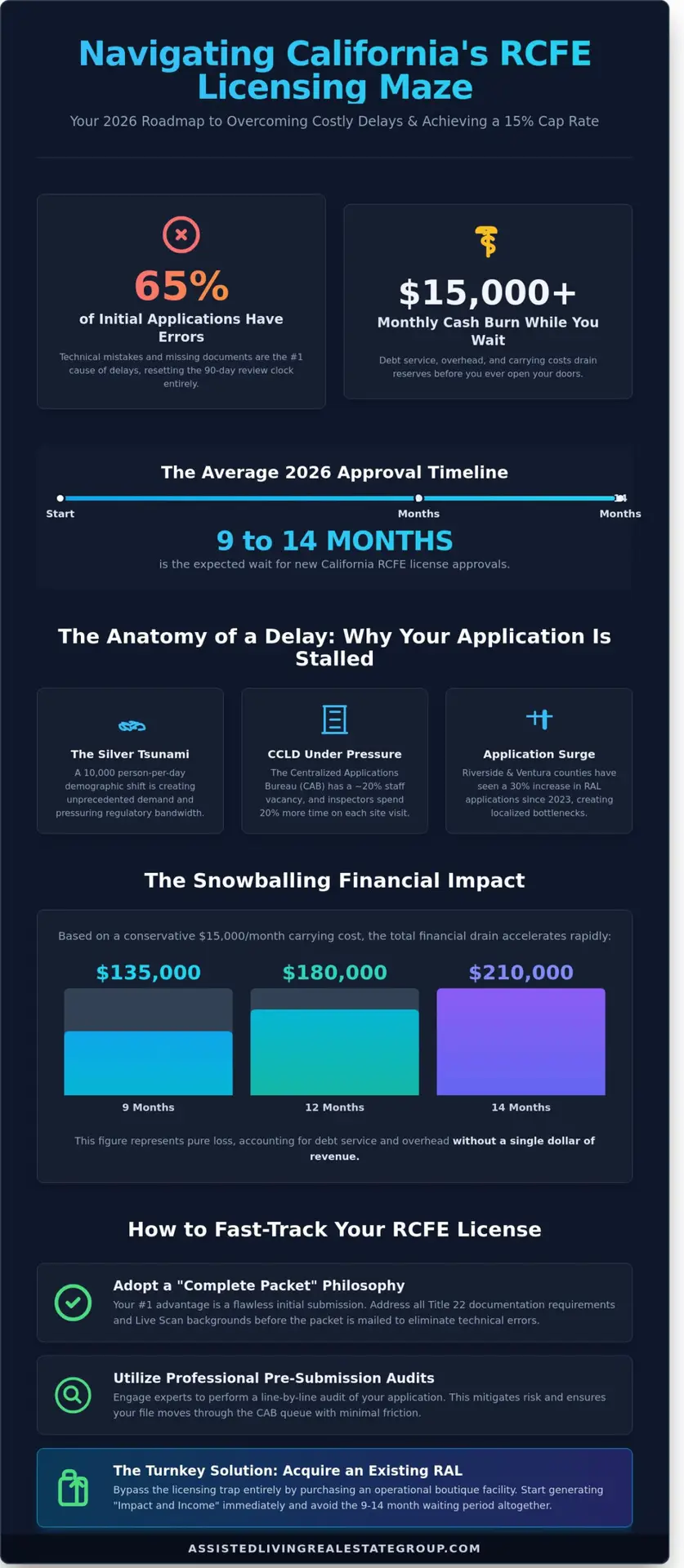
California’s senior housing market is currently at a boiling point. For the sophisticated investor, this represents a blue ocean opportunity to generate both Impact and Income. The California Department of Social Services (CDSS) acts as the primary gatekeeper for this sector, operating through the Community Care Licensing Division (CCLD). This agency ensures that all Assisted Living Facilities meet the rigorous safety and operational standards required to house the state’s most vulnerable population. However, the path to a finalized license is longer than most anticipate. In 2026, the average timeline for an RCFE license approval in California is expected to span 9 to 14 months, a duration that forces developers to account for significant carrying costs during the pre-operational phase.
The Silver Tsunami represents a 10,000-person-per-day demographic shift that is fundamentally reshaping the California real estate market. This surge in demand has placed unprecedented pressure on regulatory bandwidth. As more entrepreneurs recognize the high cap rates associated with Residential Assisted Living (RAL) models, the CCLD has struggled to keep pace with the volume of incoming applications. Navigating the administrative hurdles that often trigger rcfe licensing delays is the first step toward building a legacy in this high-barrier-to-entry market.
The Community Care Licensing Division operates as a two-tiered system that requires precision from the applicant. The Centralized Applications Bureau (CAB) in Sacramento handles the initial technical review of your “Part A” and “Part B” application packets. Once CAB determines your documentation is complete, the file is transferred to one of the local regional offices for the physical site inspection and final sign-off. Every aspect of this process is governed by Title 22, Division 6, Chapter 8 of the California Code of Regulations. These mandates dictate everything from fire clearance protocols to the specific qualifications of your facility administrator. Failing to align your physical plant with Title 22 requirements before the first inspector visit is the most common reason for a project to stall.
The year 2026 marks a critical juncture for California’s “Boutique” care home sector. Markets in Riverside and Ventura counties have seen a 30% increase in RAL applications since 2023, as investors flee the saturated markets of Los Angeles and Orange County. This geographical shift has created a localized bottleneck; Southern California regional offices are currently reporting some of the highest inspector caseloads in the state. Recent legislative updates, including enhanced staff training requirements and stricter emergency preparedness mandates, have added layers of complexity to the inspection process. These new protocols mean that inspectors now spend an average of 20% more time on each site visit compared to three years ago.
In this environment, your ability to provide a “turnkey” application is your greatest competitive advantage. Proactive planning is the only way to mitigate the financial drain of rcfe licensing delays. When you understand that the CCLD is not your adversary but a partner in safety, you can position your project to move through the queue with minimal friction. Success in the California RAL space requires a blend of real estate savvy and a deep commitment to quality of life; it’s about doing good while doing well. By mastering the current regulatory landscape, you ensure that your investment is ready to catch the wave of the Silver Tsunami rather than being pulled under by it.
The Anatomy of a Delay: Why Your RCFE Application is Stalled
Your vision of a high-yield boutique RCFE can’t materialize while your application sits in a dusty bin in Sacramento. Most investors underestimate the complexity of the California Department of Social Services (CDSS) requirements. A single missing checkmark on a 50-page document often results in an “Incomplete Packet” notification. This doesn’t just pause your progress. It resets the 90-day review clock entirely. These rcfe licensing delays are often the result of administrative friction within the Centralized Applications Bureau (CAB). As of early 2026, the CAB continues to report staffing vacancies of nearly 20 percent, which means your file might wait weeks before an analyst even opens the envelope.
Background checks are another silent killer of momentum. If your administrator or any person with over 10 percent ownership hasn’t cleared their Live Scan, the CAB won’t move an inch. This bottleneck is intensified by the ongoing backlog in California Department of Justice processing times. These checks can stretch from 14 days to over 60 days if any discrepancies arise. You can’t afford to wait until the end of the process to start these scans. You must initiate them the moment you identify your key staff members. Common friction points that trigger a full review include:
- Failure to provide a valid lease agreement or grant deed that matches the applicant name exactly.
- Inconsistent signatures across Title 22 forms like the LIC 200 and LIC 309.
- Mismatched corporate documents that don’t align with the California Secretary of State filings.
The “Blue Ocean” of Residential Assisted Living (RAL) is vast, but you must be a disciplined captain to reach it. Every day your doors are closed is a day you aren’t generating the “Impact and Income” that defines this industry. In a state with 40 million residents, the competition for licensing attention is fierce. You aren’t just competing with other RAL owners; you’re competing against a system that is designed to filter out the unprepared. If you want to avoid these pitfalls, consider a strategic partnership to streamline your path to licensure.
Common Administrative Errors in Title 22 Compliance
Precision is your greatest asset. Your Plan of Operation must be site-specific, not a generic template. You must prove you have a 3-month operating reserve in liquid assets. If your bank statements show $199,000 when your projected costs require $200,000, your application will be rejected. Inadequate staff training plans that lack the specific 40-hour initial certification details also trigger immediate denials from the state.
The Fire Clearance and Local Zoning Bottleneck
The Office of the State Fire Marshal (OSFM) is the ultimate gatekeeper. You must secure an 850 Fire Clearance, which requires coordination between state and local officials. In Southern California, local marshals often have conflicting interpretations of fire code requirements. Zoning disputes in cities like Fresno or San Jacinto can halt a license for months. These localized rcfe licensing delays are best managed through proactive communication and early pre-inspections.
The Financial Impact: The Real Cost of Waiting in California
In the high-stakes California real estate market, a dormant property isn’t just a missed opportunity; it’s a liability that compounds every 24 hours. When you’re caught in the web of rcfe licensing delays, your “Blue Ocean” strategy can quickly transform into a financial anchor. Carrying costs represent the most immediate drain on your liquid capital. For a typical residential property converted for care, you’re paying for mortgage interest, property taxes based on high California valuations, and specialized insurance premiums that don’t stop just because your doors are closed. These are non-operational assets that consume cash without producing a single dollar of “Impact and Income.”
The true pain lies in the staggering opportunity cost. A boutique 6-bed facility in a high-demand area like Orange County or Santa Clara can command $6,500 to $9,500 per resident monthly. A 6-month delay represents a gross revenue loss of up to $342,000. If you’re scaling to a 15-bed facility, that figure can exceed $800,000 in lost potential. Beyond the balance sheet, the “Staffing Leak” is a silent killer of project momentum. High-quality caregivers in California are in high demand. They won’t wait 180 days for a facility to open its doors. You’ll lose your hand-picked team to established competitors, forcing you to restart the expensive recruitment and background check cycle. Often, these setbacks originate from a misunderstanding of RCFE certification requirements, which can stall the entire application at the state level before you even hire your first employee.
Case Study: The Thousand Oaks Carrying Cost Analysis
Consider a $1.5 million property in Ventura County. With a 25% down payment and a 7.5% interest rate, the monthly mortgage payment sits at approximately $7,866. Add $1,560 for California property taxes and $450 for specialized liability insurance. Even with minimal utility usage and basic landscaping maintenance, the monthly burn rate hits $10,500. Over a 12-month delay, this investor loses $126,000 in pure cash. When you combine this with the $540,000 in lost potential revenue for a standard 6-bed boutique RAL, the total financial hit exceeds $660,000. For most entrepreneurs, that’s the difference between a thriving legacy and a failed venture.
Managing Investor Expectations and Capital Calls
Transparency is your only currency when rcfe licensing delays threaten your Debt Service Coverage Ratio (DSCR). Most commercial lenders require a DSCR of 1.25 or higher. If your licensing timeline slips from 6 months to 14 months, you risk technical default. Professional developers must structure “delay reserves” into their initial business plan to cover at least 9 months of non-operational costs. If you’re forced into an unexpected capital call, you risk diluting your own equity and damaging your reputation with partners. You’ve promised your equity holders both “Impact and Income.” While the social impact of the “Silver Tsunami” remains vital, the income side requires a methodical approach to licensing that respects the volatility of the California Department of Social Services. Failure to plan for these delays doesn’t just hurt your wallet; it takes a psychological toll on your mission to provide premium boutique care.
Strategic Mitigation: How to Fast-Track Your RCFE License
Securing your position in the California senior care market isn’t just about finding the right property; it’s about mastering the regulatory gatekeeping of the Community Care Licensing Division (CCLD). To capture the blue ocean opportunity presented by the aging demographics in the Golden State, you must approach the application as a high-stakes business merger. You don’t just submit forms. You provide a masterclass in compliance that leaves the Centralized Applications Bureau (CAB) with zero reasons to hit the pause button. Your goal is to eliminate rcfe licensing delays by proving your boutique RAL model is the gold standard for California care.
The Power of the Pre-Submission Audit
For all 2026 applications, a second set of expert eyes is a non-negotiable requirement for serious investors. Hiring a Title 22 consultant to perform a “Pre-Submission Audit” identifies the clerical landmines that trigger a 90-day setback. This auditor verifies that your LIC 200 is perfectly mirrored across your Plan of Operation and Sketch of Grounds. They also confirm your Designated Administrator’s certification is current under California’s latest 2024 standards, ensuring no gaps in their 40-hour initial training or active certificate status exist before the file hits a reviewer’s desk.
Efficiency in this stage often involves the “Complete Packet” philosophy. Instead of providing the bare minimum, over-deliver on documentation. Include your detailed emergency disaster plan and proof of a $500,000 professional liability insurance policy upfront. When you provide everything the analyst needs in a single, organized digital and physical binder, you reduce the likelihood of a “Notice of Deficiency” by 65% based on recent 2024 filing trends.
Strategic investors often look for a faster route to market through the Change of Ownership (CHOW) process. By acquiring an existing facility, you can often utilize a “Management Agreement” to operate under the seller’s license while your new application is processed. This bypass can generate cash flow 180 days sooner than a start-up application. Additionally, building a professional rapport with local CCLD Regional Managers through introductory meetings shows you’re a committed partner in the community, not just another faceless entity. This transparency builds the trust necessary to move your project to the top of the pile.
Proactive Follow-Up Techniques
Once your application is in the system, adopt the “Professional Persistent” method. Don’t wait for a letter in the mail. Call the CAB analyst every 14 days to check the status of your background clearances and fire marshal inspections. Document every phone call, name, and date in a dedicated log. This creates a paper trail that is essential if you need to escalate the matter to a supervisor or involve a specialized broker to break a stalemate. If a file remains stagnant for more than 120 days without a valid reason, this documentation serves as the foundation for a formal appeal or legal inquiry.
Successful RAL owners know that time is the most expensive commodity in real estate. By auditing your application and maintaining a disciplined follow-up schedule, you protect your ROI and accelerate your path to making a social impact. It’s about doing good while doing well, and that starts with a license in hand. If you’re ready to bypass the common pitfalls and launch your boutique facility, partner with our expert consulting team to streamline your California RCFE journey.
The Turnkey Solution: Avoiding the Licensing Trap Altogether
Starting a Residential Assisted Living (RAL) facility from the ground up in California often feels like a race against a clock that isn’t moving. New applicants frequently face a 12 to 18-month lead time before the first resident can move in. This period is a financial drain, requiring you to carry mortgage payments, insurance, and utilities without a cent of revenue. The most effective strategy to bypass rcfe licensing delays is to acquire an existing, operational business through a Change of Ownership (CHOW).
By choosing a turnkey acquisition, you secure a boutique environment that is already generating cash flow. You aren’t just buying real estate; you’re purchasing a legacy and a stabilized asset. This approach allows you to achieve “Income and Impact” on Day 1. Instead of navigating the bureaucratic maze of initial inspections and fire clearances, you focus on optimizing an existing high-level care model. In the California market, where the 65+ demographic is projected to reach 8.6 million by 2030, speed to market is your greatest competitive advantage.
The Assisted Living Real Estate Group specializes in these off-market transitions. We understand that the “Silver Tsunami” represents a blue ocean opportunity for investors who value precision over guesswork. We bridge the gap between financial spreadsheets and heart-centered care, ensuring that your entry into the market is as seamless as it is profitable.
The Strategic Advantage of CHOW over New Applications
A CHOW process allows for operational continuity that a new application cannot match. While you still must submit an application to the Community Care Licensing Division (CCLD), the facility remains open and residents continue to receive care under the seller’s license during the transition. This eliminates the 365-day vacancy risk. You inherit a proven model with established cap rates and a trained staff. For a deeper dive into this process, consult The Ultimate Guide to Buying an RCFE in California.
Partnering with a Specialized Southern California Broker
Generalist real estate brokers often stumble when faced with the specificities of California Title 22 regulations. They don’t understand the difference between an R3 and an I-2 occupancy or how a fire clearance affects your bottom line. Leveraging Teri Szoke’s 25+ years of California-specific experience ensures you don’t fall into common pitfalls. Our group manages confidential marketing because the highest-performing 6-bed and 15-plus bed facilities never hit public sites. Sellers prioritize discretion to protect their staff and resident stability. To see what is currently available, explore our current confidential RCFE listings in California.
Navigating the senior care market requires a roadmap that accounts for the unique regulatory hurdles of the Golden State. When you buy an existing facility, you effectively skip the line. You avoid the 15% to 20% failure rate associated with new startups that run out of capital while waiting for state approval. This is the professional path to scaling a portfolio of boutique care homes while ensuring that rcfe licensing delays don’t derail your investment goals. You get to focus on what matters: providing exceptional care and securing your financial legacy.
Turn Regulatory Hurdles into Your Competitive Edge
The California market doesn’t wait for paperwork. While rcfe licensing delays often stall momentum for 12 months or longer, savvy investors recognize that time is the ultimate currency. You’ve seen how a single administrative bottleneck can drain six figures from your projected ROI before the first resident even moves in. By shifting your strategy toward turnkey acquisitions or professional mitigation, you bypass the red tape that sidelines your competitors. We leverage over 25 years of specialized California experience to ensure your capital starts working immediately. Our exclusive confidential marketing strategy has secured high-value transactions across Southern California, turning the state’s aging demographics into a blue ocean of opportunity.
You don’t have to navigate the Department of Social Services alone. It’s time to transform these regulatory barriers into a protected market position that delivers both impact and income. Secure Your Legacy: Consult with California’s RCFE Experts Today. Your roadmap to a high-yield boutique facility is ready when you are.
Frequently Asked Questions
How long does it currently take to get an RCFE license in California in 2026?
Obtaining an RCFE license in California currently takes between 120 and 240 days from the date you submit your initial application. While the California Department of Social Services aims for efficiency, the massive demand from the Silver Tsunami often creates administrative backlogs. Your specific timeline depends heavily on the accuracy of your Part A and Part B packets. Investors who submit flawless documentation often see their approvals closer to the four month mark.
Can I operate my RCFE while the license application is pending?
You cannot legally provide care or accept residents while your RCFE license application is pending with the Community Care Licensing Division. California Health and Safety Code Section 1569.10 mandates that operating without a license results in immediate civil penalties of $200 per day. Use this pre-licensing phase to finalize your boutique facility renovations or train your staff. This ensures you’re ready to maximize your ROI the moment the state grants its approval.
What is the most common reason for an RCFE application to be rejected?
The most frequent cause for rejection is a mismatch between the facility’s physical layout and the written Plan of Operations. Roughly 35% of initial submissions face rcfe licensing delays because applicants fail to provide clear, scaled floor plans or specific staff training protocols. The state requires granular detail. If your application lacks specific 2026 fire safety updates or detailed disaster plans, the agency will return the entire packet for correction.
Do I need a separate fire clearance for a 6-bed residential care home?
Every 6-bed RAL home requires a formal fire clearance from the local California Fire Marshal before the state issues a license. This process involves a physical inspection to ensure the property meets Title 19 and Title 24 safety standards. You must request this inspection through the licensing agency early in the process. Delays in fire clearances account for 25% of all licensing bottlenecks in California, making it a critical step in your project timeline.
How much are the application fees for a new RCFE license in California?
For a boutique 6-bed facility, the initial application fee in 2026 is $3,230. Facilities with 7 to 15 beds pay $4,844, while larger projects face fees exceeding $6,400. These non-refundable costs are essential investments in your future RAL business. Beyond the state fee, you should budget for the $500 orientation fee and mandatory fingerprinting costs for all associated personnel to ensure a smooth, compliant launch for your investment.
What is a CHOW and how does it affect the licensing timeline?
A CHOW is a Change of Ownership, occurring when an existing RCFE business is sold to a new operator. While the real estate transaction might close quickly, the new owner must obtain their own license before taking over operations. This process typically mirrors the 120 to 240 day timeline of a new application. Navigating a CHOW requires a strategic transition plan to maintain resident care while avoiding costly rcfe licensing delays during the handoff.
Can the Assisted Living Real Estate Group help me speed up my license?
We accelerate your path to profitability by providing a battle-tested roadmap that eliminates common administrative errors. Our strategic partners help you navigate the complex intersection of California real estate and licensing requirements. By utilizing our proprietary RAL models, you avoid the trial-and-error phase that stalls most investors. We focus on getting your boutique facility operational faster, allowing you to achieve your Impact and Income goals without unnecessary setbacks.
What happens if my RCFE license application is denied?
If the state denies your application, you’ll receive a formal notice outlining the specific regulatory deficiencies. You have exactly 15 days from the date of the notice to file a written appeal and request a hearing. Denial often stems from failing to meet the “Good Character” requirements or persistent failure to correct Plan of Operation errors. It’s a significant setback that can delay your potential ROI by 12 months or more.