
The property with the higher headline yield may not deliver the stronger investment. A memory care home investment yield depends on occupancy, operating costs and property quality, as well as the care model. Market benchmarks put cap rates at about 8% for well-located, high-quality memory-care-only properties, compared with 6.75% to 7.5% for assisted living and memory care combinations. Treat these as benchmarks, then assess the California property and its operating fundamentals.
It’s easy to focus on specialized-care demand and assume it leads directly to stronger returns. But memory care home investment yield also depends on the costs and risks of delivering that care, including staffing, renovations, regulatory compliance, and occupancy stability.
This article explains what shapes yield in Southern California, how memory care compares with assisted living and nursing homes, and which risks investors can mitigate. Revenue potential is only one part of the calculation: a property’s operating model can influence both financial performance and residents’ quality of care.
Key Takeaways
- Compare stand-alone memory care with combination communities by considering how each model balances specialized services and a broader resident mix.
- Use demand trends as context, then assess whether a specific California property can translate local need into durable occupancy.
- Map regulatory, staffing, and operating risks to the factors that can reduce their impact on performance.
- Compare memory care with assisted living and nursing homes by weighing care intensity alongside the property’s revenue and operating model.
Standalone versus assisted living and memory care properties
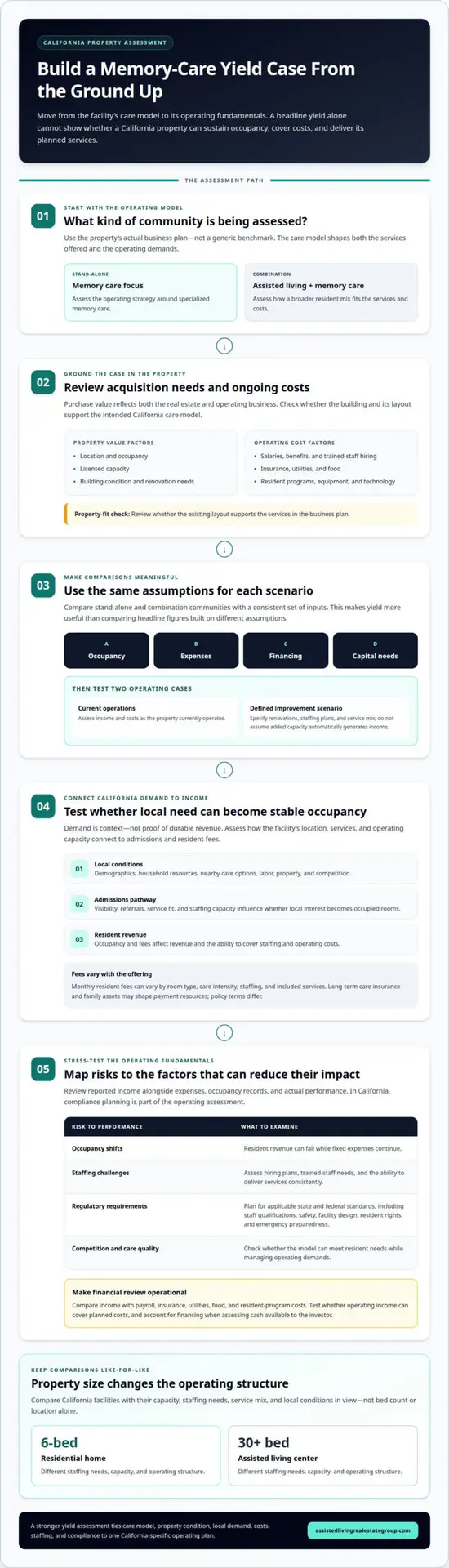
California investors comparing stand-alone memory care with combination communities should assess how each operating model supports its income and expenses. Start with the property’s actual business plan, not a generic benchmark.
In California, operators must meet applicable state and federal requirements. Standards address staff qualifications, safety, facility design, resident rights, and emergency preparedness, so compliance planning belongs in the operating assessment.
Purchase Prices and Operating Costs
A memory care home’s purchase price reflects its real estate and operating business, with value shaped by location, occupancy, licensed capacity, building condition, and renovation needs. Operating costs include salaries, benefits, insurance, utilities, food, and resident programs. Specialized equipment, technology systems, and trained-staff hiring also affect expenses. For a California property, assess how these costs fit its care model and whether its existing layout supports the intended services before comparing acquisition scenarios.
Calculating Investment Yields
Compare a stand-alone property and a combination community using the same assumptions for occupancy, expenses, financing, and capital needs. This makes memory care home investment yield a more useful decision tool than a headline figure. Test whether operating income can cover planned costs, then consider how financing affects cash available to the investor. Keep assumptions specific to the California property and its business plan.
Assess memory care home investment yield under both current operations and a clearly defined improvement scenario. Account for renovations, staffing plans, and service mix rather than assuming added capacity automatically generates income. A combination property may serve different resident needs, while a stand-alone home focuses its operating strategy on memory care. This distinction helps align projections with the facility’s actual role.
Senior living funds offer another way to participate in California communities. Potential cash flow may come from resident rental income, property appreciation, and care or service fees. Because these private investments are not easily sold or traded on public markets, compare their liquidity and payment structure with direct property ownership when shaping an investment strategy.
Senior housing demand and market trends
In California, senior-housing demand depends on local demographics, household resources, and nearby care options. Assess whether the facility’s location and service mix can support steady occupancy and resident revenue.
Occupancy Rates and Resident Fees
Occupancy measures how much of a memory care home’s licensed capacity is filled, while resident fees reflect its care offering and local market. Both affect revenue and the facility’s ability to cover staffing and operating costs. In California, occupancy depends on visibility, referrals, competition, and whether services meet families’ needs. Monthly fees vary by room type, care intensity, staffing, and included services. Long-term care insurance and family assets can shape how residents pay, but policy terms differ.
Yield Variation by Location and Property Size
Yield variation reflects the relationship between a California property’s operating income, local expenses, and investment cost. A Southern California facility may face different labor, property, and competitive conditions than another California market. Property size matters, too: a 6-bed residential home and a 30+ bed assisted living center have different staffing needs, capacity, and operating structures. Investors should compare like with like, rather than treating location or bed count as a stand-alone return predictor.
Demand trends matter most when they translate into appropriate admissions and sustainable operations. A facility’s referral network, care model, and staffing capacity affect whether local interest becomes occupied rooms. For example, a smaller home may rely on a focused referral strategy, while a larger community must coordinate admissions across more rooms and service needs. An advisor can help interpret those operating differences alongside estate planning and residents’ payment resources.
For California investors assessing senior-care properties, connect demand analysis to the facility’s operating model, not just its location. This is especially relevant when comparing California care-facility investment opportunities, where capacity, service mix, and local competition shape the investment case.
Investment risks and mitigation
California memory care returns depend on occupancy, operating performance, and regulatory compliance. Dementia care also requires consistent staffing and programs that support residents’ safety and well-being.
Factors Affecting Profitability and Returns
Profitability is the income a memory care home retains after operating expenses and financing obligations. Occupancy shifts can reduce resident revenue while fixed expenses continue. In California, staffing challenges, regulatory changes, and competition from other senior-housing operators can also affect performance. Alzheimer’s and dementia services require appropriate programs and trained staff. A model that protects care quality while managing operating demands supports stronger financial fundamentals. Projected income ultimately depends on the operator’s ability to deliver the model consistently.
Evaluating Financial Statements, Occupancy, and Operators
Financial review means testing reported income against expenses, occupancy records, and actual operating performance. Compare revenue with payroll, insurance, utilities, food, and resident-program costs in the statements provided. Reconcile occupancy reports with resident revenue to see whether vacant rooms or changing service needs affect results. Review staffing practices, compliance history, and the operator’s ability to manage a California facility. These checks help distinguish durable performance from income that depends on temporary conditions.
Regulatory exposure requires active oversight. California memory care communities operate under state and federal requirements covering staff qualifications, safety protocols, facility design, resident rights, and emergency preparedness. Noncompliance can lead to fines, penalties, or closure, disrupting care and income. Review compliance records, staff-training processes, emergency plans, and systems for documenting resident care. A written oversight plan should assign responsibility for monitoring each area and escalating problems promptly.
Operational diligence should link each risk to a practical control. Compare scheduled staffing with actual coverage and examine how vacancies are addressed. Review resident-engagement programs alongside family feedback and documented care routines. A nursing home may provide a different level of clinical care than a memory care community, so compare operating assumptions only across relevant housing models. Financial statements matter, but the operator’s ability to sustain safe, compliant dementia care determines whether reported performance can continue.
Memory care and other senior housing types
California investors should compare memory care yield with other housing models by examining both income and operating demands. A sound comparison accounts for care services, staffing, occupancy, and the property’s use.
Yields Compared with Assisted Living and Nursing Homes
Yield comparisons show how a property’s operating income relates to its investment cost, but care models differ. California memory care communities provide specialized support for cognitive impairment, while assisted living serves residents with different daily needs. Nursing homes follow a distinct care model, so their staffing and operating assumptions are not interchangeable with those of memory care. Compare net income after model-specific expenses, not just resident fees.
That distinction matters to senior-housing investors weighing care intensity against operational complexity. Memory care may generate more revenue per resident than standard assisted living because families may pay for specialized attention and tailored programs. However, that revenue must support trained staff and resident engagement. Long-term care insurance may cover assisted living memory care depending on policy terms, affecting a resident’s payment sources, not the facility’s gross yield on its own.
Yields Compared with Multifamily Rentals
Multifamily rentals generate income primarily from housing, while memory care combines accommodation with specialized care services. In California, compare each property’s income after its own operating costs. Memory care expenses include staffing and resident programs; multifamily expenses reflect property operations and tenant turnover. A higher projected revenue figure alone does not establish a higher investment yield.
Compare the models by separating property performance from operating responsibilities. Review how vacancies affect income, which expenses change with occupancy, and whether forecasts include required care services. Multifamily assets may have simpler operating assumptions, while memory care depends more directly on the operator’s ability to maintain safe, consistent care. Those differences shape risk as well as potential return.
The takeaway for California investors is to compare equivalent measures, such as net operating income against acquisition cost, then account for each model’s distinct expenses and management demands. For a closer look at California senior-care property opportunities, connect the yield comparison to the facility’s operating model.
Assisted Living Real Estate Group: RCFE Sales (Residential Care Facilities for the Elderly)
Assisted Living Real Estate Group supports California investors evaluating senior-care facility acquisitions through RCFE sales and turnkey business acquisitions. When your analysis points toward buying or selling an operating care facility, these services connect the property decision with the underlying business.
For investors comparing an operating model with projected income, a turnkey acquisition can bring the real estate and business opportunity into one transaction. Sellers seeking discretion can use the firm’s confidential marketing strategy. Assisted Living Real Estate Group also handles ARF sales and drug and alcohol recovery facility sales, serving distinct facility markets.
Bring your investment criteria and priorities into a conversation about California care-facility opportunities. Contact Assisted Living Real Estate Group to discuss your next step.
Turn Your Investment Thesis Into a Clear Next Move
A durable memory care home investment yield starts with a disciplined investment thesis, not a target return in isolation. Define the kind of California opportunity that fits your investment horizon, operational priorities, and desired role. Then focus diligence on properties whose business model aligns with your objectives and the needs of the people they serve.
Clear priorities can make the next conversation more productive. Bring your questions and preliminary criteria to discuss potential opportunities. Assisted Living Real Estate Group can help you explore the right path for your goals, whether you are considering an acquisition or assessing a facility sale. Start with a focused conversation grounded in your investment aims and the property’s operating realities.
Start a conversation with Assisted Living Real Estate Group and move forward with a clearer investment direction.
Frequently Asked Questions
What is the average investment yield for memory care homes in the United States?
There isn’t one average yield that applies to every memory care property. Market benchmarks place cap rates near 8% for well-located, high-quality stand-alone properties, compared with 6.75% to 7.5% for assisted living and memory care combinations. These are cap-rate benchmarks, not guaranteed investor returns or a California-specific average. For a California acquisition, assess local operating income and the property’s purchase price together.
What are the main risks of investing in a memory care home, including liability and labor costs?
Key risks include occupancy shifts, staffing pressures, regulatory noncompliance, and operator performance. Labor costs include wages and benefits, while inadequate safety practices or resident-rights protections can increase liability exposure. In California, assess insurance coverage alongside incident documentation, staff training, emergency procedures, and compliance records. These reviews help show whether the operation has practical controls to protect residents and support stable performance.
What financing options, down payments, and loan terms are available for memory care home investments?
California buyers may consider specialized acquisition financing or investing through a senior living fund, which is a private investment rather than a property loan. Down payments and loan terms depend on the property, transaction structure, borrower qualifications, and lender underwriting. Assisted Living Real Estate Group offers specialized financing for RCFE and senior-living acquisitions. Compare the financing structure with projected cash flow and operating needs before committing capital.