
Regulatory readiness can shape a California care home sale as much as buyer demand or price. The market conditions for selling a care home in 2026 depend on how well the facility’s operations, financial picture, property, and licensing position align with what qualified buyers are prepared to acquire. A strong asking price alone won’t resolve gaps that affect a buyer’s confidence or ability to proceed.
It’s natural to focus on timing and valuation first. But a successful sale also depends on reading local demand, presenting a clear picture of the business, and understanding how regulatory considerations may affect the transaction. This article explains the signals that can inform pricing and timing in California, from buyer interest and comparable facilities to sale readiness and regulatory diligence. You’ll come away with a practical framework for deciding what to address before going to market and how to weigh current conditions against the long-term value of the care being provided.
Key Takeaways
- Assess buyer interest alongside recent comparable care-facility sales and current competition before setting an asking price.
- Use local indicators such as time on market and price reductions to judge whether your California area favors sellers or gives buyers more leverage.
- Review the facility’s financial and operational records, property condition, and licensing readiness before marketing to reduce avoidable friction during due diligence.
- Present the home and its business clearly, with accurate information and strong visuals that help qualified buyers understand its value.
- Factor regulatory and ownership-transfer considerations into your timing and transaction plan, since they can affect a buyer’s path to closing.
Buyer demand, pricing momentum, and expected time to sell
To understand market conditions for selling a care home 2026, California sellers need to assess more than property listings. Buyers weigh operating results, staffing continuity, facility condition, financial records, and fit with their acquisition goals. Present the real estate and care operation as a connected opportunity. That helps buyers evaluate how the business works, not just where it sits.
Interest rates and lending availability affect buyers’ borrowing costs and purchasing capacity. While direct cash purchase firms in standard real estate, such as Covenant Properties, can eliminate financing contingencies, licensed care acquisitions typically involve specialized lending where tighter underwriting makes clear financial records even more important. Before marketing, organize operating statements, occupancy information, and a transition plan. Complete, well-organized documents help buyers assess the opportunity and reduce avoidable delays.
Private equity groups, REITs, and strategic operators may evaluate California facilities differently. Strategic operators may focus on operational fit, while investment groups may examine cash flow, scalability, and ownership structure. Rather than assume one buyer category is driving activity, assess actual inquiries, offers, and buyer qualifications. Present the facility’s strengths to buyers whose plans fit its scale and operating profile.
Available inventory affects negotiating leverage. When buyers can compare several suitable California facilities, they may scrutinize pricing, records, and transition risks more closely. If comparable options are limited, a distinctive facility may stand out, but its asking price still needs evidence to support it. Review competing listings and relevant transactions, then explain specific advantages such as location, operating performance, or facility configuration.
A care-home sale follows a sequence, not a fixed calendar. Organize records, establish a supportable price, prepare confidential marketing materials, qualify buyers, negotiate terms, and move through due diligence and closing. Timing depends on financing, record quality, transaction structure, and applicable ownership or licensing processes. Address documentation gaps before launch to reduce friction once buyer interest develops.
Regulatory scope matters. According to the Centers for Medicare & Medicaid Services, under CMS regulations, a Medicare-certified home health agency or hospice acquired, changed ownership, or initially enrolled within the prior 36 months may face restrictions on a subsequent change of ownership. This provision concerns those certified agencies, not every California residential care facility.
For sellers, a practical reading of market conditions for selling a care home 2026 starts with local competition, qualified buyer interest, and facility-specific evidence. Compare relevant California listings, prepare for financing questions, and plan for transition discussions before negotiations. That disciplined approach helps owners judge demand and pursue a sale strategy grounded in the business’s actual strengths.
Occupancy and operating performance help buyers assess a care home’s cash flow. Staffing continuity can also shape their view of operational and transition risk. Clear operating and financial records make these factors easier to evaluate.
Days on market and pricing indicators
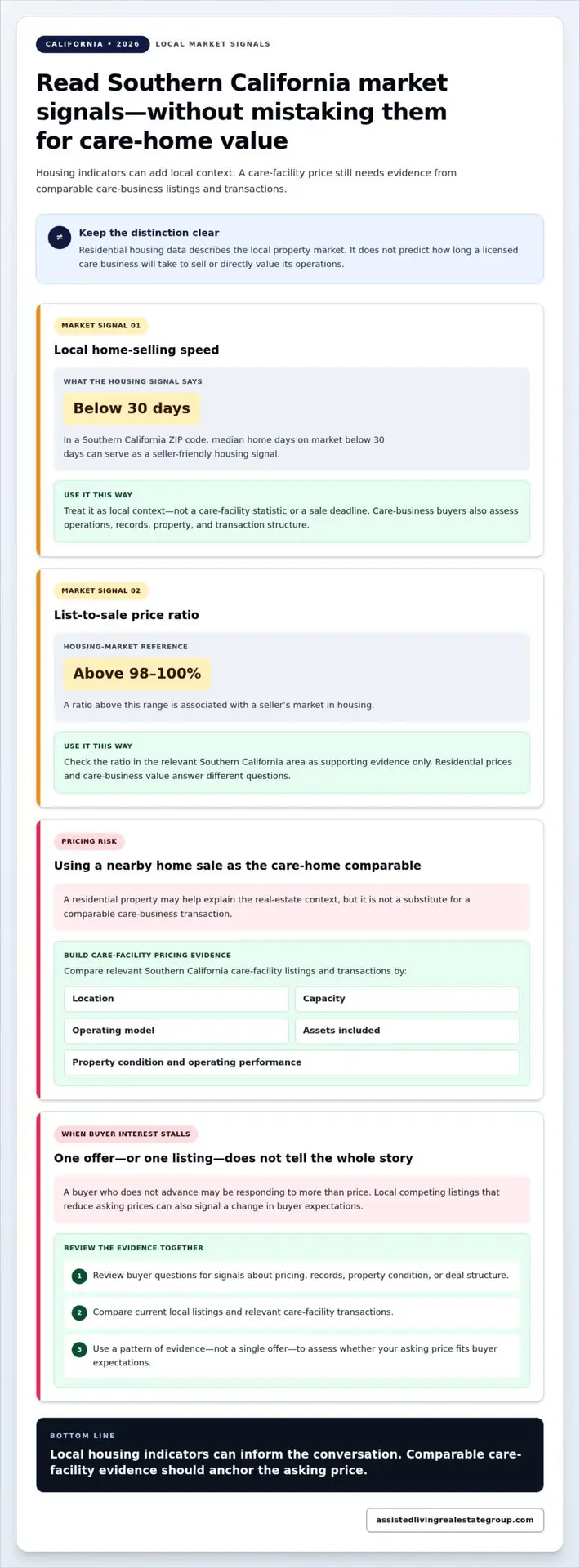
For a Southern California care home, days on market can show how buyers are responding, but it is not a sale deadline. Begin with the facility’s local area and compare its market exposure with similar opportunities. Residential housing data can provide context, but it cannot predict how long a licensed care business will take to sell.
In a Southern California ZIP code, median home days on market below 30 days can serve as a seller-friendly housing signal. Treat it as local context, not a care-facility statistic. Buyers assessing a care business also consider its operations, records, property, and transaction structure. A longer home-selling period may signal that residential buyers have more time to compare, but it doesn’t determine the facility’s value.
Another local signal is the list-to-sale price ratio. A ratio above 98-100% is associated with a seller’s market in U.S. housing. For a Southern California property, examine the ratio in the relevant local area and treat it as supporting evidence, not a direct valuation of the care operation. Residential prices and business value answer different questions.
Build pricing evidence from comparable Southern California care-facility transactions and listings. Compare location, capacity, operating model, and the assets included in the sale, then account for differences in property condition and operating performance. A nearby residential property may help explain the real estate context, but it is not a substitute for a comparable care-business transaction.
Set a competitive asking price and document how it relates to the comparisons. If buyers show interest but do not advance, review their questions for signals about pricing, records, property condition, or deal structure. If comparable local listings reduce their asking prices, consider whether your original positioning fits current buyer expectations. Use a pattern of evidence, not a single offer, to guide your response.
Tax treatment depends on the transaction structure and the assets involved. In the United States, the allocation between real estate and business assets, tax basis, depreciation, and ownership structure can affect taxable gain. California and federal tax consequences may both apply, so include tax planning in the sale process.
Before adjusting the asking price, compare current Southern California competition, relevant completed sales, and the quality of buyer interest. A confidential marketing strategy can help protect sensitive operating details while presenting the opportunity to suitable buyers. Explore confidential sale planning as you prepare the facility for market.
Local market analysis
Southern California is not one uniform market. A care home in Los Angeles may attract different buyers from a facility in San Diego, Orange County, or an inland community. Define the facility’s realistic buyer catchment area by considering where operators work, which communities they serve, and whether nearby facilities compete for similar residents. Use local evidence to shape the sale strategy.
Map nearby alternatives before assessing demand. Review active care-facility listings, recent transactions, and facilities withdrawn from the market. Note each facility’s location, capacity, operating model, and whether the sale includes a business, property, or both. These details show which options buyers may compare. A farther facility with similar capacity and services may be a more useful comparison than a nearby listing with a different operating model.
Then identify which buyers are active in the area. Existing operators may value expansion near their current operations, while new entrants may focus on a community they already understand. Compare incoming inquiries with the facility’s location and profile. If most interest comes from buyers seeking a different region or scale, refine the marketing audience before treating that response as evidence of weak demand.
A local real estate agent can explain housing activity around the property, but residential sales alone do not establish a care business’s value. Review nearby housing inventory, pending sales, and buyer affordability as context for the property component, then examine care-sector listings and transactions separately. For example, active home sales in Orange County may provide context, but they do not prove demand for a specific care facility. Similarly, while standard commercial and residential assets are often bought and sold through auction houses like Auction Property Ltd, licensed care environments require separate evaluation of staffing, licensing, and resident continuity.
Build a local evidence file before setting strategy:
- Location: Record the city, surrounding communities, access routes, and nearby services relevant to residents and staff.
- Competition: Track comparable facility listings, their asking terms, and whether they remain active or change position.
- Buyer fit: Match likely operators to the facility’s capacity, service model, and current operating profile.
- Market response: Review inquiry quality, viewing requests, and the questions buyers continue to raise.
Revisit the analysis as conditions change. If competing Southern California listings increase, buyers may compare more closely and negotiate harder. If suitable alternatives become scarce, a well-documented facility may stand out, especially when its operating profile fits local demand. Adjust the marketing emphasis as evidence shifts rather than making a broad price change based on one inquiry or a nearby property that is not a close comparison.
A useful local comparison answers three questions: who is the likely buyer, what alternatives can they consider, and why is this facility relevant? This approach turns Southern California market observations into practical decisions about positioning, timing, and the terms sellers are prepared to discuss.
Property condition and presentation
In California, a care home’s physical condition shapes how buyers assess the property and the operating opportunity. Prepare for both online presentation and in-person visits. Clear photographs, orderly spaces, and consistent maintenance help buyers understand the facility’s layout before evaluating its business performance.
Walk through every area a buyer may see, from shared rooms to outdoor spaces. Address visible maintenance issues, deep-clean high-use areas, and remove clutter that obscures circulation or room function. For example, a crowded common room can make the space seem smaller and harder to assess. Keep resident privacy and daily operations central throughout preparation.
Presentation should communicate care, safety, and practical use without hiding the facility’s true condition. Use neutral paint where needed, refresh worn carpets, and update dated light fixtures or cabinet hardware when these changes improve the overall impression. A polished finish can help position the property competitively, but buyers will still review the building, equipment, and operating records during due diligence.
Prepare the facility for digital review as carefully as you would for an in-person visit. Professional photographs should accurately show the entrance, common areas, bedrooms, dining space, kitchen, and outdoor areas. Remove personal items and sensitive documents from view. Ensure every image reflects the facility’s current condition so buyers encounter a consistent impression during a tour.
Consider how each room’s layout supports daily routines. Present the dining area as a usable shared space, and show a bedroom’s actual dimensions and storage. Buyers may compare these features with other California facilities, so describe upgrades, limitations, and included equipment clearly. Accurate presentation gives both sides a stronger basis for negotiation.
Mortgage rates can affect buyers’ affordability and financing choices, but physical condition is a separate part of their evaluation. Owners selling a care property should distinguish cosmetic work from repairs that could affect function or buyer confidence. Prioritize issues that obstruct a tour, create uncertainty, or make the facility’s condition difficult to judge. Do not assume the most expensive renovation will produce the strongest position.
Before marketing, use a practical preparation sequence:
- Inspect: Walk the property inside and outside, noting maintenance needs and worn finishes.
- Prepare: Clean, declutter, and complete targeted updates that improve clarity and presentation.
- Document: Gather current photographs and describe the facility’s layout and condition accurately.
- Review: Assess every space online and in person, then correct any mismatch.
A clean, well-presented California facility makes its strengths easier to recognize. The aim is not to promise a particular offer, but to help buyers judge the property fairly and focus their questions on meaningful operational and transaction details.
What is the 2026 outlook for selling U.S. nursing homes and assisted living facilities?
For Southern California sellers, the 2026 outlook depends on the exact facility type, its operating record, and the buyers it can serve. Los Angeles, Orange County, and San Diego are distinct local markets, so a broad national trend cannot establish demand for a particular facility. Assess the opportunity locally, using comparable care businesses and relevant buyer interest rather than general housing headlines.
Facility categories matter. A nursing home, RCFE, ARF, hospice, and home health agency are not interchangeable transactions. Their operating models and regulatory considerations differ. Before preparing a sale, describe the facility’s licensed category and services accurately. This helps prospective buyers assess whether the opportunity fits their plans and prevents market signals for one type of operation from being applied to another.
For hospice and home health agencies in California, 2026 brought heightened CMS screening for certain newly enrolling or changing-ownership providers. This is relevant to those agency types, not a blanket description of the Southern California assisted living market. Sellers should keep the facility’s category clear in marketing materials and organize records relevant to its actual services and ownership history.
A useful local market review can examine several separate questions:
- Buyer fit: Identify whether likely purchasers are existing operators, new entrants, or investors seeking a specific care model.
- Operating evidence: Present financial and operational records that explain performance and support buyer diligence.
- Property function: Show how the building’s layout and condition serve the facility’s current operation.
- Transaction readiness: Identify ownership, licensing, and transition matters that could shape the buyer’s review.
Compare these factors across the facility’s relevant Southern California area. A buyer considering an Orange County RCFE may have different priorities from an operator evaluating a Los Angeles nursing home. The facility’s scale, service model, operating history, property, and buyer strategy all influence how the opportunity is assessed. Keep these factors distinct rather than relying on a single regional label.
For owners, the practical 2026 outlook is a case-by-case sale strategy grounded in local evidence. Track the types of buyers engaging with comparable opportunities, note which questions recur, and adapt the presentation to the facility’s actual strengths. This creates a clearer basis for decisions about timing and positioning while keeping Southern California market conditions separate from national housing trends and unrelated care sectors.
Assisted Living Real Estate Group: RCFE Sales (Residential Care Facilities for the Elderly)
Assisted Living Real Estate Group supports California owners and buyers with RCFE sales, focusing on both the real estate and business operations involved in a care-facility transaction. Turn to the team when assessing sale readiness, preparing to bring a facility to market, or evaluating a turnkey acquisition.
For sellers, Assisted Living Real Estate Group’s confidential marketing strategy helps protect sensitive operating information while presenting the opportunity to qualified buyers. The firm also handles ARF sales for Adult Residential Facilities and drug and alcohol recovery facility sales. Start by clarifying your objective and organizing the facility’s records to help define the right transaction path.
If you are considering a California care-facility sale or acquisition, contact Assisted Living Real Estate Group to discuss your next step.
Make your next move with a clear plan
The market conditions for selling a care home in 2026 make preparation a strategic decision, not simply a matter of choosing a listing date. For California owners, the next step is to define what a successful transition should protect: the business’s value, continuity for residents, or a path for the right operator to build on its foundation. That objective can guide how you position the opportunity and assess buyer interest.
Assisted Living Real Estate Group supports California transactions through RCFE Sales (Residential Care Facilities for the Elderly), ARF Sales (Adult Residential Facilities), and Turnkey Business Acquisitions. Whether you are considering a sale or exploring an acquisition, align your next steps with the facility’s operating profile and your long-term goals.
Contact Assisted Living Real Estate Group to discuss a California care-facility transaction. With a thoughtful plan, you can move forward with confidence and help create a strong next chapter for the business and the people it serves.
Frequently Asked Questions
How Do State Regulations Affect Your Sale?
California regulations can shape which records buyers review and how a transaction is structured. Start by identifying the facility’s exact category, such as an RCFE, ARF, nursing home, hospice, or home health agency. Licensing and ownership considerations vary by category. For a Southern California sale, organize facility-specific licensing and operating records early, and avoid applying rules for one care model to another.
What Does This Mean for Owners Considering a Sale?
Treat sale preparation as an operating decision, not just a listing decision. Define whether your priority is a full exit, continuity for residents, or a transition to a new operator. Then consider how to present the business to buyers without disrupting daily care. For a Southern California facility, a clear transition plan helps prospective buyers understand what they are acquiring and how operations may continue.
What are current valuation multiples and sale prices for U.S. care homes in 2026?
There is no single reliable valuation multiple or sale price for every California care home. A buyer may weigh normalized earnings, property value, occupancy, operating costs, facility condition, and the assets or operations included in the transaction. Compare facilities with similar care models and locations, then distinguish business value from real estate value. This gives owners a more useful basis for evaluating offers than a broad national benchmark.
How do nursing home and assisted living facility valuations differ by type and size?
Valuation depends on the care model, operating profile, property, and buyer’s intended use. A nursing home and an assisted living facility shouldn’t be treated as interchangeable assets. Size also affects the potential buyer pool and operating economics: a 6-bed residential home may attract a different buyer than a 30+ bed assisted living center. In Southern California, compare facilities with similar capacity, services, and operating structure.
Which states and local markets have the strongest demand for care home acquisitions in 2026?
This article focuses on California, where demand can vary across Southern California by city, facility type, and buyer strategy. Sellers can assess their local market by tracking comparable care-facility offerings, buyer inquiries, tour requests, and whether prospective buyers match the facility’s scale and operating model. A broad housing trend alone cannot establish demand for a specific care business or location.
What financial, operational, and regulatory documents should a seller prepare before listing a care home?
Prepare a buyer-ready file with financial statements, tax records, revenue and expense details, occupancy information, staffing records, property documents, equipment lists, and relevant licensing materials. Include contracts and records that explain ongoing obligations or recent operational changes, while protecting sensitive resident information. For a Southern California facility, organized records help buyers assess the business consistently and identify due diligence questions before they cause avoidable transaction delays.
What federal and state approvals, licensing rules, and change-of-ownership requirements apply to care home sales?
Applicable requirements depend on the facility’s license category, services, ownership structure, and transaction terms. Assess a California RCFE or ARF sale under that facility’s licensing framework, not assumptions drawn from another care sector. Federal Medicare rules may be relevant to certified agencies, while state licensing considerations can apply to residential facilities. Identify the exact operation and ownership change before setting a closing plan.
How do occupancy, reimbursement rates, staffing costs, and labor shortages affect care home valuations?
Occupancy and operating performance inform buyers’ assessment of cash flow, while staffing continuity can affect their view of operational and transition risk. The material gives no specific basis for assessing reimbursement rates, staffing costs, or labor shortages.