
What makes assisted living appealing during a downturn can also lead investors to underestimate its risks. In California, an aging population may support long-term demand, but that does not guarantee dependable revenue for a particular facility. So, is assisted living a recession-proof investment? No investment is immune to pressure. Senior-care demand does not erase the effects of vacancies, staffing costs, operating expenses, or families’ ability to pay.
The appeal is real: care facilities address an essential need, and California’s demographic trends may create a durable foundation for opportunity. But resilience depends on more than the sector. A facility’s location, business performance, property condition, staffing model, and transaction structure all shape how it may fare in an economic slowdown.
This guide helps you distinguish the promise of California’s assisted living market from the risks of a specific opportunity. You’ll learn what recession resistance can and cannot mean, how to assess business, property, and operating factors together, and which downside scenarios to examine before pursuing an acquisition. The aim is not to predict a downturn. It is to evaluate an opportunity with discipline, protecting your investment thesis while considering the quality of care the facility is positioned to support.
Key Takeaways
- The answer to “is assisted living a recession-proof investment” depends on the specific California facility, not demand trends alone.
- Assess occupancy, resident mix, revenue collection, and operating margin separately to identify where performance may come under pressure.
- Compare smaller residential care settings with larger operations, and weigh the different risks of owning the business and real estate versus leasing to an operator.
- Stress-test potential changes in occupancy, expenses, staffing, and collections using facility records. Keep assumptions separate from verified facts.
- A well-considered opportunity needs facility-specific evidence, a workable operating plan, and a risk profile that fits your investment capacity.
Is Assisted Living a Recession-Proof Investment in California?
No. Assisted living may benefit from resilient demand because care needs do not disappear when the economy slows. But is assisted living a recession-proof investment has no guaranteed answer for a particular California facility. Demand is only one part of the equation. A prospective resident must find a suitable setting, and the facility must turn interest into occupancy, collect revenue, manage costs, and sustain operations.
For a California investor, that distinction matters. A sector can meet an enduring need while an individual Residential Care Facility for the Elderly (RCFE) faces vacancies, rising expenses, or operating challenges. Resilience describes a possible buffer, not a promise of stable performance. It does not guarantee occupancy, cash flow, returns, or resale value.
What recession resilience means for an assisted living investor
Recession resilience is a facility’s relative ability to sustain demand or continue operating through economic pressure, not a guarantee of financial results. Care needs may support interest, but a household’s finances can affect the timing, affordability, and choice of setting. Look beyond the general need for care: examine the business serving residents, the property supporting it, and the local market where it competes.
These factors vary from one California facility to another. Location, resident profile, operating model, staffing capacity, and management all affect performance. An attractive market does not automatically offset a business that struggles to retain residents or control expenses. Likewise, a capable operator cannot eliminate property, financing, or resale risk.
Why California facility performance still varies
California is not one uniform market. Local competition, household affordability, operating costs, and a property’s suitability for its intended use can all shape facility performance. These are factors to investigate, not proof that any location or care business will remain stable during a downturn. Start with the specific opportunity rather than treating statewide demand as a substitute for facility-level evidence.
Assess the care business and real estate separately, then consider how they work together. The operating business may generate revenue from resident services, while the property has its own condition, use, and market-value considerations. Operations can face pressure even if the property remains usable, and real estate value does not ensure the operator can sustain the business. Before pursuing an acquisition, understand how the business and property fit into the transaction.
California assisted living facilities operate within a state-specific licensing context. Review the requirements that apply to a particular opportunity using current, reliable California sources. Check licensing terminology and operating details against up-to-date information. A specialist California brokerage can help buyers assess the business and real estate together, while distinguishing investment potential from any guarantee of performance.
What Drives Assisted Living Demand and Revenue During a California Downturn?
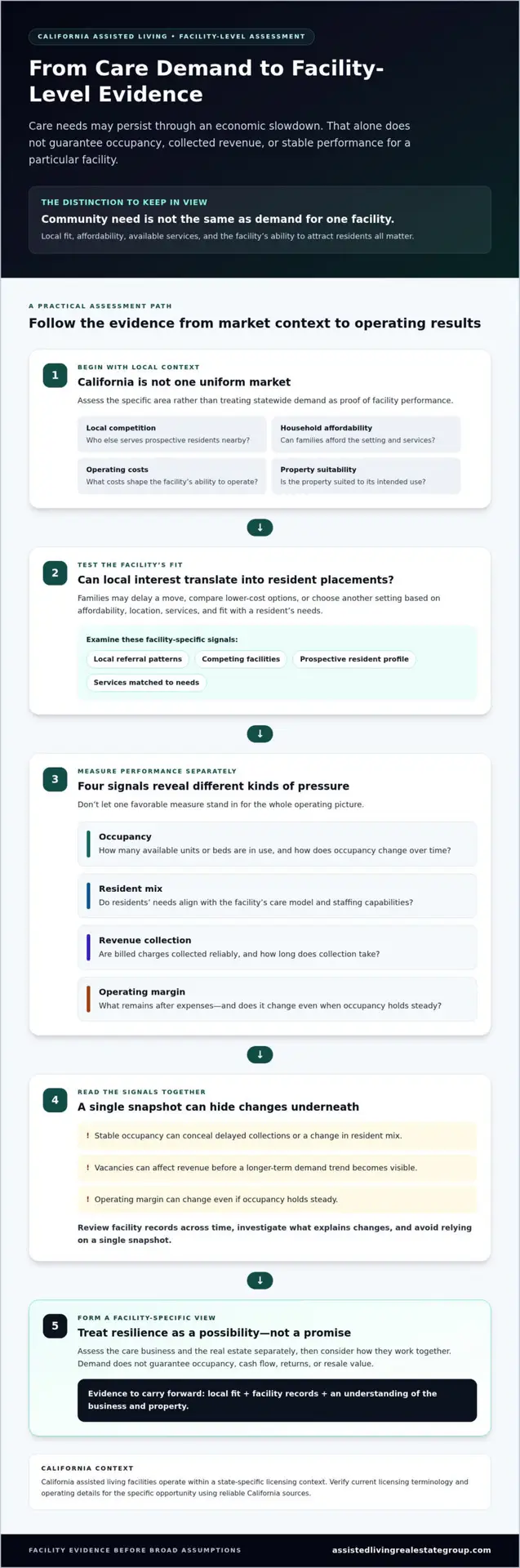
One question needs a facility-level answer: is assisted living a recession-proof investment? Care needs may persist through an economic slowdown, but demand for care does not automatically become demand for a particular California facility. Families may delay a move, compare lower-cost options, or choose another setting based on affordability, location, available services, and fit with a resident’s needs.
Demand can remain while occupancy and revenue change
Demographic need provides context, not an occupancy forecast. To understand how interest turns into revenue, examine local referral patterns, competing facilities, the prospective resident profile, and whether the care offered fits the needs of people seeking placement. A facility may have available capacity even where local demand exists if it is not reaching the right families or its services do not match their requirements.
Demand for care describes a community need; demand for one facility depends on its local fit, affordability, and ability to attract residents. This distinction helps prevent broad market trends from being mistaken for proof of a property’s performance.
Track four measures separately:
- Occupancy: How many available units or beds are in use, and how occupancy changes over time.
- Resident mix: The types of residents served and whether their needs align with the facility’s care model and staffing capabilities.
- Revenue collection: Whether billed charges are collected reliably and how long collection takes.
- Operating margin: What remains after expenses, which can change even if occupancy holds steady.
A stable occupancy figure can conceal delayed collections or a change in resident mix. Vacancies can also affect revenue before a longer-term demand trend becomes visible. Review facility records across time, investigate what explains changes, and avoid relying on a single snapshot.
Operating costs can pressure performance in a downturn
Demand does not keep expenses steady. Staffing continuity and expense management matter because labor, food, insurance, maintenance, and compliance-related costs all affect operating results. If these expenses rise faster than collected revenue, margins can narrow even while residents continue to need care. At the same time, cutting expenses without considering staffing capacity or service delivery can strain operations. Review costs in the context of the facility’s ability to maintain appropriate operations.
For a California opportunity, examine actual facility records and label expense assumptions as documented, variable, or unknown. Compare periods consistently, note unusual items, and do not substitute statewide generalizations for the property’s own history. Consider local competition and household affordability as well: a facility may face pressure on both revenue collection and expenses at once.
Investors assessing a potential purchase can use California RCFE acquisition guidance to consider the operating business alongside the property and transaction structure. This integrated view cannot eliminate uncertainty, but it can help clarify the sources of risk before moving forward.
How Do California Assisted Living Investments Compare by Facility and Structure?
California care-facility opportunities differ in scale and ownership structure. A smaller residential care setting may have a more concentrated operation, while a larger assisted living facility may involve broader staffing and management demands. Neither format is inherently safer. Exposure depends on the specific RCFE, its operating history, local competition, resident fit, and the responsibilities included in the transaction.
Smaller RCFEs and larger assisted living facilities
Scale changes the questions to ask, not the need for due diligence. In a smaller home, a change in occupancy or staffing availability may affect a larger share of operations. A larger facility may have more residents and a more complex management structure, but size alone does not establish diversified risk or dependable results. Compare each opportunity using its own records and operating model.
Use this comparison as a starting point, then test it against the facility’s actual records:
Smaller residential care setting
Exposure: Changes in occupancy or staffing may have a concentrated effect on operations.
Operational complexity: Assess how management, staffing, and day-to-day responsibilities are organized.
Key diligence: Review operating history, local alternatives, resident fit, and continuity of operations.
Larger assisted living operation
Exposure: More residents or capacity do not automatically offset competition, vacancies, or operating pressure.
Operational complexity: Examine management systems, staffing coordination, and the facility’s ability to maintain consistent operations.
Key diligence: Review performance over time, resident mix, local competition, and the basis for occupancy assumptions.
For either format, distinguish a California RCFE opportunity from other asset categories. An RCFE investment involves a care-facility business and its property or lease arrangement, so it should not be evaluated as though it were simply a general residential property. Nor is an RCFE interchangeable with a different category of care facility. Confirm the facility type and transaction scope using current, reliable California-specific information.
Owning the property, the business, or both
Ownership structure determines which risks sit directly with the investor. Buying both the real estate and operating business combines property-related exposure with responsibility for business performance. When funding larger acquisitions or facility developments, property finance and private equity partners such as thefederalgroup.com can help structure the underlying real estate investment. Acquiring the business without the property creates a different profile: the operator still depends on access to a suitable facility, while the investor’s exposure is tied more directly to the business being acquired.
With a lease, the property owner’s income depends in part on the operator’s ability to meet its obligations and keep the facility operating. A lease does not remove business risk; it changes how that risk reaches the property owner. Review the lease terms, the operator’s record, and the responsibilities assigned to each party. In every structure, separate evidence from assumptions and consider how the property and business perform together.
A California RCFE buying guide can help frame transaction questions, while specialized brokerage guidance can connect property, operating, and transaction considerations. The useful comparison is not “small or large” or “owned or leased” in isolation. It is whether the specific asset, operator, and structure fit the investor’s capacity and risk tolerance.
How Should Investors Stress-Test a California Assisted Living Opportunity?
Rather than asking only is assisted living a recession-proof investment, test how a specific California facility might respond to pressure. Build the review from facility records, then distinguish documented performance from assumptions about future conditions. A scenario is a decision tool, not a forecast or guarantee. If an important record is missing, flag the gap instead of filling it with an estimate.
Build a downside scenario from facility-level evidence
Start with a consistent historical picture of occupancy, revenue, expenses, staffing, and collections. Compare that record with a conservative scenario, changing one assumption at a time where possible. This can show which pressures may compound and which information you still need to form an investment view.
- Test occupancy. Use the facility’s verified capacity, occupancy history, and revenue records to examine how a modest decline could affect income. Note the period covered and any unusual changes. Do not assume statewide demand will fill vacancies at this location.
- Review expenses. Separate documented expenses from forecasts. Examine labor, food, insurance, maintenance, and compliance-related costs, and identify which may be difficult to reduce quickly without affecting operations. If invoices, contracts, or expense history are incomplete, record the uncertainty instead of assigning a savings estimate.
- Assess staffing and continuity. Review available staffing records, management depth, and the facility’s ability to sustain operations if key personnel leave or coverage becomes harder to maintain. Consider whether the operating plan aligns with residents’ needs. Do not treat a proposed staffing adjustment as a proven solution.
- Examine revenue collection. Compare billed revenue with amounts collected and the timing shown in facility records. Identify delays, inconsistencies, or assumptions about future collections. Occupancy and billed revenue alone do not establish how much cash the business receives or when.
Assess operational and California-specific exposure
Next, determine what the records establish about the facility and its operating context. Review license status through current California sources, and assess applicable licensing and regulatory questions using up-to-date information. Requirements can change, so do not rely on outdated summaries or assume that past operating history alone establishes current compliance.
Keep a simple evidence log: mark each input as verified, assumed, or missing, and record its source and date. A recorded expense, for example, is different from a projected expense reduction. An occupancy history is different from an expectation that referrals will increase. This separation makes the analysis more transparent and helps identify which uncertainties could change the investment decision.
Stress-testing is most useful when it considers the business, property, transaction structure, and operating continuity together. For a California opportunity, discuss RCFE transaction guidance to bring those facility-specific considerations into the acquisition review. The goal is not to remove uncertainty, but to understand where it sits before committing capital.
When Does a California Assisted Living Investment Make Sense?
A California assisted living opportunity may merit further consideration when facility-level records support the investment case, the operating model is clear, and the buyer can manage the responsibilities involved. A broad need for care is not enough. The decision should reflect the specific property, business, transaction structure, and risks the investor can reasonably carry.
A decision framework for a prospective California buyer
Start with fit. Match your goals and operating capacity to the facility’s scale and structure, whether the opportunity involves the business, the real estate, or both. Then test the case against verifiable information, not just seller expectations or general market appeal. A Southern California senior housing investment guide can provide a regional lens, but the facility’s own evidence should anchor the decision.
- Investment fit: Identify the role you expect to play and whether you have the resources and experience to oversee the facility’s business structure.
- Evidence quality: Look for consistent operating and property records that support key assumptions. Separate verified facts from projections, and identify material gaps before relying on them.
- Operating model: Understand how the facility serves its resident profile, how responsibilities are assigned, and what continuity depends on the operator, management, and property.
- Downside capacity: Consider whether your risk tolerance and financial capacity can accommodate weaker performance or unexpected operating demands without assuming a quick recovery.
Warning signs do not automatically make an opportunity unsuitable, but they call for closer analysis. Incomplete records, unclear responsibility between owner and operator, unexplained changes in performance, or assumptions that depend on uninterrupted occupancy can weaken an investment thesis. Treat missing information as a diligence issue, not as proof that the most favorable outcome will occur.
How specialized brokerage can support the next step
Specialized California brokerage guidance helps buyers assess a care-facility transaction with both the operating business and real estate in view. This perspective is especially relevant when the deal structure affects who carries property responsibilities, operating exposure, and continuity concerns. Brokerage support can clarify transaction context and facility fit, but it does not replace legal, licensing, financial, or operational review.
Assisted Living Real Estate Group provides California care-facility brokerage across business and real-estate transactions. The aim is to clarify the opportunity, its structure, and the questions that remain, not to promise returns or protection from a downturn. A sound decision depends on the evidence, your ability to execute, and your tolerance for risk.
If you’re weighing a California RCFE or related care-facility opportunity, discuss a California care-facility investment with our team.
Move Forward With a Clear California Investment Thesis
Before advancing a California care-facility opportunity, decide what evidence you need to proceed and which unanswered questions would make you pause. A sound investment decision does not require certainty. It requires clear assumptions, a realistic view of your operating capacity, and defined limits for the risks you are willing to take.
Ask yourself: is assisted living a recession-proof investment for this particular California opportunity? Let the facility’s records, transaction structure, and your investment objectives shape the answer. Turn your analysis into a focused transaction plan rather than relying on the sector’s appeal alone.
Assisted Living Real Estate Group brings over 25 years of combined care-facility industry experience to its brokerage work. Owners considering a sale can use the company’s confidential marketing strategy. This specialized perspective can help clarify a consequential decision involving a California care business and its real estate.
Explore a California care-facility investment with our team and take your next step with an informed view of the opportunity.
Frequently Asked Questions
Is assisted living a recession-proof investment?
No. The question “is assisted living a recession-proof investment” has no universal yes. In Southern California, care needs may support interest, but a specific facility can still face operating or property-value pressure. Make the analysis more useful by checking whether the purchase case holds under less favorable assumptions, then identify the evidence behind each assumption before pursuing a transaction.
Can assisted living demand stay strong while a facility struggles financially?
Yes. Families may be seeking care in a Southern California community while a particular facility struggles to turn inquiries into move-ins or collect payments on time. Review the path from inquiry to admission alongside receivables and cash records. If inquiries are steady but admissions lag, investigate whether affordability, the facility’s positioning, or a mismatch between residents’ needs and the setting may be affecting results.
Does assisted living usually perform better than other investments during a recession?
There is no reliable universal rule that assisted living outperforms other investments during a recession. Results depend on the individual asset, operator, transaction terms, and the comparison being made. For a Southern California opportunity, compare investments using a consistent time frame and measures such as operating cash flow, capital needs, value changes, and how readily an asset can be sold. Do not treat sector demand as proof of superior performance.
What California data should an investor review before buying an assisted living facility?
Start with facility-specific records: occupancy history, operating statements, resident receivables, payroll, insurance renewals, maintenance records, and the basis for projected revenue. Compare these with current California licensing information and available facility records from state sources. For a Southern California property, examine local competition and relevant market conditions as well. Record each item’s source and date so older information is not mistaken for a current operating picture.
Can a California RCFE investment lose value during a recession?
Yes. An RCFE’s real estate or operating business may lose value if market conditions, property condition, or business performance weaken. These are separate considerations: a facility may face operating pressure while its real estate is assessed separately, or a property may need work that affects buyer interest. For a Southern California transaction, compare valuation assumptions with current property evidence and the business’s documented performance.
Should investors focus on the facility’s real estate or its operating business?
Assess both, even if the transaction emphasizes one. A buyer focused on a Southern California property should still understand whether its intended care-facility use aligns with the operating arrangement. A buyer focused on the business should understand the premises it relies on and the terms governing access. Reviewing the components separately and then together can reveal dependencies that a single headline valuation might obscure.
Does California licensing make an assisted living investment recession-proof?
No. Licensing relates to the facility’s California operating context; it does not guarantee resident demand, collections, margins, property value, or resale prospects. Before an acquisition, distinguish the facility’s current status from the financial case for buying it. Review relevant records through current California sources. A licensing review and an investment analysis answer different questions, so neither should replace the other.