
The California care market can feel impenetrable. Opaque licensing requirements, the high barrier to entry in Southern California, and the constant fear of Title 22 non-compliance stop countless investors before they even begin. But for the savvy entrepreneur, these challenges signal a profound opportunity, not a dead end. Finding the right intermediate care facility for sale is the key to unlocking a powerful combination of both impact and income-a chance to build a lasting legacy while generating significant returns.
This guide is your exclusive roadmap. We will demystify the entire acquisition process, providing a clear path to identifying high-potential properties, evaluating their Medi-Cal reimbursement structures, and navigating California’s unique regulatory landscape with confidence. Consider this your definitive resource for transforming a complex market challenge into your next high-yield, high-impact investment in the Golden State.
Key Takeaways
- Differentiate between California’s Title 22 and Title 17 regulations to ensure your ICF acquisition is compliant and positioned for success.
- Master the use of Cap Rate analysis and the EBITDAR valuation method specifically tailored for Southern California’s high-yield care market.
- Uncover the strategic process for locating and securing a high-potential intermediate care facility for sale in California hotspots like the San Fernando Valley.
- Discover the advantage of using a specialized California care broker to gain access to exclusive, off-market listings and navigate high-barrier-to-entry markets.
Understanding the Intermediate Care Facility (ICF) Market in California
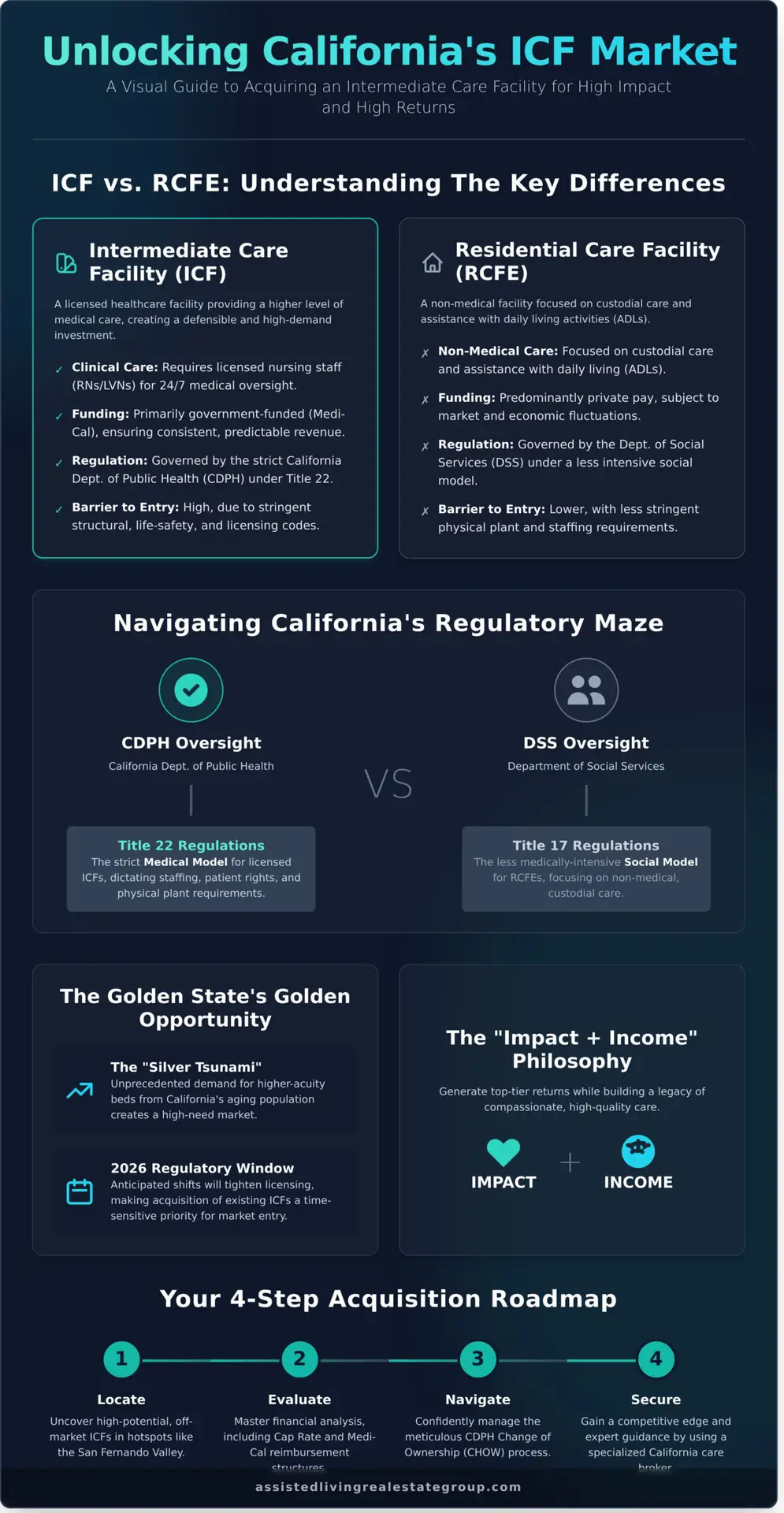
The California senior care landscape is a complex continuum, and for the savvy investor, the Intermediate Care Facility (ICF) represents a strategic position between lower-acuity Residential Care Facilities for the Elderly (RCFE) and high-dependency Skilled Nursing Facilities (SNF). This is not just real estate; it’s a high-demand healthcare asset class. With the state’s “Silver Tsunami” creating unprecedented demand for higher-acuity beds, the window of opportunity is closing. Regulatory shifts anticipated by 2026 are expected to tighten licensing and development, making the acquisition of an existing intermediate care facility for sale a time-sensitive priority for market entry.
Within this category, it’s crucial to distinguish between two primary models. The most common are facilities for the geriatric population, providing 24-hour personal and nursing care. The other major segment is Intermediate Care Facilities for Individuals with Intellectual Disabilities (ICF/DD), which serve a different demographic under specific state and federal programs. Understanding the operational, staffing, and reimbursement nuances between these is the first step toward a successful investment.
ICF vs. RCFE: Core Differences for Investors
The distinction is not subtle-it’s foundational to your business model and ROI. An RCFE provides non-medical, custodial care. An ICF, by contrast, is a licensed healthcare facility mandated by the California Department of Public Health (CDPH) to provide a higher level of care. Key differences include:
- Clinical Requirements: ICFs require licensed nursing staff (RNs/LVNs) to provide medical oversight, whereas RCFEs are focused on assistance with daily living activities (ADLs).
- Reimbursement Models: While RCFEs are predominantly private pay, ICFs are heavily integrated with government funding, primarily Medi-Cal, providing a consistent and predictable revenue stream.
- Structural & Licensing: ICFs face more stringent structural and life-safety code requirements, creating a higher barrier to entry but also a more defensible market position.
The “Impact and Income” Philosophy
The senior housing crisis in Southern California is not a problem; it’s a blue ocean opportunity. The market is saturated with institutional, low-touch facilities, leaving a significant gap for high-quality, boutique care environments. This is the core of our “Impact and Income” philosophy-a strategy that allows you to generate top-tier financial returns while creating a legacy of compassionate care. By focusing on a smaller, more intimate setting, you deliver a superior quality of life for residents and a premium investment vehicle for your portfolio. This boutique advantage is precisely what today’s families are searching for when seeking an intermediate care facility for sale, and it’s the key to dominating a niche market poised for explosive growth.
Navigating California’s Regulatory and Licensing Landscape
In the world of senior care real estate, capital is rarely the highest barrier to entry. The true gatekeeper is regulatory compliance. When you find an attractive intermediate care facility for sale in California, your success hinges on mastering the state’s complex licensing framework. This isn’t just bureaucratic paperwork; it is the foundational element that protects your investment, ensures resident safety, and ultimately secures your ability to operate. The entire process is governed by the California Department of Public Health (CDPH), a far more stringent body than many investors are accustomed to.
Successfully acquiring a licensed facility requires navigating the state’s meticulous “Change of Ownership” (CHOW) process. This is a non-negotiable, multi-stage application that transfers the operating license from the seller to you. Unlike other real estate transactions, the deal is not done until the CDPH grants its approval. This process is governed by Title 22 of the California Code of Regulations, which dictates everything from patient rights and staffing to physical plant requirements-a stark contrast to the less medically-intensive Title 17 regulations that may apply to other facility types.
CDPH vs. DSS: Who Governs Your Facility?
A critical distinction for investors is understanding who holds jurisdiction. The Department of Social Services (DSS) oversees Residential Care Facilities for the Elderly (RCFEs), which operate on a social, non-medical model. Intermediate Care Facilities (ICFs), however, fall under the strict medical oversight of the CDPH. This is because ICFs serve residents with more significant health needs, mandating higher, state-regulated nurse-to-patient staffing ratios and a clinical infrastructure that RCFEs simply do not require.
Avoiding Common Licensing Pitfalls
The path to licensure is fraught with potential delays that can jeopardize a transaction. As we look toward 2026, we anticipate continued scrutiny on operational plans and proof of financial viability. The single most important piece of due diligence is reviewing the facility’s historical “Statement of Deficiencies.” A long record of violations is a major red flag for the CDPH and can significantly complicate the CHOW process. Before closing, it is imperative to verify the facility’s current license status and compliance history directly through the CDPH portal. Understanding industry benchmarks, like those found in the CAHF Facts & Statistics, provides crucial context for a facility’s performance and compliance record. Common reasons for application rejection or delay include:
- Incomplete financial disclosures or an insufficient operational budget.
- Failure to address a previous owner’s outstanding compliance issues.
- An inexperienced management team lacking the required credentials.
Evaluating Financial Performance and ROI for ICFs
Unlocking the financial potential of an Intermediate Care Facility (ICF) requires a valuation approach that goes far beyond typical real estate metrics. While a property’s cap rate in the competitive Southern California market provides a baseline, the true value lies in the synergy between the real estate and the operating healthcare business. Investors must look past simple property assessments and adopt the industry-standard EBITDAR (Earnings Before Interest, Taxes, Depreciation, Amortization, and Rent) model. This method provides a clear picture of the facility’s operational health, separating the business enterprise value from the physical asset value and revealing the true engine of your return on investment.
Medi-Cal Reimbursement Strategies
For ICF/DD (Developmentally Disabled) facilities, California’s Medi-Cal program is the cornerstone of financial stability. Unlike private-pay models susceptible to market fluctuations, Medi-Cal provides a consistent, government-backed revenue stream. Strategic investors stay ahead of projected state rate increases, such as the ongoing rate reforms, to accurately forecast future revenue. Understanding the split between “Room and Board” charges and higher-margin “Care” services is also critical, as this directly influences profitability and the facility’s capacity for delivering high-quality, boutique care.
Due Diligence: Financial Red Flags
When you find an attractive intermediate care facility for sale, a deep dive into the financials is non-negotiable. In California, several key areas demand scrutiny:
- Labor-to-Revenue Ratio: With California’s high minimum wage, labor can consume 60-70% of revenue. An abnormally high ratio may signal operational inefficiency or understaffing risks.
- Hidden Insurance Costs: Don’t overlook the significant expense of workers’ compensation and professional liability insurance. These policies are essential safeguards but can dramatically impact your net operating income if not properly budgeted.
- Compliance Upgrade Costs: The seller’s financials may not reflect necessary capital expenditures. Calculating the cost of required upgrades to meet current licensing standards is crucial. This includes ensuring the property aligns with the detailed California DDS Program Plan Requirements, which govern everything from resident care protocols to physical plant specifications.
Thorough due diligence transforms a potential investment into a predictable asset, paving the way for achieving both profound impact and impressive income.
Market Spotlight: Southern California Geographic Opportunities
Southern California represents a blue ocean of opportunity for savvy investors in the intermediate care and recovery space. The demographic tide is turning, creating unprecedented demand in a market with high barriers to entry. Success here isn’t about finding a property; it’s about understanding the unique operational and regulatory DNA of each sub-market. From the high-density hubs of Los Angeles to the affluent enclaves of Ventura County, each area presents a distinct pathway to achieving both impact and income.
Van Nuys and Carson: High Occupancy Hubs
The San Fernando Valley and South Bay are epicenters of demand, driven by dense populations and proximity to world-class medical institutions. When an intermediate care facility for sale lists near hubs like UCLA Medical Center or Cedars-Sinai, it’s tapping into a direct pipeline of patient referrals requiring step-down care. Navigating the local landscape requires a nuanced understanding of zoning, as the requirements differ dramatically:
- 6-Bed Facilities: Often fall under state-level RCFE (Residential Care Facilities for the Elderly) zoning permissions, allowing for conversion of single-family homes in residential zones.
- 15+ Bed Facilities: Typically require commercial zoning and a more rigorous conditional use permit (CUP) process, presenting a greater challenge but also a significantly higher potential ROI.
Thousand Oaks and Ventura County
In high-net-worth communities like Thousand Oaks, the “boutique” care model thrives. These markets cater to a discerning, private-pay clientele willing to pay a premium for superior care, personalized attention, and high-end amenities. This allows for premium pricing strategies that generate exceptional returns. However, the rewards are protected by significant hurdles, including Ventura County’s stringent environmental regulations and fire codes-a critical consideration in hillside communities. Mastering these codes is non-negotiable for securing licensure and ensuring long-term operational success.
While affluent coastal areas present high-cost acquisitions and significant NIMBY (“Not In My Back Yard”) challenges, the new frontier is emerging inland. The search for an affordable intermediate care facility for sale is leading astute investors to Fresno and the Central Valley. Here, lower property costs combine with a growing need for quality care, creating a ground-floor opportunity for substantial growth. Whether you’re targeting the premium private-pay market or the high-demand inland corridors, success requires a strategic partner. To navigate these complex markets and unlock their potential, you need a specialized roadmap. Explore how our expertise can guide your next acquisition.
How to Secure an Intermediate Care Facility for Sale
Acquiring an intermediate care facility in California is more than a real estate transaction; it’s a strategic venture into a high-barrier, high-reward market. The path from identifying an opportunity to a successful operational handover is laden with regulatory complexities unique to our state. Success requires a specialized guide who understands both the investment potential and the profound responsibility of care. The right partner transforms this complex process into a clear roadmap for achieving your “Impact and Income” goals.
The Value of a Specialized Broker
General commercial brokers see a building; we see a licensed, operational healthcare business. They miss the critical nuances of California’s Department of Health Care Services (DHCS) licensing, staffing requirements, and resident acuity levels that define a facility’s true value and risk. Our team, led by Teri Szoke, meticulously vets every potential buyer, providing sellers with the confidence needed to open doors to exclusive, off-market opportunities. This is the advantage of leveraging 25 years of California-specific industry experience.
Your Acquisition Roadmap
Finding the right intermediate care facility for sale requires a methodical, proven approach. We guide our clients through a precise, step-by-step process designed to protect their interests and position them for success from day one. This journey begins long before you make an offer.
- Step 1: Financial Pre-Qualification. We connect you with lenders who specialize in California healthcare real estate, ensuring you are prepared with the right financing to act decisively when the perfect opportunity arises.
- Step 2: Identify Your Ideal Facility. We go beyond square footage and cap rates to find properties that align with your unique operational vision and financial targets, ensuring a perfect match for your “Impact and Income” philosophy.
- Step 3: Draft a Protective Letter of Intent (LOI). Our LOIs are crafted with specific contingencies for licensing transfers, operational due diligence, and other healthcare-related clauses that a standard real estate agreement overlooks.
Ready to begin your search? View our current Southern California listings and take the first step toward building your legacy in care.
Finalizing the acquisition is about ensuring a seamless transition. A well-structured deal prioritizes staff retention and resident continuity, protecting the facility’s operational integrity and goodwill. Whether structuring a lease-to-own agreement or a direct acquisition, our focus remains on creating a stable foundation for your long-term success, allowing you to do good while doing well.
Your Path to Impact and Income in California’s ICF Market
The opportunity within California’s care sector is undeniable, fueled by powerful demographic shifts that create a consistent, high-demand market. As we’ve detailed, true success hinges on mastering the state’s intricate regulatory landscape and performing rigorous financial due diligence to ensure long-term ROI. Finding the right intermediate care facility for sale is therefore not just a transaction; it’s a strategic move to build a lasting legacy of both profound social impact and significant income. This high-barrier-to-entry market demands more than just capital-it requires a strategic partner with a proven roadmap.
Navigating this journey alone is a risk. With over 25 years of combined experience focused exclusively on California’s specialized RCFE and ARF business models, our team provides the deep expertise and confidential marketing necessary to protect your investment and ensure a seamless acquisition. We hold the keys to this niche market. It’s time to move from analysis to action. Partner with California’s Specialized RCFE & ICF Brokerage and let us guide you in securing your stake in the future of boutique care.
Frequently Asked Questions: Investing in California’s Intermediate Care Facilities
What is the difference between an ICF and an RCFE in California?
This distinction is critical for any serious investor. In California, an Intermediate Care Facility (ICF) is a licensed healthcare facility providing nursing and supportive care to patients who don’t require 24-hour hospital care. They are licensed by the Department of Public Health (CDPH). In contrast, a Residential Care Facility for the Elderly (RCFE) provides non-medical, personal care and is licensed by the Department of Social Services (CDSS). ICFs represent a higher-acuity, more specialized investment opportunity.
Can I buy an Intermediate Care Facility if I don’t have a medical background?
Yes. Many successful investors do not have clinical backgrounds. The key to success is structuring your business to include a state-licensed Administrator who manages daily operations and ensures regulatory compliance. As the owner, your focus is on the real estate asset and business strategy. When you find the right intermediate care facility for sale, your first step is to build the expert operational team that will run it, allowing you to achieve both impact and income.
How long does the licensing transfer (CHOW) take in California?
Patience and preparation are essential. A Change of Ownership (CHOW) application for an ICF with California’s Department of Public Health (CDPH) is a meticulous process. Investors should anticipate a timeline of 6 to 12 months, and sometimes longer. This period involves comprehensive financial disclosures, background checks, and operational plan reviews. Navigating this high-barrier-to-entry process successfully is what separates casual buyers from strategic, long-term investors in this lucrative space.
Are there specific financing options for buying a care facility in Southern California?
Absolutely. Lenders in Southern California who specialize in healthcare real estate offer tailored financing solutions. These often include SBA 7(a) and 504 loans, which are ideal for owner-operators. Additionally, regional banks and private lenders familiar with the stable revenue models of ICFs provide conventional commercial loans. Securing the right financial partner who understands the asset class is a crucial step in structuring a profitable and sustainable acquisition in this market.
What is a typical cap rate for an ICF for sale in 2026?
While market conditions can shift, we project that cap rates for premier California ICFs in 2026 will stabilize in the 7% to 9% range. This reflects the powerful, non-discretionary demand from the “Silver Tsunami” and the significant regulatory hurdles that limit new supply. An ICF is not a typical real estate asset; it is a high-performing business, and its cap rate reflects the security and predictability of its specialized, needs-based revenue stream.
Does California require a specific administrator certificate for ICFs?
Yes, and this requirement is non-negotiable. The administrator of an ICF in California must be licensed by the Nursing Home Administrator Program (NHAP), which operates under the CDPH. This rigorous certification involves extensive training, a supervised Administrator-in-Training (AIT) period, and passing both state and national examinations. This ensures a high standard of care for residents and protects the owner’s investment from significant compliance and liability risks.
What happens to the residents when a facility is sold?
Continuity of care is the highest priority. Under California law, resident care and rights are protected during a sale. The new owner assumes the responsibility for all existing residents, and the CHOW process itself is designed to ensure a seamless transition. A well-executed transfer preserves the quality of life for residents, maintains staff morale, and protects the facility’s reputation-a critical component of its long-term value and the core of the “doing good while doing well” philosophy.
Is Medi-Cal the primary payer for Intermediate Care Facilities?
For many ICFs, particularly those serving the developmentally disabled (ICF/DD), Medi-Cal is the dominant payer. This creates a highly stable, government-backed revenue stream that is insulated from economic downturns. When analyzing an intermediate care facility for sale, a strong Medi-Cal census is often viewed as a significant asset. It provides the predictable cash flow and financial bedrock that sophisticated investors seek in a recession-resistant, mission-driven real estate investment.