
Many California investors see the potential in high-acuity care but are stopped cold by a wall of regulation. The line between CDPH and DSS oversight blurs, ROI calculations become complex, and the path to licensing seems deliberately obscure. But what if this complexity wasn’t a barrier, but a moat? For the savvy investor, mastering the precise intermediate care facility definition is the key that unlocks one of California’s most protected and profitable real estate niches. These facilities represent a unique intersection of high-need healthcare and high-return investment-a true “blue ocean” opportunity for those equipped with the right map.
This guide is that map. We will cut through the regulatory fog to provide a clear framework for evaluating ICFs as a business acquisition. You will gain a deep understanding of the critical sub-types, from ICF/DD to the more intensive ICF/DD-N, and discover a strategic path for licensing and operations specifically tailored for the Southern California market. Prepare to transform regulatory hurdles into your competitive advantage and build a legacy of both Impact and Income.
Key Takeaways
- Grasp the official California intermediate care facility definition, focusing on 24-hour supportive care, and how it fundamentally differs from a skilled nursing facility (SNF).
- Learn to distinguish the investment models of ICFs (governed by CDPH) and RCFEs (overseen by DSS), particularly regarding Medi-Cal funding versus private pay revenue.
- Discover the “scarcity factor” in the California market that positions ICFs as a high-barrier, high-reward “blue ocean” opportunity with potentially higher cap rates.
- Uncover the complex, multi-agency licensing and zoning hurdles that protect the value of existing ICF assets and create a significant competitive advantage for informed investors.
Defining the Intermediate Care Facility (ICF) in California’s Regulatory Landscape
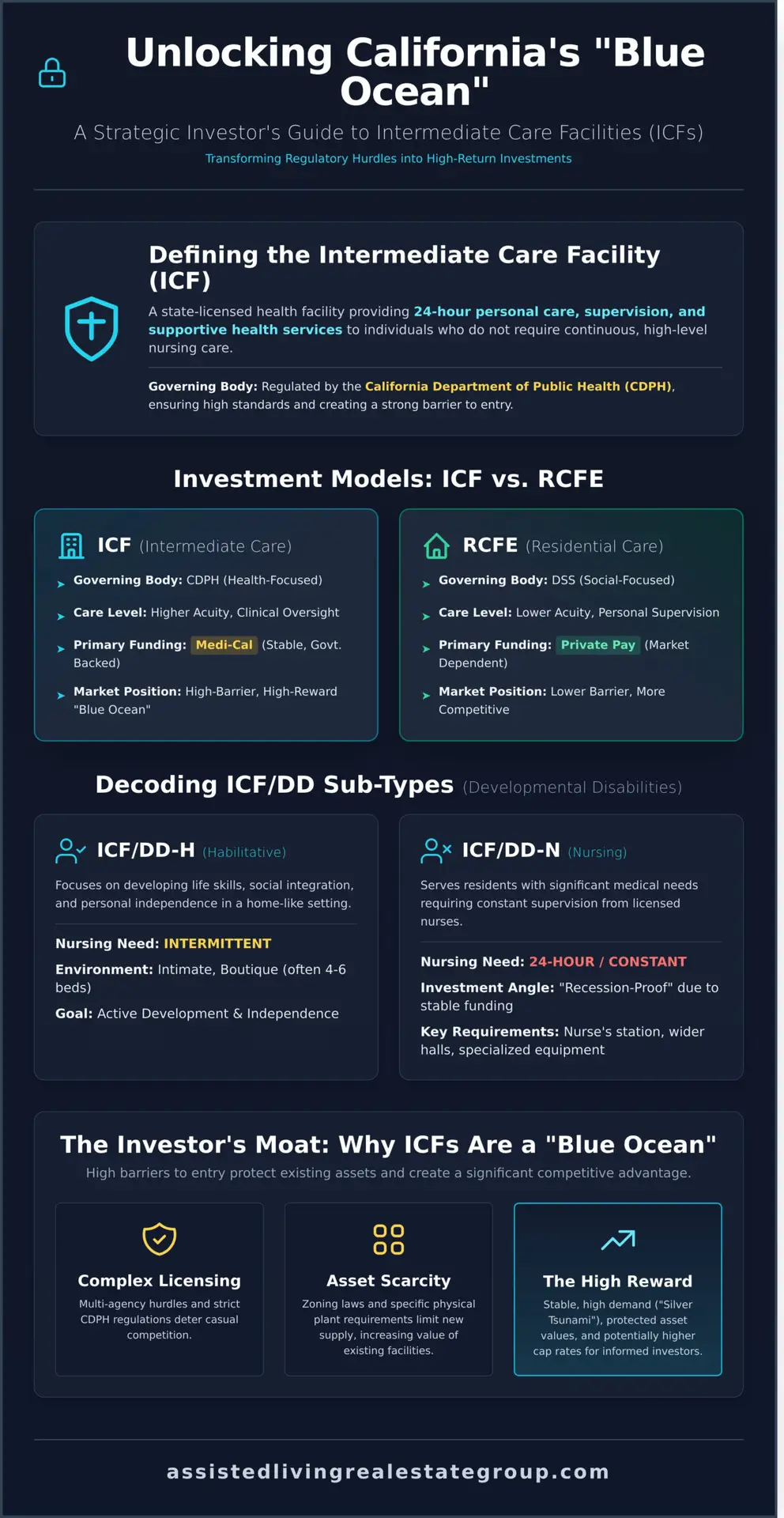
For the discerning investor, understanding the precise intermediate care facility definition is the first step toward capitalizing on one of California’s most protected real estate niches. At its core, an Intermediate Care Facility (ICF) is a state-licensed health facility providing 24-hour personal care, supervision, and supportive health services to individuals who do not require continuous nursing care. This model represents a high-barrier-to-entry asset class, meticulously regulated by the California Department of Public Health (CDPH), which ensures that only the most prepared operators can enter the market-protecting both residents and investment value.
This strict oversight creates a defensible moat around ICFs in the competitive Southern California market, making them a premium opportunity for those equipped with the right strategic guidance.
The Legal Basis: California Health and Safety Code
The legal framework for this niche is anchored in California’s Health and Safety Code, specifically Section 1250. This statute legally distinguishes ICFs from General Acute Care Hospitals and Skilled Nursing Facilities (SNFs), carving out a unique market position. The operational playbook is further detailed in Title 22 of the California Code of Regulations, which dictates everything from staffing ratios to resident rights, providing a clear roadmap for compliance and operational excellence.
Intermediate Care vs. Skilled Nursing: Bridging a Critical Gap
The investment thesis for ICFs lies in the critical service gap they fill. They are more than a residential home but less than a hospital. This level of ‘intermediate’ care is precisely what California’s aging demographic-the ‘Silver Tsunami’-increasingly requires. As thousands of seniors find themselves needing consistent clinical oversight without the intensive, high-cost services of a skilled nursing facility, the demand for ICFs skyrockets. This is not a crisis; it is a blue-ocean opportunity for investors to deliver essential services and achieve significant returns, embodying the principle of generating both Impact and Income.
The Specialized Sub-Types of ICFs in California
In California, the general intermediate care facility definition is refined into highly specific categories, primarily serving individuals with developmental disabilities (ICF/DD). For the savvy real estate investor, understanding these distinctions is not just a regulatory detail-it’s the foundation of your entire business model. The type of license you pursue directly dictates your property requirements, operational staff, and ultimately, your path to generating both impact and income. These are not one-size-fits-all facilities; they are targeted solutions for distinct resident needs.
ICF/DD-H: The Habilitative Model
The ICF/DD-H model is designed for residents who require 24-hour personal care and habilitation services but have only an intermittent need for nursing. The focus here is on developing life skills, social integration, and personal independence. Operationally, this differs significantly from standard senior care, as the goal is active development, not just comfort. As detailed in the official guide to California’s Intermediate Care Facility Types, this model supports a more independent lifestyle. In residential neighborhoods like Van Nuys and Carson, successful boutique ICF/DD-H facilities are often licensed for 4-6 beds, creating an intimate, home-like environment that is highly sought after.
ICF/DD-N: The Nursing-Focused Model
This is where medical necessity and residential living powerfully intersect. The ICF/DD-N model serves residents who need 24-hour nursing supervision from licensed nurses, but do not require the acute level of care found in a hospital. Because these residents have significant medical needs, these facilities are often considered “recession-proof”-their funding streams, largely from government sources like Medi-Cal, are stable and not tied to market fluctuations. Successfully licensing an ICF/DD-N in Southern California means meeting stringent structural requirements that go beyond a typical residential property. Key physical plant needs often include:
- Wider hallways and doorways to accommodate medical equipment and wheelchairs.
- A designated and properly equipped nurse’s station.
- Specialized bathing facilities and patient lift systems.
- Compliance with specific fire and life safety codes for non-ambulatory residents.
This higher barrier to entry creates a significant competitive advantage for investors prepared to meet the challenge, solidifying the intermediate care facility definition as a high-acuity, high-value asset class.
ICF vs. RCFE: Understanding the Investment and Operational Differences
For savvy investors in California’s senior care market, the distinction between a Residential Care Facility for the Elderly (RCFE) and an Intermediate Care Facility (ICF) is not just a matter of licensing-it’s a fundamental shift in investment strategy, risk, and reward. While both models offer a path to “Impact and Income,” their operational frameworks are worlds apart, creating a blue ocean opportunity for those equipped with the right knowledge.
The primary difference begins with regulatory oversight. RCFEs are licensed by the California Department of Social Services (DSS), focusing on non-medical, custodial care. In stark contrast, ICFs are licensed and rigorously monitored by the California Department of Public Health (CDPH). This distinction signals a move from a social model to a medical one, a crucial factor that reshapes the entire business.
The Revenue Model: Medi-Cal Reimbursement
The most significant operational divergence is the revenue source. Most RCFEs operate on a private-pay basis, subject to market fluctuations and a family’s ability to pay. ICFs, however, are predominantly funded by California’s Medi-Cal program. This government-backed reimbursement provides an incredibly stable and predictable revenue stream, insulating investors from private market volatility and allowing them to focus on delivering exceptional care while doing well by doing good.
Staffing and Liability
The clinical mandate at the core of the intermediate care facility definition necessitates a more robust and skilled team. While a 6-bed RCFE relies on trained caregivers, an ICF requires licensed nursing staff-such as LVNs and RNs-to provide 24/7 skilled nursing care. This elevated payroll is a key investment, but it directly translates into a higher quality of life for residents with complex needs. This clinical environment also introduces a higher level of professional liability, making specialized insurance brokers and legal counsel non-negotiable for navigating these business transfers successfully.
Ultimately, the “Boutique” advantage of the Residential Assisted Living (RAL) model can be powerfully applied to an ICF. By creating an intimate, high-quality home environment, you elevate the standard of care, justifying the investment and establishing a legacy asset in a high-barrier-to-entry market.
Navigating the California Licensing and Acquisition Path
Entering the Intermediate Care Facility (ICF) market in California is not for the faint of heart. It’s a high-barrier-to-entry sector defined by a complex, multi-agency approval gauntlet involving the California Department of Public Health (CDPH) and local municipalities. This regulatory maze, while challenging, creates a significant moat for savvy investors who know how to navigate it, protecting asset value and ensuring premium care standards.
The real value in an ICF investment is often the license itself, not just the real estate. Aspiring operators frequently face daunting zoning hurdles in Southern California cities like Thousand Oaks and San Jacinto, where local ordinances can halt a new development before it even begins. This is why a “Turnkey” acquisition of an existing, licensed facility is a powerful strategy. It allows investors to bypass months, or even years, of licensing delays and begin generating revenue almost immediately, securing an asset that fully meets the state’s rigorous intermediate care facility definition.
CDPH Licensing Requirements
The CDPH licensing process is meticulous. For certain facilities, it begins with securing a Certificate of Need, proving a community demand. A common pitfall in the Initial Application phase is incomplete documentation, which can trigger significant delays. When acquiring an existing facility, such as one in Fresno, the relicensing process must be managed with precision to ensure a seamless transition of operations, ownership, and patient care without any service interruption.
Southern California Market Dynamics
The demand for quality care is undeniable. Market heatmaps consistently show areas like the Inland Empire as underserved, presenting a “blue ocean” opportunity for new facilities. However, each locality has its own rules; navigating the specific zoning nuances for healthcare facilities in Los Angeles County, for example, requires deep-seated local knowledge. Leveraging over 25 years of California-specific care facility experience is not just an advantage-it’s essential for turning these complex market dynamics into a successful investment in both Impact and Income.
Understanding this landscape is the first step toward building a lasting legacy in senior care. To explore current turnkey opportunities and develop your acquisition strategy, visit assistedlivingrealestategroup.com.
Strategic Acquisition: Why ICFs are the Next “Blue Ocean” for Investors
While savvy investors have long focused on Residential Care Facilities for the Elderly (RCFEs), a far more exclusive opportunity is emerging. The market for Intermediate Care Facilities (ICFs) in California represents a true “blue ocean”-a high-barrier-to-entry space with limited competition and immense potential for both profit and purpose.
The scarcity is by design. Unlike the thousands of RCFEs across the state, ICFs are far fewer due to their complex licensing and higher acuity care requirements. This scarcity creates a powerful economic moat for owners. For investors willing to navigate this complexity, the rewards are substantial. ICFs consistently command higher capitalization rates than traditional assisted living, directly compensating for their specialized operational demands and creating a stable, high-yield asset class.
The “Boutique” ICF Opportunity
The future of high-acuity care is moving away from sterile, institutional environments. Today, families in discerning California communities like Thousand Oaks are actively seeking intimate, “boutique” care settings that offer a superior quality of life. An ICF in a residential setting provides precisely this-a home, not just a facility. Positioning your property this way transforms it from a simple real estate holding into a premium “Impact and Income” asset that builds a lasting community legacy.
Next Steps for California Investors
Successfully acquiring an ICF in the current 2026 California market requires more than capital; it requires specialized insight. A proper evaluation goes beyond the property itself, demanding a deep understanding of state-specific licensing, staffing models, and reimbursement structures. The nuanced intermediate care facility definition under California law dictates operational viability. This is where a specialized broker proves invaluable, providing access to confidential, off-market listings and the expertise to vet them properly.
Navigating this niche market alone is a significant risk. Partner with an expert guide to unlock the full potential of your investment. To explore exclusive opportunities in this sector, we invite you to View our current California care facility listings.
From Definition to Dominion: Your Path into California’s ICF Market
The California senior care landscape is evolving, and the strategic investor sees the opportunity. You now understand that an ICF is more than a building; it’s a high-demand, high-impact asset class with a complex regulatory framework distinct from RCFEs. Mastering the nuances of the intermediate care facility definition is the critical first step toward capitalizing on this “blue ocean” market. This isn’t just about cap rates; it’s about building a legacy of care and community.
Navigating this high-barrier-to-entry space requires a strategic partner. With over 25 years of specialized California care facility experience, The Assisted Living Real Estate Group leverages our proprietary “Impact and Income” framework to guide investors like you. As confidential marketing experts for both RCFE and ICF sales, we provide the roadmap to success. Explore Exclusive California ICF and RCFE Investment Opportunities and let us help you turn demographic shifts into a powerful investment. The future of boutique care is here, and it’s waiting for you.
Frequently Asked Questions About Intermediate Care Facilities
What is the primary difference between an ICF and a Nursing Home in California?
The core distinction lies in the level of medical care provided. An Intermediate Care Facility (ICF) in California is licensed to offer intermittent nursing services, focusing on residents who don’t require 24/7 skilled nursing. In contrast, a Skilled Nursing Facility (SNF), commonly called a nursing home, provides continuous, round-the-clock skilled nursing care for individuals with more acute and complex medical needs. This difference is crucial for investors targeting a specific resident acuity level and operational model.
Can an existing RCFE be converted into an Intermediate Care Facility?
While possible, converting a Residential Care Facility for the Elderly (RCFE) into an ICF is a complex and capital-intensive undertaking in California. The process requires a complete change in licensure from the Department of Social Services (DSS) to the California Department of Public Health (CDPH). This involves significant physical plant upgrades to meet stricter medical facility codes, such as commercial sprinkler systems and wider hallways, presenting a high barrier to entry that secures a premium market position.
How does Medi-Cal reimbursement work for ICF/DD facilities?
For Intermediate Care Facilities for the Developmentally Disabled (ICF/DD), Medi-Cal is the primary and most stable source of revenue. The California Department of Health Care Services (DHCS) establishes a set, all-inclusive daily rate per resident. This rate covers housing, meals, personal care, and the crucial habilitation and nursing services required. This government-backed payment structure provides investors with predictable cash flow and a recession-resistant income stream, turning social impact into reliable financial performance.
What are the staffing requirements for a boutique ICF in Southern California?
In Southern California, a boutique ICF must meet rigorous CDPH staffing mandates. This includes having a Qualified Intellectual Disability Professional (QIDP) to oversee resident care plans, licensed nurses (RNs or LVNs) to provide intermittent care, and an adequate number of trained Direct Support Professionals (DSPs). For a high-end “boutique” model, exceeding these minimums is key to delivering superior care, justifying premium rates, and building a powerful brand reputation in a competitive market.
Is an ICF considered a residential or commercial property for zoning purposes?
This is a key strategic advantage for investors. Under California law, particularly the Lanterman Act, a small ICF serving six or fewer residents is typically considered a residential use property for zoning purposes. This allows savvy investors to establish boutique care homes in desirable, quiet residential neighborhoods. This “RAL” model avoids the challenges of commercial zoning while providing residents with a true home-like environment, perfectly blending community integration with a sound real estate investment.
Why is the ICF/DD-N model particularly popular in the San Fernando Valley?
The popularity of the ICF/DD-N (Nursing) model in the San Fernando Valley is a direct response to targeted regional demand. The area is served by proactive Regional Centers, like the North Los Angeles County Regional Center, that have a significant population of clients with developmental disabilities who also have ongoing nursing needs. This creates a concentrated, high-demand micro-market, offering a “blue ocean” opportunity for specialized providers to meet a critical local need while securing impressive returns.
What is the average ROI for an Intermediate Care Facility compared to an RCFE?
An ICF typically yields a higher and more stable Return on Investment (ROI) than a standard RCFE. The primary drivers are government-guaranteed Medi-Cal reimbursement and significantly higher barriers to entry, which limit market competition. While the initial investment and operational complexity are greater, the predictable revenue and immense demand for this level of care create a superior financial model. It is the definitive path for investors seeking to achieve both significant income and lasting social impact.
How long does the licensing process take for a new ICF in California?
Securing an ICF license from the California Department of Public Health (CDPH) is a marathon, not a sprint, often taking 12 to 24 months or more. The multi-stage process involves architectural plan reviews, construction, and a final, rigorous application and survey phase. Understanding the state’s specific intermediate care facility definition and its corresponding regulations from day one is critical. Expert guidance is essential to navigate the bureaucracy, avoid costly delays, and accelerate your path to opening and generating revenue.
While this guide focuses on the specific investment landscape in California, understanding the global spectrum of care is valuable. Online directories are excellent resources for this. For instance, for those looking at the UK market, Guide2Care offers a comprehensive directory of various care providers, illustrating how different regions categorize and present care options.