
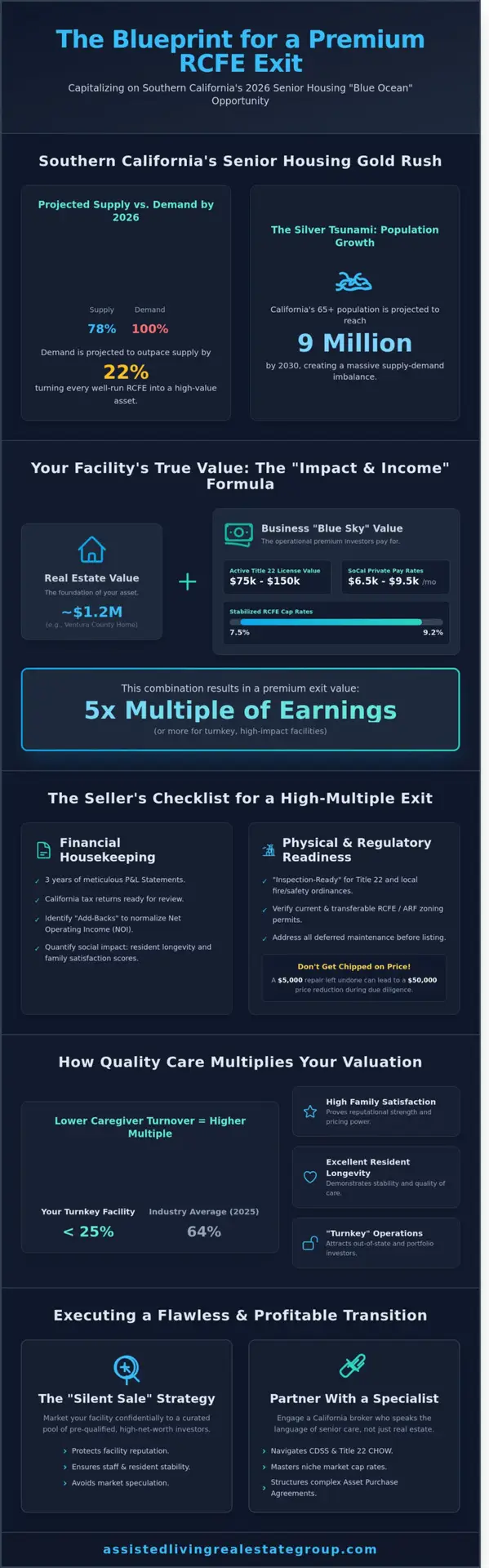
What if the most difficult transition of your career became your greatest financial victory? By 2026, the demand for boutique senior housing in Southern California is projected to outpace supply by 22 percent, turning every well-run RCFE into a high-value target for sophisticated investors. You know that learning how to sell an assisted living facility involves more than just a sign on the lawn; it requires a surgical approach to Title 22 regulatory transfers and resident retention. You’ve worked hard to build a legacy of care, and you deserve a high-multiple exit that reflects that dedication.
We understand that the complexity of a business license transition can feel overwhelming. This guide provides the definitive roadmap to master these hurdles while maximizing your Impact and Income. We’ll explore the current Blue Ocean market values and the exact steps to maintain your facility’s reputation throughout the transaction. From navigating ARF specificities to securing a qualified buyer, you’re about to discover how to turn years of service into a seamless, profitable transition.
Key Takeaways
- Position your Southern California RCFE as a premium boutique asset to capitalize on the current “Blue Ocean” market opportunity and attract high-net-worth investors.
- Master the proprietary “Impact and Income” formula to bridge the valuation gap, revealing exactly how to sell an assisted living facility for its true strategic worth.
- Implement a confidential “Silent Sale” strategy to protect your facility’s reputation and staff stability while marketing to a curated pool of qualified buyers.
- Navigate the 2026 California CDSS regulatory landscape and Title 22 requirements to ensure a seamless Change of Ownership (CHOW) without licensing delays.
- Identify the critical advantages of partnering with a specialized California broker who understands the nuances of senior care Asset Purchase Agreements and niche market cap rates.
Preparing Your Southern California RCFE for a Premium Exit
The Southern California market in 2026 represents a “Blue Ocean” opportunity for owners ready to capitalize on the Silver Tsunami. California’s 65+ population is growing toward a projected 9 million residents by 2030, creating a massive supply-demand imbalance. Mastering how to sell an assisted living facility requires more than a “For Sale” sign; it demands a strategic positioning of your 6-bed RCFE as a premium boutique asset. High-net-worth families in areas like Newport Beach and La Jolla now bypass institutional nursing homes in favor of intimate, high-end care environments. Your facility isn’t just a house. It’s a high-yield business enterprise. Initial preparation dictates whether you exit with a standard real estate price or a premium 5x multiple of your earnings.
Financial Housekeeping and ‘Impact and Income’ Metrics
Clean data drives high valuations. You must present three years of meticulously organized P&L statements and California tax returns to attract sophisticated investors. We look specifically for “Add-Backs” to normalize your Net Operating Income (NOI). This includes one-time repairs or discretionary owner expenses that won’t carry over to the buyer. In our RAL model, we emphasize the “Impact and Income” philosophy. We quantify social impact by tracking resident longevity and family satisfaction scores. These metrics prove to a buyer that your facility generates consistent revenue while delivering the high-quality care that protects their reputation and ROI.
Physical Property and Zoning Readiness
Your facility must be “inspection-ready” before the first walkthrough. In Southern California, compliance with local fire and safety ordinances is non-negotiable. Ensure your fire sprinklers and exit pathways meet the latest 2026 Title 22 requirements. Address any deferred maintenance now. A $5,000 roof repair left undone can lead to a $50,000 price chip during due diligence. Verify that your RCFE or ARF zoning permits are current and transferable. Investors pay a premium for “plug-and-play” operations where the licensing path is clear. When you understand how to sell an assisted living facility through this lens of total readiness, you secure the legacy your hard work deserves.
Calculating Your Facility’s Value: The Impact and Income Formula
Selling in 2026 requires understanding that your property is more than dirt and shingles. By 2026, California’s population over age 65 will reach 6.4 million, representing a massive demographic shift. This turns standard residential assets into high-yield Boutique environments. When you look at how to sell an assisted living facility, you’ve got to bridge the Valuation Gap. A standard home in a Ventura County neighborhood might appraise for $1.2 million, but as an active RCFE with a 95% occupancy rate, its value can skyrocket based on Net Operating Income (NOI).
In the current Southern California market, cap rates for stabilized RAL assets typically hover between 7.5% and 9.2%. These rates reflect the risk and reward of the California regulatory environment. In California RCFEs, the Cap Rate represents the ratio of your facility’s annual net operating income to its total purchase price, serving as a snapshot of your unleveraged return on investment.
Real Estate vs. Business Value Breakdown
In high-demand corridors like Thousand Oaks, the underlying real estate provides a strong safety net, but the Blue Sky value lies in the license and operations. An active, compliant Title 22 license in California can add $75,000 to $150,000 in intrinsic value simply by bypassing the 12 month state backlog for new applications. Investors prioritize facilities with a 100% private pay resident mix over SSI-dependent models. Private pay rates in Southern California now average $6,500 to $9,500 per month, creating a much higher floor for your business valuation.
The Multiplier Effect of Quality Care
Buyers pay a premium for stability. If your caregiver turnover rate is below the 2025 industry average of 64%, your business multiple increases significantly. Out-of-state investors specifically seek Turnkey operations that allow them to step into a cash-flowing machine without hiring a new administrator on day one. Understanding how to value your assisted living business helps you defend your asking price during rigorous due diligence. This is how you maximize how to sell an assisted living facility for its true worth. If you’re ready to see how these numbers apply to your specific zip code, you can request a professional valuation assessment to see your facility’s current market position.
The Power of Confidential Marketing in Senior Care Sales
Publicly listing your RCFE on standard commercial sites is a tactical error that frequently leads to a 15% drop in occupancy within the first 60 days. In the California market, news travels fast among families and staff. If a caregiver suspects a change in ownership, they might seek stability elsewhere; if a family fears a decline in care quality, they’ll look for a new home for their loved one. This is why the “Silent Sale” is the gold standard for Southern California operators. Successful sellers use “Blind Profiles” that highlight the $18,000 monthly gross income per bed or the 2024 renovation details without revealing the exact street address in Riverside or San Diego.
Your reputation is your most valuable asset. When you’re determining how to sell an assisted living facility, you aren’t just selling real estate; you’re selling a continuum of care. An “Expert Guide” acts as a firewall, protecting your brand while hunting for the right successor. This strategic partner ensures that your facility’s identity remains hidden until a buyer’s intent and financial capability are verified. It’s about maintaining the “Boutique” feel that justifies your premium rates while navigating the complexities of a high-stakes exit.
Vetting the 2026 Care Investor
The 2026 investor landscape is crowded with newcomers attracted to the “Silver Tsunami” but lacking the capital or the license to close. You must distinguish between “tire kickers” and serious RAL investors who understand California’s Title 22 regulations. We require a valid Proof of Funds (POF) and a signed Non-Disclosure Agreement (NDA) before sharing any proprietary financials. This layer of protection is central to The Value of Confidential Marketing for RCFE Sales, ensuring only those with the means to maintain your legacy see the sensitive data. When you learn how to sell an assisted living facility correctly, you realize that exclusivity increases the perceived value of the asset.
Managing the ‘Tour’ Process Discreetly
Discretion remains the priority during the physical walkthrough. We schedule tours for 6:00 PM on weekdays or during weekend lunch hours when resident activity is predictable. Buyers enter the facility framed as “insurance inspectors” or “operational consultants” to keep staff focused on care rather than gossip. Your facility must stay “Show Ready” daily; in 2026, California buyers expect boutique environments that justify premium rates. A single misplaced medication log or an unkempt garden can derail a multi-million dollar offer. This methodical approach ensures you achieve the “Impact and Income” you deserve without disrupting the lives of the seniors under your roof.
Navigating Title 22 and CDSS Regulatory Hurdles
Selling your Residential Assisted Living (RAL) facility isn’t a standard real estate transaction; it’s a high-stakes regulatory handoff. The absolute number one sale killer in Southern California is mismanaging the license transfer process. If the buyer’s application stalls because of your lack of preparation, the deal will wither in escrow. In 2026, the California Department of Social Services (CDSS) has intensified its scrutiny of “Change of Ownership” (CHOW) applications, making your expertise as a seller vital to the closing.
Understanding the 2026 CHOW timeline is essential for setting realistic expectations. On average, the Community Care Licensing Division (CCLD) takes between 120 and 180 days to process a new license application. You can’t bypass this. However, you can prevent it from stretching to 200 days or more by ensuring your facility is in peak regulatory health before the first tour. Your Title 22 compliance is your strongest negotiating leverage. A facility with zero Type A deficiencies over the last 36 months often commands a 15% premium over distressed competitors because it represents a “turn-key” operation for the buyer.
The CDSS Transfer Roadmap
First, you must provide a formal 60-day notification to the CDSS before any transfer occurs. This isn’t optional. It’s a statutory requirement under Health and Safety Code 1569.191. Second, you must actively assist the buyer with the Part A and Part B application. You are the mentor here. If the buyer doesn’t have their administrator certificate or if their financial plan is shaky, the state will reject them, and your exit strategy will crumble. Third, you must manage the “License Pending” phase. During this window, you remain the licensee of record. You carry the legal liability and the operational responsibility until the very second the new license is issued. It’s a period that requires precise coordination to maintain the boutique quality of care your residents expect.
Common Licensing Pitfalls in California
Don’t let a stale fire clearance kill your ROI. In 2026, the Office of the State Fire Marshal (OSFM) is reporting inspection backlogs of up to 50 days in Los Angeles and San Diego counties. If your clearance isn’t current, the CDSS won’t issue the new license. You also need to ensure every resident file is meticulously organized according to California Title 22 Regulations for RCFEs. This includes updated Physician’s Reports (LIC 602A) and functional appraisals. Missing documentation during the buyer’s due diligence period signals a lack of professional oversight, which can lead to aggressive price re-negotiations. Transitioning resident care plans with transparency ensures the “Impact and Income” legacy you built continues under new ownership.
Ready to secure a premium exit for your boutique facility? Schedule a strategic consultation with our Southern California experts to audit your licensing readiness.
Closing the Deal: Partnering with a Specialized California Broker
Selling a boutique senior care business in 2026 requires more than a listing; it demands a tactical exit strategy. A general commercial broker often treats an RCFE like a standard office building, but you’re selling a complex ecosystem of real estate, licensing, and human lives. This is where a Strategic Partner becomes essential. When you understand how to sell an assisted living facility, you realize the Asset Purchase Agreement (APA) must account for the specific California Department of Social Services (DSS) licensing timeline. A botched APA can lead to 120 day delays that drain your operational capital. Our team manages the due diligence period to prevent operational fatigue, ensuring your staff remains focused on care while we handle the 45 point document audit required for California compliance.
- The APA: We draft specific contingencies for the “Change of Ownership” (CHOW) process.
- Due Diligence: We utilize secure digital vaults to organize Title 22 documentation.
- Transitions: We orchestrate the 30 day notice period for families with surgical precision.
Why Specialization Matters in Southern California
California’s regulatory environment is the most rigorous in the nation. You need a broker with 25 years of RCFE-specific experience who speaks the language of Title 22. Our local network includes lenders who specialize in the “RAL” model, ensuring buyers get financed even when traditional banks hesitate. We bridge the gap between your analytical ROI goals and the heart-centered mission of your facility. This ensures you achieve maximum Impact and Income without compromising the quality of life for your residents.
Your Next Chapter: Legacy and Liquidity
Maximize your exit by structuring the sale for tax efficiency. Many Southern California owners utilize a 1031 exchange to move equity into passive NNN leases or larger boutique portfolios. This preserves your liquidity while ensuring your legacy of care remains intact under new ownership. We help you exit the daily grind while maintaining the financial rewards of your hard work. Your life’s work deserves a transition that honors the impact you’ve made on the community.
Ready to take the first step toward your exit?
Maximize Your Exit in the 2026 California Market
The Southern California RCFE landscape is shifting rapidly. Owners who master Title 22 compliance and leverage the Impact and Income Formula are positioned to capture top-tier valuations as the Silver Tsunami reaches its peak. You’ve dedicated years to providing boutique care; ensuring a seamless transition requires a sophisticated roadmap that protects your staff and residents. Understanding how to sell an assisted living facility in today’s regulatory climate isn’t just about finding a buyer. It’s about executing a confidential strategy that maintains your facility’s integrity while maximizing your ROI.
With 25+ years of specialized California care facility experience, we provide the technical expertise needed to navigate complex CDSS hurdles. Our proven track record spans Southern California, delivering results for owners from Fresno to Thousand Oaks through our exclusive Confidential Marketing Strategy. It’s time to turn your years of hard work into a lasting financial legacy. You don’t have to navigate this high-stakes transition alone.
Schedule Your Confidential Strategy Session with Teri Szoke
Your next chapter starts with a partner who understands the true value of your care and the complexity of the California market.
Frequently Asked Questions
How long does it typically take to sell an RCFE in California?
Selling a Residential Care Facility for the Elderly (RCFE) in California typically requires 6 to 12 months from the initial listing to the close of escrow. The California Department of Social Services (CDSS) Community Care Licensing Division often takes 90 to 120 days just to process the change of ownership (CHOW) application. This timeline ensures the transition protects your legacy while allowing the buyer to secure financing and complete rigorous operational due diligence before taking over the boutique care environment.
Do I need to inform the residents that I am selling the facility?
You must provide residents and their representatives with a written notice 60 days before any change in ownership that affects their care agreement. Under California Code of Regulations Title 22, maintaining transparency is a legal obligation and a strategic move to preserve your facility’s value. Keeping families informed prevents sudden move-outs that could lower your valuation during the escrow period. It’s about maintaining trust while transitioning your mission to a new owner.
Can I sell the business license without selling the real estate?
You can sell the business operations and license while retaining ownership of the real estate through a long-term lease agreement. This asset-light model allows you to generate passive rental income while the new operator manages the boutique care environment. Many Southern California investors prefer this structure because it lowers their initial capital requirement while you maintain a high-value real estate asset in your portfolio. It’s a proven strategy for those who want to exit operations but keep their property.
What is the current average cap rate for assisted living facilities in Southern California?
In 2026, the average cap rate for assisted living facilities in Southern California ranges between 7.5% and 9.5% depending on the specific county. Boutique RAL homes in high-demand areas like Newport Beach or La Jolla often command lower cap rates near 7% due to their premium market position. Understanding these metrics is essential when learning how to sell an assisted living facility for maximum ROI in a competitive market. These numbers reflect the high barrier to entry in the California market.
What happens to my staff when I sell my care home?
Most staff members remain with the facility through the transition to ensure continuity of care for the residents. In California, you’re responsible for paying out all accrued vacation time and final wages upon the close of escrow. Buyers usually want to retain your trained caregivers because their expertise is vital to maintaining the facility’s high quality of life and operational stability. Keeping your team intact during the sale process often leads to a higher valuation and a smoother transition.
How does the ‘Silver Tsunami’ impact the value of my facility in 2026?
The Silver Tsunami has transformed the 2026 market into a blue ocean of opportunity for sellers. With over 10,000 Americans turning 80 every day, the demand for boutique care in California has outpaced supply by 15% this year. This demographic shift increases your facility’s valuation as investors seek stable, mission-driven assets that offer both significant financial returns and a lasting legacy. Your facility is no longer just a building; it’s a solution to a massive demographic need.
Is a formal appraisal required before listing my RCFE?
A formal appraisal is required if your buyer is utilizing SBA 7(a) or 504 financing, which covers 90% of small-scale RCFE transactions in California. While you can list based on a Broker Opinion of Value, a certified appraisal ensures your price aligns with current 2026 market data. This step eliminates guesswork and provides the technical credibility needed to move savvy investors from curiosity to a state of conviction. It’s a necessary component of a professional and transparent sales process.
What is the difference between selling an RCFE and an ARF in California?
The primary difference lies in the resident population; an RCFE serves seniors aged 60 and older, while an Adult Residential Facility (ARF) serves adults aged 18 to 59 with disabilities. When considering how to sell an assisted living facility, remember that RCFEs often command higher valuations in Southern California due to the aging demographics. Both require distinct CDSS licenses, but the RCFE model is the cornerstone of the boutique Impact and Income philosophy that modern investors prioritize.