
The biggest financing mistake may happen before a lender reviews the numbers: treating an assisted living acquisition as one simple purchase. If you’re exploring how to get a loan to buy an assisted living facilitiy in California, first clarify whether the deal includes the real estate, the operating business, or both. That structure affects what needs financing and how a lender may assess the property, business cash flow, your qualifications, and the transaction documents.
Financing can feel complicated when occupancy, licensing work, and closing timelines all affect the acquisition plan. Coordinate these moving parts early rather than treating financing as a separate task. This guide covers financing categories to consider for California facility purchases, what to organize for a lender-ready application, and how to align loan diligence with the broader acquisition process.
Understanding the facility, business, and property together is essential. Assisted Living Real Estate Group specializes in California RCFE and ARF transactions, helping buyers make sense of those components as they prepare to work with lenders and move an acquisition forward.
Key Takeaways
- Clarify whether a California RCFE acquisition includes the operating business, real estate, or both, since the deal structure shapes financing preparation.
- Organize borrower finances, facility operations, property records, and transaction documents to give lenders a clear picture of the proposed purchase.
- Compare conventional commercial financing, SBA-backed options, and seller financing, then review current terms and facility eligibility for each route.
- To understand how to get a loan to buy an assisted living facilitiy, coordinate lender diligence with the buyer, seller, broker, and California licensing workstreams.
- Specialized RCFE and ARF transaction guidance can help buyers understand the facility, business, and property components of a California purchase.
How a Loan to Buy an Assisted Living Facility Works in California
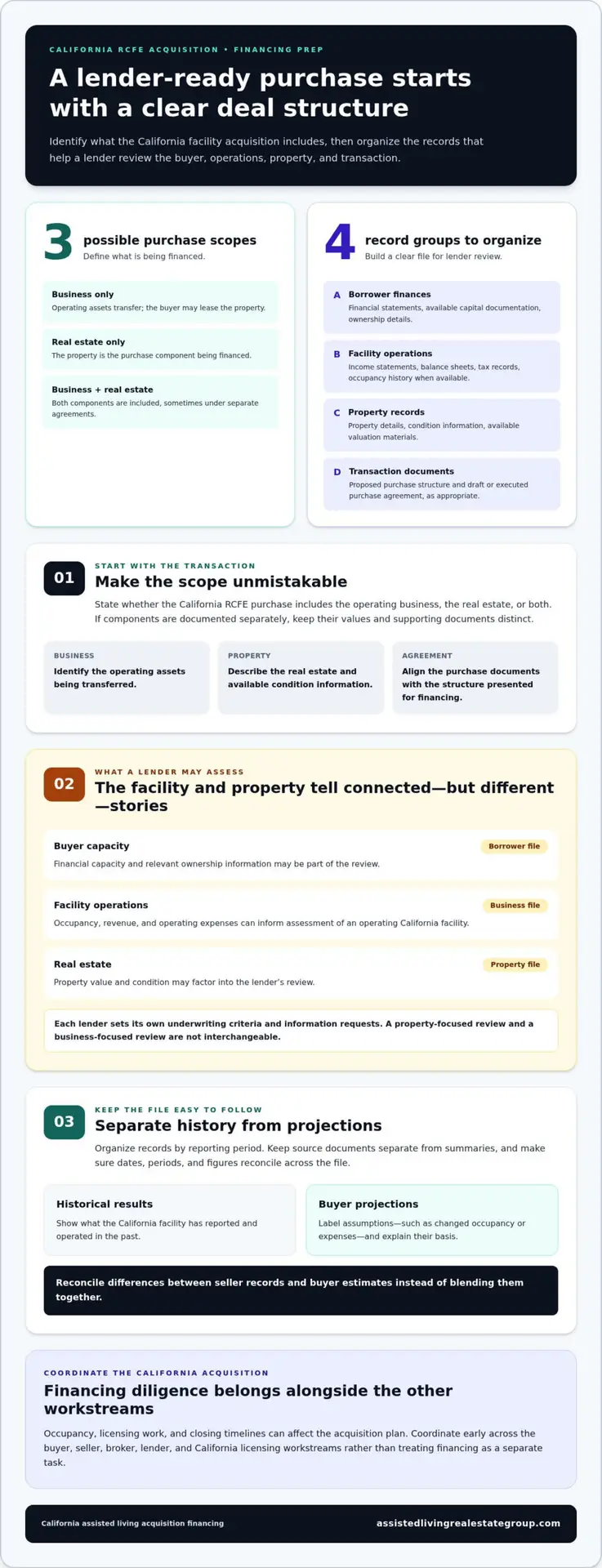
Facility acquisition financing is funding structured around the buyer, the operating business, the property, or a combination of those assets to complete a care-facility purchase. In California, an RCFE transaction may transfer business assets, real estate, or separate components under related agreements. Before comparing financing options, identify exactly what the purchase includes.
This differs from a conventional home mortgage. A home mortgage generally centers on a residence and the borrower’s ability to repay. A commercial acquisition loan may also involve a California care-facility business and income-producing property, so a lender may consider the buyer, facility operations, and real estate in its review. There’s no single qualification formula. Each lender evaluates the transaction under its own criteria.
For buyers researching how to get a loan to buy an assisted living facilitiy, the first step is not choosing a loan name. It’s defining the deal clearly enough to understand what needs financing. For a California RCFE, identify the business and property components in the proposed acquisition and determine how each is documented.
What exactly are you financing: the business, the property, or both?
In a business-only purchase, the buyer acquires agreed operating assets without buying the underlying real estate. The facility may continue operating at a property the buyer leases. In a combined purchase, the transaction includes both the business and the property. Some California sales document these components separately, while others present them together.
The purchase agreement and asset allocation help establish what is being transferred and how the transaction is presented for financing. For example, a buyer considering an RCFE in Southern California should distinguish the value assigned to the operating business from the value assigned to the property when they are separate components. The right structure depends on the specific deal, not a universal template.
Why assisted living financing differs from ordinary property financing
A lender reviewing an operating California facility may consider more than the property’s value. Occupancy, revenue, operating expenses, and property condition can each inform the lender’s assessment of the acquisition. A property-focused review and a business-focused review are not interchangeable, even when they concern the same RCFE.
The lender sets the scope of its underwriting and the information it requests. Don’t assume that one lender’s criteria apply to every financing path. Clarifying the business and real estate components early gives the buyer, seller, broker, and lender a shared basis for discussing the transaction and its financing.
Prepare a Lender-Ready Assisted Living Facility Purchase
A well-organized application helps a lender understand both the buyer’s capacity and the facility’s financial picture. Document requests vary by lender, transaction structure, and financing route. Use the categories below as a preparation framework, then organize the file around the lender’s specific requests.
Clear records help a lender assess the facility’s operating performance, the buyer’s financial capacity, and how the proposed acquisition may be repaid. Keep source documents separate from summaries, and make sure dates, reporting periods, and figures reconcile across the file.
Organize borrower and facility financial information
Start with a borrower file that is easy to review. Depending on the lender’s process, useful information may include personal or entity financial statements, documentation of available capital, and relevant ownership information. Label each file clearly and identify the buyer or ownership entity it relates to.
For the California RCFE, gather available facility financial and operating records. Organize them by reporting period so a reviewer can follow the history without piecing it together from scattered documents.
- Borrower finances: Financial statements, available capital documentation, and relevant ownership details.
- Facility operations: Income statements, balance sheets, tax records, and occupancy history, when available.
- Property records: Property details, condition information, and available valuation materials.
- Transaction documents: The proposed purchase structure and draft or executed purchase agreement, as appropriate to the stage of the deal.
Keep historical results separate from buyer projections. If a forecast assumes higher occupancy or changed expenses, label the assumption and explain its basis. Reconcile differences between seller-provided records and buyer estimates rather than blending them into one set of figures. That helps a lender distinguish what the facility has done from what the buyer expects to change.
Prepare property and transaction records for review
Describe the property and transaction together. State whether the proposed purchase includes the operating business, real estate, or separately documented components. Include available information about property condition and valuation, and make sure the purchase agreement reflects the structure presented for financing. A specialized California RCFE buying guide can help place document preparation within the wider acquisition process.
If a facility is in a rural California community, the USDA Community Facilities Direct Loan program information identifies assisted living facilities as an eligible project type. Use that information as a starting point for research, then review current program criteria for the project. Eligibility depends on the project and applicable requirements.
A practical answer to how to get a loan to buy an assisted living facilitiy starts with a file that clearly separates borrower, business, property, and transaction information. Assisted Living Real Estate Group’s California RCFE transaction experience can help buyers understand how those components fit together as they prepare for lender review.
Compare Financing Paths for a California Assisted Living Acquisition
The right financing path depends on what the California transaction includes, how the buyer plans to operate the facility, and what a lender or seller is willing to consider. A structure suited to a property purchase may not cover the operating business, and one route may not finance every component. Use this comparison to frame questions about the deal, not as a guarantee of availability or approval.
| Financing path | Potential fit | Key considerations |
|---|---|---|
| Conventional commercial financing | A purchase involving commercial property, an operating business, or both, depending on the lender and deal. | The lender may assess property value and facility performance as related but distinct factors. Documentation and timing depend on its review and the transaction structure. |
| SBA-backed options | Potential options to investigate include SBA 7(a) and 504 financing for qualifying California acquisitions. | Review current program eligibility, permitted uses, lender participation, facility eligibility, and applicable terms. Don’t assume either program covers every business or real estate component. |
| Seller financing | A negotiated component when the seller is willing to finance some portion of the transaction. | Terms depend on the parties and deal. Coordinate any proposed arrangement with the purchase structure and other financing under consideration. |
Commercial real estate and business acquisition financing
Commercial lenders may consider a facility’s real estate and operating company together while still evaluating them separately. Property condition and value raise different questions from occupancy, revenue, expenses, and historical performance. A California RCFE’s operating records may inform underwriting, but they do not guarantee a particular decision. The lender makes that assessment. Specialized brokerage guidance can help clarify the transaction components without replacing lender underwriting.
SBA-backed and seller-financing possibilities
For a buyer considering SBA 7(a) or 504 financing, review current program rules and whether the intended use and RCFE transaction are eligible. Requirements and terms can change, and participation depends on the program and lender. HUD’s official HUD Section 232 Program portal is another resource for healthcare-facility financing information. Treat it as a separate avenue to research, not a presumed fit for every California acquisition.
Seller financing may help structure a deal if both parties agree, but it is not automatic and may interact with other financing. As you evaluate how to get a loan to buy an assisted living facilitiy, compare each route against the same questions: What is being acquired? Which components might the financing cover? What records and review will it involve? Review current requirements with the relevant program and lender before relying on a particular path.
How to Apply for an Assisted Living Facility Loan Step by Step
A clear application process keeps financing diligence connected to the California facility purchase, rather than treating the loan as a separate track. The buyer, seller, lender, and broker may handle different parts of the process, while licensing-related work proceeds alongside the transaction. Lender requests, closing conditions, and timing vary, so allow the purchase schedule to account for the specific review.
Move from acquisition concept to financing request
Start with a well-defined transaction and build the financing request around what is actually being acquired. A concise summary helps the lender understand the proposal before reviewing supporting records.
- Define the purchase. Establish whether the target California RCFE transaction includes the operating business, the property, or both. Note any components documented separately so the proposed financing matches the deal structure.
- Assemble the records. Gather borrower information and available facility and property documents. Organize them by category and reporting period, and identify missing items instead of leaving gaps unexplained.
- Prepare a transaction summary. Outline the purchase structure, facility context, and available historical information. Separate verified facts from buyer projections, and label assumptions such as expected occupancy or planned operational changes.
Respond to underwriting and coordinate California diligence
Once the lender begins its review, consistent communication matters. Assign a point person to track requests and share the same current figures across lender, seller, and buyer discussions. If a projection changes or new information surfaces, explain what changed and update the relevant materials instead of circulating conflicting versions.
- Answer lender questions promptly. Submit requested documents in an orderly format, explain how records relate to the purchase, and flag discrepancies between seller records and buyer estimates. Incomplete files and inconsistent projections can lead to avoidable follow-up.
- Track financing and purchase diligence together. Maintain a shared timeline for lender conditions, seller deliverables, property review, and relevant California licensing work. Use California RCFE licensing guidance as part of the broader acquisition plan, while keeping licensing questions distinct from loan underwriting.
There’s no universal closing timetable. The lender’s review, transaction structure, document readiness, and applicable conditions all affect timing. Assisted Living Real Estate Group helps buyers understand the facility and transaction context as they coordinate a California acquisition. If you’re shaping a California facility purchase, discuss your acquisition goals with the team.
A practical answer to how to get a loan to buy an assisted living facilitiy is a disciplined process: define the deal, organize the evidence, respond consistently, and keep financing and facility diligence moving in step.
Connect Facility Financing With a Confident California Purchase
A strong acquisition plan brings financing, operations, property review, and California licensing diligence into the same conversation. Confirm what the purchase includes, organize borrower and facility records, compare financing paths, and coordinate each review against the purchase timeline. These steps help you approach the transaction with clarity, but they can’t guarantee a lender’s decision or a completed sale.
Keep financing, operations, and licensing diligence aligned
A transaction that appears financeable still needs careful review of the facility’s operations and property. Lender approval, completion of the purchase, and licensing outcomes are distinct processes, each with its own review and timing. Coordinate the workstreams without assuming that progress in one determines the result of another. A California RCFE purchase guide can also help you place financing preparation within the broader acquisition journey.
Get specialized guidance on the facility acquisition
Understanding how to get a loan to buy an assisted living facilitiy starts with understanding the deal itself: the facility, its operating business, the property, and how those components fit together. Assisted Living Real Estate Group specializes in California RCFE and ARF transactions and brings more than 25 years of combined care-facility industry experience. That transaction guidance complements lender underwriting; it does not replace the lender’s review or promise loan approval.
Ownership combines financial and operational planning with the opportunity to contribute to care in California communities. Keep the mission in view, and ground each decision in the facts of the acquisition, the facility’s operations, and the financing path under consideration.
If you’re considering a California RCFE or ARF purchase, discuss your acquisition goals with Assisted Living Real Estate Group and explore facility opportunities suited to your plans.
Build a Clear Path to Your California Facility Purchase
Financing an assisted living facility starts with a precise acquisition plan. Identify whether the deal includes the RCFE business, the real estate, or both. Then organize borrower, operating, property, and transaction records so lenders can assess the opportunity, and compare financing paths against the deal’s actual structure.
As you consider how to get a loan to buy an assisted living facilitiy, keep lender underwriting, property and operating diligence, and California licensing work aligned. Each is a distinct part of the purchase, and progress in one does not guarantee an outcome in another.
Specialized transaction guidance can help you understand how the facility, business, and property fit together. Assisted Living Real Estate Group focuses on California RCFE and ARF transactions, backed by more than 25 years of combined care-facility industry experience. That perspective complements lender review as you shape a disciplined acquisition plan with financial and care goals in view.
Explore California RCFE and ARF acquisition opportunities with a specialized team, and take your next step toward a confident purchase.
Frequently Asked Questions
Can I get a loan to buy an assisted living facility in California?
Financing may be available, but approval depends on the buyer, transaction structure, facility, and lender review. If you’re planning how to get a loan to buy an assisted living facilitiy in Southern California, first identify whether the acquisition includes the operating business, the real estate, or both. Lenders may assess those components differently, and no financing route guarantees approval. A clear purchase structure and organized financial records can help present the opportunity.
What types of loans can be used to buy an assisted living facility?
Potential routes include conventional commercial financing, SBA-backed options such as 7(a) or 504, and seller financing negotiated as part of the transaction. HUD’s Section 232 program may also be relevant to some residential care facility projects. These options differ in purpose, eligibility, underwriting, and which purchase components they may finance. For a California RCFE acquisition, review current program rules and lender criteria rather than assuming a route fits every facility or buyer.
Can an SBA loan be used to buy an RCFE in California?
An SBA-backed loan may be worth investigating for a California RCFE purchase, but eligibility isn’t automatic. SBA 7(a) and 504 are distinct financing categories, and permitted uses, facility eligibility, lender participation, and current terms can vary. The transaction’s structure also matters: acquiring business assets may raise different questions from purchasing real estate or acquiring both. Review current program requirements with the participating lender before building your acquisition plan around SBA financing.
How much down payment do I need to buy an assisted living facility?
There isn’t one down-payment figure that applies to every California assisted living acquisition. The amount, if required, depends on the financing route, lender assessment, borrower qualifications, transaction structure, and assets being purchased. A business-only purchase may be evaluated differently from a combined business-and-property transaction. Rather than relying on a general estimate, prepare borrower financial information and a clear deal summary, then discuss the required capital contribution with the lender.
What documents do lenders need for an assisted living facility loan?
Requests vary by lender and deal, but buyers can prepare borrower financial statements, available capital documentation, and ownership information. Facility records may include income statements, balance sheets, tax records, and occupancy history, when available. Organize property details, condition information, valuation materials, and the draft or executed purchase agreement as appropriate. Keep historical results separate from forecasts, label assumptions, and reconcile differences between seller records and buyer projections.
Does buying an RCFE include the license?
Don’t assume that an RCFE license automatically transfers as part of a California sale. The purchase may include business assets, real estate, or both, while licensing is a separate workstream with its own requirements and review. Clarify what the transaction documents cover and coordinate licensing diligence alongside financing and closing preparation. A lender’s approval or a completed purchase should not be treated as confirmation of a licensing outcome.
Can I finance the assisted living business and the real estate together?
Possibly, depending on the lender, financing route, buyer qualifications, and structure of the California transaction. Some acquisitions involve one purchase covering both the operating business and property; others document those components separately. A lender may evaluate business performance and property value as related but distinct factors. Present the purchase agreement and asset allocation clearly, then confirm which components the proposed financing can cover. One financing route may not fit every part of a deal.
How long does it take to get financing for an assisted living facility?
There’s no standard timeline for financing a California assisted living facility. Timing depends on the lender’s review, the transaction structure, the completeness of borrower and facility records, and any conditions that must be satisfied before closing. Incomplete documents, unexplained gaps, or inconsistent projections can lead to additional questions and delays. Coordinate lender requests with seller deliverables, property diligence, and California licensing work so each workstream advances alongside the purchase.