
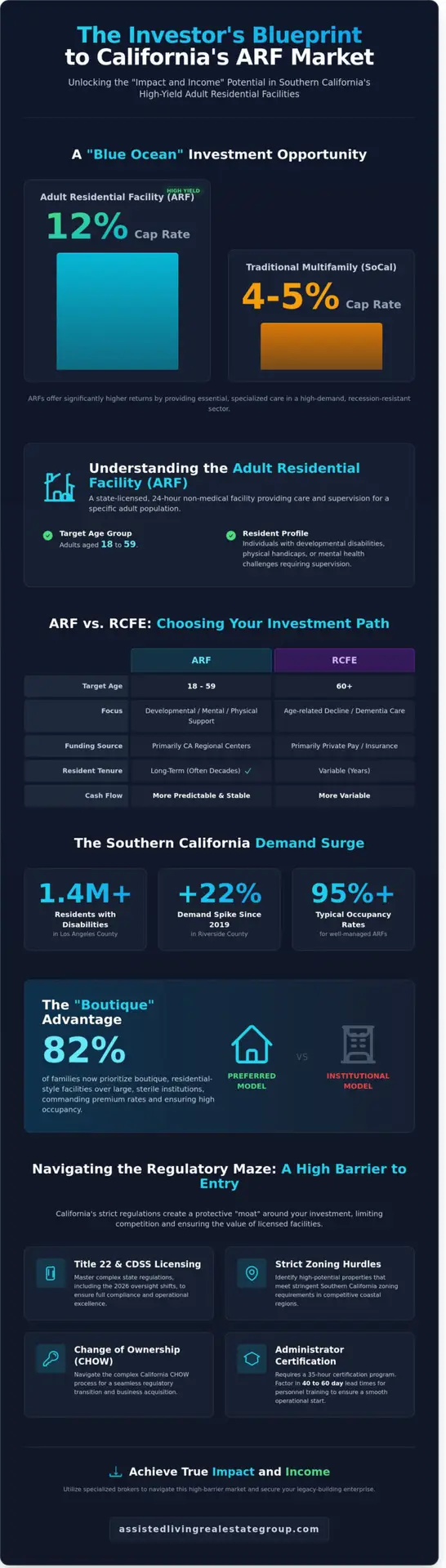
What if your next real estate acquisition didn’t just yield a 12% cap rate, but also solved a critical housing shortage for California’s vulnerable adult population? You’ve likely noticed that traditional multifamily yields in markets like Orange County and San Diego have compressed to 4% or 5%, leaving savvy investors searching for a blue ocean opportunity. You understand that the demand for specialized care is skyrocketing, yet the complexity of state regulations often feels like an impenetrable wall. Learning how to buy an ARF requires more than a standard broker; it demands a strategic roadmap through the 2026 CDSS licensing landscape and a deep understanding of Title 22 compliance.
This guide promises to master those complexities for you, transforming a high-barrier-to-entry market into a turnkey business acquisition. We’ll show you how to secure off-market boutique facilities that meet strict Southern California zoning requirements while maximizing your financial returns. From distinguishing ARF regulations from RCFE standards to identifying high-yield properties in competitive coastal regions, you’re about to discover how to achieve true Impact and Income. We’ll analyze the specific 2026 shifts in Title 22 oversight and the three key markers of a high-yield boutique property that ensures your investment legacy remains secure.
Key Takeaways
- Capitalize on the “Blue Ocean” investment opportunity within Southern California’s non-medical care sector for adults aged 18 to 59.
- Learn to navigate strict California zoning hurdles to identify high-potential “Boutique” properties from San Jacinto to Van Nuys.
- Master the financial metrics of the 2026 market, including EBITDA and cap rates, to understand exactly how to buy an ARF with high-yield potential.
- Navigate the complex California “Change of Ownership” (CHOW) process and Title 22 standards to ensure a seamless regulatory transition.
- Discover the strategic advantage of utilizing specialized California brokers to execute confidential acquisitions that protect your “Impact and Income.”
Understanding the Adult Residential Facility (ARF) Market in Southern California
Under California law, an Adult Residential Facility (ARF) is a non-medical facility that provides 24-hour non-medical care for adults aged 18 through 59. These residents often live with developmental disabilities, physical handicaps, or mental health challenges that require consistent supervision. Gaining a foundational Understanding the Adult Residential Facility (ARF) Market helps investors see why California’s regulatory framework under Title 22 is so unique. It creates a high barrier to entry that protects your investment once you’re licensed. For the savvy entrepreneur, this niche represents a “Blue Ocean” opportunity. While most residential investors fight over slim margins in the traditional rental market, the ARF sector offers a path to significantly higher cap rates through specialized service delivery.
The “Impact and Income” philosophy is at the heart of this asset class. You’re not just buying a property; you’re acquiring a high-yield business that solves a critical social crisis. Southern California faces a chronic shortage of quality beds for the adult population, making this a recession-resistant play. When you learn how to buy an ARF, you’re positioning yourself to earn premium monthly rates while providing a dignified, boutique environment for a vulnerable population. It’s a rare instance where the moral compass and the profit motive align perfectly.
The Demographic Demand in SoCal
Los Angeles County currently houses over 1.4 million residents living with some form of disability according to recent Department of Public Health data. In neighboring Riverside County, the demand for specialized adult housing has spiked by 22% since 2019. These aren’t just numbers; they represent thousands of families searching for alternatives to large, sterile institutions. Boutique, residential-style facilities are outperforming institutional models because they offer a higher quality of life and personalized care plans. This shift in consumer preference ensures that well-managed ARFs maintain 95% or higher occupancy rates, even when the broader real estate market fluctuates.
ARF vs. RCFE: Choosing Your Investment Path
While both models operate out of residential homes, the target demographic is the primary differentiator. Residential Care Facilities for the Elderly (RCFE) serve those aged 60 and older, focusing on age-related decline and dementia. Conversely, an ARF serves the 18-59 cohort, which often involves working with California’s Regional Centers for resident placement and funding. This distinction is vital for your ROI projections because the reimbursement structures and staffing requirements vary significantly under Title 22 regulations. You can explore the granular differences in our RCFE vs ARF comparison guide to determine which license fits your long-term goals.
Licensing requirements also diverge when it comes to administrator certifications. An ARF administrator must complete a specific 35-hour certification program approved by the California Department of Social Services. If you’re wondering how to buy an ARF and hit the ground running, you must account for these 40 to 60-day lead times for personnel training. The stability of the ARF market is bolstered by the fact that many residents are long-term placements, often staying for decades rather than years. This leads to lower turnover costs and more predictable cash flow compared to senior care, where resident acuity levels can change rapidly.
Choosing the right path in Southern California requires a strategic partner who understands the local zoning nuances in cities like Long Beach, Riverside, or Temecula. The “Expert Guide” approach ensures you don’t just buy a building, but you launch a legacy-building enterprise. By focusing on boutique environments, you command higher price points and attract the best staff, creating a virtuous cycle of growth and community impact.
Identifying the Right ARF Property: From San Jacinto to Van Nuys
The California care market has shifted. Families no longer want institutional warehouses for their loved ones; they want “Boutique” environments. This shift represents a massive “blue ocean” opportunity for investors. Currently, 82% of families searching for Adult Residential Facilities (ARFs) prioritize a residential feel over clinical settings. When you understand how to buy an ARF, you aren’t just buying a house. You’re acquiring a high-yield business asset that generates both impact and income. The value proposition lies in the hybrid nature of the investment. You’re capturing the appreciation of California real estate while simultaneously building a business with recession-resistant cash flow.
Zoning is the primary hurdle that stops most investors before they start. California’s Title 22 regulations dictate specific physical requirements that a standard residential home might not meet. You must verify fire sprinkler requirements, egress points, and local municipal density limits. Navigating the California Licensing Maze involves checking with the California Department of Social Services to ensure a specific address isn’t within 300 feet of another licensed facility. Ignoring these granular details can lead to a property that’s impossible to license, turning a potential goldmine into a stagnant liability.
Location Strategy: Where to Buy in Southern California
Location dictates your cap rate and your resident demographic. In San Jacinto and broader Riverside County, entry costs remain accessible, often ranging between $550,000 and $750,000 for suitable properties. Demand here is driven by a 14% increase in the local aging population since 2020. Moving toward Van Nuys and Carson, you find high-density urban pockets. These areas benefit from established referral networks and proximity to major medical hubs like Kaiser Permanente. For those targeting the luxury segment, Thousand Oaks offers a premium “Boutique” market. While property costs exceed $1.8 million, monthly resident fees often top $9,000, providing a significant ROI for high-end care models.
Lease-to-Own vs. Direct Purchase
Securing the right property doesn’t always require a massive down payment. Lease-to-own opportunities allow you to control the real estate while you secure your license, a process that typically takes 6 to 9 months in California. This structure protects your capital during the pre-operational phase. To succeed, you need to structure deals that clearly separate the business operations from the real estate ownership. Many savvy entrepreneurs use this method to scale quickly, often transitioning to a full purchase once the facility reaches 90% occupancy.
Finding these deals requires more than a standard MLS search. Specialized brokers often hold “pocket” listings that never hit the public market. These off-market assets frequently come with existing improvements that save you $50,000 or more in renovation costs. If you want to accelerate your search, consulting with a strategic partner can help you identify these hidden gems before they’re snatched up by institutional competitors. Mastering how to buy an ARF means looking where others aren’t, focusing on properties that can be transformed into high-impact, high-income boutique care homes. Every square foot must be evaluated for its ability to provide dignity to residents and profit to your portfolio.
Analyzing the Numbers: Valuation, ROI, and Financing for CA Facilities
Buying a California ARF isn’t just a property acquisition; it’s the purchase of a high-yield operational engine. When you’re researching how to buy an ARF, you must look beyond the residential real estate value. You’re buying a licensed business where the “Success Fees” and goodwill often carry as much weight as the square footage. Valuation in this niche is driven by EBITDA (Earnings Before Interest, Taxes, Depreciation, and Amortization). A stabilized facility in a high-demand area like Orange County or Los Angeles typically commands a higher multiple because the barrier to entry is so steep. It’s a blue ocean opportunity for those who can navigate the numbers.
Projected data for 2026 shows that standard Cap Rates for Southern California care facilities are stabilizing between 7.5% and 9.2%. While traditional residential real estate might offer lower yields, the “Impact and Income” multiplier of a boutique ARF allows for significantly higher returns. This premium exists because you’re providing specialized care that high-net-worth families are willing to pay for. Operational efficiency, such as optimizing your staffing ratios and reducing turnover, directly boosts your property value by increasing the net operating income that future buyers will capitalize.
The Due Diligence Financial Checklist
Reviewing the numbers requires a surgical approach. You need to verify three years of P&L statements and federal tax returns to ensure the income isn’t just a temporary spike. Analyze the resident fee structures to see if they align with current 2026 market rates in California. Many older facilities undercharge, representing a value-add opportunity for a savvy investor. Your checklist must also include:
- Occupancy Trends: Look for a consistent 90% or higher occupancy rate over the last 24 months.
- Regulatory Compliance Costs: Ensure the budget accounts for the strict standards of the California Department of Social Services (CDSS) Adult Care Licensing, as non-compliance leads to heavy fines.
- Hidden Liabilities: Investigate workers’ compensation history and Title 22 compliance records to avoid inherited legal headaches.
California-Specific Financing Hurdles
Traditional mortgage lenders often stumble when they see the complexity of a care facility’s income streams. They’re used to simple rent rolls, not the nuanced service fees of an ARF. In California, 65% of specialized care acquisitions are funded through SBA 7(a) loans because they allow for lower down payments and longer amortization terms. However, these loans require the buyer to have a clean track record and a solid management plan. For investors who need to move faster, private commercial lending offers a quicker path, though often at a 2% to 3% higher interest rate.
Success depends on working with a lender who understands the California Community Care Licensing (CCLD) framework. They need to know that the license is tied to the operator, not just the building. If you’re ready to secure your capital, you can explore specialized Financing Your RCFE/ARF Purchase structures that bridge the gap between your vision and the closing table. Understanding how to buy an ARF means mastering these financial levers to ensure your investment is as sustainable as it is profitable.
Navigating the California Licensing Maze: A Step-by-Step Acquisition Guide
California’s regulatory environment is a fortress that protects the vulnerable, yet it often intimidates the unprepared investor. To secure your place in the “Silver Tsunami” market, you must master the Community Care Licensing Division (CCLD) requirements. You aren’t just purchasing real estate; you’re acquiring a highly regulated service business where Title 22 compliance is the baseline for entry. Mastering how to buy an ARF requires a strategic approach to the “Change of Ownership” (CHOW) process. In California, licenses are non-transferable. This means the buyer must secure a fresh license approval before the seller can legally exit the business. Poorly timed CHOW applications account for 18% of failed escrow attempts in Southern California. You must synchronize your financial closing with the state’s regulatory clock to ensure a seamless transition of care and cash flow.
The Application and Relicensing Process
Your journey begins with the mandatory LIC 9202 orientation. This four hour session is the prerequisite for submitting your formal application. Following this, you must complete the LIC 200 form and secure your Administrator Certification. This requires 35 hours of state-approved initial training and passing a rigorous exam with a score of 70% or higher. Every person with a 10% or greater interest in the business must pass a Live Scan fingerprint clearance through the Department of Justice. Finally, the pre-licensing inspection ensures your boutique property meets strict safety codes. State inspectors will verify that water temperatures stay between 105 and 120 degrees Fahrenheit and that your fire clearance is approved by the local Southern California fire marshal.
Staffing and Operational Due Diligence
Operational success in a 6-bed ARF hinges on your ability to balance impact and income through efficient staffing. California law generally requires a 1:6 staff-to-resident ratio for basic care, but high-acuity residents often demand a 1:3 ratio to maintain the premium “boutique” experience. The Administrator role is the heartbeat of the facility. If you aren’t serving as the certified administrator yourself, you must hire a qualified individual who is available to the facility at least 40 hours per week. During the acquisition, your primary goal is staff retention. Data shows that 65% of residents feel more secure when their familiar caregivers remain after a sale. Ensuring the seller’s staff stays through the transition protects your investment and maintains the continuity of care that justifies higher monthly rates.
The path to owning a boutique care facility is complex, but the financial and social rewards are immense for those who follow the right roadmap. Understanding how to buy an ARF is about more than just numbers; it is about building a legacy of quality care. Our team specializes in navigating these specific California hurdles to ensure your deal closes on time and in full compliance.
Ready to secure your high-yield care facility in Southern California? Contact the Assisted Living Real Estate Group today to review our current turnkey inventory and expert consulting services.
Executing a Turnkey Acquisition with a Specialized California Broker
Standard residential realtors often treat a care home like a typical three-bedroom suburban house. This approach is a liability. Learning how to buy an ARF requires a deep understanding that you aren’t just buying real estate; you’re acquiring a highly regulated healthcare entity. Generalists frequently overlook California Title 22 compliance, fire clearance specifics, and local zoning ordinances that can derail a deal 45 days into escrow. Specialized brokers understand that the value lies in the license and the operational history, not just the square footage.
Confidentiality is the cornerstone of a successful ARF transaction. Publicly listing a facility on a standard site can cause immediate damage to the business reputation. Staff members may quit out of uncertainty, and families often move residents to avoid perceived instability. We’ve seen occupancy rates drop by 25 percent when a sale is handled poorly. We utilize rigorous Non-Disclosure Agreements (NDAs) and “Confidential Marketing” to protect the seller’s legacy while ensuring the buyer inherits a stable, revenue-generating environment.
Teri Szoke and the Assisted Living Real Estate Group act as the essential bridge for investors entering this space. We transform the complex “Silver Tsunami” demographic shift into a manageable “blue ocean” opportunity. Our team manages the transition from the initial offer through the final day of escrow, coordinating with California Community Care Licensing (CCL) to ensure the Change of Ownership (CHOW) process remains on track. This meticulous oversight allows you to focus on your mission while we handle the technical hurdles of the acquisition.
The “Expert Guide” Advantage
Success in the California care market demands more than just capital. It requires a partner with 25 years of specific experience in the state’s regulatory environment. We provide access to exclusive, off-market listings in high-demand areas like Fresno, Van Nuys, and Thousand Oaks. Our team manages specialized “Success Fees” and complex lease negotiations that general brokers don’t understand. We ensure your lease terms are structured to support long-term ROI while maintaining full compliance with state law.
Your Next Steps to “Impact and Income”
The demand for high-quality, boutique care is at an all-time high. Investors who act now can secure a position in a market that offers both significant financial rewards and a lasting social legacy. We invite you to schedule a confidential consultation to define your specific investment goals and risk tolerance. Whether you’re looking for a single facility or a multi-location portfolio, our roadmap simplifies the process of how to buy an ARF in California. Review our current inventory to find your next opportunity.
Ready to start your journey? View Current California Care Facility Listings and discover how we help you achieve both impact and income in the residential care industry.
Claim Your Stake in the Southern California Care Revolution
The 2026 market for Adult Residential Facilities represents a blue ocean opportunity for investors who prioritize both impact and income. Navigating the complexities of Title 22 and CDSS licensing requires a strategic roadmap. You now understand that securing a boutique property in high-demand regions like San Jacinto or Van Nuys is the foundation for a high-yield portfolio. Learning how to buy an ARF in California is about more than real estate; it’s about mastering a specialized niche that bridges the gap between financial growth and compassionate service.
Success in this high-barrier-to-entry sector depends on having the right partner. The Assisted Living Real Estate Group offers 25+ years of specialized brokerage experience to guide your journey. We provide exclusive access to off-market Southern California listings, ensuring you see the best opportunities before the competition. Our experts handle the technical details of licensing compliance so you can focus on scaling your investment. Partner with Southern California’s ARF Experts – Contact Us Today to begin your acquisition. Your path to a meaningful legacy starts with a single, decisive step toward professional excellence.
Frequently Asked Questions
What is the difference between an ARF and an RCFE in California?
The primary distinction lies in the age and needs of the residents served under California Department of Social Services guidelines. Adult Residential Facilities (ARFs) cater to individuals aged 18 to 59 with physical or developmental disabilities, while Residential Care Facilities for the Elderly (RCFEs) serve seniors 60 and older. Both models offer a boutique care environment, yet they operate under different subsections of Title 22 regulations that dictate specific staffing and care protocols.
Can I buy an ARF in California if I am not a licensed administrator?
You can absolutely own an ARF without holding an administrator certificate yourself. California law allows investors to act as the licensee while hiring a certified administrator to oversee the 24 hour clinical and operational requirements. This structure enables savvy entrepreneurs to focus on scaling their portfolio and achieving high impact and income while professionals handle the daily care logistics. It’s a strategic way to enter this high barrier market.
How much does it cost to buy a 6-bed Adult Residential Facility in Southern California?
Current 2024 market data indicates that a 6-bed ARF in Southern California typically costs between $900,000 and $1,600,000. This valuation includes both the residential real estate and the business’s goodwill. Prices fluctuate based on the specific county, but the 35% profit margins often found in these boutique settings justify the initial capital outlay for serious investors looking for stable yields in the care industry.
How long does the California ARF licensing process take?
Securing your license from the Community Care Licensing Division generally takes between 180 and 270 days. This timeline accounts for the mandatory 3-part orientation, the rigorous background check process, and the final component II and III inspections. Understanding this schedule is vital when planning your transition and learning how to buy an ARF effectively within the competitive California landscape. We recommend starting the application immediately after opening escrow.
Are there specific zoning requirements for ARFs in cities like Thousand Oaks or Carson?
California Health and Safety Code 1566.3 protects small care homes by preventing cities from imposing restrictive zoning on facilities with 6 or fewer residents. In municipalities like Thousand Oaks or Carson, these boutique homes are legally classified as residential use. This means you don’t need a conditional use permit, which removes a massive barrier to entry for new owners. Local ordinances cannot treat these facilities differently than a standard single-family home.
What is “Confidential Marketing” and why is it used for care home sales?
Confidential marketing is a strategic sales approach that keeps the facility’s identity private to protect the business’s 100% occupancy rate and staff morale. If employees or families hear of a sale through a public listing, it can trigger unnecessary turnover or resident departures. We use strict non-disclosure agreements to ensure the transition remains seamless. This preserves the asset’s value and ensures the income stream stays intact for the new owner.
Can I use an SBA loan to buy a California care facility business?
The SBA 7(a) loan program is a powerful tool that allows you to finance up to 90% of the acquisition cost for both the real estate and the business. This is a cornerstone strategy for those researching how to buy an ARF because it preserves your liquid cash for operational reserves. Lenders in California view these facilities favorably due to the recession-proof demand of the aging population and the state’s strong regulatory framework.
What is Title 22 and how does it affect my ARF purchase?
Title 22 is the specific set of California Code of Regulations that governs the operation, physical plant, and staffing of your facility. It acts as the definitive roadmap for compliance, covering 100% of the requirements from fire safety to medication management. Mastering these regulations is the difference between a struggling facility and a high-performing boutique care home. During your purchase, you must ensure the current facility’s physical plant meets every Title 22 requirement.