
Higher interest rates can push cap rates upward, raise borrowing costs, and put downward pressure on RCFE values when net operating income stays constant. That is the core of how interest rates affect RCFE values: the same operating performance may support a lower sale price when buyers face costlier debt and require a higher return.
It is natural to focus on the loan payment, but interest rates can influence more than financing. They can also affect the price a buyer is willing to pay, the seller’s proceeds, and the cash flow left after debt service. For California RCFE owners and investors, understanding these connections can clarify acquisition, refinancing, and sale decisions. This article explains how rate changes can affect cap rates and property values, why financing costs matter to net cash flow, and how those pressures can shape sale-price expectations. It also separates the care business’s operating value from the real estate and financing factors that affect a transaction, helping you assess an opportunity with financial discipline and the long-term purpose of senior care in view.
Key Takeaways
- Compare cap-rate scenarios using the same net operating income to see how pricing may shift without changes to operations.
- Distinguish property income from cash remaining after debt service; financing terms can affect investor cash flow even when operations are steady.
- Understand why a higher rate assumption can reduce the present value of future income and influence lump-sum valuation.
- Include borrowing and refinancing conditions when assessing sale-price expectations for a California RCFE.
- Use both operating performance and transaction financing to build a more complete view of an RCFE investment.
How do interest rate hikes affect cap rates?
Higher interest rates can raise cap rates, lowering income-property values when net operating income remains unchanged. In the United States, the federal funds rate was 0.25% to 0.50% in mid-March 2022, according to the U.S. Federal Reserve. By the end of July 2023, it was 5.25% to 5.50%, according to the U.S. Federal Reserve. These policy rates influence financial conditions, but they aren’t the same as a Southern California RCFE buyer’s loan rate.
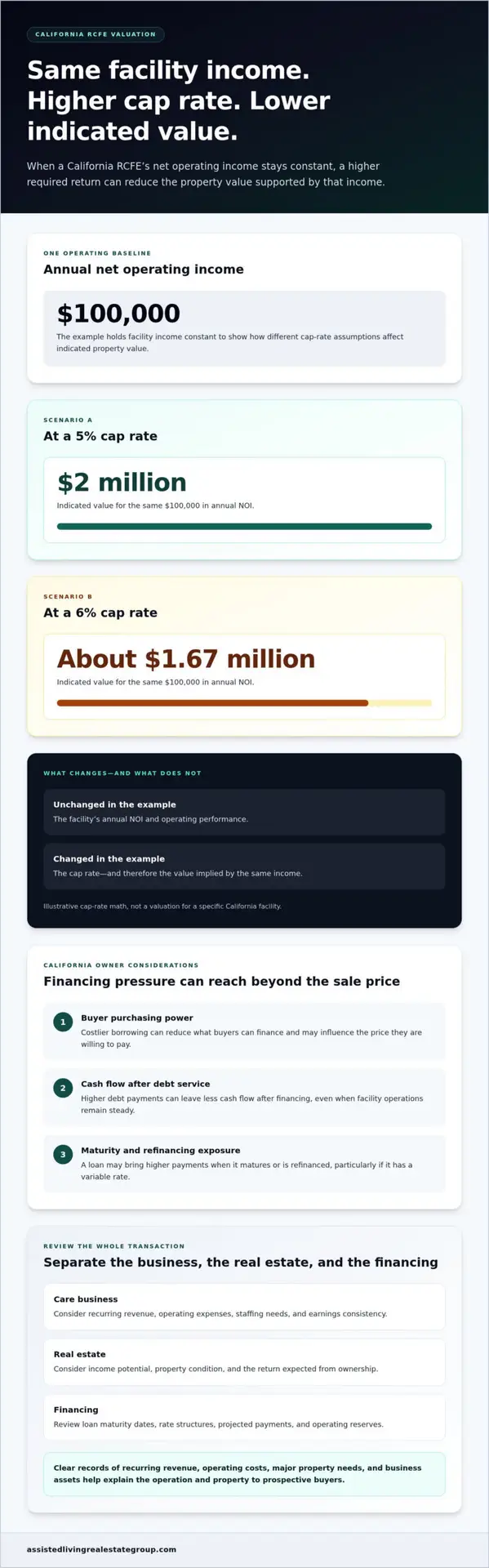
For context, average commercial real estate borrowing costs are near 6.57%, while average cap rates are around 6.34%. These broad market figures provide context, not a valuation for a specific California facility. A cap rate relates annual net operating income to property value. If an asset produces $100,000 in annual NOI, a 5% cap rate implies a $2 million value; at 6%, the same income implies about $1.67 million. The operation stays the same, but the return buyers require changes.
Interest rate increases can also affect investor demand in Southern California. Costlier borrowing may reduce purchasing power, while higher debt payments leave less cash flow after financing. Buyers may seek lower prices or stronger income, and sellers may need time to adjust expectations. The National Association of Realtors has reported that commercial real estate transaction volume often slows during rising-rate periods, while property values can take time to adjust. In California, that can widen the gap between a seller’s price expectation and a buyer’s financing-based offer.
Loan maturities create another consideration for California owners. A property financed under earlier terms may face higher payments when its loan matures or requires refinancing, especially with a variable-rate loan. Review maturity dates, rate structures, projected payments, and operating reserves to understand potential pressure on facility cash flow. Planning before a loan matures gives an owner a clearer view of how revised financing could affect the property’s operating flexibility.
Higher rates can also change the feasibility of construction, expansion, or development in Southern California. More expensive borrowing raises projected debt service, so expected operating income must support the project’s financing and costs. Owners can protect value by monitoring NOI, managing expenses, maintaining reserves, and planning around loan maturities. Reviewing financing assumptions alongside operating performance helps identify where a property’s resilience comes from. These considerations matter when assessing an existing RCFE or weighing a future investment in California’s senior-care market.
Interest rates and lump-sum valuation
In a Southern California RCFE transaction, a lump-sum offer can reflect both the care business and the property. Interest rates influence how buyers assess the capital required, future income, and financing available for an acquisition. It is useful to distinguish which parts of a facility’s value come from operations and which relate to the real estate.
Start with the business’s earnings. A buyer assessing a California care operation considers recurring revenue, operating expenses, staffing needs, and earnings consistency. Higher borrowing costs can make future earnings less attractive relative to the capital needed to acquire the business. Clear, well-documented operating records help buyers assess whether earnings are sustainable rather than relying on optimistic projections.
Property valuation has a separate focus. Buyers consider the real estate’s income potential, condition, and the return they expect from owning it. Interest rate changes can influence that return expectation and the capital buyers are willing to allocate. For a Southern California RCFE, distinguish the property’s contribution to a proposed lump sum from the value assigned to the operating business.
This distinction matters in negotiations. If a buyer’s total offer changes, it may reflect revised financing assumptions, a different view of business earnings, or a changed assessment of the real estate. Reviewing these components separately helps a seller understand an offer and identify which assumptions to discuss.
Prepare by organizing records that explain the operation’s earnings and the property’s condition. Clear documentation of recurring revenue, operating costs, major property needs, and business assets gives buyers a stronger basis for analysis. In a changing rate environment, complete information can help distinguish financing concerns from questions about the facility’s underlying performance.
Buyers can compare the proposed lump sum with the resources needed to operate the facility after closing. Financing terms affect both the capital available for the purchase and the funds left for operating priorities. A careful review connects the transaction price to the business’s ongoing needs and the property’s role in the acquisition.
For a California buyer, evaluating an acquisition means assessing the operation and its real estate together without confusing their separate contributions. A turnkey RCFE business acquisition can bring those elements into one transaction for buyers evaluating a care facility and its operating business.
How interest rates affect borrowing costs and commercial property values
For a Southern California RCFE, higher financing costs can affect buyer demand and operating cash flow. The key is how loan payments interact with facility income and operating needs.
RCFE Property Values and Sale Prices
Higher rates can reduce the amount buyers can finance, putting pressure on sale prices when their purchasing power falls. For a Southern California facility, a buyer compares expected income with debt costs and the return required from the investment. If financing absorbs more available cash, the buyer may offer less, seek stronger operating performance, or delay the purchase.
This effect can reach sellers even when a facility’s operations remain stable. A buyer’s financing model may change before the property’s income does, creating different price expectations. Rising interest rates can also slow commercial real estate transactions as both sides adjust. For an owner considering a sale, understanding the relationship between operating results and current financing conditions helps explain why buyer interest may shift.
Inflation adds another consideration. Higher borrowing costs can coincide with rising expenses, while an RCFE’s ability to adjust revenue depends on its operating circumstances. Buyers examine whether income can support debt payments and ongoing costs, rather than relying on past performance alone. The practical valuation question is whether expected cash flows can support the proposed investment in the current rate environment.
Commercial property values can also respond gradually. A seller may base expectations on earlier transactions, while a buyer uses current borrowing terms. This timing difference can affect negotiations and transaction volume. Comparing recent operating results with buyer financing assumptions gives both sides a clearer basis for discussing value, without treating a national rate trend as a precise forecast for an individual California RCFE.
Financing Costs and Operator Cash Flow
Interest rates affect financing costs by changing the payments required to carry borrowed capital. For RCFE operators, higher payments can leave less cash for payroll, maintenance, supplies, or reserves. The effect is most direct when a loan has a variable rate or reaches refinancing, because new terms may increase debt service even if monthly operating income is unchanged.
Consider an operator whose income stays steady while loan payments rise. The remaining cash flow narrows, reducing flexibility to manage expense increases or invest in the facility. If rates rise while inflation puts pressure on operating costs, both sides of the budget can tighten at once. Reviewing loan terms alongside operating cash flow helps identify the pressure point: payment changes, expense growth, or income that cannot adjust quickly.
California RCFE owners can assess this exposure by mapping loan structure, maturity timing, payment obligations, and operating income. Fixed-rate and variable-rate loans respond differently as market rates change, and refinancing can also reset borrowing costs. This review helps operators understand whether current income supports payments under the loan’s actual terms, rather than assuming today’s cash position will remain unchanged.
For buyers and operators, maintaining adequate reserves matters because debt service competes with essential operating needs. A facility with steady income may still face tighter cash flow if financing costs increase. Stronger operating performance can provide more room to absorb payments. The effect of rising interest rates therefore depends on the loan, the RCFE’s income, and the timing of its expenses.
NOI, net cash flow, and cap rates
Net operating income (NOI) measures property income after operating expenses but before mortgage payments. Net cash flow reflects what remains after debt service, so interest rates affect an owner’s available cash differently from the property’s cap rate.
A commercial property example makes the distinction clear: $60,000 of annual NOI and a $1 million market value represent a 6% cap rate. If the mortgage payment is $35,000, net cash flow is $25,000. The cap rate describes property income relative to value; the remaining cash flow reflects financing as well. That difference matters when assessing both investment returns and an owner’s ability to meet operating needs.
Interest rates affect each measure through a different channel. A higher required return can push the cap rate upward, lowering indicated value if NOI stays constant. Higher mortgage costs can also reduce cash flow after debt service, even when property income and operating expenses remain unchanged. Buyers should separate the property’s earning performance from their credit and financing assumptions.
Occupancy, reimbursement rates, and operating costs shape an RCFE’s sensitivity by determining how much income is available to support expenses and debt payments. Lower occupancy or reimbursement revenue can weaken NOI, while rising labor and other operating costs reduce the cushion for mortgage payments. Stronger, stable income can provide more room to absorb financing pressure.
For a California RCFE, occupancy affects revenue through the number of residents served, while reimbursement rates influence income per resident. Staffing and facility expenses determine how much revenue becomes NOI. These factors do not move in isolation: reduced revenue combined with higher expenses can tighten cash flow before a loan payment changes.
Make the analysis more useful by reviewing three figures separately: current NOI, debt service, and net cash flow after financing. Then compare expected income with operating costs and loan terms. If NOI changes, recalculate the cap rate using the current value; if mortgage payments change, recalculate net cash flow. This shows whether pressure comes from the asset’s performance, its financing, or both.
Cap rates do not include an owner’s mortgage payment, so they are not a direct measure of available cash. A property can show a stable cap rate while refinancing increases debt service and reduces cash flow. Conversely, stronger NOI can support value even as borrowing costs rise, though the resulting cash position still depends on payment terms.
This distinction explains the practical effect of interest rates: cap rates inform property value and expected returns, while financing determines the cash remaining after debt service. For an RCFE investment, tracking both measures gives owners a clearer view of operating strength, valuation pressure, and potential reductions in distributable cash.
How do higher interest rates affect RCFE property values and sale prices?
Higher interest rates can lower an RCFE’s sale value when buyers require stronger returns and operating income stays constant. The effect on a Southern California sale depends on the property’s income, the care business’s performance, and buyers’ financing assumptions.
For income-producing real estate, rising rates typically put upward pressure on cap rates. A higher cap rate generally means a lower indicated value if net operating income does not change. Buyers may revise offers even when a facility’s occupancy, revenue, and daily operations remain stable. Sellers should distinguish a change in market pricing from a change in the facility’s underlying performance.
Sale negotiations can reflect competing calculations. A seller may emphasize established operations and reliable income, while a buyer weighs debt costs, expected returns, and future cash flow. If those assumptions differ, the parties may see value differently. A useful discussion starts with the facility’s operating results, then considers how current financing conditions influence the offer.
RCFE transactions can involve both an operating business and real estate. The business assessment may consider sustainable earnings and operating continuity; the property assessment focuses on real estate income and its market cap rate. Keeping these components distinct helps owners understand what drives a proposed sale value, rather than treating one combined figure as a complete explanation.
Timing matters, too. During rising-rate periods, commercial real estate transaction volume can slow as buyers and sellers adjust pricing expectations. Asking prices and completed-sale evidence may then become less aligned. For a California owner, reviewing current facility performance alongside the assumptions behind an offer can clarify whether a gap reflects financing, income expectations, or transaction terms.
Before setting sale expectations, organize the facility’s financial picture: operating income, expenses, occupancy trends, debt obligations, and planned investment needs. Then compare the buyer’s valuation assumptions with those operating facts. If a buyer applies a higher cap rate, ask how that assumption relates to the property’s income. If the offer includes the care business, assess how its earnings were valued separately.
This analysis makes the market effect clearer. Rates do not change every RCFE’s value by the same amount; property income, business performance, financing structure, and buyer demand all influence the result. Understanding how interest rates affect RCFE values helps owners interpret offers without confusing a financing-driven price adjustment with weaker operations.
Owners preparing to sell can develop a confidential RCFE sale strategy that presents the facility’s operating and property fundamentals clearly to prospective buyers.
Assisted Living Real Estate Group: RCFE Sales (Residential Care Facilities for the Elderly)
Assisted Living Real Estate Group facilitates California RCFE sales, helping owners and buyers assess the facility’s real estate and operating business as they move forward. Consider its support when interest-rate shifts affect sale expectations, acquisition timing, or the financing assumptions behind a transaction.
Owners preparing to sell can use a Confidential Marketing Strategy to protect the facility’s reputation and operations while connecting with qualified buyers. Buyers exploring an operating facility can consider Turnkey Business Acquisitions; ARF Sales are also available for Adult Residential Facilities. Each path serves a different transaction need, so start by identifying whether you plan to sell, acquire, or market confidentially.
For guidance on a California RCFE sale or acquisition, contact Assisted Living Real Estate Group to discuss your next step.
Turn Your Rate Analysis Into a Clear Next Move
Understanding how interest rates affect RCFE values is most useful when it informs a decision. Align your investment timeline with financing assumptions and the facility’s operating priorities. This creates a stronger foundation for deciding whether to prepare for a sale, assess an acquisition, or continue building the business.
Assisted Living Real Estate Group supports California RCFE and ARF sales, along with turnkey business acquisitions. If you are weighing a transaction, bring your goals and the questions shaping your decision into the conversation. A focused discussion can help clarify the path that fits your plans and the roles of the facility’s business and real estate.
Contact Assisted Living Real Estate Group to discuss your California RCFE sale or acquisition. Take the next step with purpose, and keep the facility’s long-term value and mission in view.
Frequently Asked Questions
Will Lower Interest Rates Boost Property Values?
Lower interest rates can support higher property values, but they do not guarantee an increase. In Southern California, lower borrowing costs may bring more buyers into the market and strengthen competition for suitable RCFEs. The effect depends on whether buyer demand grows and whether a facility’s income supports its asking price. Owners can distinguish broad market momentum from property-specific value by considering operating performance alongside buyer interest.
How do interest rates affect RCFE cap rates and investor required returns?
Higher interest rates can lead investors to seek higher returns, putting upward pressure on cap rates. A cap rate reflects the relationship between a property’s income and its price, while an investor’s required return can also account for risk, financing, and future plans. For a Southern California RCFE, compare the return implied by a proposed price with the buyer’s expectations and the facility’s income stability.
How do mortgage rates affect RCFE acquisition prices and buyer purchasing power?
Higher mortgage rates can reduce a buyer’s purchasing power by increasing borrowing costs and required payments. As a result, a buyer may need to contribute more capital, target a lower purchase price, or reconsider the acquisition. For example, two buyers evaluating the same Southern California RCFE may reach different price limits because their loan terms and available capital differ. The property’s operating income remains central to the buyer’s assessment.
How do adjustable-rate loans and refinancing risks affect RCFE values?
Adjustable-rate loans can expose an RCFE owner to higher payments when the rate resets, while refinancing can replace existing terms with new borrowing costs. That risk can affect cash available for operations and influence a buyer’s assessment of future earnings. Owners can review the loan’s reset terms, maturity date, refinancing requirements, operating income, and reserve capacity to understand how payment changes could affect the facility’s financial resilience.
What are current RCFE cap rates, sale prices, and financing rates in California?
Broad commercial real estate borrowing costs are near 6.57%, and average cap rates are around 6.34%. These figures are general market context, not RCFE-specific California rates or sale prices.