
The highest offer for your Southern California RCFE is almost never the best one. It’s a bold statement, but in a market governed by California’s stringent Title 22 regulations, a dollar figure on a page means very little without the right credentials behind it. You’ve poured years into building not just a business, but a home for your residents, and you deserve a clean exit that funds your retirement and protects that legacy. Wasting months on a hopeful buyer who ultimately fails the Department of Social Services licensing review is a costly, disruptive mistake you can’t afford.
This is where the distinction between a potential buyer and a qualified buyer for your business becomes critical. This guide provides the strategic roadmap to vet prospects effectively, ensuring you only engage with individuals who possess both the verified capital and the regulatory readiness to close. We’ll outline the non-negotiable financial and operational criteria every serious contender must meet, allowing you to secure your “Impact and Income” and transition your facility with confidence.
Key Takeaways
- Understand why a buyer’s financial strength is not enough and what truly defines a qualified investor in California’s highly regulated RCFE market.
- Identify the three primary buyer personas active in the Southern California senior care space to align your exit strategy with their unique investment goals.
- Discover the critical “licensing gap” that derails deals in escrow and learn how to secure a qualified buyer for your business who possesses proven regulatory readiness.
- Explore strategic channels beyond public listings, including specialized brokerage databases and confidential industry networks, to connect with serious SoCal investors.
What Defines a Qualified Buyer for a Business in the RCFE Sector?
Selling your Residential Care Facility for the Elderly (RCFE) isn’t like selling a retail store or a restaurant. The transaction involves more than just assets and goodwill; it’s a transfer of legacy and responsibility for vulnerable lives. The generic definition of a buyer with a down payment simply won’t work. Finding a truly qualified buyer for business operations in California’s highly regulated senior care market demands a far more sophisticated vetting process. You need an investor driven by both Impact and Income, someone who sees the immense opportunity within Southern California’s “Silver Tsunami” not just as a demographic shift, but as a chance to build a profitable enterprise founded on compassionate care.
This investor profile is fundamentally different from a generalist. They aren’t just acquiring real estate; they are becoming stewards of a community. They understand that the true value of an RCFE is tied directly to its reputation, its staff, and its ability to deliver exceptional quality of life to its residents. They recognize that in this sector, cutting corners on care to boost short-term profits is the fastest way to destroy long-term value.
The Three Pillars of RCFE Qualification
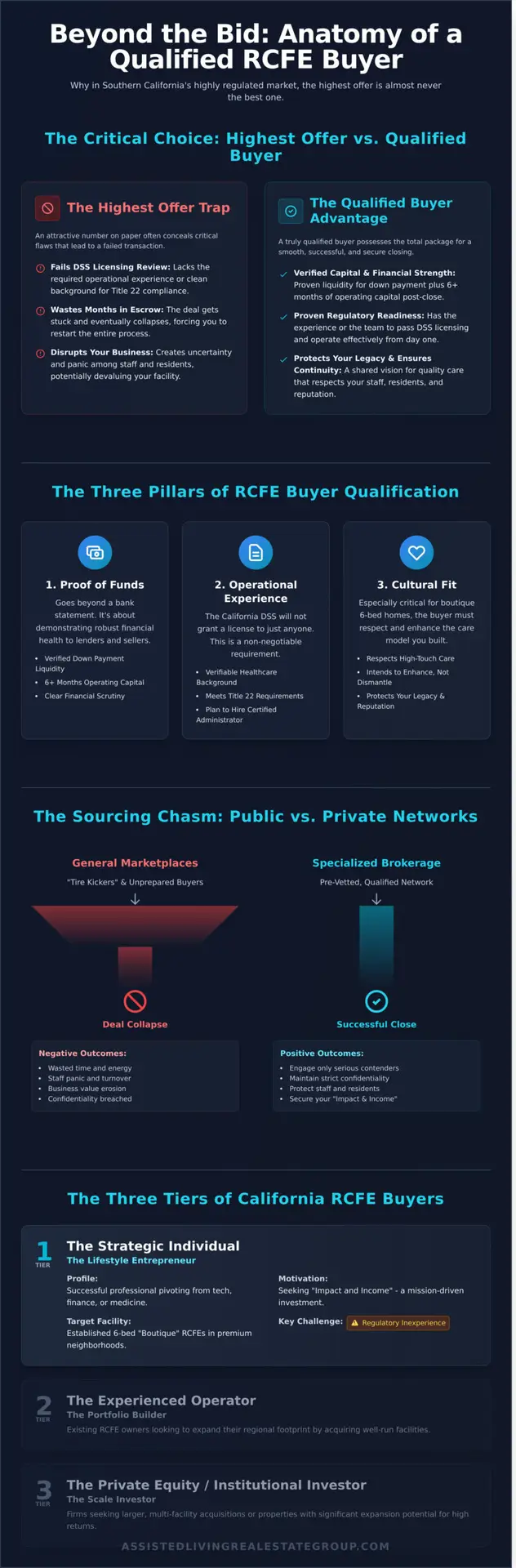
A serious buyer in the California RCFE space must stand firmly on three pillars. First is Proof of Funds that goes beyond a simple bank statement. Lenders and sellers need to see verified liquidity for the down payment, plus at least six months of operating capital post-acquisition. This financial scrutiny is intense, as the buyer must demonstrate a clear understanding of various Business Valuation Methodologies to justify the loan and prove they can weather any initial operational challenges. Second is Operational Experience. The California Department of Social Services (DSS) will not grant a license to just anyone. A potential buyer must have a verifiable background in healthcare management or a concrete plan to hire a certified RCFE administrator who meets the stringent requirements of Title 22. Finally, there’s Cultural Fit. This is especially critical for “Boutique” 6-bed Residential Assisted Living (RAL) homes. The right buyer respects the intimate, high-touch care model you’ve built and intends to enhance it, not dismantle it for a generic, institutional approach.
Why General Marketplaces Fail Senior Care Sellers
Listing your facility on a public business-for-sale website is a critical mistake. These platforms attract a flood of “tire kickers”-individuals with no healthcare background who are unprepared for the complexities of DSS licensing and operational oversight. This wastes your valuable time and energy. More dangerously, a public listing can create panic among your dedicated staff in communities like San Jacinto or Carson, who may fear for their job security under new, unknown ownership. This instability can lead to staff turnover, disrupt resident care, and ultimately devalue your business before a sale is ever finalized. The role of a specialized RCFE broker is to act as a gatekeeper, discreetly marketing your opportunity to a pre-vetted network and ensuring that only a truly qualified buyer for business continuity ever learns of the sale. This protects your legacy, your staff, and your bottom line.
This is where specialized firms like Healthcare Biz Brokers, Inc. add significant value, bringing a network of vetted buyers and deep knowledge of healthcare-specific transactions.
The Three Tiers of Buyers for California Care Facilities
Your exit strategy isn’t just about when you sell; it’s about who you sell to. The California senior care market isn’t a monolith. It’s a dynamic ecosystem populated by distinct buyer personas, each with unique motivations, financial capabilities, and operational expertise. Finding the right qualified buyer for business success means understanding which tier your facility appeals to, as this directly dictates your valuation, negotiation leverage, and the legacy you leave behind. The price you command is a direct reflection of the buyer you attract.
Tier 1: The Strategic Individual (The Lifestyle Entrepreneur)
This is the fastest-growing buyer class in the boutique Residential Assisted Living (RAL) space. Often a successful professional from tech, finance, or medicine, this individual is pivoting their career. They aren’t just buying a business; they’re buying a new mission. They seek the “Impact and Income” model and are drawn to established 6-bed RCFEs in premium residential neighborhoods like Thousand Oaks or Irvine. Their primary challenge is operational and regulatory inexperience. They require significant guidance to navigate the state’s complex RCFE Licensing Requirements. For sellers with a well-documented, compliant operation, this buyer represents a “Blue Ocean” opportunity, as they often value a turnkey system and are willing to pay a premium for a smooth transition.
Tier 2: The Multi-Facility Operator (The Scaler)
These are the established regional players. A Tier 2 buyer already owns and operates multiple facilities and is looking to expand their footprint, perhaps moving from the San Fernando Valley into new markets like Fresno or Bakersfield. They possess the “Regulatory DNA” to manage compliance effortlessly and have the back-office infrastructure-from staffing to billing-to absorb a new property with high efficiency. This buyer is primarily motivated by economies of scale. They seek stable, cash-flowing assets that can be immediately integrated into their portfolio. They scrutinize profit and loss statements and census numbers, making them a less emotional but highly decisive qualified buyer for business assets that are already performing.
Tier 3: Institutional Investors and REITs
This tier operates on a different plane. Private equity firms and Real Estate Investment Trusts (REITs) are not interested in 6-bed homes. Their acquisition targets are large-scale, often 30+ bed assisted living centers or entire portfolios. Their decisions are driven by cold, hard metrics: capitalization rates, net operating income, and long-term real estate appreciation. For these buyers, the care component is a variable in an ROI calculation. Selling to a Tier 3 entity is a high-stakes process that demands flawless, audited financial records going back at least three years. The barrier to entry is immense, but for larger operators, it can represent the highest possible enterprise valuation.
Ultimately, the type of buyer you attract will define your final sale price. A Tier 1 buyer might offer a lower cap rate because they are buying a lifestyle and a proven system. A Tier 3 investor will hold you to a strict market-rate cap rate based purely on risk and return. Aligning your facility’s story and financials with the right buyer profile is the most critical step in maximizing your exit, and understanding your buyer’s profile is the first move toward a successful transaction.
Financial Strength vs. Regulatory Readiness: The California Trap
The most costly mistake a California care facility owner can make is believing that cash equals qualification. It doesn’t. This flawed assumption creates a dangerous “licensing gap” during escrow-a chasm between a buyer’s financial offer and their actual ability to be approved by the state’s Community Care Licensing Division (CCLD). Deals die in this gap every single day, leaving sellers with wasted time, legal fees, and a business stuck in limbo.
Your buyer doesn’t just need to satisfy your asking price; they must satisfy the rigorous demands of California’s Title 22 regulations. These aren’t mere guidelines; they are the bedrock of senior care operations and the CCLD’s primary tool for vetting applicants. A comprehensive understanding of California’s RCFE Laws and Regulations is non-negotiable for any serious contender. Before you even consider a Letter of Intent (LOI), you must verify a buyer’s ability to secure an RCFE license by demanding proof of:
- RCFE Administrator Certification: Does the buyer (or a designated partner) hold a current certification?
- Verifiable Experience: Can they provide a resume or portfolio of successful operations in California’s senior care market?
- Clean Background: Have they completed a background check that is clear of any convictions that would disqualify them from licensure?
This proactive vetting is the only way to identify a truly qualified buyer for business who can carry your legacy forward, ensuring both Impact and Income.
The Reality of RCFE Licensing Delays
In 2026, the average RCFE licensing timeline in California from a complete application submission to approval is 90 to 120 days. An unprepared buyer, however, can easily turn this into a 6 to 9-month ordeal, tying up your property without a close in sight. Their incomplete application gets kicked back by the CCLD, initiating a painful cycle of corrections that drains your momentum. As a pre-emptive check, ask about their licensing history. Have they successfully secured a “Provisional” or “Permanent” license in California before? A proven track record with the CCLD is worth more than a proof of funds letter.
Vetting the Financial “Liquidity” for California Operations
Lenders in the boutique senior care space operate on a different risk model. They aren’t just funding real estate; they’re bankrolling a highly regulated healthcare operation. They know that without a license, the property’s revenue is zero, making the buyer’s operational expertise a critical factor in their underwriting. The California Department of Social Services (CDSS) mandates that all new license applicants demonstrate at least three months of operating capital in reserve. This isn’t for the down payment; it’s a liquidity test to ensure the facility can cover payroll and expenses from day one. Finding a qualified buyer for business means finding someone who has planned for this specific capital requirement. For a deeper dive, review our guide on Financing Your RCFE Purchase: A Buyer’s Guide.
5 Strategic Channels to Source Qualified Buyers in SoCal
Selling your care facility isn’t a numbers game; it’s a matching game. The goal isn’t to attract the most offers, but the right offer from a buyer with the capital, experience, and vision to protect your legacy. In Southern California’s competitive landscape, this requires a multi-pronged strategy that moves beyond a simple “For Sale” sign. It demands precision, discretion, and access to exclusive networks where the most serious players operate.
Here are five strategic channels essential for connecting with a truly qualified buyer for your business, ensuring you achieve both maximum value and a seamless transition of care.
- Leveraging a Specialized RCFE Brokerage Database: We don’t just list your property; we connect it directly to a curated database of over 1,200 pre-vetted investors and operators. Each prospect is qualified based on their proof of funds, California DSS licensing history, and specific acquisition criteria, from 6-bed RALs in San Diego to 40-bed facilities in Orange County.
- Confidential Networking within CAHF: The California Association of Health Facilities (CAHF) is more than an industry group; it’s a network of the state’s most committed operators. Through discreet, one-on-one conversations at regional chapter meetings or targeted introductions, we can identify established owners who are actively seeking to expand their California footprint.
- Targeted “Blind Listings” on Industry Portals: To maintain confidentiality, we utilize “blind listings.” These profiles highlight key financial metrics like a 15% cap rate and operational details like licensed capacity, but only mention a general area, such as “East San Gabriel Valley,” protecting your specific location until a buyer is fully vetted and under a non-disclosure agreement.
- Direct Outreach to Established Operators: A successful operator in Ventura County often has the infrastructure and appetite to acquire a synergistic facility in Santa Barbara County. We proactively identify and approach these logical buyers, presenting your facility as a strategic opportunity for regional consolidation, not just another property on the market.
- Utilizing Proprietary “Boutique” Care Investor Lists: This is our blue ocean. We maintain an exclusive list of high-net-worth individuals and private funds specifically seeking the “Boutique” care model. These investors understand the premium returns and social impact generated by smaller, high-quality RALs and are prepared to pay a premium for turnkey operations.
The Power of Confidential Marketing
Your business is your legacy. Protecting it during a sale is paramount. Imagine marketing a 12-bed facility in Fresno; instead of listing the street address and alerting staff, a “teaser” profile is created. It highlights the $750,000 gross annual income and its prime location near a major medical center, attracting high-intent buyers while maintaining complete operational privacy. This is the core of The Value of Confidential Marketing for RCFE Sales.
Local Market Spotlights: Where the Buyers Are
Buyer demand varies dramatically across SoCal. The Inland Empire attracts operators focused on scale, where acquisition costs per bed can be 10-15% lower than in Los Angeles County. Conversely, the San Fernando Valley, especially Van Nuys, remains a hotbed for ARF and RCFE acquisitions due to its zoning and dense referral networks, commanding premium valuations. We’re also seeing a notable shift toward “Lease-to-Own” opportunities, a structure gaining favor with operators under 40 who need a pathway to ownership in California’s high-cost real estate market.
Finding the right qualified buyer for your business means knowing exactly where to look and how to approach them. Our proprietary database contains over 1,200 vetted California investors. Access our network to find your ideal buyer today.
How Assisted Living Real Estate Group Vets for Success
Selling your care facility isn’t just a transaction; it’s the transfer of a legacy. You’ve poured years into building a community and a reputation for quality care. The last thing you want is for that to be dismantled by an ill-equipped successor. That’s why we developed our proprietary vetting process over 25 years, specifically designed to identify the right operators for Southern California’s unique market. We don’t just find a buyer. We find the right buyer.
Our methodology goes far beyond a simple credit check. We utilize the “Impact and Income” scorecard, a comprehensive evaluation tool that ensures a potential buyer is prepared to honor your legacy while achieving financial success. A strong balance sheet is just the entry ticket. True qualification requires much more. We assess candidates on a deeper level, analyzing their operational DNA to ensure a seamless transition for your residents and staff. This process is how we find a truly qualified buyer for business continuity and growth.
We scrutinize every potential operator against critical California-specific benchmarks, including:
- Licensing Acumen: A proven history of navigating California’s Department of Social Services (DSS) and maintaining compliance with Title 22 regulations.
- Operational Philosophy: A documented care model that aligns with the boutique, high-quality environment you’ve cultivated, not a plan to cut corners.
- Capital Strategy: Financial reserves not just for the acquisition, but for future investment in the property and staff, ensuring long-term stability.
- Community Commitment: A clear, actionable plan for resident continuity and staff retention, protecting the very heart of your business.
This is how we bridge the critical gap between real estate value and business operations. The property is the vessel, but the operational excellence is the engine. We ensure your buyer knows how to command both.
The ALREG Difference: Specialized Brokerage
A general commercial broker sees a building; we see a licensed, thriving RCFE. They don’t understand the nuances of census, staffing ratios, or state licensing. Our exclusive focus on California care homes means we have a private, pre-approved network of buyers actively seeking facilities like yours. For example, in 2023 we successfully transitioned a 6-bed home in San Diego County, connecting the owner with a seasoned operator from our network who had a decade of experience specifically in the Southern California market.
Start Your Confidential Exit Strategy
The first step toward a successful exit is understanding your facility’s true market worth, combining both its real estate and business value. A professional valuation provides the strategic clarity needed before ever speaking to a potential buyer. It positions you for maximum return and a smooth transition. To begin crafting your confidential exit plan, schedule a private consultation with our founder, Teri Szoke. Let’s protect your legacy and unlock your future.
Get a Confidential Valuation for Your CA Care Home
Secure Your Legacy: The Final Step in Your RCFE Sale
Selling your Southern California care facility is more than a transaction; it’s the culmination of your life’s work. Navigating California’s complex Title 22 licensing while identifying buyers with both financial strength and operational readiness is a unique challenge. Finding the right qualified buyer for business requires more than a simple listing; it demands a strategic approach that protects your legacy, your residents, and your bottom line.
Don’t leave this critical step to chance. Assisted Living Real Estate Group leverages over 25 years of specialized California care facility experience to connect you with vetted individuals from our exclusive “Impact and Income” buyer database. Our confidentiality-first marketing strategy ensures your business operations remain undisturbed while we secure the ideal successor for your boutique care home. It’s time to achieve your financial goals and ensure your legacy of care continues.
Partner with SoCal’s RCFE Experts to Find Your Qualified Buyer and take the first step toward your successful exit today.
Frequently Asked Questions About Selling Your California Care Facility
How long does it take to find a qualified buyer for an RCFE in California?
Finding a qualified buyer for a California RCFE typically takes between 6 and 12 months. This timeline accounts for targeted marketing, rigorous buyer vetting, and comprehensive due diligence. A significant portion of this period, often 90 to 120 days, is dedicated to the buyer’s licensing application process with the California Department of Social Services (DSS). Preparing a professional marketing package upfront can help attract serious prospects and shorten the initial phase of the sale.
Can a buyer from out-of-state qualify for a California RCFE license?
Yes, an out-of-state buyer can absolutely qualify for a California RCFE license. The critical factor is their ability to meet all requirements set by the California Department of Social Services (DSS). This includes completing a California-specific 80-hour RCFE Administrator Certification Program from an approved vendor and passing the state’s administrator exam. We often guide out-of-state investors through this process, ensuring they establish the necessary local presence and qualifications to operate successfully within California.
What is the most important financial document a buyer must provide?
The most critical financial document is a current Proof of Funds (POF) statement. This isn’t just a bank balance; it must clearly demonstrate the buyer has sufficient liquid capital for the entire down payment plus at least three to six months of post-close operating expenses. For a transaction involving an SBA loan, which over 70% of these deals do, this verified liquidity is a non-negotiable requirement for both the seller’s broker and the lender before proceeding with an offer.
Is it possible to sell my business if the buyer doesn’t have care experience?
Yes, you can sell to a buyer without direct care experience. The key is that the new owner must hire a California-licensed RCFE Administrator to manage daily operations and ensure regulatory compliance. This is a common and successful model, attracting investors with strong business acumen who can focus on growth while a qualified professional handles resident care. Finding a qualified buyer for business operations often means looking for strong management skills, not just prior healthcare experience.
How do I keep my business sale confidential from my employees in California?
Maintaining confidentiality is paramount and achieved through a multi-step process. We begin with a “blind listing” that omits identifying details. Every prospective buyer is then required to sign a stringent Non-Disclosure Agreement (NDA) before receiving any sensitive information. All communications are funneled through your broker, and any on-site tours are strategically scheduled after hours or presented as “insurance inspections” or “licensing visits” to avoid alerting staff and residents until the deal is secure.
What happens if a buyer is denied a license by the California DSS during escrow?
If a buyer is denied their license by the California DSS, the purchase agreement’s licensing contingency is triggered. This clause is standard in RCFE sales contracts and is designed to protect both parties from this specific risk. Typically, the contingency allows the buyer to cancel the contract and have their earnest money deposit returned. The seller is then free to place the facility back on the market, which is why pre-qualifying a buyer’s eligibility is a critical first step.
Do buyers prefer RCFE or ARF facilities in the current Southern California market?
In the current Southern California market, investor demand is overwhelmingly stronger for RCFEs over ARFs. This preference is driven by the massive demographic wave of aging baby boomers, creating a predictable and growing private-pay client base. Lenders also view the RCFE model more favorably, associating it with higher property values and more stable revenue streams. This makes finding a qualified buyer for business assets in the RCFE space a more streamlined process than for other facility types.
What is a “blind listing” and why is it used for care facility sales?
A blind listing is a confidential marketing advertisement that presents the key financial and operational details of your care facility without revealing its name, address, or other identifying information. It is the foundational tool for maintaining confidentiality during a sale. By using a blind listing, we can attract a wide pool of potential buyers while protecting your business from the disruption that public knowledge of a sale could cause among your employees, residents, and their families.