
You’ve found the perfect Residential Care Facility for the Elderly. The asking price seems right. But what is the real number? For savvy investors looking to capitalize on California’s Silver Tsunami, this question is critical. The figure on the listing sheet is merely the starting point; it doesn’t account for the labyrinth of licensing transfer fees, the nuanced valuation of goodwill versus real estate, or the working capital required to ensure a seamless transition of care from day one. This is where most acquisitions encounter financial surprises, derailing an otherwise powerful opportunity for both Impact and Income.
This guide is your roadmap to financial clarity. We will decode the complete cost of buying an RCFE in California, moving far beyond the purchase price to give you a line-item-level understanding of every expense. By the end, you will have the strategic foresight to budget accurately, evaluate opportunities with confidence, and build your legacy in boutique senior care without the burden of unexpected financial setbacks. Let’s build your pro forma with precision.
Key Takeaways
- Master the dual-asset valuation of an RCFE, understanding you’re acquiring both a valuable piece of real estate and a profitable healthcare operation.
- Look beyond the listing price to understand the full cost of buying an RCFE in California, including often-overlooked expenses for due diligence and licensing that protect your investment.
- Prepare for long-term success by strategically budgeting for post-closing liquidity, ensuring your facility thrives and meets lender requirements from the moment you take ownership.
- Pinpoint the specific drivers that dictate an RCFE’s final price tag-including licensure and operational history-to confidently assess value and negotiate from a position of strength.
The Two Pillars of an RCFE Purchase Price: Real Estate & Business Value
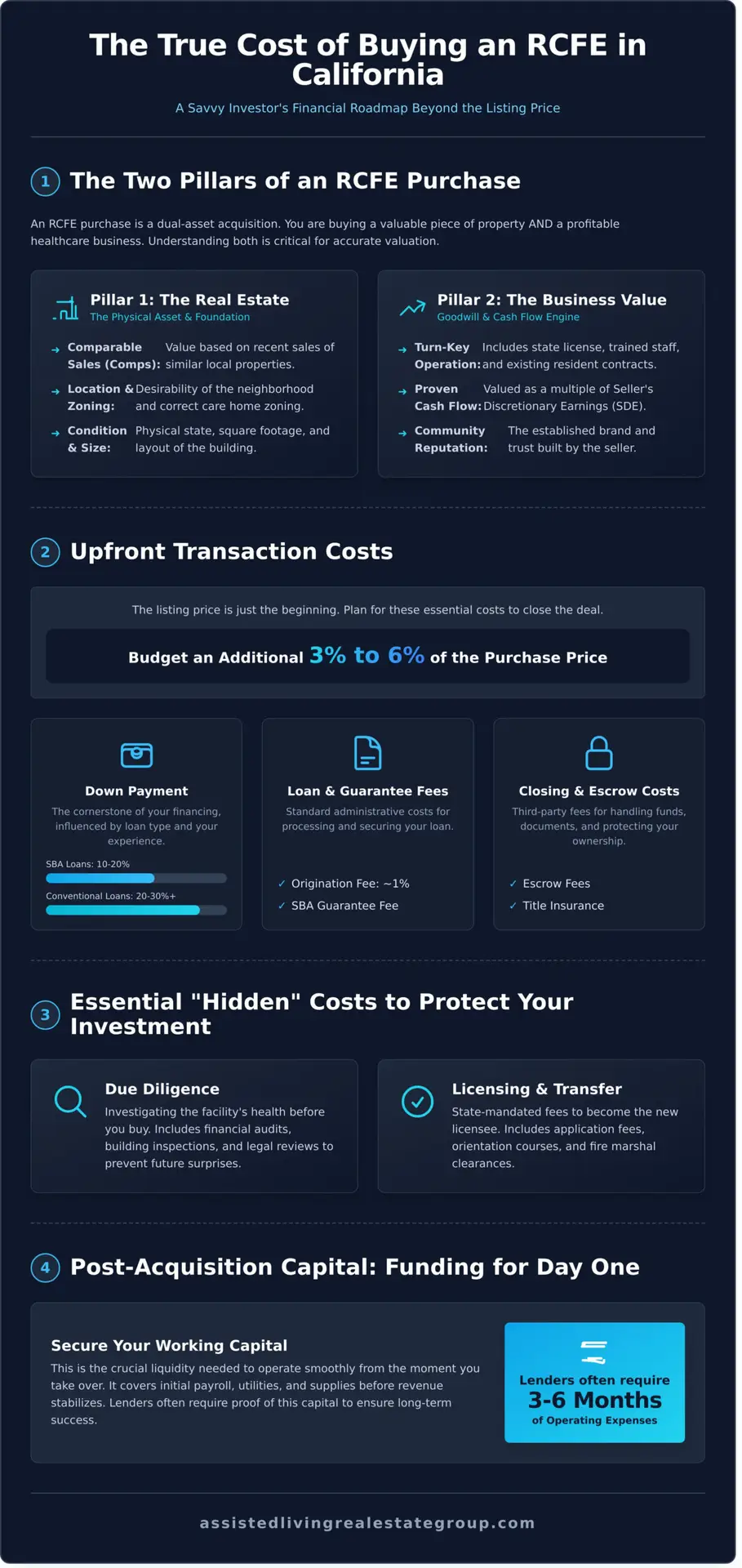
To truly grasp the cost of buying an RCFE in California, you must first understand a critical distinction: you are not acquiring one asset, but two. The final purchase price is a sophisticated blend of the tangible property and the intangible, income-producing business operating within its walls. This dual nature is what defines a Residential care facility as a unique investment class, separating savvy investors from the unprepared. Understanding how brokers and lenders evaluate each component separately is the first step toward negotiating effectively and securing the right financing for your legacy investment.
Valuing the Physical Asset: The Real Estate
This is the foundation of your investment-the physical structure and land. A licensed commercial real estate appraiser determines this value based on hard data, not emotion. This is the component traditional lenders understand best, often making it a straightforward portion of the financing puzzle. Key valuation factors include:
- Comparable Sales (Comps): Recent sales of similar properties in the immediate vicinity.
- Location & Zoning: Desirability of the neighborhood and proper zoning for care home operations.
- Condition & Square Footage: The physical state of the building, its size, and layout.
Assessing the Business Value: Goodwill & Cash Flow
Here is where your goal of generating both Impact and Income comes to life. The business value, often called “goodwill,” represents the facility’s proven ability to generate immediate and consistent cash flow. It is typically calculated as a multiple of the Seller’s Discretionary Earnings (SDE) or EBITDA. This value isn’t just a number; it’s the price you pay for a turn-key operation, including the state license, the trained staff, existing resident contracts, and the community reputation the seller has built. This is the engine of your investment, and it is valued based on its performance.
Breaking Down the Upfront Transaction Costs
The purchase price of a Residential Care Facility for the Elderly (RCFE) is a significant figure, but it’s only the headline number. True strategic investors understand that the total upfront investment required to close the deal involves several other critical line items. Failing to budget for these transactional costs is a common misstep that can jeopardize an otherwise perfect opportunity. A complete financial picture is essential when calculating the total cost of buying an RCFE in California, encompassing everything from lender fees to initial California RCFE licensing costs. As a general rule, you should budget an additional 3% to 6% of the purchase price to cover these essential closing expenses.
The Down Payment: What Lenders Expect
Your down payment is the cornerstone of your financing package and a direct reflection of your commitment. For SBA loans, which are a popular vehicle for RCFE acquisitions, lenders typically expect a down payment of 10-20%. Conventional commercial loans often require a higher threshold, typically in the 20-30% range or more. The final figure is influenced by your operational experience, personal credit, and the financial strength of the facility itself. A higher down payment not only reduces your loan amount but also signals to lenders that you are a lower-risk partner, often resulting in more favorable interest rates and terms-directly boosting your long-term ROI.
Loan Origination and Guarantee Fees
Lenders don’t work for free, and their fees are a standard part of the acquisition process. You can expect a loan origination fee, which typically amounts to around 1% of the total loan value, to cover the lender’s administrative costs for processing your application. If you are leveraging an SBA loan, you will also encounter a “guarantee fee,” which is paid to the government to secure their backing. While these fees can often be rolled into the total loan amount, it’s crucial to request a full, transparent breakdown from your lender to understand precisely how they impact your bottom line.
Closing Costs, Escrow, and Title Insurance
The final step in the transaction is managed by a neutral third party, and their services come with associated costs. These include:
- Escrow Fees: Paid to the escrow company for securely handling the funds and documents throughout the closing process.
- Title Insurance: A one-time premium for a policy that protects you and your lender from any undiscovered liens or ownership claims on the property from the past. This is non-negotiable for protecting your legacy investment.
- Miscellaneous Costs: This category includes state and county transfer taxes, recording fees for the new deed, and other minor administrative charges.
A specialized broker will provide you with a detailed estimate of these costs, ensuring there are no surprises as you move toward creating an enterprise of both Impact and Income.
The ‘Hidden’ Costs: Budgeting for Due Diligence and Licensing
The sticker price is only the beginning. First-time investors often make a critical error: they underestimate the pre-acquisition expenses that protect their capital. These are not optional add-ons; they are the essential investments you make before you own the facility to ensure you’re buying a sound asset, not inheriting a financial nightmare. Failing to properly budget for this phase can jeopardize the entire deal, turning a golden opportunity into a costly mistake. Factoring these elements into the total cost of buying an RCFE in California is the mark of a savvy, strategic investor.
Investing in Professional Due Diligence
This is your opportunity to look under the hood. A thorough due diligence process uncovers the operational and physical realities of the facility, protecting you from expensive surprises post-closing. Key investments include:
- Commercial Building Inspection: A detailed assessment of the property’s structural integrity, HVAC, plumbing, and electrical systems to identify deferred maintenance.
- Financial Audit: Verification of the seller’s profit and loss statements, rent rolls, and occupancy rates by a qualified CPA.
- Phase I Environmental Site Assessment: Often a lender requirement, this report identifies potential environmental liabilities associated with the property.
Navigating California’s RCFE Licensing Transfer Costs
In California, the license is the lifeblood of the business. You cannot operate without it, and the transfer process is meticulous and unforgiving. The entire process is governed by the state’s stringent California RCFE licensing regulations, managed by the Department of Social Services (DSS). Budget for application fees, background checks (Live Scan) for all key personnel, and mandatory administrator certification courses if you or your manager are not already certified. Many successful investors also hire a specialized licensing consultant to navigate the bureaucracy, an investment that can save months of costly delays.
Legal and Accounting Professional Fees
Do not attempt to navigate a complex commercial transaction without an expert team. These professionals are your shield, protecting your legal and financial interests at every turn. Your attorney will scrutinize the purchase agreement and all contracts, while your CPA provides critical financial analysis and advises on the optimal structure for your new business entity. Cutting corners here is the ultimate false economy; the right advice saves you multiples of its cost in the long run, securing both your impact and your income.
Post-Acquisition Capital: Funding for Day One and Beyond
The purchase price is only one part of the equation. A critical mistake new investors make is underestimating the capital required after closing the deal. The true cost of buying an RCFE in California includes the strategic funds required to stabilize operations, enhance the asset, and ensure a seamless transition for both residents and staff. This post-closing liquidity isn’t just a safety net; it’s a launchpad for long-term success and a non-negotiable for savvy operators.
Essential Working Capital for a Smooth Transition
Your facility must operate flawlessly from the moment you take ownership. Working capital is the lifeblood that ensures this continuity, covering essential expenses like payroll, utilities, insurance, and supplies for the first few months. This financial buffer is critical while your accounts receivable cycles normalize. Lenders recognize this reality and will typically require you to hold three to six months of operating expenses in reserve, preventing a cash flow crisis during the most vulnerable phase of your new venture.
Budgeting for Capital Expenditures (CapEx)
A successful acquisition often involves immediate value-add opportunities. Your due diligence likely uncovered needs for repairs or strategic upgrades that can transform the property. A dedicated CapEx budget allows you to address these items proactively, from installing new safety equipment to cosmetic updates that elevate the resident experience and justify premium rates. Setting aside a CapEx reserve is the mark of a prudent operator focused on both legacy care and asset appreciation. Let our experts help you build a comprehensive acquisition budget.
Initial Marketing and Staffing Costs
Your two most valuable assets are your residents and your staff. A comprehensive plan for the cost of buying an RCFE in California must account for protecting both. This includes funding for marketing campaigns to maintain or improve occupancy rates and resources for recruiting, training, or retaining key caregiving staff. Investing in your team and brand from day one sends a powerful message of stability and commitment, laying the foundation for a thriving community and a profitable enterprise where you can truly achieve both impact and income.
Key Factors That Influence the Final RCFE Price Tag
Not all Residential Care Facilities for the Elderly (RCFEs) are created equal. Two facilities with the same bed count can have vastly different valuations. Understanding the key drivers behind the price tag is not just an academic exercise; it is the strategic intelligence you need to identify true value, avoid overpaying, and build a legacy of both Impact and Income. A deep dive into these variables reveals the true drivers behind the cost of buying an RCFE in California.
Location: Regional Price Differences Across California
The adage “location, location, location” holds immense power in the RCFE market. A boutique facility in a high-income coastal community like Orange County or the Bay Area will command a premium price due to higher private-pay rates and property values. In contrast, opportunities in the Inland Empire or Central Valley may offer a more accessible entry point. Key value-adds include:
- Proximity to major hospitals and medical centers.
- Location within affluent neighborhoods with strong senior demographics.
- Favorable local zoning that protects against new competition.
The Impact of Occupancy and Private Pay Mix
A facility’s financial health is its most critical asset. A high occupancy rate is the goal, but the quality of that occupancy is what separates premier investments from struggling ones. A high percentage of private-pay residents is the gold standard, generating significantly more revenue and operational stability than facilities reliant on lower, less reliable government reimbursements. Look for consistent, stable occupancy and a strong resident payor mix to ensure a robust ROI.
Facility Size, Condition, and License Capacity
The physical asset and its licensing are foundational to its value. The licensed bed count directly dictates maximum revenue potential. A modern, well-maintained property that requires minimal immediate capital expenditure (CapEx) is far more valuable than a “fixer-upper.” Furthermore, a clean compliance history with the Department of Social Services (DSS) is non-negotiable; it signifies a well-run operation and mitigates future risk. An immaculate record is, in itself, a priceless asset.
Analyzing these factors requires more than a simple spreadsheet; it demands market-specific expertise. A specialized broker provides the granular insights needed to navigate these dynamics and structure a winning offer. To learn how we assess opportunities and uncover true value, connect with our team of experts.
From Complex Costs to Clear Opportunity: Your RCFE Acquisition Blueprint
Understanding the true cost of buying an RCFE in California is an exercise in strategic mastery, not just accounting. The final price tag is a complex equation, balancing the tangible value of real estate with the intangible goodwill of an operating business. Success demands a comprehensive budget that anticipates not only the transaction but also the critical costs of due diligence, licensing, and essential post-acquisition capital.
Navigating this high-stakes landscape alone is a risk. For over 25 years, the Assisted Living Real Estate Group has provided the specialized roadmap investors need. We offer expert guidance on valuation, financing, and licensing, all while protecting business continuity with confidential marketing. This is more than a transaction; it’s the foundation of your legacy in senior care-an opportunity to achieve both impact and income.
Don’t let complexity obscure the immense opportunity. Partner with an expert to navigate your RCFE acquisition and transform your vision into a thriving reality.
Frequently Asked Questions About RCFE Investment Costs
What is a typical price range for a 6-bed RCFE in California?
The cost of buying an RCFE in California for a 6-bed facility is highly dependent on location. In markets like the Central Valley, prices may range from $800,000 to $1.2 million. In prime coastal regions like Los Angeles or the Bay Area, that figure can easily exceed $2 million. This price reflects the combined value of the real estate asset and the licensed, operational business-a turnkey investment in a high-demand sector.
Can I use an SBA loan to cover the real estate, business, and working capital costs?
Yes. An SBA 7(a) loan is a powerful financing vehicle for acquiring an RCFE. Savvy investors leverage these loans to finance the real estate purchase, the business’s goodwill value, and even a portion of the required working capital. This integrated financing solution streamlines the acquisition process, allowing you to secure a cash-flowing asset with a more strategic capital structure, preserving your liquidity for initial operations and growth initiatives.
How much working capital should I have in the bank after closing on an RCFE?
Prudent investors should plan for three to six months of operating expenses in reserve. For a typical 6-bed RCFE, this can range from $75,000 to $150,000. This capital buffer is not just a safety net; it’s a strategic tool. It covers payroll, utilities, and unforeseen expenses during the transition, safeguarding your investment and ensuring you can maintain the highest standard of boutique care for your residents from day one.
Are the real estate and the business operations always sold together?
Not always. While many transactions are a package deal including both the real property and the licensed business, some are “business-only” opportunities where you lease the facility. Buying both provides total asset control and long-term appreciation. A lease option lowers the initial barrier to entry, but it sacrifices the real estate equity component of your investment. Your long-term goals for impact and income should dictate the ideal structure for your acquisition.
What are the biggest and most common cost-related mistakes RCFE buyers make?
The two most critical errors are underestimating working capital needs and insufficient due diligence. A lack of post-closing liquidity can cripple a new operation before it stabilizes. Furthermore, failing to meticulously vet a facility’s financial records, staffing history, and regulatory compliance can lead to inheriting costly problems. A strategic partner helps you navigate these pitfalls, turning potential liabilities into a clear path toward profitability and purpose.
Is it more expensive to buy an existing RCFE than to start one from scratch?
While the upfront purchase price of an existing RCFE may seem higher, starting from scratch often carries immense hidden costs and risks. The startup route involves zoning hurdles, construction delays, and a lengthy, uncertain licensure process with zero initial cash flow. Acquiring a turnkey, cash-flowing facility de-risks the investment, provides immediate ROI, and allows you to focus on enhancing operations rather than navigating a bureaucratic maze from a standing start.
How does the ‘private pay’ versus ‘Medi-Cal’ resident mix affect the facility’s cost?
The resident payor mix is a primary valuation driver. A facility with a high concentration of private-pay residents commands a premium price because it generates a higher, more predictable Net Operating Income (NOI). These boutique care homes are more insulated from fluctuating government reimbursement rates. In contrast, a Medi-Cal-heavy facility’s value is tied directly to state funding, which can introduce volatility and cap revenue potential, directly impacting the asset’s market value.