
What if the most consequential part of a California assisted living sale happens after buyer and seller agree on the deal? The chow process assisted living buyers and sellers face involves more than transferring a property or business. The incoming owner also needs to plan for the licensing transition.
It’s natural to have questions about how a change may affect residents, staff, and daily operations. In California, an existing RCFE license doesn’t simply transfer to a new owner. The incoming owner must obtain a license. That makes it important to coordinate transaction planning with the regulatory and operational handoff, rather than treating them as separate tasks.
This guide explains the California CHOW process and the transaction and licensing questions to address early. You’ll learn how to distinguish the business and property components, organize the licensing transition with appropriate professional support, and plan confidential communications that support an orderly handoff. Specialized brokerage guidance can help clarify transaction considerations while keeping residents and operations in view.
Key Takeaways
- Clarify whether a California deal includes the facility business, the property, or both before setting transaction assumptions.
- Use current California Department of Social Services and Community Care Licensing Division guidance to confirm licensing steps and application materials.
- Plan the chow process assisted living transaction alongside licensing and operational milestones. They may not follow the same schedule.
- Assign responsibility for diligence, documents, communications, and transition tasks to reduce avoidable handoff confusion.
- Specialized brokerage coordination and confidential marketing can help organize sensitive sale discussions.
What Does the CHOW Process Mean for a California Assisted Living Facility?
A change of ownership, or CHOW, is a transition in who owns or operates a licensed care facility. It isn’t automatically the same as selling the building. In California, a deal may include the facility business, its operating assets, the real estate, or a combination. Clarifying what changes hands matters because a property transfer alone may not resolve licensing questions about ownership and operations.
Quotable definition: A business sale changes ownership of the care-facility operation. A real-estate-only sale changes ownership of the property and doesn’t, by itself, establish that the operating business or its licensing status has changed.
California’s Community Care Licensing Division, within the California Department of Social Services, oversees licensing for Residential Care Facilities for the Elderly (RCFEs) and Adult Residential Facilities (ARFs). For an RCFE, the existing license doesn’t simply transfer to a new owner. The incoming owner must obtain their own license. ARFs are a distinct facility category, so consider their applicable licensing pathway separately rather than assuming it matches the RCFE process.
CHOW, facility sale, and real estate transfer: what is the difference?
Consider a California RCFE sale where the seller transfers the operating business and the buyer separately acquires the property. The business and real-estate components may be negotiated and documented separately, but they connect in practice: the buyer needs to understand how the proposed ownership and operating arrangement relates to licensing. In a property-only sale, the facility business may remain with its current owner. Calling a transaction a “sale” or “CHOW” doesn’t determine the licensing outcome. The transaction facts and current California requirements matter.
Who is involved in a California assisted living ownership transition?
The buyer and seller define the deal and clarify what is changing hands. Facility leadership identifies operational responsibilities that need attention during the handoff. Transaction professionals can coordinate business and real-estate considerations, while the California Department of Social Services Community Care Licensing Division provides the relevant licensing channel. Legal questions should be addressed with qualified legal counsel.
These roles are distinct. A specialized California brokerage can coordinate transaction considerations and confidential seller communications, but it doesn’t make licensing decisions or provide legal representation. At the outset, assign an owner to each transaction, document, and communication task. The chow process assisted living buyers and sellers plan should connect the sale structure to licensing questions without treating brokerage coordination as regulatory approval.
How California Licensing Connects to an Assisted Living CHOW
In California, the Community Care Licensing Division (CCLD), within the California Department of Social Services (CDSS), is central to licensing Residential Care Facilities for the Elderly (RCFEs) and Adult Residential Facilities (ARFs). A facility transaction can also involve separate property, business, and local land-use considerations. Treat these as distinct workstreams. Combining them into one assumed approval process can obscure which questions need to be resolved and by whom.
A sale agreement can define what the parties intend to transfer, but it does not by itself satisfy or resolve California licensing requirements. For an RCFE, the cited California Code of Regulations states that the license is not transferable and a new application is required for a change of ownership. That reference concerns RCFEs. Don’t automatically apply it to an ARF, whose licensing pathway must be considered under the requirements for that facility type.
How RCFE and ARF context affects CHOW planning
An RCFE, or Residential Care Facility for the Elderly, and an ARF, or Adult Residential Facility, are distinct California facility categories. The license type and details of the proposed ownership and operating arrangement both matter when planning a transition. A buyer evaluating an RCFE shouldn’t assume an ARF follows the same process, or that the transaction structure alone determines the outcome. First identify the facility type and the changes contemplated. Then confirm the applicable path using current California guidance.
Which California requirements should be checked before relying on a timeline?
Before relying on forms, submission steps, or regulatory deadlines, consult current CDSS and CCLD guidance for the facility type and transaction facts. Requirements and application materials can change, so a timeline from another transaction may not fit the current situation.
Keep regulatory milestones separate from deal milestones. A purchase agreement, diligence period, real-estate closing target, staff transition plan, and licensing steps are related, but they are not interchangeable. Create a working schedule with separate entries for transaction dates and steps based on verified regulatory guidance. If a claim about approval, continued operation, or submission timing cannot be tied to authoritative California information, leave it unresolved rather than building the handoff around an assumption.
This distinction gives buyers and sellers a clearer basis for coordinating the deal. A California brokerage familiar with RCFE and ARF transactions can help organize business and property considerations alongside the transaction plan. For California facility transaction planning, that coordination can keep moving parts visible without confusing brokerage support with a licensing decision or legal advice.
How to Coordinate the California CHOW Transaction and Facility Handoff
A well-planned California CHOW connects deal terms to the practical work of handing over a care-facility business. Start by defining what is being acquired, then organize diligence, confirm the applicable licensing steps, and assign responsibility for each transition task. This sequence helps surface assumptions early, but it isn’t a fixed regulatory timetable.
Keep transaction milestones distinct from licensing milestones. A target closing date is a deal-planning point, not proof that a licensing step is complete or that an operating arrangement is permitted. Buyers and sellers should have qualified legal and financial advisers review transaction assumptions, while current California licensing information is confirmed through the appropriate state channels. A California RCFE buying guide can also help buyers prepare for broader acquisition questions.
What should buyers and sellers coordinate before closing?
Begin with a shared record of what the transaction includes: the facility business, operating assets, property, or a defined combination. Organize relevant facility, business, property, and operational information for diligence. A clear document index and one person assigned to coordinate requests can keep the review orderly and limit unnecessary sharing of sensitive details.
Agree on who coordinates each workstream, responds to information requests, and shares updates. Brokerage coordination can connect business and real-estate considerations, while legal and financial advisers address matters within their professional roles. Track licensing questions separately rather than assuming the purchase documents resolve them.
How can the handoff protect operational continuity?
Plan the handoff around the facility’s actual responsibilities, not just the closing calendar. Identify who will oversee staffing coordination, records transfer, vendor relationships, access to essential business information, and day-to-day management. For each task, record the responsible person, the information needed, and when the handoff should occur in relation to verified transaction and licensing milestones.
Plan communications just as carefully. Decide how and when relevant updates will reach residents, families, employees, and other stakeholders, while protecting confidential transaction information until disclosure is appropriate. Avoid promising uninterrupted operations unless the specific transition plan supports that claim. Instead, identify possible gaps, assign follow-up responsibility, and keep care-related operational needs central to the plan.
This is where the chow process assisted living transaction becomes more than a change in ownership on paper. It calls for a coordinated plan that respects the deal structure, California licensing context, and people affected by the handoff.
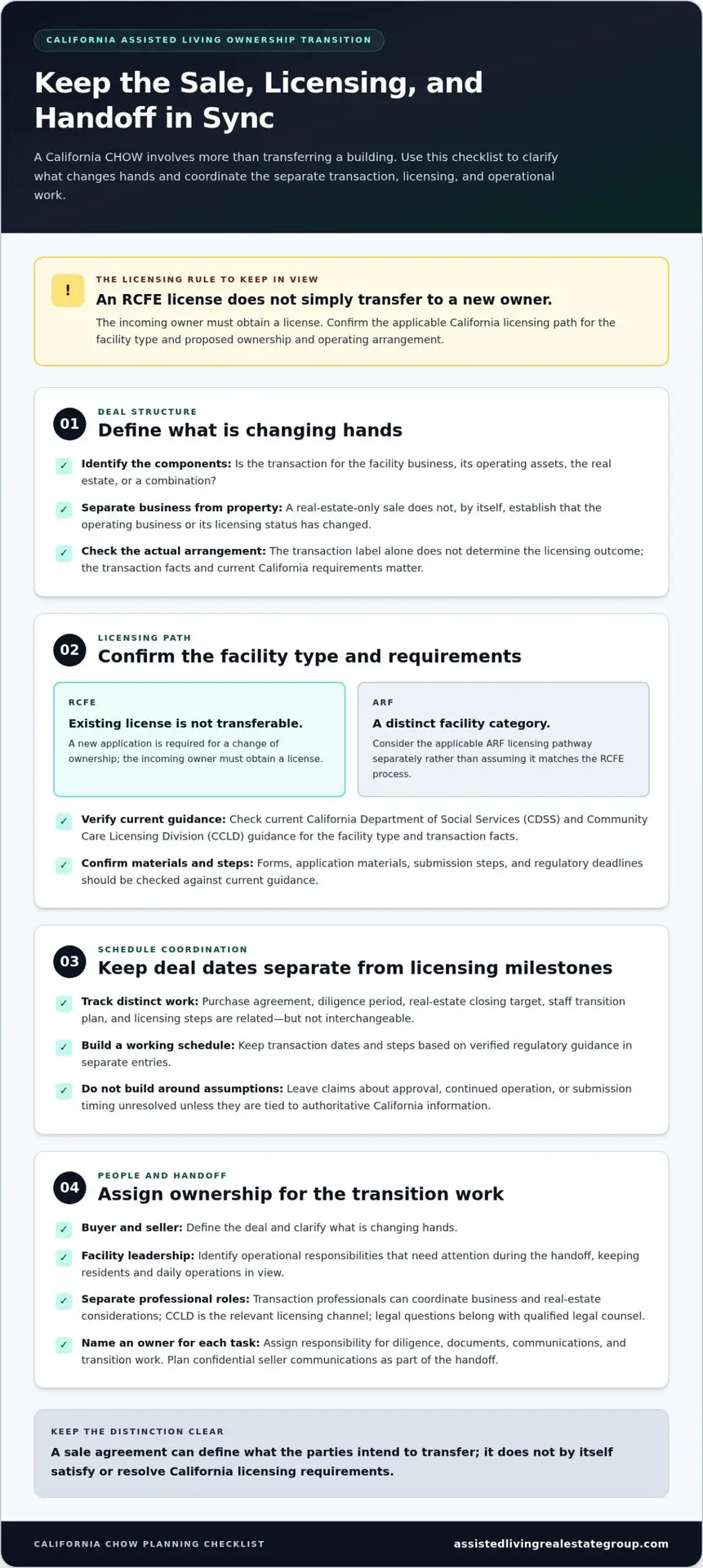
Common California CHOW Risks and a Practical Planning Checklist
A California CHOW can be harder to coordinate when the transaction plan and licensing assumptions don’t line up. For example, a buyer and seller may agree on what they believe is changing hands before clarifying how the facility’s ownership and operating arrangement affect licensing questions. That mismatch is a planning risk, not proof that a transaction will be delayed or denied.
Facility-specific facts matter. The facility type, proposed business and property transfers, and planned operating handoff help determine which questions need review. Incomplete diligence materials, unclear responsibility for documents, and uncoordinated transaction and regulatory milestones can also create avoidable friction. These issues don’t automatically determine a licensing outcome, but unresolved questions can make it harder to plan the transition.
What can complicate a change of ownership?
Look for gaps between what the purchase documents describe and what each party expects to happen operationally. Confusion can arise when no one is assigned to organize diligence materials, track open questions, manage sensitive communications, or coordinate handoff tasks. Keep regulatory questions distinct from transaction decisions and direct them to the appropriate California licensing contacts or qualified advisers. A California RCFE licensing guide can provide broader context alongside current official guidance.
What belongs on a CHOW planning checklist?
Use a working checklist that names an owner for each task and records its status. Keep California regulatory questions in a separate section, and verify regulatory claims against current authoritative guidance before relying on them. Include:
- Transaction scope: Record what the parties intend to transfer, including the business, operating assets, and property considerations.
- Diligence: Track facility, business, property, and operational information requested, received, and outstanding.
- Milestones: Separate deal dates from licensing steps and internal transition goals. Don’t assume they share a schedule.
- Communications: Assign responsibility for updates to residents, families, employees, and other relevant stakeholders, with confidentiality in mind.
- Handoff: Identify who will coordinate staffing, records, vendor relationships, and day-to-day operational responsibilities.
Review the resident-care and staffing continuity plan with the responsible facility leadership. The aim isn’t to promise uninterrupted operations. It’s to surface dependencies, clarify accountability, and plan around verified milestones. A disciplined chow process assisted living plan can help buyers and sellers identify gaps before they become last-minute questions.
For California facility transaction coordination, explore specialized brokerage support focused on care-facility sales and confidential marketing.
When Specialized Brokerage Support Can Help With a California CHOW
A California care-facility transaction can involve more than agreeing on price. Buyers and sellers may need to coordinate the business, operating assets, real estate, confidentiality, and practical handoff. A brokerage focused on California Residential Care Facilities for the Elderly (RCFEs) and Adult Residential Facilities (ARFs) can help organize those transaction discussions.
Assisted Living Real Estate Group brings more than 25 years of combined care-facility industry experience to its California transaction work. The team helps buyers and sellers frame questions about the facility and business, identify transaction details that need further review, and keep real-estate and business considerations connected. Brokerage coordination supports the transaction but doesn’t replace legal advice or decisions by California licensing authorities.
How does a specialized broker support the transaction?
A specialized broker can coordinate communication between buyer and seller, organize key transaction information, and clarify how the proposed deal treats the facility business and property. Familiarity with care-facility transactions can help parties raise relevant questions early rather than relying on assumptions from a different type of property or business sale. This support is especially useful when ownership, operations, and real estate are being discussed together.
For sellers, confidential marketing can help manage sensitive communications while exploring a potential sale. Coordinating what information is shared, with whom, and at what stage can help maintain discretion during the transaction. Buyers can use a focused discussion to outline acquisition goals and understand the facility’s transaction context.
What is a useful next step for a California buyer or seller?
Start by defining your position: are you buying, selling, or exploring a lease arrangement for a California care facility? Gather a high-level picture of the facility, the business or property involved, your objectives, and the questions you want to resolve. You don’t need every detail settled before an initial discussion. A clear starting point makes it easier to focus the conversation.
Chow process assisted living planning begins with understanding the deal and its moving parts. Specialized brokerage support can help buyers and sellers organize the transaction conversation while keeping licensing and legal questions in their proper lanes. Discuss your California care-facility transaction with a team focused on California RCFE and ARF sales and acquisitions.
Move Forward With a Clear California CHOW Plan
A California facility transition starts with a clear picture of what the deal includes and how transaction, licensing, and operational handoff considerations fit together. Keep sale milestones separate from regulatory steps, verify current California requirements, and assign responsibility for records, communications, and day-to-day transition planning.
The chow process assisted living buyers and sellers face is both a business transaction and a transition involving people and operations. Specialized brokerage coordination can connect facility, business, and real-estate considerations without replacing legal advice or licensing decisions. Assisted Living Real Estate Group focuses on California RCFE and ARF transactions and brings more than 25 years of combined care-facility industry experience. Its confidential marketing strategy helps sellers manage sensitive sale discussions.
Whether you’re preparing to buy, sell, or explore a care-facility opportunity, a focused conversation can help clarify your goals and the transaction questions to address next. Discuss your California care-facility transaction and take the next step with confidence.
Frequently Asked Questions
What does CHOW mean in assisted living?
CHOW means “change of ownership,” referring to a change in who owns or operates a licensed care facility. In California, distinguish a facility-business transaction from a property-only sale, since ownership of the building and the care operation may change separately. The transaction details and facility type help determine which licensing questions to address. A sale agreement alone doesn’t establish the licensing outcome.
Is a new license required when an assisted living facility changes ownership in California?
For a California Residential Care Facility for the Elderly (RCFE), the incoming owner must apply for and obtain their own license. The existing RCFE license doesn’t transfer. Adult Residential Facilities (ARFs) are a separate facility category, so don’t assume their requirements are identical. Identify the facility type and transaction structure, then confirm the current pathway, application materials, and requirements with California’s Community Care Licensing Division.
How long does the California assisted living CHOW process take?
There isn’t one reliable timeline for every California CHOW. Timing can depend on the facility and transaction facts, application requirements, and coordination of regulatory and deal milestones. A purchase agreement’s target dates aren’t licensing deadlines or confirmation that a regulatory step is complete. Build a provisional transaction schedule, then confirm current timing through California Community Care Licensing before relying on dates or making operational plans.
Can a buyer operate an RCFE while a change of ownership is pending?
Don’t assume a buyer can operate an RCFE while an ownership change is pending. Because an RCFE license doesn’t transfer and the incoming owner must obtain their own, the buyer’s authority to operate depends on the applicable licensing status and transaction facts. Confirm the issue using current California Community Care Licensing guidance before taking operational control or setting a transition date. Brokerage coordination isn’t regulatory approval or legal advice.
What is the difference between an RCFE and an ARF CHOW?
An RCFE is a Residential Care Facility for the Elderly; an ARF is an Adult Residential Facility. They are distinct California facility categories, and their licensing pathways shouldn’t be treated as interchangeable. CHOW planning depends on the facility’s license type and the proposed transaction. Identify the category, then use current California guidance to confirm which licensing steps and materials apply to that change.
Does buying the property transfer the assisted living facility license?
No. Buying the real estate doesn’t, by itself, transfer an assisted living facility license or establish that the buyer owns the operating business. For a California RCFE, the existing license isn’t transferable to a new owner. A transaction may separate the property from the business, so clarify exactly what’s included and verify licensing implications for the facility type and proposed ownership arrangement.
What should buyers prepare for a California CHOW?
Before advancing a California CHOW, clarify whether the deal includes the facility business, operating assets, property, or a combination. Organize relevant facility, business, property, and operational information for diligence, and assign responsibility for documents, communications, and handoff tasks. Keep licensing questions separate from deal milestones and verify them using current state guidance. A chow process assisted living plan should also address transition responsibilities with facility leadership.