
The team that makes an RCFE look ready to operate may also be the team most dependent on the current owner. Buying an RCFE with existing staff can support continuity, but familiar faces alone don’t show whether care routines and daily operations will remain steady after closing.
An established team can be an advantage. Staff may know residents’ preferences, routines, and facility procedures, but workforce stability, training records, payroll information, and the owner’s role all deserve careful review. The goal is to understand what works today, where knowledge sits, and what may need to change after the sale.
This guide explains how California buyers can assess an RCFE’s workforce as part of acquisition due diligence. You’ll learn which employee and operational records to review, how to identify key roles and owner-dependent processes, and what transition questions can reveal gaps. You’ll also compare retaining, changing, or gradually rebuilding a team while keeping resident care in view. Assisted Living Real Estate Group specializes in California care-facility transactions and brings more than 25 years of combined care-facility experience to evaluating the operating business and property together.
Key Takeaways
- Buying an RCFE with existing staff means assessing team fit and continuity, not assuming employees will remain after the sale.
- Review the staff roster, roles, credentials, schedules, and compensation records alongside the facility’s actual care routines.
- Compare retaining the team, making targeted changes, or rebuilding gradually by weighing continuity, knowledge retention, transition effort, and uncertainty.
- Plan staff communications and operational handoffs before closing, and align workforce decisions with transaction documents and California licensing requirements.
- Assess the acquisition as both a facility and an operating business by reviewing team fit, record quality, transition feasibility, and documented transaction terms.
Buying an RCFE With Existing Staff: What Continuity Really Means
“Existing staff” describes the workforce in place during due diligence. It doesn’t promise that those employees will remain after closing. For a buyer buying an RCFE with existing staff, the practical question is whether the people, routines, and operating knowledge that support the facility can continue under the proposed transaction and transition plan.
An RCFE acquisition involves connected but distinct elements: the property, the operating business, California licensing, and workforce arrangements. A facility may be marketed as turnkey, but that label doesn’t establish what happens to employees or mean the operation will continue unchanged. Nor should a buyer assume the RCFE license automatically passes with the sale. California change-of-ownership licensing requirements must be considered separately.
RCFEs are part of the broader assisted living category, where daily routines and relationships can be central to residents’ experience. Familiar caregivers may help residents and families feel more at ease during a change in ownership, but that outcome isn’t guaranteed. A useful transition plan accounts for the people involved and the work that must continue.
Operational continuity can preserve routines and know-how, but it doesn’t guarantee employee retention. Transaction documents and applicable California requirements shape what changes at closing. Workforce arrangements should be defined in the transaction documents, with employment terms and related obligations reviewed with qualified transaction counsel.
What does “existing staff” mean in an RCFE sale?
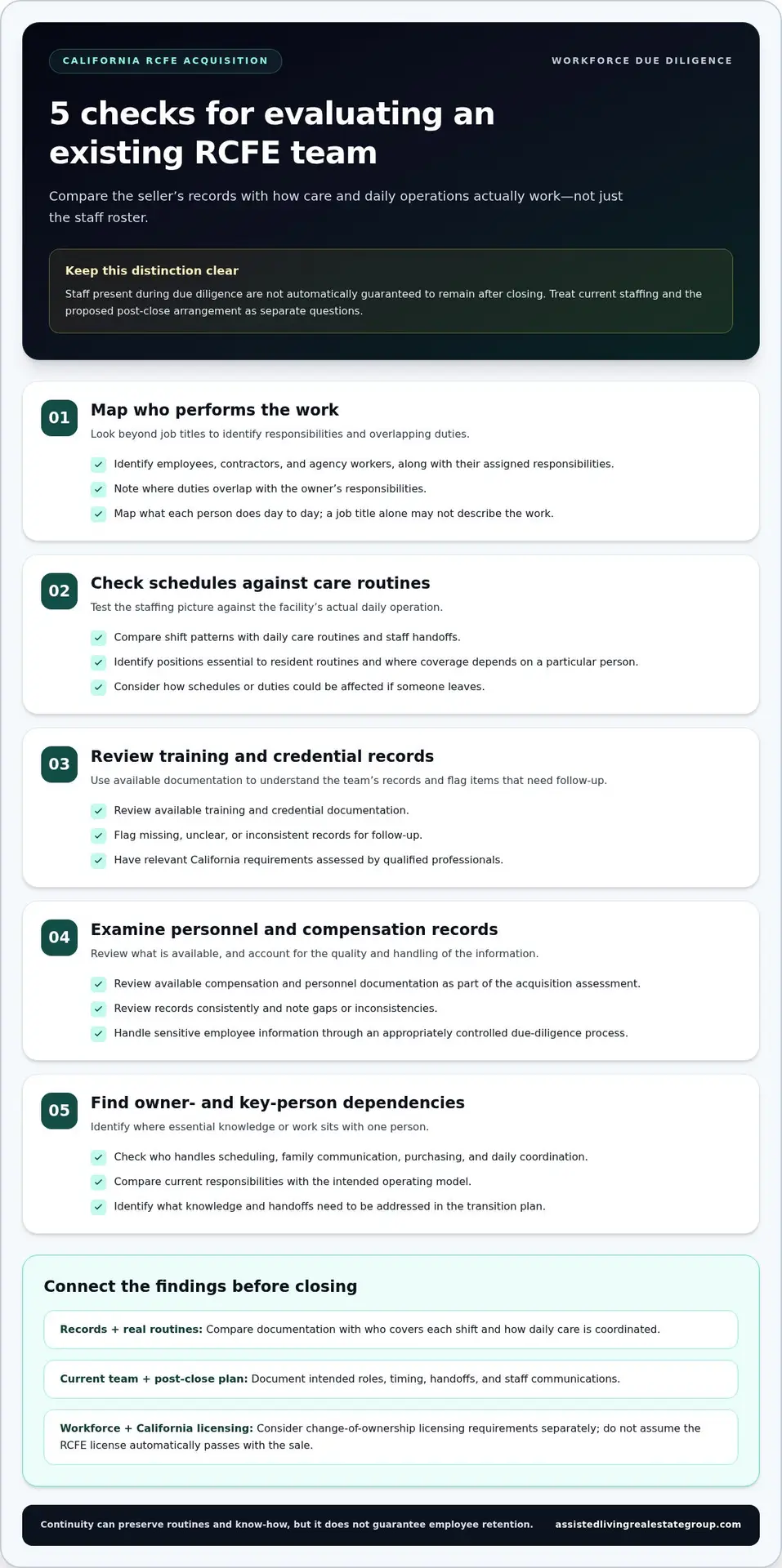
Start by identifying who performs the work. The roster may include employees, contractors, agency workers, and people whose responsibilities overlap with the owner’s. A caregiver who knows residents’ routines has a different operational role from an owner who handles scheduling, family communications, or purchasing. Map responsibilities rather than relying on job titles alone.
Next, separate the current staffing picture from the proposed post-close arrangement. The presence of employees during a sale, or a “turnkey” description, doesn’t mean employment automatically transfers or continues. Document intended arrangements and handoffs, including roles, timing, and communications.
Why workforce continuity matters to California care operations
Care routines are part of the daily operation. Staff may know how residents prefer assistance, how schedules fit together, and which tasks require coordination. Preserving that knowledge can inform transition planning and help limit avoidable disruption, although it can’t guarantee resident or family confidence. In a small California care home, an unexpected vacancy may also require schedule adjustments or a shift in duties among the remaining team.
Continuity matters to both resident care and the operating business. Before deciding whether the existing team is an advantage, identify which positions are essential to daily routines, where responsibilities depend on the current owner, and how coverage could be affected if someone leaves. This turns a reassuring roster into a practical assessment of transition risk.
How to Evaluate an Existing RCFE Team Before You Buy
A roster is a starting point, not a staffing assessment. When buying an RCFE with existing staff, compare the seller’s records with how the California facility actually operates: who covers each shift, which roles support resident routines, and where responsibilities depend on one person.
Assess the roster, roles, schedules, training and credential records, compensation documentation, and owner-dependent duties as one connected picture. Review available records consistently, note gaps or inconsistencies, and handle sensitive employee information through an appropriately controlled due-diligence process. Financial and operating assumptions are only as useful as the records behind them.
Which workforce records and roles deserve closer review?
Use the available records to map employees’ roles, tenure, schedules, and responsibilities. Review personnel, training, and credential documentation, and have relevant California requirements assessed by qualified professionals. Compare scheduled coverage with documented routines instead of assuming a job title describes what someone does each day.
- Roster and roles: Identify employees, contractors, and agency workers, along with their assigned responsibilities.
- Schedules and coverage: Compare shift patterns with the facility’s actual daily care routines and handoffs.
- Training and credentials: Review available records and flag missing, unclear, or inconsistent documentation for follow-up.
- Compensation and personnel records: Examine the records available for the acquisition review, handling sensitive details carefully.
- Owner and key-person duties: Identify tasks performed personally by the owner or a single employee, such as scheduling, family communication, or coordinating daily operations.
How can buyers assess retention risk and team fit?
Compare the current team’s responsibilities with your intended operating model. If one person holds essential process knowledge, or coverage depends on a narrow set of roles, document the resulting knowledge and scheduling gaps. These are transition risks to plan for, not automatic reasons to reject a facility.
Employee conversations and retention expectations can affect a transaction, so coordinate their timing and content with the seller and transaction counsel. Don’t treat informal assurances as settled employment arrangements. Instead, identify roles important to continuity, handoffs that may be needed, and how proposed workforce arrangements will be documented.
For buyers assessing both the facility and its operating business, California RCFE acquisition guidance can help frame the broader transaction review.
Retain, Restructure, or Rebuild: Comparing RCFE Staffing Scenarios
No single staffing plan suits every California RCFE acquisition. The right approach depends on what diligence shows about role clarity, coverage, team knowledge, and your operating plan. If you’re buying an RCFE with existing staff, compare the practical trade-offs before deciding how much of the current structure to preserve.
| Scenario | Continuity | Transition effort | Knowledge retention | Operational uncertainty |
|---|---|---|---|---|
| Retain most of the team | May support familiar routines | Often lower if roles remain clear | More existing know-how may remain available | Depends on individual choices and documented arrangements |
| Make targeted changes | Preserves selected routines while addressing identified gaps | Requires coordination around affected roles | Depends on which responsibilities and people change | Concentrated around changed roles and handoffs |
| Rebuild gradually | May involve more adjustment to routines | Requires a deliberate transition plan | Existing knowledge may be lost unless captured | Can remain elevated while responsibilities and coverage are re-established |
These are planning considerations, not guarantees or legal requirements. Employees make their own decisions, and transaction documents define the parties’ agreed arrangements. Consider any role expected to continue alongside the applicable California licensing process and have the relevant arrangements reviewed by qualified transaction counsel and licensing professionals.
When might retaining the current team support continuity?
Retention may be worth considering when diligence shows that responsibilities are clear, daily routines are documented, and important operational knowledge is shared rather than held by one person. A team familiar with residents’ preferences and established handoffs may help you understand how the facility functions. Identify owner-dependent duties that may not continue after closing, such as scheduling or coordinating operations.
When might targeted changes or a phased rebuild make sense?
Targeted changes may fit when records reveal a specific role gap or your documented operating plan calls for different responsibilities. A phased rebuild may be more manageable than changing several roles at once, but it still requires planning for coverage, handoffs, and resident routines. Verify applicable California requirements as part of that plan. Don’t treat headcount alone as proof that staffing is appropriate. Ratio-specific analysis belongs in a dedicated California RCFE staffing-ratios guide when available.
Base the decision on evidence: documented team strengths, identified gaps, your experience, and the care priorities the operating plan must support. This turns a staffing preference into a transition strategy.
Plan a California RCFE Staff Transition Before Closing
Plan the staff transition alongside the acquisition, not during the first days after closing. For buyers buying an RCFE with existing staff, a written sequence can clarify who is responsible for each handoff, which matters are settled in the transaction, and what still needs confirmation. Align workforce planning with transaction terms and California licensing requirements.
What should a California-focused transition plan cover?
Build the plan around defined responsibilities for the seller, buyer, and designated operational leads. Keep confirmed transaction terms separate from assumptions about post-close employment. Staff being present before closing doesn’t establish who will work for the buyer afterward. Have employment arrangements and related terms reviewed by qualified counsel.
A practical sequence can include:
- Before closing: Organize agreed records and identify operational handoffs, including scheduling processes and duties previously handled by the owner or a key employee.
- Communication planning: Agree who will communicate with employees, what can be shared, and when. Protect confidential employee information and coordinate messages with the transaction parties.
- At handoff: Transfer agreed operational information through an appropriate process, and clarify who is responsible for pending tasks and routine coordination.
- Early operating review: Compare actual coverage and daily routines with the transition plan. Record emerging gaps and address them through the appropriate operational and professional channels.
Keep resident routines in view. For example, naming a new point person for scheduling can reduce confusion about who coordinates coverage, without assuming that any employee’s role or employment will continue automatically.
How do licensing and operations intersect during a change?
Licensing status and ownership changes are distinct from workforce arrangements. Don’t assume a facility’s existing license, approval, or authorization automatically transfers with the sale. Verify current requirements with the California Department of Social Services (CDSS), its Community Care Licensing Division (CCLD), and qualified licensing professionals before relying on specific regulatory steps. Confirm how the applicable process affects the proposed transaction and operating timeline.
Include that verification in the transition schedule. Staffing plans and operational handoffs need to align with the buyer’s California licensing pathway. Base the plan on confirmed requirements rather than informal expectations. For a deeper overview, see California RCFE licensing.
A California RCFE acquisition brings property and operating-business considerations together. Explore specialized RCFE acquisition guidance to frame the transaction and transition plan with both in view.
Make an Informed RCFE Acquisition With Specialized California Guidance
A sound acquisition decision depends on more than a promising property or a familiar team. If you’re buying an RCFE with existing staff, assess whether workforce evidence and the transaction plan support the operation you intend to acquire. Bring these four factors into focus:
- Team fit: Do staff roles and documented responsibilities align with the way you plan to operate?
- Record quality: Are roster, scheduling, training, credential, and compensation records clear enough to inform your decision?
- Transition feasibility: Can responsibilities and operational knowledge be handed off without relying on assumptions about who will remain?
- Verified terms: Are workforce arrangements and other material transaction terms documented and reviewed with the appropriate professionals?
Unclear records, concentrated responsibilities, or unresolved handoffs don’t automatically determine the outcome, but they should shape due diligence, the transition plan, and your assessment of the operating business. Keep financial analysis and resident-care continuity in the same conversation.
How can a specialized broker support the acquisition process?
A care-facility transaction involves more than the property. Buyers also need to understand the operating business and how the proposed transaction fits their acquisition priorities. Assisted Living Real Estate Group specializes in California RCFE and ARF transactions, including the real estate and operating-business considerations. The team brings more than 25 years of combined care-facility experience to buyer guidance and helps frame the transaction questions that deserve attention. Legal, employment, and licensing matters require review by qualified professionals.
For a broader overview of the acquisition process, explore the California RCFE licensing guide alongside your transaction-specific diligence. Licensing information and workforce arrangements are distinct parts of the review, and both should be grounded in verified California requirements and documented terms.
What should buyers do next?
Consolidate your diligence questions, identify the roles and routines most important to continuity, and define your priorities for the California RCFE acquisition. A focused discussion can help clarify how the facility and operating business align with your objectives before you settle on a transition approach.
Discuss your California RCFE acquisition goals with a brokerage focused on care-facility transactions.
Move Forward With a Clearer Acquisition Plan
Buying an RCFE with existing staff is a decision about operational fit, not simply the presence of a familiar team. Review workforce records against daily routines, identify duties that rely on the owner or a key employee, and compare retaining, changing, or gradually rebuilding the team based on documented needs. Distinguish confirmed transaction terms from assumptions about staffing after closing.
A California RCFE acquisition brings together property, operating-business, and transition considerations. Specialized guidance can help you assess them as parts of one decision while keeping resident-care continuity in view. Assisted Living Real Estate Group focuses on California RCFE and ARF transactions, with more than 25 years of combined care-facility experience.
Bring your priorities and diligence questions into the next step. Discuss your California RCFE acquisition goals and explore how a focused transaction plan can align your investment objectives with operational planning. With clear records, realistic expectations, and specialized guidance, you can move toward an acquisition with greater confidence.
Frequently Asked Questions
Can employees automatically transfer when you buy an RCFE?
No. Buying an RCFE in Southern California doesn’t automatically mean every current employee will work for the buyer after closing. Employment arrangements depend on the transaction structure, documented terms, individual decisions, and applicable California requirements. Review workforce records and purchase documents with qualified transaction and employment professionals. Treat retention as a diligence question to resolve and document, not as a feature guaranteed by an RCFE listing.
What staff records should you review when buying a California RCFE?
Review available staff rosters, roles, schedules, training and credential documentation, and relevant payroll or personnel records. Compare those documents with how the Southern California facility operates day to day, including who handles key routines and handoffs. Look for responsibilities concentrated with the current owner or one employee. Records and requirements can vary by transaction, so make sure California-specific questions receive qualified professional review.
Can you buy an RCFE and keep its current caregivers?
Potentially, but a buyer can’t assume every caregiver will remain after the sale. Individual employees make their own decisions, and the transaction terms, role expectations, and buyer’s operating plan all matter. During diligence, assess which routines depend on current caregivers and identify essential handoffs. Plan communications carefully, and address California employment and licensing considerations before relying on a retention assumption.
How do you assess whether an RCFE team is a good fit?
Compare documented roles, experience, schedules, and operational knowledge with the facility’s needs and your intended operating approach. For a Southern California RCFE, consider whether important routines depend on a single person, whether records are complete enough to support your review, and whether responsibilities are clearly understood. A roster or one conversation can’t tell the whole story. Evaluate the available evidence and make sure regulatory questions receive California-specific professional review.
Does an RCFE license automatically transfer when the facility is sold?
Don’t assume an RCFE license or regulatory approval automatically transfers with a property or business sale. California ownership and licensing requirements can affect the transaction and its timeline, so verify the applicable process and facility status with current California sources and qualified licensing professionals. Build confirmed requirements into your Southern California acquisition planning rather than relying on assumptions about existing approvals or setting a closing date before the process is understood.
What is the biggest risk when buying an RCFE with existing staff?
A key risk is assuming the team, its knowledge, and its working arrangements will stay unchanged after closing. That assumption can hide owner-dependent duties, uncertain retention, documentation gaps, or handoffs that need planning. Assess workforce information alongside facility operations and clarify proposed arrangements in transaction planning. For a Southern California acquisition, have California-specific employment and licensing questions reviewed before treating any staffing or regulatory assumption as settled.