
A promising RCFE can still be the wrong first business. Buying an RCFE as a first-time business owner means weighing more than a property’s appeal or revenue potential. You need to understand the operating business, the responsibilities of resident care, and California’s licensing process before you commit.
It’s natural to focus on the acquisition price and picture taking over an established facility. But owning the real estate and running the care business are distinct responsibilities, and a seller’s license doesn’t simply transfer with a sale. A suitable opportunity must fit your experience, available resources, and goals, as well as the work required to operate responsibly.
This guide will help you assess your readiness, compare acquisition paths, and identify what to investigate in a California RCFE opportunity. You’ll learn how to evaluate the facility and its operating business together, compare buying an established operation with other ownership structures, and identify where specialized brokerage guidance can help you assess transaction fit. By the end, you’ll have a clearer framework for asking questions and deciding whether an opportunity aligns with your business goals and commitment to responsible care.
Key Takeaways
- Assess whether your experience, resources, and goals align with the demands of operating a California RCFE before pursuing a deal.
- Compare an established operation with a property or business requiring substantial setup. Consider the transition work and operational leadership each path demands.
- When buying an RCFE as a first-time business owner, look beyond listing claims and asking price. Review operating records, property details, and the facility’s circumstances.
- Use clear decision gates to define your capacity, investigate opportunities, plan funding, and prepare for a transition before moving forward.
- A California care-facility specialist can help you assess the property and operating business together and consider whether an opportunity fits your experience and transition capacity.
Buying an RCFE in California: Is This the Right First Business for You?
In California, a Residential Care Facility for the Elderly (RCFE) provides residential care and supervision for older adults. Buying one means taking on a care-business commitment, not simply acquiring a building. You’ll need sound business judgment and a clear understanding of how the facility supports residents and sustains its operations.
Buying an RCFE as a first-time business owner may suit an entrepreneur interested in both business ownership and California’s care sector. But enthusiasm isn’t a readiness plan. Consider whether your experience, availability, resources, and approach to leadership can support the responsibilities of the specific facility you’re considering.
What does owning an RCFE ask of a first-time business owner?
Ownership involves stewardship: setting priorities, monitoring the business, and ensuring decisions support responsible operations over time. You may not provide care yourself, but you’ll need a reliable way to understand how the facility is functioning and respond when challenges arise. Be candid about the level of involvement you want, how you handle complex decisions, and whether you can balance financial discipline with resident-centered priorities. An attractive property or favorable market cannot guarantee a successful business.
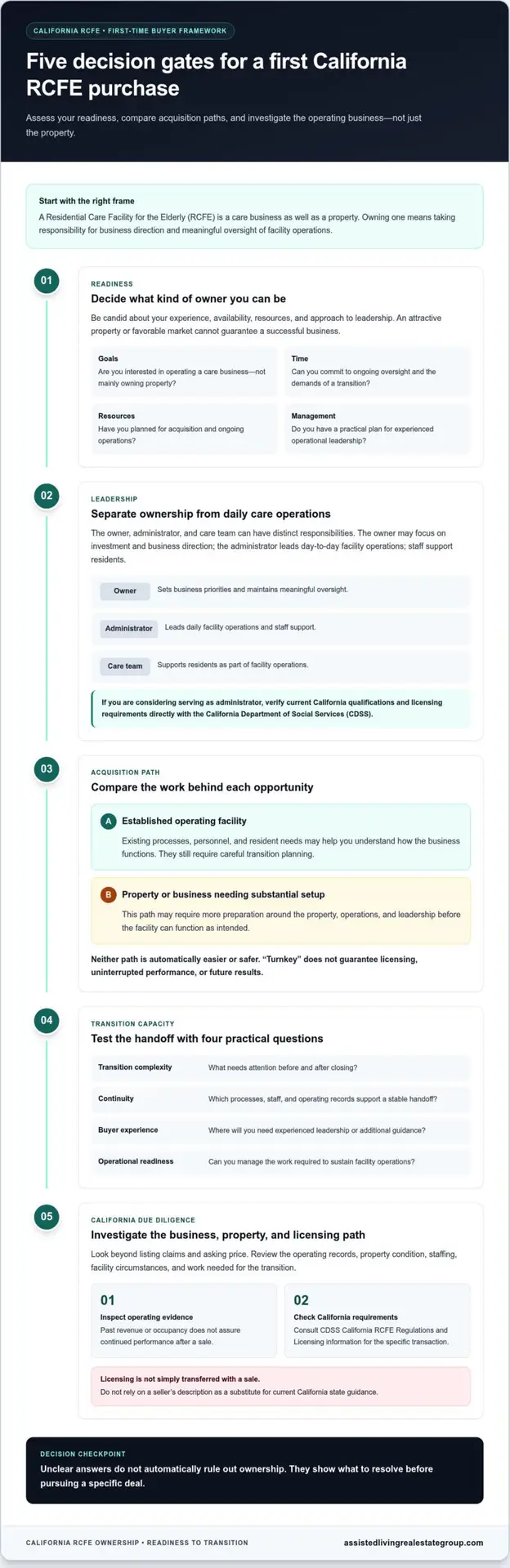
Use this readiness check to identify what you still need to resolve:
- Goals: Are you drawn to operating a care business, rather than mainly owning a property?
- Time: Can you commit to ongoing oversight and the demands of a business transition?
- Resources: Have you planned for both the acquisition and ongoing operations?
- Management: Do you have a practical plan for experienced operational leadership?
Unclear answers don’t automatically rule out ownership. They show which issues to address before pursuing a specific deal.
Owner, administrator, and care operations: understand the roles
The owner, administrator, and care team can have distinct responsibilities. An owner may focus on the investment and business direction, while an administrator leads day-to-day facility operations and staff support residents. Owning the facility means being accountable for the business, not personally delivering every aspect of daily care.
Before moving forward, decide who will lead operations and how you’ll maintain meaningful oversight. If you’re considering serving as the administrator, verify current California qualifications and licensing requirements with the California Department of Social Services (CDSS). Requirements can depend on the circumstances, so confirm the rules that apply directly with the state before settling on an ownership and leadership plan.
A California care-facility specialist can help you consider how a prospective property and operating business fit together. Start with your own readiness: define the role you want, the responsibilities you can manage, and the leadership structure the facility needs.
Compare RCFE Acquisition Paths Before Choosing Your First Deal
Your first decision isn’t simply which RCFE looks most attractive. It’s which acquisition path matches your ability to manage a transition, maintain operational continuity, and lead a care business responsibly. An operating facility may have established processes and an existing team. A property or business requiring substantial setup can demand more preparation before operations are ready. Neither path is automatically easier or safer.
For someone buying an RCFE as a first-time business owner, compare the work behind the label. “Turnkey” may describe how an opportunity is presented, but it doesn’t guarantee licensing, uninterrupted performance, or future results. Review the circumstances of the transaction, including operating records, property condition, staffing, and the steps needed for a transition.
An operating facility versus a more complex startup path
An established operation may give you a clearer view of how the business functions, but existing routines, personnel, and resident needs still require careful transition planning. Past revenue or occupancy doesn’t assure continued performance after a sale. A less-established opportunity gives you a different starting point, but may require more preparation around the property, operations, and leadership before it can function as intended.
Compare the paths using four practical questions:
- Transition complexity: What needs attention before and after closing?
- Continuity: Which processes, staff, and operating records support a stable handoff?
- Buyer experience: Where will you need experienced leadership or additional guidance?
- Operational readiness: Can you manage the work required to sustain the facility’s operations?
For California licensing information relevant to a transition, consult the California RCFE Regulations and Licensing resource from the California Department of Social Services. Check the requirements for the specific transaction rather than relying on a seller’s description as a substitute for current state guidance.
Choose a facility size and setting that fit your capacity
Scale affects the shape of ownership. A smaller home and a larger assisted living center can differ in staffing needs, management structure, property considerations, and the level of oversight required. Assisted Living Real Estate Group handles opportunities ranging from 6-bed homes to centers with 30 or more beds. That range shows the variety of opportunities, not which size is right for you. Choose based on your leadership capacity and resources, not bed count alone.
In Southern California, local market context can inform your review, but it doesn’t replace due diligence on the individual facility. Compare its setting, operating needs, and transition demands with your plan. Assisted Living Real Estate Group specializes in RCFE transactions and can help you assess how the property and operating business fit together. Explore California RCFE acquisition opportunities as you define what kind of deal fits your goals.
Evaluate an RCFE Opportunity Beyond the Listing and Asking Price
A listing is a starting point, not proof of value. A listing alone can’t establish an RCFE’s value or suitability because it doesn’t show whether the records, property, and operating realities support its claims. Before making an offer, separate what you know from what you’re assuming, then identify the evidence that would resolve each gap.
Evaluate three connected elements: the operating business, the physical property, and the care operation. A financial summary may not account for upcoming maintenance or transition needs. A well-presented building doesn’t show whether the business can sustain its operations. Treat each claim as a question to investigate, not a conclusion, and assess the opportunity using facility-specific evidence relevant to its California setting.
Does the operating business fit your financial and management capacity?
Review historical financial information with qualified transaction and accounting advisers. Compare reported income and expenses with supporting records, and examine occupancy and staffing information over time. Ask how operating costs, staffing changes, and the proposed transition could affect the business after a sale. Don’t rely on generic return-on-investment promises or projections that aren’t supported by facility records.
Consider whether documented performance and operating needs fit your financial plan and management capacity. For example, if records show changes in staffing or occupancy, understand how those changes affect expenses and continuity before relying on a projection. Treat estimates as assumptions until you can trace them to relevant facility information. A market overview or general industry trend cannot establish the value of a particular California RCFE.
What should a first-time buyer learn about the property and operations?
Assess the physical site and care business together. Property condition, maintenance requirements, location, and the practical demands of continuing operations can affect one another. A building that appears suitable may still need attention that changes your budget or transition plan. Operational strengths shouldn’t distract from unresolved property concerns.
Before making an offer, organize your review around evidence and open questions:
- Financial: Do source records support reported income, expenses, and occupancy history?
- Staffing and continuity: What do facility records show about staffing and maintaining operations through a transition?
- Property: What condition, maintenance, and location factors need further assessment?
- California licensing and compliance: What does the facility’s history show, and which details need review with appropriate California expertise?
Keep a written record of each claim, its supporting document, and any unanswered question. This helps prevent a seller’s description from being mistaken for verified fact. If important records are missing, inconsistent, or unclear, resolve the gap before treating the asking price as a sound basis for an offer. A care-facility-focused brokerage can help you assess the property and operating business together, while qualified advisers address the financial and California-specific review relevant to the transaction.
Build a California RCFE Buying Plan With Clear Decision Gates
A disciplined buying plan turns interest into a sequence of decisions. For someone buying an RCFE as a first-time business owner, the goal isn’t to rush through every stage. Advance only when the evidence and your capacity support the next commitment.
Set your acquisition criteria before reviewing opportunities
Start with a written brief. Define your preferred facility size and California location, the level of owner involvement you can sustain, and the operating priorities that matter most. Note the resources you can bring to the acquisition and the responsibilities you can personally oversee. A conversation with a specialized brokerage can help align these criteria with an acquisition search, including opportunities in Southern California.
Coordinate financing, diligence, and California licensing preparation
Use verified transaction information to shape your funding plan. Generic assumptions about revenue, expenses, or property condition can distort the amount and type of capital an opportunity may require. Review operating records, the property, and transition needs before relying on projections or setting expectations for a handoff.
Plan for California licensing early, rather than treating it as a final administrative task. The appropriate process depends on the transaction. Review current requirements and application guidance through the California Department of Social Services RCFE resource, and include licensing preparation in your transition plan. Separate financing and licensing guides can provide more detail on those topics, but they don’t replace facility-specific review.
Use decision gates at each stage:
- Define capacity: Set your size, location, involvement, and resource criteria. Proceed only when they’re clear enough to guide a search.
- Review opportunities: Compare each facility with your criteria. Pause if the core operating demands exceed your experience or management plan.
- Investigate: Reconcile claims with transaction records, property information, and relevant California licensing details. Don’t advance while material questions remain unanswered.
- Plan funding: Base your plan on verified information and the transaction’s actual needs. Reassess if the evidence changes your assumptions.
- Prepare transition: Align operational leadership, property considerations, and licensing preparation before committing to a handoff plan.
These gates aren’t hurdles to clear at any cost. They’re safeguards that let you stop, revise your criteria, or proceed with a stronger basis for decision. Assisted Living Real Estate Group can help connect the real estate and operating-business dimensions as you assess fit. Discuss your California RCFE acquisition criteria as you turn your plan into a focused search.
Move From First-Time Buyer to Prepared RCFE Owner With Specialized Guidance
A first acquisition is easier to evaluate when you consider the property and operating business together. A California specialist brokerage can help you interpret facility opportunities, understand transaction considerations, and compare a listing with your goals and transition capacity. That perspective can be especially useful when you’re buying an RCFE as a first-time business owner and learning how the real estate and care-business elements intersect.
Assisted Living Real Estate Group brings more than 25 years of combined experience in the care-facility industry. This experience helps put a buyer’s search in context, from understanding what a listing describes to identifying questions that merit deeper review. Brokerage guidance supports transaction evaluation, but it doesn’t replace legal, accounting, or licensing advice from appropriate professionals.
How specialized brokerage guidance supports a first-time buyer
RCFE-focused guidance connects facility characteristics with the realities of acquisition. A broker who works with care-facility opportunities can help you compare the property and operating-business dimensions, interpret listing information in context, and consider whether an opportunity aligns with your experience and intended level of involvement. The purpose is to help you make an informed assessment before advancing, not to promise a particular outcome.
Prepare for a focused conversation about your RCFE acquisition
Arrive with a clear picture of what you’re seeking and what you can take on. Buyers exploring California opportunities, including in Southern California, can make the conversation more productive by outlining their:
- Goals: What do you want the acquisition to accomplish?
- Preferred location and size: Which California settings and facility scale suit your plan?
- Involvement: What responsibilities can you personally oversee, and where will you need operational leadership?
- Priorities: Which business, property, and transition factors are essential, and which are flexible?
These criteria give a specialist broker a clearer basis for discussing transaction fit and focusing the search. They can also help you recognize when an opportunity falls outside your capacity, even if its presentation is appealing. A strong match should make sense on paper and in light of your resources, objectives, and readiness to support a responsible transition.
Bring your acquisition goals into focus with a conversation about California RCFE opportunities that align with your plans. Discuss your California RCFE acquisition goals.
Take Your Next Step With a Clearer Acquisition Strategy
Your first RCFE acquisition can be more than a business decision. It can be the start of a purposeful role in California’s care community, provided the opportunity fits your readiness and the responsibilities you’re prepared to take on. Keep your next move focused: define what a suitable acquisition looks like, identify the questions that still need answers, and seek transaction guidance that considers both the property and operating business.
For anyone buying an RCFE as a first-time business owner, a thoughtful conversation can turn broad interest into clear acquisition priorities. Assisted Living Real Estate Group specializes in California RCFE and care-facility transactions, helping buyers assess opportunities in relation to their goals and transition capacity.
Start a conversation about your RCFE acquisition strategy and take the next step with a more informed perspective. Preparation can help you pursue an opportunity with confidence and a commitment to responsible care.
Frequently Asked Questions
Is buying an RCFE a good first business for an entrepreneur?
It can suit an entrepreneur prepared to lead a regulated care business, but readiness is especially important for a first-time owner. Before buying an RCFE as a first-time business owner, consider whether you can fund operations, establish capable leadership, and make decisions with residents’ well-being in mind. A promising opportunity isn’t enough on its own. Your experience, support team, and commitment to active oversight all matter.
Can I own an RCFE without managing its daily operations?
Yes. Ownership and daily management can be separate when you have a sound plan for operational leadership. Identify who will handle administration, how that person’s responsibilities will be defined, and how you’ll stay informed about the facility’s performance. If you won’t serve as administrator, verify current California requirements for the person who will. Ownership can be less hands-on, but it still calls for informed oversight and timely decisions.
How much working capital does a new RCFE owner need?
There’s no single amount that fits every California RCFE. The required cushion depends on the facility’s expenses, staffing, occupancy, transition needs, and available operating funds. California’s application process calls for applicants to demonstrate sufficient funds to operate for at least three months. Build a facility-specific forecast that accounts for payroll, utilities, insurance, supplies, maintenance, and potential changes in revenue, then review the assumptions with qualified financial advisers.
What should I learn about an RCFE before making an offer?
Understand the facility’s resident profile, service model, staffing structure, and recent operating history, along with issues that could affect continuity after a sale. Review resident agreements and fee schedules to understand how services and charges are represented. In California, examine available licensing and citation information with appropriate expertise, and compare it with the facility’s own records. Write down unresolved questions before deciding whether to submit an offer.
Can a first-time business owner buy an operating RCFE in California?
Yes. A first-time owner can pursue an operating RCFE, but the purchase doesn’t automatically authorize the new owner to operate under the seller’s license. California licensing is nontransferable, and the applicable path may involve a change-of-ownership application or a new license application. Determine which process applies with the California Department of Social Services early in transaction planning, since licensing preparation and transition timing need to fit the deal.
What is the difference between buying an RCFE business and buying its real estate?
Buying the business means acquiring the operating enterprise described in the transaction agreement. Buying the real estate means acquiring the property itself. A transaction may include one or both, so clarify exactly what is being purchased, what is excluded, and what arrangements allow operations to continue at the site. In California, don’t assume that acquiring either the property or the business transfers the seller’s RCFE license.
How can I assess demand for an RCFE in a specific California area?
Start with the local picture, not statewide demand alone. Compare the area’s older-adult population and growth with the number, size, and service mix of licensed RCFEs nearby. California licensing information can help identify existing facilities, while local demographic data and facility-specific occupancy records add context. Consider whether the opportunity serves a distinct need, but treat market indicators as evidence to investigate, not proof of future occupancy or profitability.