
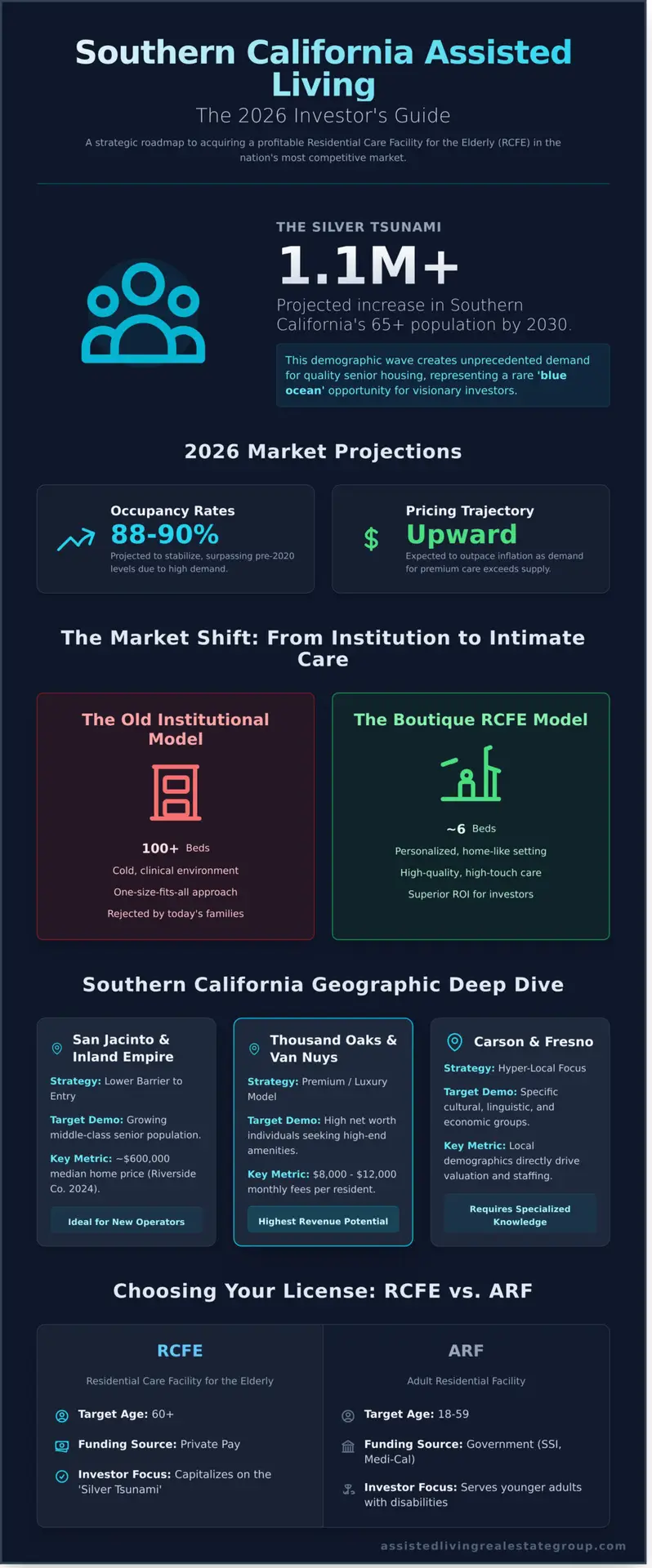
By 2030, Southern California’s 65 and older population is projected to swell by over 1.1 million people, creating an unprecedented demand for quality senior housing that large, institutional models simply cannot meet. You already see the opportunity. You recognize that this demographic wave isn’t a looming crisis but a rare ‘blue ocean’ for visionary entrepreneurs ready to achieve both significant impact and predictable income.
This 2026 investment guide is your strategic partner, delivering the expert roadmap needed to master the search for premium assisted living facilities for sale ca. We’ll help you move beyond the uncertainty of public listings to confidently acquire a profitable, compliant Residential Care Facility for the Elderly (RCFE) in the nation’s most competitive market. Inside, we will break down the critical valuation metrics for a 6-bed versus a 30-bed facility, reveal proven strategies for navigating California’s dense Title 22 regulations, and give you the blueprint to secure a turnkey boutique care business built for long-term success.
Key Takeaways
- Learn why Southern California’s ‘Silver Tsunami’ and the shift to boutique care models create a prime ‘blue ocean’ opportunity for savvy senior housing investors.
- Master the financial metrics specific to the California market, including how to properly value both the real estate and the licensed business entity to calculate a strong cap rate.
- Navigate the complexities of California’s Title 22 regulations and local zoning laws to ensure your facility acquisition is fully compliant and positioned for long-term success.
- Discover the essential strategies for finding and evaluating profitable assisted living facilities for sale ca, including how to access exclusive off-market deals through a specialized RCFE broker.
The Southern California Market for Assisted Living Facilities in 2026
California’s “Silver Tsunami” isn’t a distant threat; it’s the single greatest real estate opportunity of the next decade. The California Department of Finance projects the state’s 65+ population will swell by nearly 4 million by 2060, creating unprecedented demand for quality senior housing. For the savvy investor, this isn’t a crisis. It’s a blue ocean. This demographic wave is driving a powerful shift away from outdated, institutional models toward intimate, high-end Residential Assisted Living (RAL) homes.
The market is demanding a better solution. Today’s families are actively rejecting the cold, clinical feel of 100-bed facilities, seeking personalized, boutique environments that feel like home. This is where the 6-bed RCFE (Residential Care Facility for the Elderly) model excels in California. It offers a superior quality of life for residents and a more profitable, manageable business for operators. For a foundational overview, many investors start by asking, What is Assisted Living?, and then quickly realize the boutique RAL model is its highest and best expression.
Looking ahead to 2026, the outlook is exceptionally strong. Projections based on National Investment Center for Seniors Housing & Care (NIC) data indicate that California’s assisted living occupancy rates will surpass pre-2020 levels, likely stabilizing between 88% and 90%. Pricing in the boutique RCFE sector is expected to continue its upward trajectory, outpacing standard inflation as the demand for personalized, high-touch care far exceeds the limited supply of premium properties.
The Impact and Income Philosophy
Senior housing stands as a uniquely recession-resistant asset class, driven by non-negotiable demographic need rather than economic cycles. Our philosophy is simple: achieve exceptional ROI through compassionate, heart-centered care. By creating beautiful, high-quality boutique homes, you’re not just investing in real estate; you’re building a legacy and making a profound social impact on the lives of seniors and their families. It’s the definition of doing good while doing well.
Southern California Geographic Trends
Geography dictates strategy. Different Southern California submarkets present unique opportunities for investors examining the various assisted living facilities for sale ca has to offer. A deep understanding of local demographics is critical for success.
- San Jacinto and the Inland Empire: With a median home price in Riverside County hovering around $600,000 in early 2024, this region offers a lower barrier to entry. It’s a high-growth area ideal for new operators looking to establish a foothold and meet the explosive demand from a growing middle-class senior population.
- Thousand Oaks and Van Nuys: These are premium markets. The high net worth demographics in Ventura County and the San Fernando Valley support luxury RCFE models commanding monthly fees of $8,000 to $12,000 per resident. Here, the focus is on high-end amenities and services, leading to higher property valuations.
- Carson and Fresno: Local demographics directly drive facility valuation. Carson’s dense, urban setting near Los Angeles creates demand for specific cultural and linguistic care, while Fresno’s Central Valley economy influences pricing and staffing models differently. A successful investment requires a hyper-local focus.
Understanding RCFE vs. ARF: Which California Facility is Right for You?
Your investment journey begins with a critical decision. It’s a choice that defines your market, your revenue model, and your operational strategy. In California, the landscape is split between two primary license types: the Residential Care Facility for the Elderly (RCFE) and the Adult Residential Facility (ARF). Understanding this distinction is the first step toward building a successful portfolio of assisted living facilities for sale ca.
An RCFE is designed to serve California’s fastest-growing demographic: adults aged 60 and over. This model capitalizes on the “Silver Tsunami,” providing a continuum of care that allows residents to age in place with dignity. The revenue stream is overwhelmingly private pay, tapping into family assets and long-term care insurance. In contrast, an ARF serves a younger population, adults aged 18-59, who often have developmental disabilities or chronic mental health conditions. This model is typically funded through government sources like SSI and Medi-Cal, managed via contracts with one of California’s 21 Regional Centers.
Which path offers a faster entry? For most real estate investors, the RCFE licensing process is more direct. While both license types are governed by the California Department of Social Services (CDSS) and require strict adherence to the state’s Title 22 Regulations, the ARF model adds the complexity of vendorization with a Regional Center, a process that can extend timelines significantly.
The Boutique RCFE Model
The 6-bed “boutique” RCFE is the cornerstone of high-return assisted living investment in California. Operating from a converted single-family home, this model boasts lower overhead and fosters an intimate, non-institutional environment that commands premium monthly rates, often exceeding $48,000 in gross monthly income in markets like Orange County. For investors seeking to expand, scaling to a 15 or 30-bed facility allows for operational efficiencies without sacrificing the high-touch care that justifies top-tier pricing.
Adult Residential Facility (ARF) Opportunities
The ARF model presents a different, yet compelling, path to achieving both impact and income. Success here lies in specialization. By focusing on high-acuity niches like mental health or developmental disability support, you meet a critical social need. California’s Level 4 ARFs, particularly Level 4I facilities designed for individuals with intensive behavioral needs, receive the highest state reimbursement rates, creating a stable, government-backed revenue stream. Navigating the CDSS and Regional Center partnership is complex, but the rewards are a defensible market position and consistent cash flow.
Choosing between an RCFE and an ARF is a strategic decision that shapes your entire business. It dictates your property requirements, your staffing model, and your financial projections. Making the right choice from the outset is critical, and understanding these regulatory and financial nuances is where a strategic partner becomes invaluable.
Financial Analysis: Valuing Assisted Living Facilities for Sale in CA
Unlocking the true potential of an assisted living facility begins with a rigorous financial analysis. This isn’t just about buying a building; it’s about acquiring a dynamic, licensed business. The valuation of assisted living facilities for sale ca is a dual-component process: you are assessing the tangible real estate asset and the intangible, yet highly valuable, licensed operational entity. A failure to dissect both elements can lead to a critical miscalculation of your future ROI.
The starting point for most investors is the capitalization rate, or “cap rate.” This metric, which measures the net operating income (NOI) relative to the property’s asset value, provides a snapshot of potential return. In the competitive Southern California market, a “good” cap rate isn’t a single number. For a stabilized, private-pay Residential Care Facility for the Elderly (RCFE) in Orange or San Diego county, cap rates in Q1 2024 hovered between 6.5% and 8.0%. A newer facility with high occupancy will trend toward the lower end, while an older property with deferred maintenance will demand a higher-return cap rate to compensate for the risk.
Beyond the cap rate, a sophisticated analysis of the business requires a deep dive into its EBITDA (Earnings Before Interest, Taxes, Depreciation, and Amortization). This figure reveals the true operational cash flow. The business value is often calculated as a multiple of EBITDA, typically ranging from 3.5x to 5.0x for small-to-mid-size California RCFEs. When reviewing a Profit & Loss statement, your job is to identify “add-backs” like owner salaries or non-recurring expenses to normalize the earnings and reveal the facility’s actual profitability. This detailed review separates a turnkey, cash-flowing asset from a “fixer-upper” that requires significant capital. Assessing a fixer-upper demands a meticulous audit against the state’s stringent operational mandates; bringing a facility into compliance with the California Title 22 Regulations for fire safety and accessibility can easily add over $150,000 to your initial investment.
Valuation Drivers in Senior Care
Three factors disproportionately influence the value of any RCFE in California. First is occupancy history, the primary indicator of business health. A facility demonstrating a consistent 36-month occupancy rate of 95% or higher commands a premium. Second are staffing costs, which can account for up to 65% of total expenses in the state. An operator who has mastered efficient scheduling and minimized staff turnover has a more valuable, predictable business. Finally, a significant premium is placed on “grandfathered” facilities in municipalities with restrictive zoning, creating a competitive moat that protects future cash flow.
Financing Your Acquisition
Securing capital for one of the premier assisted living facilities for sale ca offers several distinct pathways. SBA loans, particularly the 7(a) and 504 programs, are a primary tool for new owner-operators, often allowing for as little as 10% down on the combined real estate and business purchase. As we look toward 2026, conventional commercial lenders in California are projected to require a minimum of 30% equity and a robust Debt Service Coverage Ratio (DSCR) of 1.35x. Don’t overlook the power of seller financing; in many transactions under $3 million, a seller carry-back note covering 10-20% of the price can bridge the gap between your capital and the bank’s lending threshold, making the deal possible.
Due Diligence and Title 22 Compliance in Southern California
Profit follows precision. In the high-stakes market of California senior housing, your financial success is directly tied to the rigor of your due diligence. This isn’t just about checking boxes; it’s about safeguarding your investment and ensuring you can deliver the boutique care experience that commands premium returns. The California Code of Regulations, Title 22, is the definitive rulebook for Residential Care Facilities for the Elderly (RCFEs), and mastering its nuances separates savvy investors from those who face costly violations and operational shutdowns.
A comprehensive due diligence process for assisted living facilities for sale ca goes far beyond a standard property inspection. You must scrutinize every operational and physical detail through the lens of a state licensor. This includes:
- The Title 22 Checklist: Verifying everything from administrator certification and staff training records (requiring 40 hours of initial training) to resident rights postings and medication management protocols. A single deficiency can jeopardize your license.
- Zoning and Use Permits: A facility in Carson may have different conditional use permit (CUP) requirements for a 7-bed expansion than one in Fresno. We confirm the existing permit is transferable and aligns with your future growth plans.
- Physical Plant Inspections: Your investment must meet stringent fire safety standards, including properly maintained sprinkler systems and fire clearances. It also requires full ADA compliance and RCFE-specific modifications like secured perimeters for memory care residents and accessible bathrooms.
- Operational Audit: This is where the facility’s true health is revealed. We meticulously review resident files for complete admission agreements as mandated by Title 22 Section 87507, assess the quality of care plans, and validate staff credentials and background checks.
Navigating CDSS and Licensing
The California Department of Social Services (CDSS) holds the keys to your operation. The Change of Ownership (CHOW) application is an exhaustive process, often taking 90-120 days, and any error can send you back to square one. A pre-existing positive relationship with the region’s Licensing Program Analyst (LPA) is invaluable. A seller with a history of violations can create significant delays, which is why a clean compliance record is a top-tier asset for any buyer.
Southern California Local Regulations
State compliance is only half the battle. In Southern California, municipal codes add another layer of complexity. Los Angeles County, for example, has its own fire and safety codes that often exceed state mandates. Securing a zoning variance to expand a 6-bed RAL to a 10-bed model in a residential neighborhood requires a deep understanding of local politics and community relations. Failing to account for these hyper-local rules is a common and expensive mistake for new investors.
Don’t let regulatory hurdles derail your vision of achieving both impact and income. A flawed due diligence process is the single greatest threat to your investment. Download our proprietary Southern California RCFE Due Diligence Checklist to ensure every detail is covered before you close.
The Buying Process: Why a Specialized RCFE Broker is Essential
Acquiring a Residential Care Facility for the Elderly (RCFE) in California is not a standard real estate transaction. It’s the acquisition of a living, breathing business where residents’ well-being and staff morale are paramount. A general commercial broker sees square footage and cap rates; a specialized RCFE broker understands the delicate ecosystem of care, licensing, and legacy. The wrong approach can jeopardize the very asset you seek to purchase.
The stakes are simply too high for a generalist. A public “For Sale” sign can trigger panic, leading to resident departures and staff resignations that erode the facility’s value overnight. This is why confidential marketing is non-negotiable. A specialist broker doesn’t list your future investment on public portals. Instead, we leverage a private, pre-vetted network of qualified buyers, ensuring the sale process is handled with the discretion and professionalism it demands. This protects the existing residents’ quality of life and preserves the business’s operational integrity for a smooth transition.
In the hyper-competitive Southern California market, the most desirable opportunities are never publicly advertised. These off-market listings are sourced through decades of relationship-building and a reputation for closing complex deals. An expert RCFE broker provides exclusive access to these properties, giving you a critical advantage over investors who are only seeing what’s left on the open market. This is how you find the true “blue ocean” opportunities in a crowded field.
The Advantage of a Specialized Brokerage
A generalist broker can’t navigate the intricate web of California’s Title 22 regulations or the specific requirements of the Department of Social Services (CDSS). With over 25 years of dedicated experience in the California care industry, the Assisted Living Real Estate Group acts as your strategic partner. We understand the nuances of negotiating care facility contracts, which encompass not just the property but the business goodwill, operational protocols, and critical licensing contingencies. We bridge the gap, ensuring your investment is both financially sound and operationally viable from day one.
Our role extends far beyond the closing table. We provide essential post-acquisition support, guiding you through every step of the complex relicensing process with the CDSS. This operational consulting ensures a seamless handover, helping you establish best practices and maintain the high standard of care your residents deserve. This comprehensive support system is what separates a simple transaction from a successful, long-term investment in the senior care sector.
Your Roadmap to Closing
We provide a clear and methodical path from the initial Letter of Intent (LOI) to the final close of escrow. Our process is designed to manage the transition meticulously, ensuring that for the residents, the change in ownership is seamless and positive. Protecting operational stability is our priority, because we know that a thriving community is the foundation of a profitable investment. If you are serious about exploring the premier assisted living facilities for sale ca has to offer, your journey starts here. View our current Southern California listings.
Your Next Step: Mastering the Southern California RCFE Market
The path forward is clear. Southern California’s demographic wave isn’t just a statistic; it’s the single greatest investment opportunity in senior care for the next decade. Success here hinges on two critical pillars: a masterful understanding of California’s intricate Title 22 regulations and a disciplined financial analysis to identify true value. This isn’t a market for guesswork. Finding premier assisted living facilities for sale ca demands a guide who has already mapped the terrain. With over 25 years of specialized California experience, our team provides the boutique-focused investment roadmap you need to navigate complex licensing and zoning challenges.
We don’t just find properties; we architect legacies. Our Proprietary Confidential Marketing Strategy uncovers off-market deals that others can’t access. It’s time to move from analysis to action. Explore Exclusive Southern California RCFE Listings and let’s build your portfolio of Impact and Income together.
Frequently Asked Questions: Investing in California Assisted Living
How much does it cost to buy a 6-bed RCFE in Southern California?
A 6-bed boutique RCFE in Southern California typically costs between $1.2 million and $2.5 million as of 2024. The final price is a direct function of the real estate’s value, current occupancy rates, and the facility’s verified monthly gross income. A turnkey property in a prime location like Orange County with a high cap rate will command a premium. This investment isn’t just a transaction; it’s the acquisition of a powerful asset positioned to generate both significant income and lasting impact.
What is the difference between an RCFE and an ARF in California?
The primary difference is the population served. A Residential Care Facility for the Elderly (RCFE) is licensed by the California Department of Social Services (CDSS) to care for seniors aged 60 and older. In contrast, an Adult Residential Facility (ARF) is licensed to serve adults aged 18 to 59, who often have developmental or physical disabilities. Understanding this distinction is critical for aligning your investment with the correct demographic and regulatory framework.
How long does the RCFE licensing process take in 2026?
You should project a 9 to 12-month timeline for the complete RCFE licensing process in 2026. This estimate, based on current CDSS processing speeds, includes application submission, component review, and the final on-site inspection. Delays are common, so building this timeframe into your business plan is essential for a smooth launch. A meticulously prepared application is the single most effective tool for expediting your approval and beginning operations sooner.
Can I buy an assisted living facility without prior healthcare experience?
Yes, you can own an RCFE without direct healthcare experience, but the facility must be managed by a state-certified administrator. California law requires every licensed RCFE to have a certified administrator responsible for daily operations. As an investor, you can either hire a qualified professional or become certified yourself by completing the state-mandated 80-hour Initial Certification Training Program (ICTP) and passing the state exam. This ensures quality of life for residents remains paramount.
Are there specific zoning requirements for care homes in Los Angeles County?
For a facility with six or fewer residents, the requirements are straightforward. The California Health and Safety Code (Section 1566.3) mandates that a small RCFE be considered a residential use of property. This means if a property is zoned for a single-family home in Los Angeles County, it is permitted by right to operate a 6-bed care home. This state law supersedes more restrictive local ordinances, creating a clear path for development in residential neighborhoods.
What is Title 22, and why is it critical for California care facilities?
Title 22 is the section of the California Code of Regulations that governs community care facilities, including RCFEs. It is the operational bible for your business. These regulations dictate everything from staffing ratios, resident rights, and medication management to food service and physical plant safety. Strict and continuous adherence to Title 22 isn’t just a legal requirement; it is the foundation of providing excellent care, protecting your residents, and safeguarding your investment from costly violations.
Does the real estate usually come with the business in an RCFE sale?
It varies, but the most strategic acquisitions include both the business and the real estate. Many listings for assisted living facilities for sale ca offer this turnkey package, providing you with complete control and long-term asset appreciation. Alternatively, some sellers may offer the business with a long-term property lease. While this lowers the initial capital outlay, owning the real estate is the superior path for building a lasting legacy and maximizing your financial returns.
How do I find confidential assisted living listings in Southern California?
You find these opportunities by partnering with a specialized commercial real estate broker. The best assisted living facilities for sale ca are rarely advertised on public platforms like the MLS to protect the privacy of residents and staff. A niche broker maintains a network of qualified sellers and provides access to these confidential, off-market listings. This expert guidance is the key to uncovering the most lucrative and impactful investment opportunities in the market.