
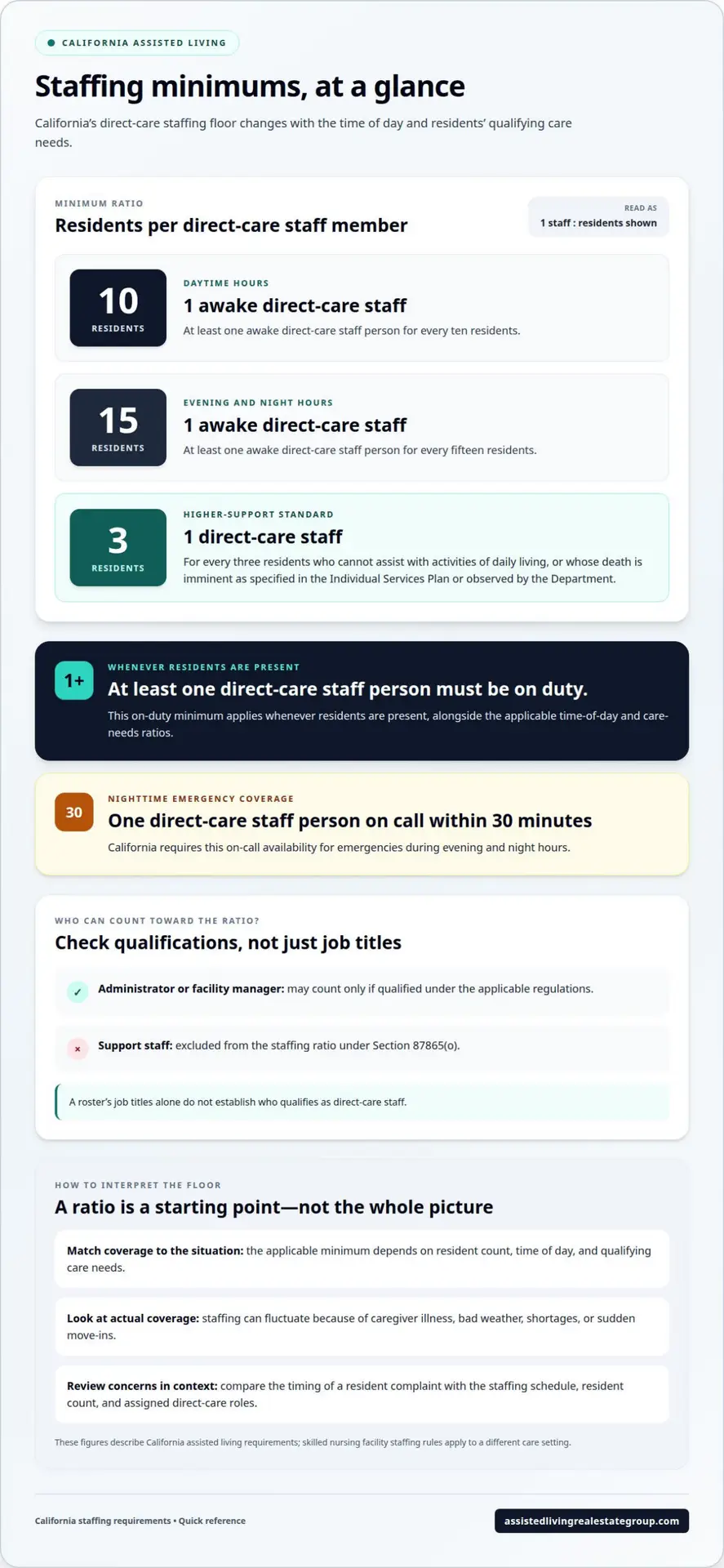
California’s assisted living staff-to-resident ratio requirements set a minimum of one awake direct-care staff person for every 10 residents during daytime hours and every 15 residents during evening and night hours. At least one direct-care staff person must be on duty whenever residents are present, with a tighter one-to-three ratio for residents who cannot assist with activities of daily living or whose death is imminent, as specified in their Individual Services Plan or observed by the Department.
Those minimums answer the basic question, but they don’t describe every community’s actual caregiver coverage. A typical industry ratio is about one caregiver for every eight residents, while some communities use one caregiver for every 15 residents at night. Understanding the difference between a legal floor and a typical staffing pattern matters when assessing resident support or evaluating a care-home opportunity. This article explains what ratios measure, what research says about minimum staffing, and how California’s assisted living rules compare with common industry practice.
Key Takeaways
- Learn what a staffing ratio measures and why a facility’s actual coverage can change with residents’ needs and staffing conditions.
- See how research on minimum staffing standards informs the discussion, while distinguishing research findings from California requirements.
- Understand how California’s assisted living rules differ from standards for other care settings.
- Use typical caregiver coverage as context when assessing an RCFE, rather than treating an industry pattern as a legal minimum.
What is a staff-to-resident ratio in assisted living?
A staff-to-resident ratio compares the number of direct-care workers available with the residents present. In California assisted living, the minimum depends on the time of day and residents’ needs. At least one direct-care staff person must be on duty whenever residents are present. During daytime hours, the minimum is one awake direct-care staff person for every ten residents. During evening and night hours, it is one awake direct-care staff person for every fifteen residents.
Some residents need a higher level of support. California requires one direct-care staff person for every three residents who cannot assist with activities of daily living, or whose death is imminent as specified in the resident’s Individual Services Plan or observed by the Department. During evening and night hours, a facility must also have at least one direct-care staff person on call within 30 minutes for emergencies.
The count has limits. California’s staffing ratio excludes support staff under Section 87865(o). An administrator may count if qualified under Sections 87864 and 87865. A facility manager may count if qualified under Sections 87864.1 and 87865. This distinction matters when reviewing a roster: job titles alone don’t establish who qualifies as direct-care staff.
Monitoring connects required ratios with the staff actually available. Skilled nursing facilities must keep accurate, readily accessible records of schedules, qualifications, and training for inspection. They must promptly report staffing-related incidents or violations to the appropriate regulatory agencies. These nursing-home rules are distinct from assisted living requirements.
Resident complaints can reveal gaps between planned coverage and daily care. Review the timing of a concern alongside the staffing schedule, resident count, and assigned direct-care roles. For instance, a complaint about delayed assistance at night calls for reviewing evening coverage, not just the daytime roster.
Staffing can fluctuate because of caregiver illness, bad weather, shortages, or sudden move-ins. A ratio is a staffing floor, not a complete picture of care. Skilled nursing homes also have minimum staffing standards, including licensed nursing requirements, but those rules apply to a different setting. For assisted living, the applicable minimum depends on resident count, time of day, and qualifying care needs.
Research on minimum staffing standards
Minimum staffing rules are designed to set a floor, but hours alone don’t show how care is distributed. California skilled nursing facilities must provide at least 3.2 hours of direct care per resident per day through direct-care staff. This standard measures total care time, not a fixed number of workers beside residents at every moment. It also applies to skilled nursing, so it shouldn’t be treated as an assisted living ratio.
A study examining California and Ohio staffing standards from 1996 to 2006 found total nursing hours per resident increased about 5%. The changes weren’t even across facilities. Nursing homes in the bottom quartile for staffing increased staffing at all levels. Facilities in the top quartile saw no change in registered-nurse or licensed-practical-nurse staffing, while certified-nurse-assistant staffing declined.
The same study reported mixed quality-of-care indicators. Average cited deficiencies rose from 7.9 to 8.6 after standards were implemented, while the share of nursing homes with a severe deficiency decreased by 60%. Registered-nurse hours per resident day fell; licensed-practical-nurse and nursing-assistant hours increased. These results show why a single staffing measure can hide changes in skill mix and performance.
In California, distinguish direct-care hours from staff-to-resident ratios. A minimum-hours rule counts care delivered over a day; a ratio compares staffing with the residents present at a particular time. Neither measure alone captures residents’ acuity, required tasks, or whether staff have the qualifications for their duties. Research can inform policy, but nursing-home findings do not establish assisted living requirements. Use them as context, then identify the California setting and the staffing measure that applies.
State staffing regulations and regulatory reviews
California’s assisted living rules identify limited ways to count staff, not a general waiver from staffing requirements. An administrator or facility manager may count toward the ratio only if they meet the qualifications in the applicable regulations; support staff are excluded under Section 87865(o).
The rules apply to direct-care staff when residents are present. Facilities must keep at least one direct-care staff person on duty, with one awake staff person for every ten residents during daytime hours and one for every fifteen during evening and night hours. The higher-need standard is one direct-care staff person for every three residents who cannot assist with activities of daily living, or whose death is imminent as specified in the Individual Services Plan or observed by the Department. At night, at least one direct-care staff person must also be on call within 30 minutes for emergencies.
These provisions are California-specific. Assisted living communities aren’t regulated at the federal level, so federal nursing-home staffing rules shouldn’t be substituted for California’s assisted living requirements. The staffing-ratio regulation cites Health and Safety Code Section 1568.072 as authority and Sections 1568.02 and 1568.072 as references. Those identifiers help distinguish this framework from rules for skilled nursing facilities.
The regulation’s history also matters during a review. California first filed it as an emergency on June 7, 1991, and it became operative that day. California refiled it as an emergency on December 3, 1991, and it became operative that day. An amendment was filed on November 4, 1996, and became operative on December 4, 1996.
For a practical compliance review, compare the resident count and time of day with the required direct-care coverage. Then assess whether staff counted in the ratio meet the qualification rules and whether exclusions under Section 87865(o) have been applied. That distinction helps determine whether a roster shows adequate qualifying coverage, rather than simply a headcount. Regulatory reviews should keep assisted living requirements separate from standards governing nursing homes and hospitals.
Typical assisted living caregiver-to-resident ratios
California’s legal minimum and a community’s typical staffing pattern answer different questions. One caregiver for every eight residents is an industry comparison point. Some assisted living communities use one caregiver for every fifteen residents at night. These figures describe reported practice, not mandatory statewide ratios or a promise of continuous one-to-one support.
Consider how the comparison works. At a 1:8 pattern, sixteen residents correspond to two caregivers if the ratio is applied evenly. At 1:15, fifteen residents correspond to one caregiver. Those simple examples don’t establish the staffing required for a particular California facility. Actual coverage must account for the applicable rules and residents’ care needs.
Time of day matters. A night roster with fewer caregivers may reflect a different staffing pattern, but the ratio alone doesn’t show how quickly a caregiver can respond. Review who is on duty, which workers provide direct care, and whether their qualifications match their assigned duties. A licensed professional’s presence is not the same as the number of caregivers available for routine assistance.
Resident acuity matters as much as headcount. A community serving residents who need frequent help with daily activities may need a different staffing plan from one serving residents with fewer hands-on care needs. Move-ins, illness, and staff shortages can also change coverage between shifts. Because operations change over time, a historical ratio should not stand in for a current staffing picture.
Use 1:8 as an industry comparison, not a California legal benchmark; treat 1:15 at night the same way. Then compare the facility’s staffing plan with its resident needs and the applicable mandatory requirements. If you’re evaluating an RCFE purchase, review California RCFE acquisition opportunities with staffing context in view.
Assisted Living Real Estate Group: RCFE Sales (Residential Care Facilities for the Elderly)
Assisted Living Real Estate Group supports Southern California buyers and sellers through RCFE sales and turnkey business acquisitions. If staffing capacity is part of your acquisition analysis, review the facility’s operating model alongside its resident profile and applicable care requirements. The firm handles specialized listings ranging from 6-bed residential homes to larger 30+ bed assisted living centers across the region, offering context for opportunities at different scales.
For owners preparing to sell, a confidential marketing strategy can help protect a facility’s reputation and operations while connecting with qualified buyers. Assisted Living Real Estate Group also handles sales of Adult Residential Facilities (ARF) throughout Southern California. Its brokerage services support buyers and sellers through care-facility transactions; they do not replace regulatory guidance or direct care.
Contact Assisted Living Real Estate Group to discuss buying or selling a Southern California care facility.
Build a stronger foundation for your next decision
Understanding California’s staff-to-resident ratio requirements is one part of evaluating a care-home opportunity. Next, consider how the facility’s operating model, resident needs, and staffing plan fit together. This broader view can help buyers assess whether an opportunity aligns with their goals and help owners prepare for a thoughtful transition.
For buyers exploring a California RCFE, a transaction-focused discussion can bring operational context into the acquisition process. Sellers can consider how to present their facility while protecting its reputation and continuity. The next step depends on whether you’re buying, selling, or evaluating a turnkey business opportunity.
Assisted Living Real Estate Group offers RCFE Sales, ARF Sales, and Turnkey Business Acquisitions. Contact Assisted Living Real Estate Group to discuss your next step in California’s care-home market. A well-informed decision can support both a sustainable business and a stronger future for the people it serves.
Frequently Asked Questions
What are California’s staff-to-resident ratio requirements for assisted living facilities?
California requires assisted living facilities to maintain direct-care coverage according to the time of day and residents’ support needs. When assessing a proposed schedule, for example, distinguish residents who can assist with daily activities from those who cannot. The higher-support requirement may apply to the latter group. A facility’s total headcount alone doesn’t establish compliance; the roles and qualifications of staff counted in the ratio matter.
What are California’s staffing requirements for adult residential facilities and group homes?
Adult Residential Facilities and group homes should not automatically be assessed using the RCFE staffing schedule. Requirements depend on the facility’s license category, so identify the facility type before comparing a roster with a ratio. When reviewing a California facility, first establish whether it is an RCFE or an ARF, then assess the staffing rule for that category.
How do California staffing requirements differ by facility type and resident care needs?
California requirements differ between assisted living and skilled nursing settings, and resident needs also affect staffing. Skilled nursing facilities must provide at least 3.2 hours of direct care per resident per day, including at least 2.4 hours through certified nursing assistants. Direct-care hours are not the same measure as a staff-to-resident ratio. A resident’s acuity helps determine the level of attention needed.
Does California require minimum staff coverage on each shift or overnight?
Yes. California assisted living facilities must maintain required awake direct-care coverage according to the time of day, rather than relying only on an average across shifts. Overnight, the rule also requires at least one direct-care staff person on call within 30 minutes for emergencies. For a schedule review, compare the actual shift roster with the residents present during that shift.
Which California laws and regulations govern residential care staffing ratios?
California’s assisted living staffing-ratio regulation cites Health and Safety Code Section 1568.072 as its authority and Sections 1568.02 and 1568.072 as references. Sections 87864, 87864.1, and 87865 address which administrators or facility managers may count toward staffing; Section 87865(o) specifies support staff excluded from the ratio. Match each provision to the facility type and staffing role being reviewed.
What penalties apply to California facilities that fail to meet staffing requirements?
Penalties depend on the facility type and the rule violated, so hospital staffing penalties shouldn’t be assumed to apply to an RCFE or ARF. Under California SB 596, hospital nurse staffing-ratio violations carry standard penalties of $15,000 for a first violation and $30,000 for subsequent violations. The law also sets higher penalties for immediate-jeopardy violations. These amounts concern hospital rules, not residential-care penalties.