
A fresh coat of paint can conceal costly maintenance problems. A practical California RCFE acquisition checklist starts with the building’s condition, maintenance history, and inspection record, not its first impression. California RCFEs are inspected annually, and inspections may be scheduled or unannounced. Review the facility’s inspection history alongside a careful walkthrough.
It’s reasonable to focus on the property: repairs can affect both the investment and residents’ daily comfort. But a sound acquisition decision also depends on whether the operation behind the building is financially stable, properly staffed, and prepared to meet California licensing requirements.
This guide explains how to assess the facility, cash flow, staffing costs, resident and employee records, working conditions, and licensing before acquiring an RCFE. Use these steps to identify strengths, surface operational risks, and determine which details need closer attention before moving forward.
Key Takeaways
- Compare cash flow with payment records and staffing costs to see whether the facility’s operating performance holds up under scrutiny.
- Look beyond appearances: maintenance records and inspection outcomes can reveal issues a walkthrough may miss.
- Review resident care plans, staff records, and workplace practices to understand how the operation supports consistent care.
- Assess licensing and compliance alongside the business fundamentals; according to the California Department of Social Services, California RCFEs must carry liability insurance of at least $1,000,000 per occurrence and $3,000,000 annually.
Cash flow, payment records, and staffing costs
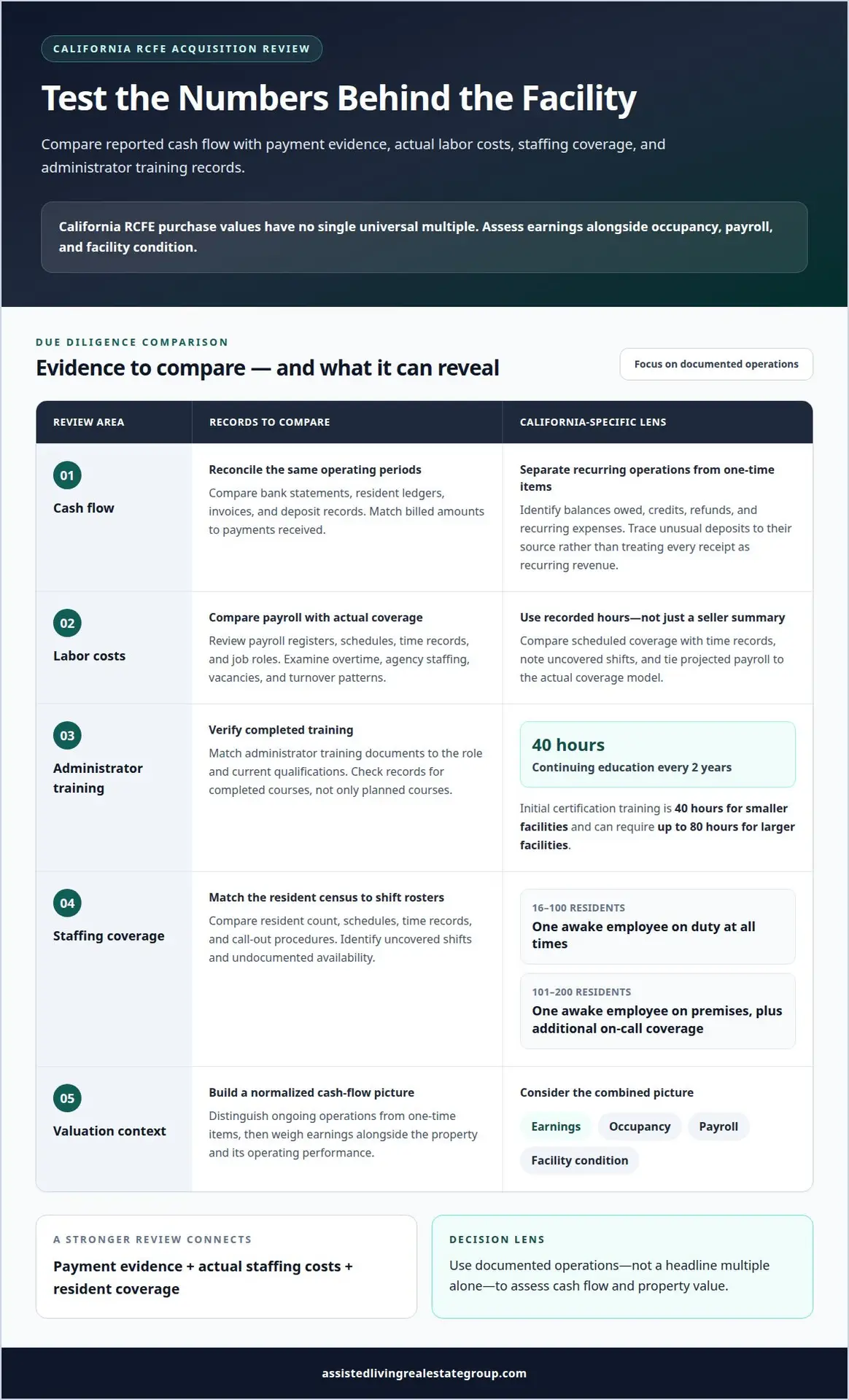
Test whether reported earnings reflect dependable resident payments and realistic labor costs. California RCFE purchase values have no single universal multiple. Assess earnings and property value in light of occupancy, payroll, and facility condition.
-
Review Cash Flow and Payment Records
Reconcile bank statements, resident ledgers, invoices, and deposit records for the same operating periods. Compare billed amounts with payments received, then identify outstanding balances, credits, refunds, and recurring expenses. Trace unusual deposits to their source instead of counting every receipt as recurring revenue. Build a normalized cash-flow picture that separates ongoing operations from one-time items. For valuation, weigh earnings alongside property condition and occupancy rather than relying on a headline multiple alone.
-
Inspect Staffing and Training Records
Compare payroll registers, schedules, time records, and job roles to understand actual labor costs and coverage. Review overtime, agency staffing, vacancies, and turnover patterns, then compare scheduled coverage with recorded hours. Match administrator training documents to the role and current qualifications. California RCFE administrators complete 40 hours of continuing education every two years. Initial certification training is 40 hours for smaller facilities and can require up to 80 hours for larger facilities. Check that records document completed training, not just planned courses.
-
Match Staffing to Facility Size
Use the resident census to assess required coverage against the facility’s staffing schedule. California RCFEs with 16-100 residents must have one awake employee on duty at all times. Facilities with 101-200 residents require one awake employee on premises plus additional on-call coverage. Compare these requirements with shift rosters, time records, and call-out procedures. Identify uncovered shifts and determine whether the staffing plan can support day-to-day operations without depending on undocumented availability. Tie projected payroll to the actual coverage model, not only to the seller’s summary.
Are the RCFE’s Facilities Well Maintained?
Assess the building’s physical condition alongside its California inspection history. A walkthrough matters, but maintenance records and past corrections can show whether problems were addressed.
-
Review Maintenance and Inspection History
Request maintenance logs, repair invoices, and inspection records, then compare documented work with what you see during the walkthrough. Check high-use areas, including bathrooms, kitchens, resident rooms, and common spaces, for recurring leaks, damaged flooring, or deferred repairs. California RCFEs are inspected annually, with scheduled and unannounced inspections. Compare inspection dates and findings with the maintenance timeline to spot unresolved patterns.
-
Assess Deficiencies and Enforcement
Review each inspection finding, any Plan of Correction, and evidence that corrective work was completed. California RCFE inspections may result in Plans of Correction, civil penalties, or license suspension or revocation. Match each cited issue to a repair record, revised procedure, or other documented response. For example, recurring concerns merit closer attention if successive records show similar findings without clear resolution. Separate closed items from open concerns in your diligence notes.
-
Check Background and Inspection Records
Organize the facility’s inspection documents and ownership-application records by date, issue, and follow-up action. California RCFE change-of-ownership background checks and application review typically take 60-120 days, depending on agency workload and application completeness. Treat that review as part of transaction planning, not a substitute for examining the property and its operating history. Compare the application timeline with the anticipated closing schedule and flag any unresolved inspection findings that could affect continuity.
California Title 22, section 87303 sets requirements for RCFE maintenance and operations. Use that standard to frame your facilities review, then connect each concern to its documentation and potential operational impact. If you’re evaluating an acquisition, California RCFE sales opportunities can help you compare facilities through the lens of both property condition and ongoing operations.
Resident and staff records and working conditions
Review resident files and staffing practices together to understand care delivery and operational continuity. California RCFEs provide non-medical assistance, so compare residents’ needs with the services the facility actually provides.
-
Review Resident and Staff Records
Compare staff schedules, time records, job descriptions, and training documents with actual daily coverage. Note vacancies, repeated schedule changes, and documented complaints or corrective actions. In resident files, review service agreements, care notes, and records of changes in needs. Look for consistent documentation across shifts, not just complete-looking folders. These records can reveal whether the facility’s routines support residents and staff in practice.
-
Verify Admission and Assessment Practices
Sample admission files and confirm each includes a pre-admission assessment and an individualized care plan. Compare documented needs with services, staffing routines, and resident records after admission. California RCFEs serve adults aged 60 and older; adults under 60 may be admitted when their needs are compatible with existing residents. Check whether the assessment explains that compatibility and how staff respond to changing needs. California RCFEs provide non-medical assistance and aren’t required to employ a physician or licensed nurses.
- Match each resident’s assessed needs to the facility’s service scope. Review meal and snack records because California RCFEs must provide three nutritionally balanced meals per day, with snacks available. Identify care needs that may exceed the facility’s non-medical role. Compare those needs with care plans and documented arrangements rather than assuming the license covers medical services.
- Separate SSI residents’ accounts when analyzing revenue. Reconcile resident payment records with ledgers, credits, and outstanding balances, then identify the payer source for each account. Model how vacancies or resident departures could affect collected revenue. Resident attrition after an RCFE ownership change averages 20-30%, so include a transition plan for communication, continuity of care, and retention. Note which staff members manage resident and family updates during the handover.
California RCFE licensing and regulatory framework
For California buyers, an RCFE acquisition checklist should connect licensing status with the property, contracts, and transaction risks. Review these records together to understand what the operation requires after ownership changes.
- Confirm the facility’s RCFE license and the administrator’s individual certification as separate records. California RCFEs need a license to operate, and the California Department of Social Services regulates them through its Community Care Licensing Division. Check that the license, approved capacity, and current operating details align. Administrators must obtain certification before managing an RCFE, so include the manager’s certification status in transaction planning.
-
Verify Building, Fire, Zoning, and Accessibility Requirements
Compare the property’s current layout and use with its building, fire-clearance, zoning, and accessibility records. Review available approvals, site plans, and inspection documents for consistency with how the facility operates. Note discrepancies between the paperwork and observed conditions, such as a changed room layout. These findings help identify what needs resolution before the building can support the intended care operation.
-
Assess Legal, Insurance, Tax, and Liability Risks
Review entity documents, tax filings, insurance policies, claims, and outstanding obligations as one diligence set. According to the California Department of Social Services, California RCFEs must carry liability insurance of at least $1,000,000 per occurrence and $3,000,000 annually. Compare policy details with the facility’s operations and ownership transition. Reconcile tax filings with financial statements, and document liabilities that could affect the transaction or ongoing business.
- Read resident agreements for rates, adjustment terms, and refund provisions. These contract terms affect collections and obligations after a sale, so compare them with account records and outstanding balances. Don’t assume existing terms will change or continue without reviewing each agreement. Add these licensing and contract checks to an RCFE acquisition checklist for a California purchase. California RCFEs are governed primarily by Title 22, Division 6, Chapter 8, alongside applicable RCFE provisions in the Health and Safety Code.
For support evaluating a care-facility transaction, explore turnkey business acquisitions.
Assisted Living Real Estate Group: RCFE Sales (Residential Care Facilities for the Elderly)
Assisted Living Real Estate Group supports California buyers and sellers through RCFE sales and turnkey business acquisitions. If your due diligence points to an opportunity that fits your operational goals, the firm can help assess the transaction with both the facility and its business in view.
For owners preparing to sell, a confidential marketing strategy can help protect the facility’s reputation and operations while connecting with qualified buyers. Buyers considering an RCFE or Adult Residential Facility can explore options aligned with their acquisition objectives. The next step depends on whether you’re purchasing an operating facility, preparing a sale, or evaluating a turnkey opportunity.
For support with a California care-facility transaction, contact Assisted Living Real Estate Group.
Turn Due Diligence Into a Confident Next Step
A California RCFE acquisition checklist can turn complex due diligence into a clearer investment decision. Connect what you’ve learned with your acquisition priorities: the operating model you want to sustain, the transition you can manage, and the care environment you aim to protect. This keeps the decision grounded in both business realities and residents’ continuity.
Before moving forward, organize your findings into questions that shape the transaction: which issues need resolution, which terms need clarification, and what would make the opportunity a strategic fit? A focused conversation can help you evaluate an RCFE or ARF opportunity in light of your goals.
Contact Assisted Living Real Estate Group to discuss your next step. With a disciplined process and a mission-driven outlook, you can pursue an acquisition built for lasting value.
Frequently Asked Questions
Can I Just Buy a Home and Turn It into an RCFE?
No. Buying a California home doesn’t authorize RCFE operations; the facility needs an RCFE license to operate legally. Before choosing a property, assess whether its layout and proposed use fit the intended care model. Review applicable land-use, building, fire-clearance, and accessibility matters, then plan for licensing and qualified administration. A home that appears suitable may need changes or approvals before it can serve residents.
What due diligence should buyers perform before acquiring a California RCFE?
Use an ordered review that connects records to the transaction’s assumptions. Compare bank deposits with resident account statements, test occupancy against current agreements, and map payroll and vendor commitments to projected operations. Then assess property condition, inspection history, resident records, and administrator readiness. For each unresolved issue, record the supporting evidence, its potential effect on operations, and whether it changes your acquisition decision.
What are California RCFE license transfer and change-of-ownership requirements?
Plan for a change-of-ownership application and don’t treat a facility’s existing license as automatically transferred to a buyer. California RCFE change-of-ownership applications are typically submitted 60-90 days before anticipated closing. From application submission to license issuance, the process typically takes 3 to 12 months. Build that timing into the transaction schedule and distinguish the facility license from the administrator’s individual certification.
What financial records, occupancy data, and expenses should RCFE buyers review?
Review bank statements, billing ledgers, resident agreements, payroll records, and recurring vendor invoices as one financial picture. Compare the resident census with billed services and collected payments, noting vacancies, credits, and overdue balances. Separate recurring income from one-time receipts, then identify expenses that could change after ownership. For example, compare scheduled staffing costs with payroll actually paid instead of relying only on a seller’s operating summary.
How can buyers verify RCFE citations, complaints, inspection reports, and enforcement history?
Build a facility-specific record by matching inspection reports with citations, Plans of Correction, and any documented enforcement actions. California RCFEs receive scheduled and unannounced inspections, and findings may lead to civil penalties or license suspension or revocation. For each issue, compare the report date, corrective response, and evidence of resolution. Look for repeated findings across separate reports, since recurrence can signal an ongoing operational weakness.
What California RCFE staffing, training, and administrator requirements should buyers assess?
Assess both staffing coverage and the administrator’s eligibility to manage the facility. California RCFE administrator applicants must be at least 21 years old, complete an approved Initial Certification Training Program, and pass the state certification exam. Certification must be obtained before managing an RCFE and renewed every two years. Review the administrator’s certification and continuing-education records alongside schedules, time records, and training documentation for other staff.