
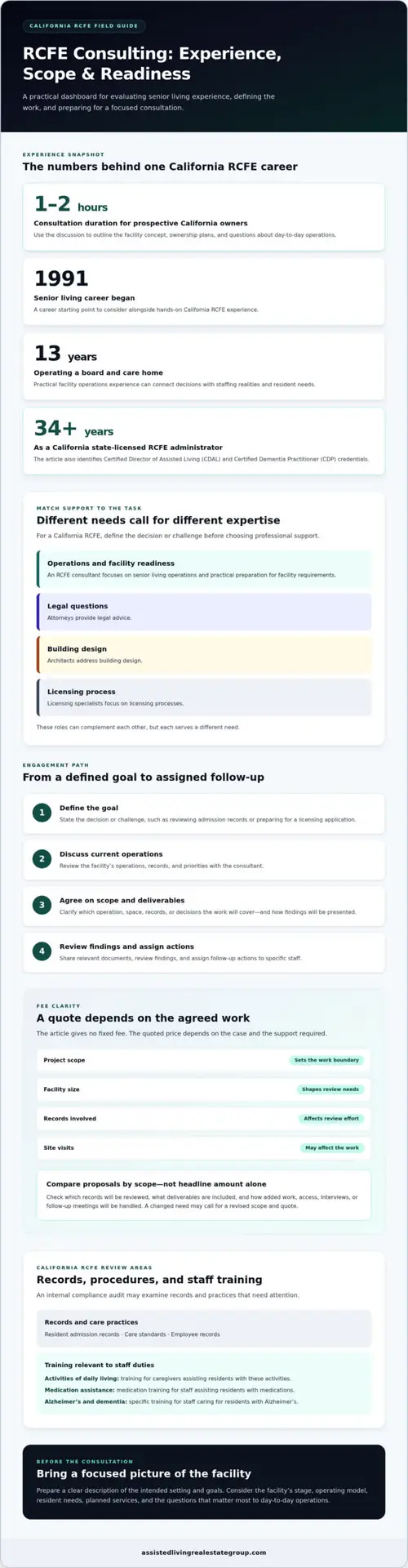
For potential California RCFE owners, a consultation takes 1-2 hours. Hiring an RCFE consultant can bring focused guidance on facility operations, licensing preparation, and the decisions involved in establishing or running a senior living business. The most useful advice reflects California RCFE experience and the realities of day-to-day care.
When hiring an RCFE consultant, look beyond the title: practical senior living experience and a clear understanding of your facility’s needs matter. The right support can help you identify operational priorities and prepare for decisions, while keeping resident well-being central to business planning.
This article explains what RCFE consultants do, what experience to consider, and how to assess a proposed scope and fee. You’ll also learn when consulting may fit your California facility’s needs, and when a real estate or ownership decision calls for a different kind of support.
Key Takeaways
- Define the support you need by identifying whether your priority is facility operations, compliance preparation, or a potential ownership transition.
- Assess a consultant’s California senior living experience, relevant credentials, and understanding of the operational demands of an RCFE.
- Understand how consulting fees can depend on the scope of work, facility needs, and level of support involved.
- Prepare for Community Care Licensing requirements by organizing staff training records, policies, procedures, and required application materials.
Consulting for residential care facilities for the elderly
California RCFE consulting may address operating practices, licensing preparation, and facility readiness. Before hiring an RCFE consultant, define the decision or challenge you need help resolving.
Consultant Roles Compared
An RCFE consultant focuses on senior living operations and practical preparation for facility requirements. Attorneys provide legal advice, architects address building design, and licensing specialists focus on licensing processes. Their work can complement each other, but each serves a different need. Choose support based on the task: operational review, legal question, physical planning, or application preparation.
Consulting needs also vary by California county and facility size. Location shapes the local context, while capacity, resident needs, and planned services affect the scope of an operational review. A small residential home and a larger assisted living center may need different priorities, staffing plans, and documentation reviews.
Hiring and Working Steps
To hire and work with a consultant, first define the goal, such as reviewing admission records or preparing for a licensing application. Next, discuss the facility’s current operations, records, and priorities, then agree on the work scope and deliverables. During the engagement, share relevant documents, review findings, and assign follow-up actions to specific staff.
An internal compliance audit may examine resident admission records, care standards, and employee records. This gives owners a structured view of procedures or documentation that may need attention. RCFE licensing or de-licensing work may cover a whole facility or only part of it, so clarify which operation or space the work concerns.
For prospective California owners, a consultation takes 1-2 hours. Use that time to outline the facility concept, ownership plans, and questions about day-to-day operations. Bring a clear description of the intended setting and goals; focused preparation helps keep the discussion relevant to the decisions ahead.
Consultant qualifications and senior living experience
Prioritize hands-on California RCFE experience over a polished title. A consultant who has managed a care home can connect operating decisions with resident needs, staffing realities, and business priorities. Look for experience relevant to your facility’s stage, whether you’re planning an opening, addressing operational gaps, or assessing an established assisted living business.
Credentials can add useful context. Keith Payne began his senior living career in 1991, operated a board and care home for 13 years, and has over 34 years of experience as a California state-licensed RCFE administrator. His Certified Director of Assisted Living (CDAL) and Certified Dementia Practitioner (CDP) credentials indicate specialized training alongside practical experience.
Evaluate experience against the work you need done. Ask how the consultant’s background applies to your facility’s operating model, resident profile, and priorities. For example, someone reviewing dementia-care operations should understand considerations involved in supporting residents with Alzheimer’s. Facility administration experience can also help turn broad observations into practical management steps.
Risks include relying on someone whose background is limited to general business advice, or accepting recommendations without a clear scope and deliverables. Also distinguish a consultant’s experience from an administrator’s job requirements: one employer’s hiring criteria do not automatically define qualifications for consulting work.
Use a focused review before agreeing to an engagement. Match the consultant’s experience and credentials to your stated goal, then clarify which records, procedures, or decisions the work will address. Ask how findings will be presented and what actions you’ll receive, such as a prioritized list of operational issues or recommendations for staff practices.
Specific care areas offer a practical way to assess expertise. California RCFE caregivers assisting residents with activities of daily living require training on those activities; staff assisting with medications require medication training. Staff caring for residents with Alzheimer’s need training specific to dementia and Alzheimer’s. A consultant’s familiarity with these distinct needs can help you determine whether their senior living experience fits your facility.
Consulting rates
A consultant’s fee depends on the work agreed for a California RCFE. The price depends on the case and is given after a quote request; cost factors include the project scope, facility size, records involved, and whether the work requires site visits. A review of selected procedures differs from support covering several operational areas. Define the need before comparing proposals.
Ask for a written scope that connects each task to a deliverable. For example, an internal review might cover resident admission records, care standards, and employee records. A broader engagement could address additional operating procedures or preparation for a licensing process. Clear boundaries help you understand what the quoted fee covers and which tasks fall outside the engagement.
Clarify how changes to the work will be handled. If an initial records review identifies another area requiring attention, ask whether it calls for a revised scope and quote. Apply the same approach to facility access, interviews, and follow-up meetings. Documenting expectations helps prevent confusion about added work and keeps the project focused.
Compare proposals by matching scope, not by looking at the headline amount alone. One California consultant may include document review and a written summary, while another may focus on meetings or operational guidance. Check which records will be reviewed, how findings will be delivered, and whether recommendations include practical next steps. This makes proposals easier to assess side by side.
Before agreeing, outline the facility’s priority, available records, and desired outcome. A prospective owner preparing an RCFE concept may need a different scope from an operator reviewing existing procedures. Share those details and request the tasks, deliverables, and payment terms in writing. A defined engagement gives both sides a shared reference point as the work proceeds.
How can an RCFE consultant help with California Community Care Licensing requirements?
In California, an RCFE consultant can help owners organize licensing tasks, staff training records, and facility documents. The consultant provides preparation and operational guidance, not legal representation or a substitute for the licensing authority.
California RCFE licensing applications have two main components: Part A and Part B. Part A covers basic information, while Part B includes mandatory supporting documents, policies, and procedures. A consultant can help map materials to each component, identify gaps, and organize records for review.
Ownership changes also require attention. California facility licenses are mandatory for new ownerships and changes in ownership, and are obtained from the Community Care Licensing Division. A consultant can help owners plan licensing work around a proposed transaction, organize facility information, and coordinate operational preparation. For a change of ownership, clarify which tasks relate to the application and which concern ongoing operations.
Staff training is another practical focus. The California Department of Social Services requires RCFE staff to receive training within their first few weeks and ongoing training each year thereafter. Training must be conducted by a qualified trainer, documented, and supported by materials available for inspection by the LPA. A consultant can help organize training records and materials, then identify incomplete documentation for follow-up.
Use a simple readiness sequence: match application documents to Part A or Part B, organize staff training records, and review supporting materials for consistency. For example, compare training documentation with subjects relevant to staff duties, then note missing records for resolution. Leave final application and licensing decisions to the responsible California authorities.
If you’re evaluating a California RCFE ownership transition alongside licensing preparation, explore California RCFE facility opportunities as a related next step.
Assisted Living Real Estate Group: RCFE Sales (Residential Care Facilities for the Elderly)
Assisted Living Real Estate Group supports California senior living ownership transitions through RCFE Sales and related business acquisition opportunities. Consider this next step when you’re evaluating a facility purchase or sale, rather than seeking operational consulting or legal representation.
For owners preparing to sell, the company’s confidential marketing strategy helps protect the facility’s reputation and operations while connecting with qualified buyers in the assisted living sector. Buyers can explore turnkey business acquisitions, and operators considering other residential care settings can review ARF sales. Each path centers on the facility and its underlying business, helping align an ownership decision with your objectives.
If you’re considering a California RCFE transaction, contact Assisted Living Real Estate Group or visit assistedlivingrealestategroup.com.
Set your next move with purpose
Turn your facility goals into a clear decision plan. Before hiring an RCFE consultant, define the outcome you need, the decisions that depend on it, and how those choices support responsible operations and long-term business viability. A focused brief can keep professional guidance connected to your priorities instead of letting the process drift into disconnected tasks.
If your plans involve ownership, acquisition, or a sale, treat that as a distinct business decision alongside operational and licensing preparation. Aligning the facility’s care mission with its ownership strategy can help you move forward with clarity. Assisted Living Real Estate Group can discuss California RCFE opportunities as you consider that path.
Contact Assisted Living Real Estate Group to start a conversation about your next step. Thoughtful planning can support a senior living venture built around both strong stewardship and meaningful care.
Frequently Asked Questions
What does an RCFE consultant do in California?
An RCFE consultant helps owners assess operational questions and prepare for facility decisions. For example, an owner could request a focused review of admission practices before changing intake procedures. The consultant can identify records or processes that need attention and outline practical next steps. Define the desired outcome first to keep the engagement tied to a specific California RCFE need.
When should you hire an RCFE consultant?
Bring in a consultant when a facility decision has operational or licensing implications that need focused attention. Examples include planning a new California care-home venture, preparing for an ownership transition, or responding to gaps identified in an internal review. Early guidance can help owners sequence tasks and assign responsibility before deadlines or transaction milestones create pressure.
How much does an RCFE consultant cost in California?
There is no single fee that fits every California RCFE consulting engagement. For a useful quote, distinguish between a one-time assessment, preparation for a defined project milestone, and ongoing advisory support. Ask the proposal to separate the core assignment from optional follow-up work. That breakdown helps you choose support that fits the project without paying for tasks you do not need.
How do you find and vet a qualified RCFE consultant?
Assess California-specific RCFE experience against the task you need completed. Ask the consultant to describe a comparable project, the work performed, and the deliverables provided, without sharing confidential facility details. Then clarify the engagement’s boundaries, communication process, and how recommendations will be documented. A written scope makes it easier to see whether the proposed work addresses your operational priorities.
What experience and credentials should an RCFE consultant have?
Look for direct senior living operations experience and credentials relevant to the consultant’s focus. For a dementia-care question, dementia-specific knowledge matters; for an operating review, facility administration experience is more relevant. Evaluate credentials alongside practical examples of similar responsibilities. The strongest fit is the background that matches your facility’s needs.
What services do RCFE consultants provide for licensing and opening a facility?
RCFE consultants may support licensing preparation, internal compliance reviews, and operational planning for a new facility. For an opening, that can mean organizing application materials and policies around planned services and the operating model. Consultants can guide preparation, but California facility licenses come from the Community Care Licensing Division. Their support helps owners manage the work without confusing consulting guidance with licensing authority.