
A financially sound RCFE purchase depends on more than the asking price. Financial planning for an RCFE purchase means assessing acquisition costs, when funds must be available, how the purchase will be funded, and whether the facility’s performance can support ongoing operations. Consider potential returns alongside the risk of a cash shortfall.
It’s understandable to focus first on the purchase price, but timing shapes the full financial commitment. Funds may be needed at different stages, while operating income and expenses follow their own schedules. Mapping those moving parts helps you assess the opportunity carefully and estimate how much working capital the transition may require.
This guide explains which costs to assess, how to map cash-flow timing, what payment methods and financial reports can reveal, and how to weigh potential gains against losses in California. You’ll see how purchase assumptions connect to working capital and operating performance, helping you judge whether an RCFE acquisition fits your financial capacity and long-term goals.
Key Takeaways
- Map when purchase funds and operating cash are needed to see how timing could create pressure after closing.
- Read financial reports together to assess revenue, expenses, working capital, and the assumptions behind projected performance.
- Compare payment methods by how each affects available cash, ongoing obligations, and flexibility during the transition.
- Evaluate potential profit against operating costs and cash-flow risks, then consider whether an RCFE acquisition fits your goals in California.
Cash-flow timing and risk
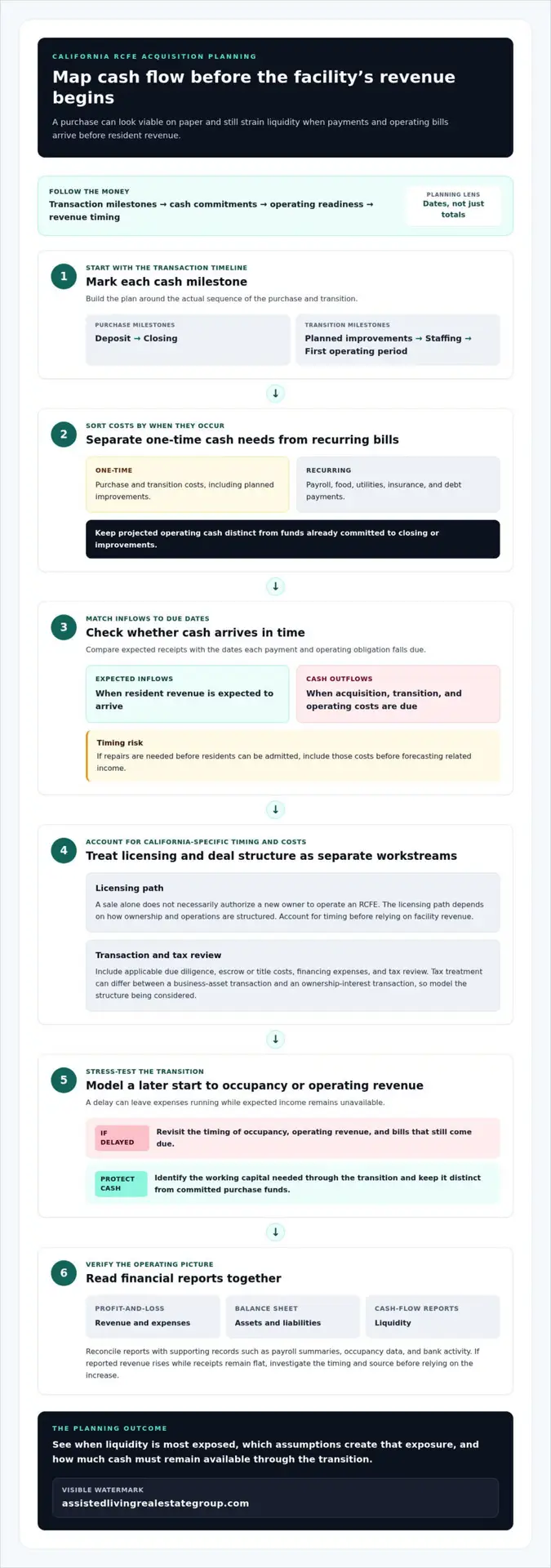
Cash-flow planning tracks when money enters and leaves the RCFE, not just whether projected revenue exceeds expenses. It accounts for the timing and risk of expected cash flows. A purchase may look viable on paper yet strain liquidity if acquisition payments, transition expenses, and operating bills come due before resident revenue arrives.
Build a timeline around the transaction’s actual milestones: deposit, closing, planned improvements, staffing, and the first operating period. If the facility needs repairs before residents can be admitted, include those costs before forecasting related income. Separate one-time purchase and transition costs from recurring obligations such as payroll, food, utilities, insurance, and debt payments. Compare expected inflows with the dates those obligations fall due.
In California, treat licensing as a separate workstream. A sale alone does not necessarily authorize a new owner to operate an RCFE. The licensing path depends on how ownership and operations are structured, so account for timing before relying on facility revenue. A delay between closing and operating approval can leave expenses running while expected income remains unavailable.
California taxes and transaction costs depend on the deal structure. Include tax review and transaction expenses in the cash plan, such as due diligence, escrow or title costs, and financing expenses where applicable. Tax treatment can differ depending on whether the transaction involves business assets or an ownership interest, so model the structure under consideration rather than applying one assumption to every purchase. For insights on evaluating entity classifications and tax considerations during an acquisition, accounting and advisory specialists such as SD Mayer provide helpful frameworks.
- Separate timing: Mark each expected payment and receipt against the transaction timeline.
- Stress-test delays: Model what happens if occupancy or operating revenue begins later than planned.
- Protect working capital: Keep projected operating cash distinct from funds committed to closing or improvements.
This timing view makes financial planning for an RCFE purchase more useful for decision-making. It shows when liquidity is most exposed, which assumptions drive that exposure, and how much cash must remain available through the transition.
Financial analysis and reporting
RCFE financial analysis tests whether documented performance supports the purchase assumptions. In California, compare the facility’s records with its operating model, capacity, and condition.
RCFE Purchase Costs
The purchase cost is the amount tied to acquiring the RCFE business and any included assets. In California, the price depends on the case and is given after a quote request. Location, bed count, occupancy, facility condition, and included business assets all shape the assessment. These factors matter because the headline price alone doesn’t show the cash needed to sustain operations.
Review the purchase structure alongside the financial records. Separate business assets from any real estate included in the transaction, then identify which liabilities and operating obligations will transfer. This breakdown helps you compare the proposed purchase price with the facility’s performance and the resources required after closing.
Price Differences by Location and Capacity
Location, licensed bed capacity, and occupancy influence how buyers assess an RCFE’s earning potential and purchase value. A facility with more beds may have greater revenue potential, but only if occupancy and operating performance support it. Capacity on paper does not equal occupied, income-producing beds.
Compare facilities using consistent measures: current occupancy, revenue per resident, operating expenses, and the condition of the property and business assets. A lower-occupancy facility, for example, may call for a different revenue outlook than a similar-capacity facility with stronger occupancy. Use actual records, not capacity alone, to test the assumptions behind a proposed price.
Staffing and Resident-Care Expenses
Staffing and resident-care expenses vary with the operating model, employee schedules, wages, and residents’ support needs. These costs matter because payroll and care-related spending directly affect operating margins and the cash available for other obligations.
Compare payroll records with schedules and resident-care arrangements. Review overtime, open shifts, benefits, training, food, supplies, and other recurring costs. Historical expenses may change if resident needs or staffing arrangements change after purchase, so reflect those conditions in projected results.
Use the profit-and-loss statement to assess revenue and expenses, the balance sheet to examine assets and liabilities, and cash-flow reports to understand liquidity. Reconcile each report with supporting records, such as payroll summaries, occupancy data, and bank activity. If reported revenue rises while receipts remain flat, investigate the timing and source before relying on that increase. This review connects purchase assumptions to actual operating performance.
Methods of payment
Payment structure determines how much capital you commit at closing and what obligations follow. For a California RCFE acquisition, compare available funds, financing, and any seller-financed terms against the facility’s cash needs.
Buyers may use cash, third-party financing, seller financing negotiated with the seller, or a combination. Cash avoids scheduled loan payments but ties up capital that could otherwise support operations. Borrowing preserves some cash but adds principal, interest, and repayment obligations. Seller financing can spread part of the purchase payment over time if both parties agree on the terms.
How much down payment and working capital should buyers budget for an RCFE? The down payment depends on the purchase structure and financing terms. Set a working-capital target by forecasting payroll, resident-care supplies, utilities, insurance, and other operating outflows against expected collections. Include a scenario with slower occupancy or delayed receipts.
Compare each method by its effect on liquidity, total repayment obligations, and flexibility. A buyer who uses most available cash at closing, for example, may have less room to cover payroll while resident revenue builds. A buyer relying on debt should include scheduled payments in the operating forecast, even during periods of lower occupancy. Match repayment timing to realistic cash flow, not the most optimistic revenue projection.
- Cash: Identify how much capital remains after closing for operating needs.
- Third-party financing: Include repayment terms and related costs in projected cash flow.
- Seller financing: Model the agreed payment schedule alongside recurring expenses.
- Combined funding: Track which source funds each part of the purchase and transition.
Before choosing a structure, prepare a side-by-side forecast for each option. Include closing payments, recurring debt service, transition spending, and projected collections. Test how each option performs if occupancy grows more slowly than expected. This comparison clarifies the trade-off between preserving cash now and taking on future payment commitments, helping align the funding plan with responsible facility operations.
Opportunity for profit or loss
An RCFE can generate operating income, but profit depends on collected revenue relative to total expenses. A California buyer should evaluate the operating model rather than treat capacity or projected income as proof of financial performance. Documented revenue should support costs, debt obligations, and necessary reinvestment.
Start with a base case using actual collections, occupancy, payroll, resident-care expenses, and recurring obligations. Then test a downside case in which occupancy falls, collections slow, or staffing expenses rise. Compare both cases against costs that continue even when beds are unoccupied, such as facility expenses and scheduled debt payments. A surplus in the base case may become a loss if revenue drops while fixed costs continue.
Separate operating performance from one-time items. A single large expense can make one period look weaker, while a one-time receipt can make it appear stronger. Review trends across available reporting periods, identify unusual transactions, and assess whether ordinary operations generate enough cash to meet regular obligations. This helps reveal whether projected returns depend on repeatable performance or exceptional circumstances.
Profit also depends on execution after acquisition. If you plan to improve occupancy, include the costs and timing of that effort in the forecast. If the facility needs repairs or changes to its operating model, account for them before counting added revenue. A practical forecast links each proposed improvement to its expense, expected operational effect, and impact on cash flow.
- Test assumptions: Compare actual collections with projected revenue and occupancy.
- Model downside: Assess lower revenue alongside continuing payroll, debt, and facility expenses.
- Protect reinvestment: Include repairs and operating needs before treating surplus cash as distributable profit.
For a California RCFE, the purchase decision should account for both financial returns and the resources needed to sustain resident care. A disciplined base case and downside case make the potential for profit or loss visible, helping buyers judge whether expected returns justify the operational and financial risks.
Assisted Living Real Estate Group: RCFE Sales (Residential Care Facilities for the Elderly)
Assisted Living Real Estate Group supports buyers considering California RCFE sales when they’re ready to assess a facility and its operating business together. Its specialized brokerage guidance can help frame the acquisition around the facility’s financial records, business operations, and transition needs, connecting the purchase decision to the practical demands of ownership.
Turnkey Business Acquisitions may suit buyers seeking an established care-home business rather than a standalone property. For owners preparing to sell, the Confidential Marketing Strategy is designed to protect the facility’s reputation and operations while connecting with qualified buyers in the assisted living sector. These services are relevant when a transaction involves both a care business and a sensitive operating environment.
For a California RCFE acquisition or sale, contact Assisted Living Real Estate Group to discuss your transaction.
Shape Your Next California Acquisition
Start by defining what successful ownership means to you. Consider how closely you want to be involved in operations, which type of care business aligns with your purpose, and what financial commitments you’re prepared to sustain. These priorities give your acquisition criteria a practical foundation and help align your mission with your investment goals.
Use those criteria to focus your conversations and assess opportunities against your operating experience and investment horizon. Financial planning for an RCFE purchase is most useful when it informs a clear decision, not just a spreadsheet. If you’re considering a California care-facility transaction, Assisted Living Real Estate Group offers RCFE Sales (Residential Care Facilities for the Elderly), ARF Sales (Adult Residential Facilities), and Turnkey Business Acquisitions.
Contact Assisted Living Real Estate Group to discuss your acquisition goals and take a thoughtful next step toward ownership.
Frequently Asked Questions
What financing options are available to buy an RCFE, including SBA loans?
Buyers may use cash, lender financing, seller financing, or a combination. SBA-backed financing may also be an option, depending on program requirements and transaction structure. Compare funding sources by repayment terms, collateral requirements, and their effect on post-closing liquidity. A financing plan that covers the acquisition but leaves little operating capital, for example, may create pressure during a slower transition.
How do RCFE revenue, operating costs, and cash flow affect valuation?
Revenue and operating costs shape the earnings a buyer may reasonably expect, while cash flow shows whether the business can meet obligations as they fall due. Strong reported revenue may still warrant closer scrutiny if collections lag or expenses are rising. In Southern California, compare the facility’s records with assumptions about its local market rather than relying on revenue alone.
What financial due diligence should buyers perform before purchasing an RCFE?
Reconcile reported income with bank deposits, resident billing records, and occupancy information. Compare payroll records with staffing schedules, and review vendor invoices for recurring or unusual expenses. Also examine tax filings, debt obligations, unpaid bills, and planned repairs. Comparing these records can reveal gaps between reported performance and the cash actually available to operate the California facility.
What are the main financial risks of buying an RCFE and how can buyers reduce them?
Key risks include lower-than-projected occupancy, rising payroll or care expenses, delayed collections, unexpected repairs, and obligations that continue during an operating transition. Reduce exposure by testing a downside forecast, reviewing liabilities and property condition, and preserving funds for unexpected operating needs. A written transition plan can clarify which expenses arise before expected revenue reaches the business.
What taxes and transaction costs apply to an RCFE purchase in California?
Taxes and transaction costs depend on the deal structure, including whether the purchase involves business assets or an ownership interest. Include tax review, due diligence, escrow or title costs, and financing expenses where applicable.