
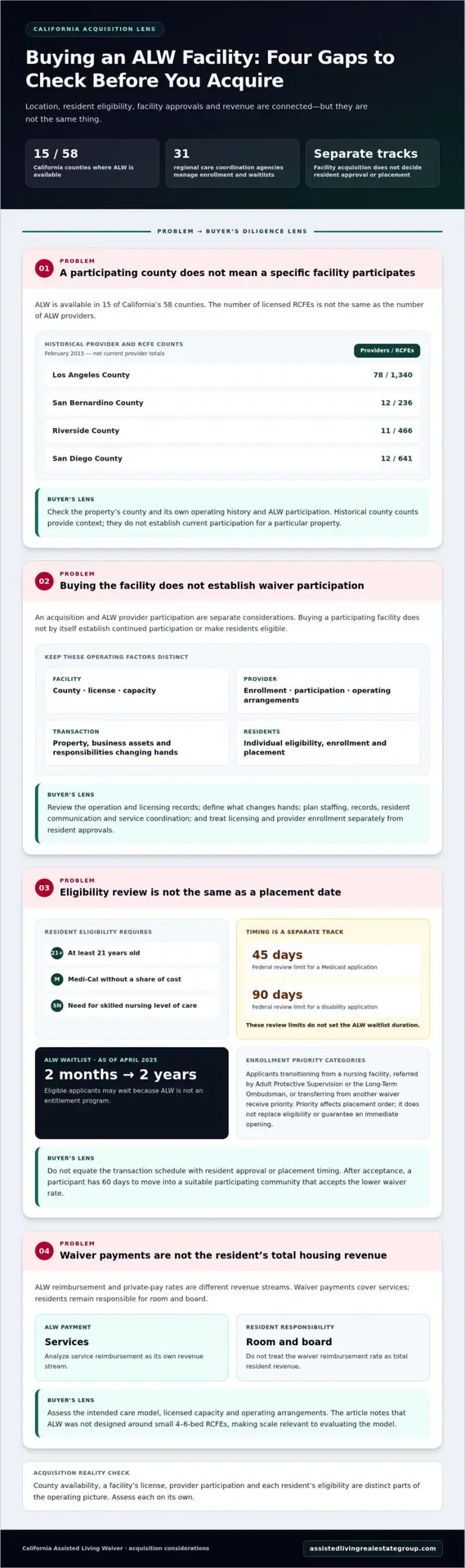
Only 15 of California’s 58 counties offer the Assisted Living Waiver, according to the California Department of Health Care Services. Buying an assisted living waiver facility in California therefore means understanding both the waiver’s service model and the state’s licensing requirements, not simply acquiring an assisted living property.
The waiver is a Medi-Cal program that covers certain home and community-based services for eligible residents in participating assisted living communities. For prospective owners, the distinction matters: a facility’s license and a resident’s waiver eligibility are separate parts of the operating picture. This guide explains what the Assisted Living Waiver covers, where it operates, how enrollment and provider approval work, and which California licensing and Title 22 requirements shape an acquisition. With those fundamentals in view, you can assess the opportunity with clearer expectations about the care model, compliance responsibilities, and business fit.
Key Takeaways
- The Assisted Living Waiver operates in 15 of California’s 58 counties, according to the California Department of Health Care Services, so location is central to evaluating a facility’s potential fit.
- Separate resident eligibility and facility participation from the acquisition itself; the waiver is not an entitlement program, and eligible residents may face a waitlist.
- California RCFE licensing and compliance fall under Title 22, according to the California Department of Social Services, Community Care Licensing Division. A facility’s licensing history matters when assessing an acquisition.
- Consider provider enrollment and ownership changes alongside licensing requirements, since buying a facility does not by itself establish waiver participation.
- Use the article’s approval and regulatory overview to frame due diligence around the facility’s location, operating status, compliance record, and intended care model.
California Assisted Living Waiver background and counties
The Assisted Living Waiver (ALW) is California’s 1915(c) Medicaid waiver for home and community-based services. The ALW may provide support through community-based care or home health services. For a buyer, the program’s local footprint matters: a facility’s license, its county, and ALW provider participation are separate factors in evaluating its operating potential.
The California Department of Health Care Services states that ALW is available in 15 of California’s 58 counties. That county limit makes location a central part of acquisition analysis. In a participating county, prospective owners still need to distinguish the number of licensed residential care facilities from the smaller set of ALW providers. County availability alone does not establish that a particular facility participates.
Historical counts illustrate how provider supply and RCFE supply differed across Southern California. The figures below are from February 2015, not current provider totals:
- Los Angeles County had 78 ALW providers among 1,340 RCFEs.
- San Bernardino County had 12 ALW providers among 236 RCFEs.
- Riverside County had 11 ALW providers among 466 RCFEs.
- San Diego County had 12 ALW providers among 641 RCFEs.
These figures show why county-level assessment needs more than a count of licensed facilities. For example, Los Angeles County’s historical ALW provider count was 78, while San Bernardino County’s was 12. Those records provide context, but they cannot establish present-day competition or participation for a specific property. A buyer should evaluate the facility’s own operating history and intended care model.
ALW reimbursement and private-pay rates represent different revenue streams. Waiver payments cover services, while residents remain responsible for room and board. Analyze these separately rather than treating the reimbursement rate as total resident revenue.
A buyer can purchase an existing facility that participates in ALW. The acquisition itself, however, does not establish continued provider participation or make residents eligible. The facility’s county, enrollment status, licensed capacity, and operating arrangements all matter. ALW was not designed around small 4-6-bed RCFEs, so scale is relevant to evaluating the model.
There is no single purchase price or valuation multiple for every California facility. Whether real estate is included, licensed capacity, operating performance, and property condition all affect value. The purchase price depends on the specific opportunity and is determined through an assessment.
Application and approval timelines
Buying a facility in California and applying for ALW participation are separate processes. Buyers assess the facility and its operating records, while residents pursue eligibility, enrollment, and placement through the waiver process. For anyone buying an assisted living waiver facility in California, this distinction matters: the transaction schedule does not determine when residents are approved or placed.
For residents, eligibility comes first. ALW applicants must be at least 21, qualify for Medi-Cal without a share of cost, and need a skilled nursing level of care. Meeting those criteria doesn’t guarantee immediate placement. California’s ALW isn’t an entitlement program, so eligible applicants may wait for an available opening.
Application review and waiver placement are separate timing questions. Federal law allows Medicaid offices up to 45 days to review an application, or up to 90 days for a disability application. Those review limits don’t set the ALW waitlist duration. As of April 2025, the waitlist period ranged from two months to two years, so placement may take longer than the initial eligibility decision.
California contracts with 31 regional care coordination agencies to manage ALW enrollment and waitlists. Applicants transitioning from a nursing facility, referred by Adult Protective Supervision or the Long-Term Ombudsman, or transferring from another waiver receive enrollment priority. Priority affects placement order; it doesn’t replace eligibility requirements or create an immediate opening. Buyers should account for this distinction when assessing the timing of resident transitions.
Once accepted, a participant has 60 days to move into a suitable participating community that accepts the lower waiver rate. The placement must match the person’s care needs and the community’s available services. Facility location, capacity, and willingness to accept the applicable rate all affect whether it can serve that participant.
For buyers, purchasing and transferring a facility follows a different sequence from resident enrollment:
- Review the operation: Assess the business, resident mix, licensing records, and any existing ALW participation.
- Define the transaction: Identify which property, business assets, and operating responsibilities will change hands.
- Plan continuity: Address staffing, records, resident communication, and service coordination during the transition.
- Separate approvals: Treat licensing and provider enrollment distinctly from each resident’s eligibility and placement.
Buying an assisted living waiver facility in California means planning around parallel timelines. A closing date does not approve new ALW participants or transfer their eligibility. Treat the transaction, licensing, enrollment, and placement as separate processes, then build a transition plan around the facility’s actual operating needs.
That distinction is especially important when buying an assisted living waiver facility in California with current participants. Individual approvals and suitable placements remain separate from the ownership change. The transition plan should preserve continuity of care while the new operator addresses facility-level requirements.
CDSS licensing and compliance history
Due diligence should examine the facility’s finances, staffing, property, and California licensing record. Confirm the RCFE license is current and in good standing, and establish that all citations have been resolved before completing the acquisition.
Begin with the license and compliance history. Match the licensed facility and operator to the business being sold. Review available inspection records, citations, complaint findings, and corrective actions. Consider both a citation’s status and its subject: recurring concerns about resident supervision, medication practices, or the building may require attention after closing. Keep unresolved items visible in the transaction review rather than treating the license as the only compliance signal.
Financial diligence should connect reported performance to day-to-day operations. Compare revenue records with resident agreements, occupancy information, and deposits. Where applicable, separate private-pay income from payments associated with ALW participants. Review payroll, food, utilities, maintenance, insurance, and room-and-board obligations. Identify unusual revenue changes or deferred expenses, then assess their potential effect on cash flow and planned operations.
- Compliance: Review the license, citations, inspection history, and documented corrective actions.
- Finances: Reconcile income and expenses against operating records and resident agreements.
- Staffing: Compare schedules, payroll, job roles, and coverage with the community’s care needs.
- Property: Inspect resident rooms, common areas, equipment, and building systems; identify repairs that could affect housing or operations.
Staffing records can show whether the care model matches the residents served. Compare schedules with payroll and assigned duties. Look for gaps between planned coverage and actual staffing, turnover patterns, and reliance on temporary coverage. Consider how to maintain continuity of care during an ownership change. These records help determine whether reported results reflect a stable team or a temporary staffing pattern.
Review the property for both condition and function. Walk through resident rooms, shared spaces, kitchens, and accessible routes. Compare what you observe with maintenance records and planned repairs. For an ALW-focused operation, assess whether the physical environment supports the services offered to participants. In financial analysis, keep room and board separate from care-service revenue.
Create a written diligence file linking each issue to its evidence, business impact, and proposed resolution. For example, pair a citation with its corrective-action record, or a major repair with relevant inspection and maintenance documents. This gives buyers a clearer view of the licensed operation they would assume and the resources needed to sustain safe, consistent residential care.
California Title 22 regulations
Title 22 shapes California RCFE licensing, operations, staffing, and resident protections. For an ALW-participating facility, assess those duties alongside waiver participation and the care model.
Provider Enrollment and Ownership Changes
ALW provider enrollment is separate from an RCFE license, so a sale alone doesn’t establish waiver participation for a new owner. California contracts with 31 regional care coordination agencies to manage enrollment and waitlists. A buyer should identify which entity holds the facility license, which participates in ALW, and how the ownership transition affects each operational role. Treat those as distinct diligence questions, not one approval.
Enrollment also affects resident access. Applicants transitioning from a nursing facility, referred by Adult Protective Supervision or the Long-Term Ombudsman, or transferring from another waiver receive enrollment priority. That priority applies to participants, not a buyer’s ownership application. Map the community’s current provider relationships and resident services before planning a transition, accounting for the separate enrollment and licensing processes.
Licensing Requirements
California RCFEs are licensed and regulated by the Department of Social Services Community Care Licensing Division (CCLD) under Title 22 regulations, according to the California Department of Social Services, Community Care Licensing Division. That framework governs the facility’s licensed operation; the ALW program concerns services and payment for eligible participants. One doesn’t replace the other.
Staffing rules vary with facility size. California assisted living facilities serving 16 residents or fewer must have staff available in the facility. Facilities serving 16-100 residents must have one staff member awake. Those serving 101-200 residents must have one awake staff member and another on call. Each additional 100 residents above the stated staffing tiers requires another awake staff member.
ALW residential care also involves participant protections beyond ordinary building operations. Participants are entitled to a legally enforceable lease and privacy, including a lockable room, choice of roommates, control over their schedule, and visitors at any time. The waiver requires private rooms, and in most cases its payment is insufficient to cover a private room at market rates. These requirements affect room planning and the resident experience.
Financial, Regulatory, and Operational Risks
Key risks include a mismatch between revenue and room costs, unresolved compliance issues, and staffing demands that exceed the operating plan. Assess whether the ALW service model can support the community’s housing arrangement and care services. Do not treat waiver payments as room-and-board revenue.
Staffing is both an operational and financial consideration: the applicable awake-staffing tier depends on resident capacity. Compare schedules and payroll with the facility’s licensed size, then assess whether coverage supports participants’ care needs. Review the license history and corrective-action records, since unresolved citations can require attention during the ownership transition.
For a senior care acquisition, connect each risk to its effect on daily care and financial performance. A private-room commitment affects room availability, while staffing requirements shape recurring operations. Title 22 compliance and ALW participation remain separate obligations, so evaluate both before finalizing the facility’s post-sale operating plan.
What are California ALW provider enrollment, ownership-change, and licensing requirements?
California buyers should consider three items separately: the RCFE license, the facility’s ALW provider enrollment, and the ownership transition. A purchase agreement transfers business or property interests; it does not by itself establish that a new operator can continue serving ALW participants under the same arrangements.
Start by identifying who holds each role: the licensed operator, the business entity involved in ALW participation, and the property owner. Compare those names with the transaction structure. A real estate sale, an operating-business sale, and a change in the licensed operator can affect different parts of the operation. Address each one distinctly in the agreement and transition plan.
California contracts with 31 regional care coordination agencies to manage ALW enrollment and waitlists. That coordination structure makes existing program relationships an important part of acquisition diligence. Document which agency relationships support the facility’s current participant services, what services the community provides, and which records explain those arrangements. Keep resident-level eligibility separate from the facility’s provider status.
Licensing is another track. California RCFEs are licensed and regulated under Title 22 by the Department of Social Services Community Care Licensing Division. Before closing, compare the facility’s license information and compliance records with the proposed ownership and operating structure. A license record, ALW participation, and the sale documents answer different questions; aligning them helps expose transition gaps early.
A practical acquisition review can proceed in this order:
- Identify the transaction: Clarify whether the deal involves property, the operating business, or both.
- Map approvals and roles: List the current license holder, operator, ALW provider entity, and incoming parties.
- Review program operations: Examine participant services, relevant agency relationships, and operating records.
- Plan continuity: Document who will manage care, staffing, records, and resident communications during the transition.
- Resolve open items: Address licensing, compliance, and provider-enrollment questions before relying on continued ALW operations.
These steps provide a diligence framework, not a determination of the regulatory actions triggered by a specific transaction. Ownership structure, the identity of the licensee, and changes to the operating entity all matter. Keep the transaction timeline separate from resident enrollment or placement decisions. Closing the sale does not make an individual eligible for waiver services.
For buyers assessing a California RCFE purchase, explore RCFE acquisition opportunities as part of the broader review of the facility, its business, and its intended operating model.
Assisted Living Real Estate Group: RCFE Sales (Residential Care Facilities for the Elderly)
Assisted Living Real Estate Group helps California buyers explore RCFE Sales and Turnkey Business Acquisitions when evaluating a senior care facility and its operating business together. After assessing county availability, licensing, compliance history, and the distinction between an RCFE license and ALW provider participation, buyers can discuss their acquisition goals with a specialized brokerage focused on care facilities.
Buyers can compare a facility’s operations with their intended care model and investment objectives. Sellers planning a transition can use Confidential Marketing Strategy to support a discreet sale process. Assisted Living Real Estate Group also offers ARF Sales for buyers and sellers focused on Adult Residential Facilities.
To discuss a California care-facility acquisition or sale, visit assistedlivingrealestategroup.com.
Build the Right Next Step for Your California Acquisition
Buying an assisted living waiver facility in California involves more than choosing a property. Align your acquisition goals with the facility’s operating model and the kind of community you intend to sustain. This clarity can focus your diligence and help you pursue a business that fits your investment objectives and commitment to care.
Assisted Living Real Estate Group offers RCFE Sales, ARF Sales, and Turnkey Business Acquisitions for California care-facility buyers. If you’re ready to discuss a potential acquisition, contact Assisted Living Real Estate Group to explore a path forward.
Make your next move with purpose: a well-matched care business can bring sound planning and meaningful service together.
Frequently Asked Questions
What is the Assisted Living Waiver?
California’s Assisted Living Waiver (ALW) is a Medi-Cal program that funds certain home and community-based services for eligible residents in participating communities. It serves people aged 21 or older who qualify for Medi-Cal without a share of cost and need a skilled nursing level of care. The waiver can offer an alternative to nursing facility care, but it doesn’t make every licensed residential care home an ALW provider.
What services are covered by the Medi-Cal ALW?
Medi-Cal ALW can cover assistance with activities of daily living, meals, medication administration, housekeeping, social activities, and skilled nursing care as needed. Support is based on a participant’s assessed care needs and the services provided through the participating community or a licensed home health agency. Room and board is separate from waiver-covered care services, so residents must be able to pay their housing costs.
What is an assisted living waiver facility in California, and what services can it provide?
An assisted living waiver facility is a licensed California residential care setting that participates in the ALW and serves eligible residents. It may provide personal assistance, meals, medication support, housekeeping, and social activities, with skilled nursing care as needed. For example, a resident may receive help with daily routines while living in a community setting. A facility’s license alone does not mean it participates in the waiver.
How do California Community Care Licensing rules apply when buying a residential care facility for the elderly (RCFE)?
California RCFEs operate under Title 22 and oversight by the Department of Social Services Community Care Licensing Division. For a purchase, distinguish the facility’s license from the real estate and business interests changing hands. Review the license status, inspection and citation records, and how the proposed ownership structure relates to the licensed operation. Staffing obligations also depend on facility capacity, so the operating plan should match the applicable requirements.
Which California counties offer the Assisted Living Waiver, and how does county availability affect a purchase?
The California Department of Health Care Services says the ALW is available in 15 of the state’s 58 counties. County availability can influence whether a facility can serve local ALW participants, but it doesn’t establish provider participation or resident eligibility. For a purchase, assess the facility’s exact location and existing program operations separately. A licensed RCFE in a county outside the waiver’s service area shouldn’t be valued on assumed local ALW demand.
What does it cost to buy an assisted living facility in California, and what are typical valuation multiples?
There is no single purchase price or valuation multiple when buying an assisted living waiver facility in California. Costs vary widely based on facility size, geographic location, real estate ownership versus lease agreements, current occupancy rates, and overall financial performance. Generally, operating facilities are valued using multiples of EBITDA (Earnings Before Interest, Taxes, Depreciation, and Amortization) or as a price per bed. Buyers working with Assisted Living Real Estate Group typically find that facilities with strong Medi-Cal ALW integration, stable staffing, and clean regulatory histories command competitive pricing within the market.