
A care home can be ready for sale on paper before its owner is ready to let go. The emotional side of selling a care home in California is easier to manage when you make room for both the personal meaning of the business and the practical demands of a transition. Feeling anxious or attached doesn’t mean you’re making the wrong decision.
You may carry memories of the home’s beginnings, the people it has served, and the work it took to build. At the same time, uncertainty about timing, what comes next, and which connections may change can make the decision feel heavier. These feelings deserve attention alongside the business considerations.
This article explores ways to prepare emotionally, reduce uncertainty by understanding the stages of a sale, and preserve the home’s history without letting it dictate every decision. It also considers how a faster sale may affect the transition, why social connections matter, and how a thoughtful plan can help you move forward with greater clarity.
Key Takeaways
- Break the sale into clear stages so each decision feels more manageable and less overwhelming.
- Capture meaningful memories and details before sorting belongings, helping preserve a home’s story while preparing it for sale.
- Weigh the emotional strain of a faster transition against the time needed to make thoughtful decisions about possessions and next steps.
- Make space for conversations about familiar routines, neighbors, and friendships when planning a move from a longtime California home.
- A confidential, specialized RCFE sale can help connect the business transition with the home’s purpose and legacy.
Faster sale options and emotional load
In California, a faster care home sale may reduce uncertainty, but it can compress important decisions. First, distinguish the sale of a care home business from the sale of a family residence. Their timelines and emotional demands differ, so treating them as one transaction can make planning less clear.
Emotional adjustment after a sale
Emotional adjustment is adapting to changed responsibilities, routines, and identity after selling a business. For care home owners, daily work can be closely tied to years of commitment and memories. There’s no single timetable for adjusting after a business sale. For comparison, sadness for home sellers often settles within 2 to 6 weeks of moving into a new home. That estimate concerns home sellers, not care home business owners.
A traditional California home sale typically takes 2 to 4 months from listing to closing. Preparing a home for a traditional sale often adds 2 to 8 weeks before listing, while the period from accepted offer to closing is typically 30 to 45 days. These figures describe a traditional home sale, not the sale of a care home business. They can help families understand why preparation and closing may require separate planning.
Balancing attachment and financial decisions
Balancing attachment and finances means recognizing a care home’s personal meaning while assessing the transaction through clear business priorities. This matters because memories of residents, staff, and years of work can pull against practical decisions about timing and terms. Write down the financial questions that need answers, then note what you most want preserved about the home’s legacy. Keeping these considerations distinct helps you weigh both thoughtfully.
A rushed transition can strain adult children, particularly when they’re managing family responsibilities alongside a sale. Agree early on who will handle specific tasks, who will take part in decisions, and how updates will be shared. Allow time to sort possessions, since rushing can lead to regret. For example, decide together which items to keep before clearing rooms or preparing a California residence for sale.
Speed may shorten the period of uncertainty, but it doesn’t remove the need for considered choices. Set aside time to review documents, discuss priorities, and understand each proposal before deciding. If relatives are involved, agree on how offers will be discussed and decisions communicated. A defined process can help family members avoid feeling excluded or pressured during a consequential change.
If emotional strain includes substance-use concerns, the Substance Abuse and Mental Health Services Administration (SAMHSA) lists the National Helpline number as 1-800-662-4357. For the sale, identify the next decision and the person responsible for it. A written timeline, named decision-makers, and protected time for personal goodbyes can help make even a faster transition more deliberate.
Preparing emotionally before listing
For many California owners, a care home represents independence, achievement, and years of personal commitment. Preparing emotionally before listing means acknowledging that attachment while creating enough structure to make clear decisions. A plan can give the transition shape without asking you to dismiss the memories behind the business.
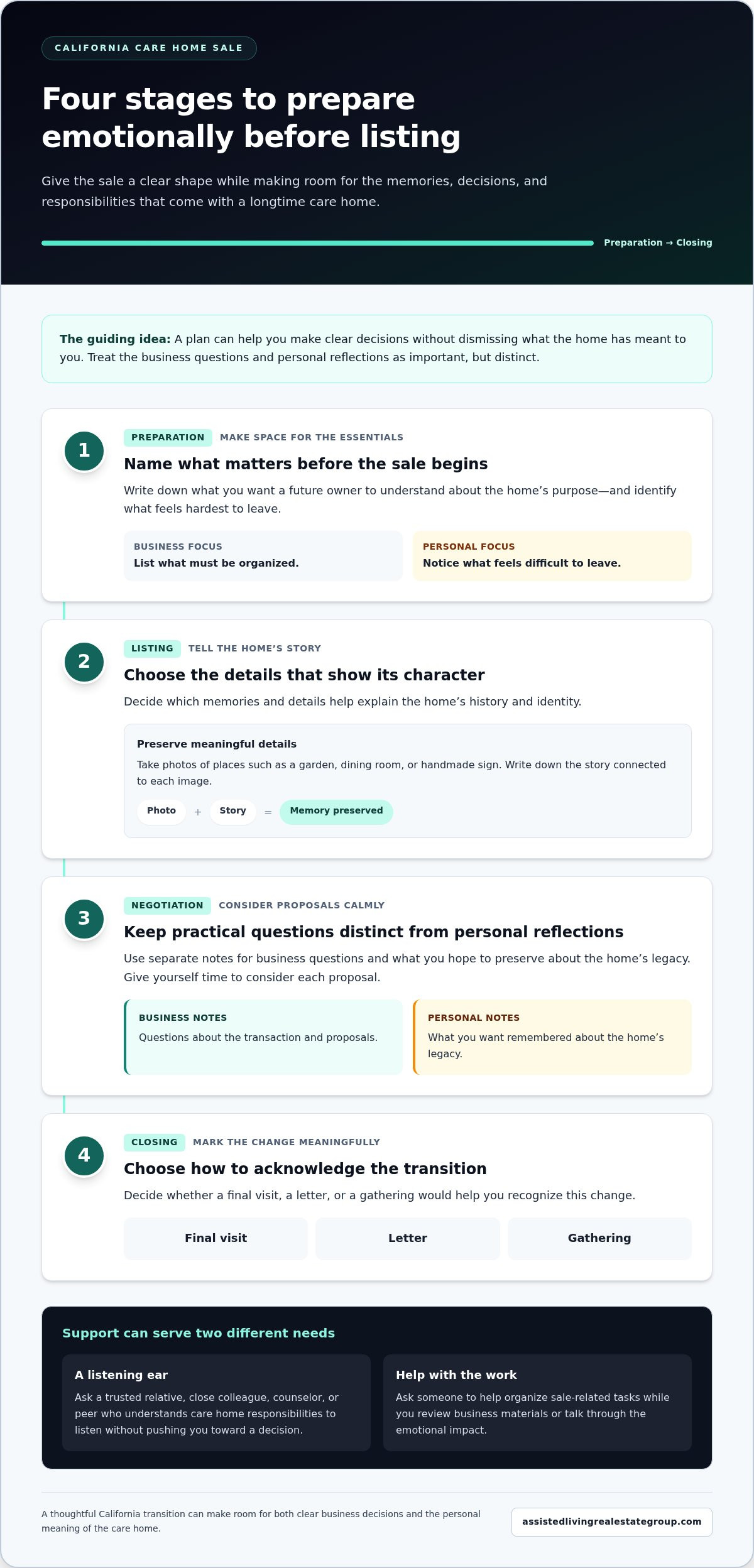
Break the sale into preparation, listing, negotiation, and closing, with distinct decisions at each stage. During preparation, identify what must be organized and what feels hardest to leave. At listing, decide how you want to describe the home’s history. During negotiation, take time to consider proposals calmly. At closing, plan a meaningful way to mark the change.
- Preparation: Write down what you want a future owner to understand about the home’s purpose.
- Listing: Choose the details and memories that help explain its character.
- Negotiation: Keep business questions separate from personal reflections in your notes.
- Closing: Decide whether a final visit, letter, or gathering would help you acknowledge the transition.
Sorting through a lifetime of belongings can bring grief and a sense of loss. Before listing, take photos of meaningful details, such as a garden, dining room, or handmade sign, and write down the story connected to each image. If an item carries a memory but has no practical place in your next chapter, recording its story can preserve its meaning without requiring you to keep everything.
Support can come from trusted relatives, close colleagues, a counselor, or a peer who understands the responsibility of operating a care home. Ask one person to listen without pushing you toward a decision, and another to help organize sale-related tasks. For example, a family member might record stories while you review business materials. This division lets you talk through the emotional impact while keeping important work moving.
Discuss the sale with people who understand what the home has meant to you, while clarifying which decisions remain yours. A former colleague may help you remember the progress behind the business; a trusted adviser can help keep financial questions in view. Set a regular time to review both, rather than making every conversation about the sale.
For a California transition, specialized care home sale planning can help you understand the business-sale process while you prepare personally. Start by writing down the questions you want answered before listing, then bring that list into your planning conversations.
A home’s history and marketing value
A California care home’s history can help prospective buyers understand its identity and development. Present that story as context, not as proof of value. For example, if an owner adapted a shared room for group activities, explain what changed and how the space is used today. A specific, verifiable account is more useful than a sweeping claim about the property’s past.
Keep the facility’s operating history separate from the building’s physical history. A seller might describe how a California care home’s common areas have supported resident activities, then document renovations or other property changes separately. This helps buyers understand both the business’s character and the real estate without confusing personal meaning with evidence about the building.
Choose details that help a buyer picture the facility’s current use. If a California home has a garden, for instance, describe its actual role, such as providing space for outdoor activities. Avoid implying that a garden, a particular room, or an older feature automatically makes the facility more suitable. Explain what exists and how it fits into the home’s current operation.
Historical details should be accurate and relevant. Before including a statement in California marketing materials, identify whether it describes the building, the business, or an owner’s personal memory. A documented renovation belongs in the property description; an owner’s attachment may be better suited to a personal account. This distinction keeps the presentation credible and helps buyers focus on information relevant to their decisions.
- Describe the facility’s current spaces and their actual uses.
- Keep building history separate from business milestones.
- Use specific, verifiable details rather than broad claims.
- Leave private resident stories out of marketing materials.
A carefully framed history can give a California listing a clear identity without overstating what the past means for a future owner. For example, explain how a documented change shaped the facility’s layout, then describe the layout as it stands today. The goal is to show how the business and property have evolved while giving buyers a grounded picture of what they are considering. Personal memories can remain meaningful even when they don’t belong in promotional material.
Specific memories can add texture when they are presented as personal history rather than evidence of suitability or value. The home described in the article was built in 1926, and one family raised five children there during the Depression. A teacher lived in the home for 40 years and planted every rose in the garden. Those details may explain the garden’s story, but they do not establish what a future buyer will experience.
Other details can be framed just as carefully: the homeowner spent two years restoring the kitchen, while original tile in a vintage home’s bathroom was laid by hand nearly a century ago. A commenter said their parents had lived in their home since 1959. Such accounts can offer a sense of continuity, provided the presentation distinguishes remembered experience from documented features and the home’s current use.
Anxiety during the selling process
Selling a California care home can make ordinary business questions feel personal. Anxiety may arise when buyer inquiries raise concerns about confidentiality, staff reactions, or the facility’s future. Identify the precise trigger before responding. For example, if an inquiry worries you because it could start rumors, decide who should handle the conversation and what information is appropriate to share.
Uncertainty can also grow when several sale-related conversations happen at once. Sort incoming questions into categories, such as property, operations, and transition planning. If a prospective buyer asks how a room is used, answer with relevant facility information rather than interpreting the question as criticism of your work. A clear, subject-by-subject response keeps discussions focused.
Prepare for emotionally charged moments by deciding how you’ll pause a conversation. You might say, “I’d like to review that detail before responding,” then follow up with the information. This is useful when a comment about maintenance or operations feels like a judgment on years of effort. In California, keeping the discussion focused on the facility and its records can help protect your perspective and professionalism.
- For buyer questions: Answer the specific issue raised, not an assumed criticism.
- For staff concerns: Share only appropriate updates through the agreed communication channel.
- For difficult feedback: Note the concern, identify the relevant records, and respond once you’re ready.
- For tense meetings: Take a brief pause before deciding what to say next.
Visits can feel especially exposing when the facility is also your workplace. Before a scheduled visit, identify which areas are relevant, who will accompany the visitor, and how the visit will fit around normal operations. For instance, agree on a route that avoids interrupting a resident activity. This turns an unpredictable event into a defined business interaction.
Protect your attention between discussions. Choose a specific time to review sale messages, and silence notifications outside that window if they interrupt other responsibilities. If a message feels upsetting, draft a response without sending it, then revisit the wording later. A calm, factual reply is more likely to address the issue than one written while emotions are high.
If anxiety is affecting your ability to manage daily responsibilities, talk with someone you trust or seek support from a qualified mental health professional in California. For business concerns, write down the specific question and the information needed to resolve it. Separating emotional support from transaction decisions helps you address both directly, without expecting one conversation to solve everything.
Concerns about losing social connections
Leaving a California care home can change daily relationships for owners, relatives, staff, residents, and families. A thoughtful communication plan helps preserve connections through the transition.
Effects on family members and staff
Selling a family-owned care home can change family roles and workplace relationships at the same time. Relatives may have built their identity around the home, while staff may feel uncertain about familiar routines. For example, a family member who handled weekend calls may need to discuss how responsibilities will shift. Give staff clear updates about what is known and identify a consistent person to answer questions.
Communicating the sale to residents
Communicating a sale means sharing clear, respectful information with residents and their families while protecting privacy. Unanswered questions can intensify fears about losing familiar people or routines. Coordinate the timing and wording of updates with those responsible for resident communication. Use plain language, explain what will happen next, and make time for individual conversations. Avoid promising specific outcomes before they’re settled.
Leaving a caregiving profession
Leaving caregiving after a sale can mean grieving daily purpose, close relationships, and a role built around helping others. An owner’s work may have shaped everyday routines, from morning check-ins to addressing a resident’s concerns. Identify which parts of caregiving you’ll miss most. A former owner who values mentoring staff, for instance, could explore ways to share experience without remaining responsible for daily operations.
Building purpose and routine after selling
Building purpose after selling means creating new commitments that offer structure and meaningful connection. It matters because open time can feel unfamiliar after years of making decisions for a care home. Choose a dependable weekly activity, such as meeting a former colleague for coffee or joining a local community group. Keep a simple calendar and review it each week. A planned routine gives the next chapter its own shape.
Before the transition, write down the relationships you want to maintain and how you’ll do so. For example, ask a trusted colleague whether they’d like occasional check-ins and agree on a suitable channel. Let residents and families know how to raise questions through the appropriate facility contacts. These steps acknowledge feelings without blurring new responsibilities.
If you’re preparing to sell a California care home, explore a confidential marketing strategy that can help protect the business’s privacy during the sale process.
Assisted Living Real Estate Group: RCFE Sales (Residential Care Facilities for the Elderly)
Assisted Living Real Estate Group supports California owners planning to sell an RCFE or ARF as they prepare for a business transition. Its specialized sales focus helps owners consider the facility’s operational context alongside the real estate and plan for a change in ownership.
For owners concerned about discretion, Assisted Living Real Estate Group’s Confidential Marketing Strategy helps protect the facility’s reputation and operations while connecting with qualified buyers. Turnkey Business Acquisitions offer buyers a path to an established care business. These options can clarify next steps while respecting the work and relationships behind the facility.
If you’re considering selling a California care home, contact Assisted Living Real Estate Group to discuss the next step for your facility.
Shape the Next Chapter With Intention
The decision to sell can mark a change in your role, not an end to the value of your work. The emotional side of selling a care home deserves space in your planning, alongside the practical choices that will shape what comes next. Give yourself permission to define success in personal terms: a thoughtful handover, a future for the facility, or time to pursue a different purpose.
For owners weighing their next move in California, Assisted Living Real Estate Group works with RCFE Sales (Residential Care Facilities for the Elderly), ARF Sales (Adult Residential Facilities), and Turnkey Business Acquisitions. A focused conversation can help you consider which direction fits your facility and priorities, while keeping sight of the legacy you’ve built.
When you’re ready to discuss a possible transition, contact Assisted Living Real Estate Group. A clear next step can turn a difficult decision into a more deliberate beginning.
Frequently Asked Questions
What emotions do care home owners commonly experience when selling their business?
Owners can feel grief, anxiety, pride, relief, and uncertainty, sometimes all at once. The emotional side of selling a care home may become especially noticeable when a routine or responsibility that shaped everyday life is about to change. For example, an owner may feel proud of what the facility has become while worrying about how others will carry its values forward. Conflicting feelings are part of a significant personal and business transition.
How can a care home owner prepare emotionally to sell?
Prepare by identifying what the sale represents beyond the transaction: a career, family commitment, or community role. Write a short statement about what you hope to carry into your next chapter, such as mentoring others or spending more time with family. Share it with someone you trust before major decisions. That perspective can help you distinguish the parts of your identity you’re leaving behind from the values you can continue to live out.
How can sellers manage stress and grief during a care home sale?
Give stress and grief a regular, defined place rather than expecting them to disappear during business discussions. For example, schedule a weekly conversation with someone you trust that isn’t focused on transaction tasks. If a particular meeting feels emotionally charged, invite a supportive colleague to join and help you stay grounded in your priorities. If distress persists or disrupts daily life, consider speaking with a qualified mental health professional in California.
How long does it typically take to adjust emotionally after selling a business?
There’s no single timetable for adjusting after selling a care home business. For comparison, sadness for home sellers often settles within 2 to 6 weeks of moving, but that estimate is not for business owners.