
Closing isn’t the moment to let insurance lapse. To understand how to ensure a smooth RCFE transaction in California, review the facility’s inspection reports, complaints, and deficiencies; don’t transfer operations until the buyer has their own license and insurance; and keep the seller’s coverage in place until the transaction fully closes. These steps help protect continuity as responsibility moves from seller to buyer.
It’s easy to focus on the purchase agreement and closing date, but a sound handoff also depends on clear records, verified licensing, and active insurance through the transition. Review inspection records, align licensing and insurance with the operating handoff, and maintain the seller’s coverage through closing. Addressing these details in sequence helps buyers and sellers understand their responsibilities before operations change hands.
Key Takeaways
- Turn inspection reports, complaints, and deficiencies into focused due-diligence questions and clear transaction terms.
- Keep the licensing and insurance milestones separate from the purchase agreement’s closing date, especially in a lease-to-buy arrangement.
- Coordinate the buyer’s coverage start with the operational handoff, while keeping the seller’s insurance active through closing.
- Organize the California sale or purchase as a sequence of due diligence, agreement, licensing, insurance, and transition decisions.
- Assess how resident occupancy, included assets, and turnkey readiness can influence an RCFE’s value and deal structure.
1. Inspection reports, complaints, and deficiencies
Start California RCFE due diligence with the facility’s inspection reports, complaint records, and deficiency findings. Read them alongside the seller’s responses and evidence of corrective action. A resolved deficiency and a recurring issue have different operational implications, so note dates, repeated themes, and documented follow-up. Compare the records with current practices described during the transaction. Discuss any gap between written procedures and actual operations before finalizing purchase terms.
California RCFEs provide care for people over 60 who need assistance but not 24-hour care. They are non-medical facilities and aren’t required to have medical staff on site. That distinction makes operational records especially important: review how the facility documents resident support, staff communication, and responses to changes in condition. California RCFE staff must communicate a resident’s change of condition to the resident’s physician and responsible party, if any. Look for records that show how the facility handles those communications, without treating an RCFE as a medical provider.
What permits, zoning approvals, and fire clearances are needed for an RCFE transaction? Review the facility’s existing RCFE license, applicable local zoning approvals, permits, and fire-clearance records. Compare them with the property’s current use and the buyer’s intended operation. If renovations or operating changes are planned, identify the approvals relevant to those changes before closing.
What due diligence should buyers conduct before purchasing an RCFE? Review inspection reports, complaints, deficiencies, corrective-action records, licensing materials, resident documentation, and operating procedures. Organize findings by issue, supporting evidence, and outstanding action so purchase discussions address the facility’s documented conditions.
How are resident agreements, deposits, and care plans handled during an RCFE sale? Inventory resident agreements, deposit balances, and current care plans, then document how each record and responsibility will be handled at transition. Reconcile deposit records with the facility’s ledger and establish a controlled handoff for resident-specific information.
Incident reporting also belongs in the compliance review. California RCFE administrators must report an unusual resident incident to their Licensing Program Analyst by telephone within 1 business day and submit a written report within 7 days. Compare incident records with complaint files and corrective actions to identify unresolved operational patterns. For example, repeated documentation gaps may signal a process issue even when individual events differ. A clear record review helps buyers distinguish isolated findings from concerns that could affect transition planning, resident continuity, and the transaction’s risk allocation.
2. Seller licensing and insurance before transferring operations
Tie the operating handoff to the buyer’s own licensing and insurance milestones. In California, an RCFE buyer needs their own license before operations transfer; the seller’s license and policy don’t automatically protect the incoming operator. Put required milestones and the party responsible for meeting them into the transaction schedule. A signed purchase agreement alone doesn’t establish that the buyer is authorized or insured to operate.
How do California DSS license transfers and change-of-ownership approvals work for RCFEs? Treat a change of ownership as a licensing transition, not a simple handover of the seller’s license. The buyer must obtain their own license before taking over operations. Align the expected ownership date with that licensing milestone, and don’t schedule the operational transfer before it.
Set a separate effective date for insurance. A seller’s RCFE policy may cover only the policyholder, other RCFE owners, and employees, excluding the buyer as a third party. The buyer’s policy can be scheduled to begin when the seller’s loan funds or when the buyer accepts their first resident. Match the chosen trigger to the actual handoff so coverage is ready when the buyer assumes risk.
How should buyers and sellers structure RCFE financing, escrow, and purchase agreements? Coordinate the funding trigger, escrow release, licensing milestone, insurance start, and operations handoff in one written timeline. Specify who handles each step and what event permits the next. For a lease-to-buy arrangement, include a firm date for the buyer’s licensing, insurance, and assumption of full ownership.
A lease-to-buy timeline needs more than a target closing date. State the date by which the buyer must have licensing and insurance and assume full ownership. Connect that deadline to the agreement’s funding and possession terms. If the schedule changes, update the milestones together rather than allowing occupancy, control, or responsibility to shift informally.
How should buyers and sellers identify risks that could derail an RCFE transaction? Compare financing readiness, licensing milestones, insurance exclusions, staffing continuity, and outstanding compliance actions with the proposed handoff date. For example, a funding delay can leave the buyer’s policy inactive if coverage starts only when the seller’s loan funds. A missed licensing deadline can also prevent a planned operating transition.
Incident reporting remains an operational responsibility during transition. California RCFE administrators must report an unusual resident incident to their Licensing Program Analyst by telephone within 1 business day and submit a written report within 7 days. Identify who holds the administrator role at each stage, and assign responsibility for timely reporting in the transition plan.
For a lease-to-buy structure, lease-to-own care home opportunities can be relevant when the buyer needs an ownership transition organized around licensing and insurance milestones.
3. Maintaining seller insurance through transaction closing
A California RCFE seller should keep insurance active until the transaction fully closes. Signing documents, transferring funds, and handing over operations may happen at different times, so treat each as a separate closing milestone. Don’t cancel the seller’s policy just because the buyer expects to take control soon. Delayed funding or an unfinished closing item can create a gap between expectation and completion.
Review the seller’s policy to understand who and what it covers. An RCFE seller’s policy may cover the policyholder, other RCFE owners, and employees, while excluding the buyer as a third party. Continued coverage for the seller doesn’t automatically make the buyer an insured party. Compare the policy’s named insureds and covered facility with the transaction documents and planned handoff.
Build an insurance checkpoint into the closing timeline. Record the expected closing date, the scheduled date for operations to change hands, and who is responsible for confirming that the seller’s policy remains active. If escrow or funding moves, update the insurance checkpoint too. A revised closing date should prompt a review of the coverage timeline, not an assumption that the original plan still applies.
Use policy documents, not verbal assumptions, to track the seller’s coverage. Keep the declarations and relevant correspondence with the transaction file, and record any policy changes made before closing. For example, if the seller changes ownership details or facility operations during the pending sale, document the change and its timing. Clear records help both sides understand what coverage was in place at each stage.
The buyer’s coverage must also align with the seller’s policy and the operational transition. The buyer’s policy can be scheduled to take effect when the seller’s loan funds or when the buyer accepts their first resident. Identify the applicable trigger in the transaction timeline. Coordinate the seller’s policy end date with the actual closing so a funding delay or resident handoff doesn’t create an unintended coverage gap.
Make responsibilities explicit during the final handoff. The seller should maintain their policy through closing, while the buyer tracks the start of their own coverage. Document who will communicate schedule changes and who will retain updated policy records. If closing is delayed, for example, both parties can refer to revised milestone dates instead of relying on an outdated calendar.
After closing, retain the seller’s final policy records with the completed transaction documents. Note the actual closing date and when the buyer’s coverage became effective. This creates a clear timeline if questions later arise about the transition. In California RCFE transactions, maintaining the seller’s insurance through full closing is a practical safeguard, not a substitute for confirming the buyer’s separate licensing and coverage arrangements.
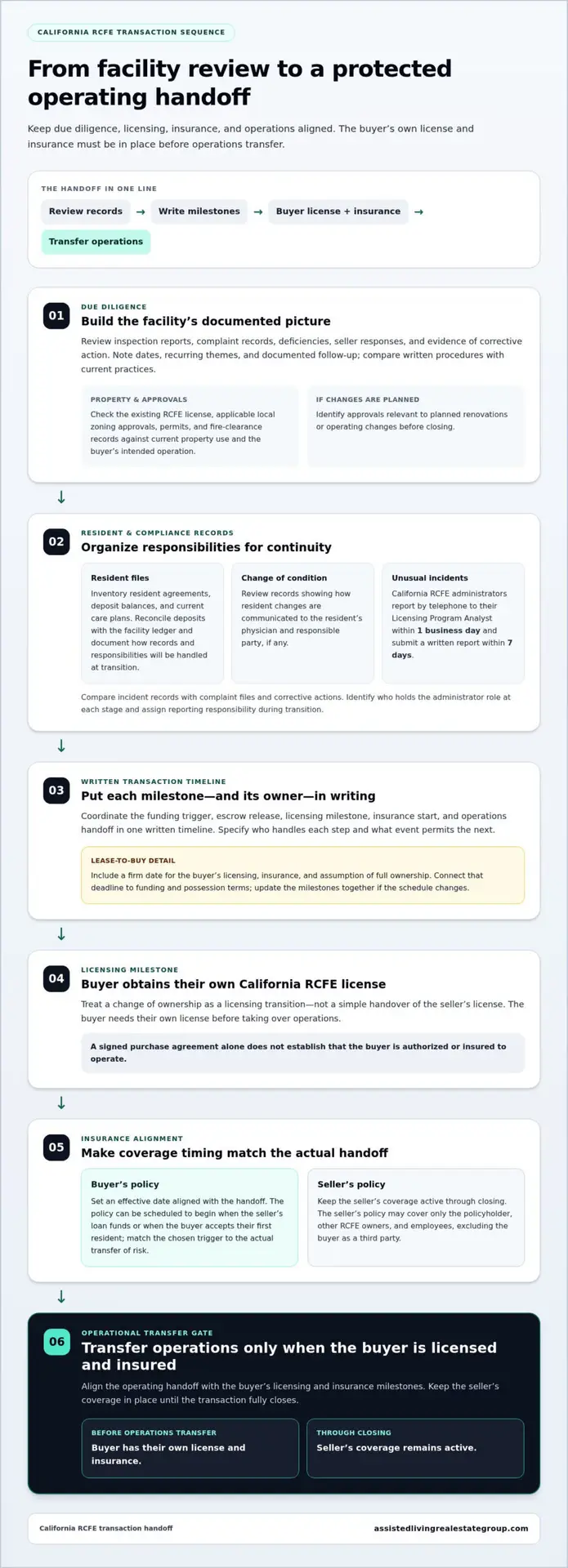
4. What are the steps to buy or sell an RCFE in California?
Use a written transaction sequence and assign an owner to each decision. Before negotiating final terms, the parties can clarify which facility, assets, records, and transition responsibilities are included. A practical way to ensure a smooth RCFE transaction is to define these components before setting the handoff schedule.
- Define the transaction. Identify whether the proposed sale includes the real estate, the operating business, or both. List furniture, equipment, records, and other assets included in the deal. For example, distinguish items that convey at closing from equipment the seller will remove. This shared definition helps buyers compare the proposal with their intended operation.
- Prepare or review the business picture. Sellers can organize occupancy information, operating expenses, staffing details, resident agreements, and facility records. Buyers can compare those materials against their intended operating model and note unanswered questions. Keep assumptions visible: if projected occupancy depends on future admissions, label it as a projection rather than presenting it as current performance.
- Set preliminary terms. Record the proposed assets, responsibilities, timing, and conditions in a written term sheet or purchase agreement. Define how the parties will handle deposits, resident agreements, equipment, and records at transition. Tie each commitment to a practical milestone, such as document delivery, funding, or possession, rather than relying on a general handoff date.
- Complete transaction due diligence. Review facility, business, staffing, financial, and operational records against the terms under discussion. Maintain a written issue log that identifies the document reviewed, the question raised, and the agreed response. If a finding changes the transaction’s scope, revise the relevant terms before signing final closing documents.
- Coordinate approvals and readiness. Build the buyer’s licensing, insurance, funding, staffing, and operational preparation into one timeline. Assign responsibility for each task and track dependencies. For example, a planned operations handoff should follow the buyer’s licensing and insurance readiness, not merely the date the parties expect to sign.
- Close and transfer control deliberately. Confirm the agreed closing conditions, funding, possession, asset inventory, and records handoff. Record the actual closing date and the person responsible for each transition task. Keep resident-related information controlled and transfer it only through the process agreed by the parties, preserving continuity in facility operations.
For a California RCFE seller, a prepared transaction file makes the business easier to understand. For a buyer, a sequenced review turns diligence findings into decisions before closing. Keep the agreement, milestone calendar, and asset inventory aligned as details change. Changes to funding or possession should prompt a review of related transition dates, responsibilities, and coverage. This sequence helps ensure a smooth RCFE transaction while keeping each party’s responsibilities clear.
5. What is an RCFE worth, and how are purchase prices calculated?
There’s no standard figure for a California RCFE. Value depends on the assets included, the facility’s operating performance, and its physical condition. Buyers and sellers should distinguish the real estate, business operations, furnishings, and equipment before discussing an overall purchase price. This breakdown clarifies what each party is valuing.
Start with operating information. Review current occupancy, resident agreements, income, expenses, staffing, and documented operating costs. Compare the seller’s records with the buyer’s assumptions. For example, a buyer projecting higher occupancy should distinguish that future possibility from the facility’s current resident count. This helps prevent projections from being mistaken for established performance.
Next, assess the property and the assets included in the transaction. List furniture, equipment, and other items, record their condition, and note whether they convey with the business. For example, furniture could be valued separately from the operating business rather than grouped into one undifferentiated figure. A detailed inventory also helps prevent later disagreements about what the purchase includes.
Compliance and readiness can affect a buyer’s assessment. Review inspection records, unresolved deficiencies, licensing status, fire-clearance records, and required operational improvements. A facility needing corrective work may require a different transition plan from one with documented readiness. Connect each identified issue to its likely effect on timing, responsibilities, and terms under negotiation.
For a turnkey RCFE, a buyer may also consider how prepared the facility is for continued operation. One seller reported receiving more than market price after preparing a facility as a turnkey, Fire Marshal-approved RCFE. This illustrates how readiness may influence an individual negotiation; it isn’t a standard valuation formula or a promise of a particular outcome.
An RCFE’s purchase price depends on the specific transaction and is provided after a quote request. Factors include occupancy, operating records, property condition, included assets, compliance needs, and transaction structure. Use them to build a documented rationale, not an unsupported per-resident shortcut. If buyer and seller value an asset differently, identify the item and its condition separately.
Before finalizing terms, prepare a shared schedule of proposed business and property components, included assets, supporting records, and open issues. Tie each proposed value to evidence. For example, list furniture separately from resident-related operating assumptions. This makes negotiations more transparent and helps both parties distinguish current assets from projected performance, supported by guidance from Assisted Living Real Estate Group.
Assisted Living Real Estate Group: RCFE Sales (Residential Care Facilities for the Elderly)
Assisted Living Real Estate Group supports California buyers and sellers with RCFE sales, connecting transaction goals to the realities of operating a residential care facility. Sellers preparing to bring a facility to market can use confidential marketing to protect business information while reaching qualified buyers. Buyers evaluating an acquisition can explore turnkey business acquisitions when operational readiness is central to their plans.
Bring your priorities to the discussion: whether you’re selling, evaluating an RCFE purchase, or considering a turnkey opportunity. Clear priorities focus the next steps on both the facility and the business, rather than treating the sale as a property-only transaction.
To discuss a California RCFE sale or acquisition, contact Assisted Living Real Estate Group.
Turn a California Care Facility Opportunity Into a Clear Next Step
Decisions around an RCFE sale affect more than the closing date. They shape how ownership, business operations, and continuity of care align during a pivotal transition. If you’re considering how to ensure a smooth RCFE transaction, start by defining your desired outcome and the structure that best supports it.
Assisted Living Real Estate Group works with California buyers and sellers on RCFE and ARF sales and supports buyers pursuing turnkey business acquisitions. Whether you’re preparing to sell, assessing an acquisition, or considering a facility purchase with an operating business, a focused conversation can clarify the opportunity and the transaction path ahead.
Bring your priorities and questions to the discussion, then decide how you want to move forward. Contact Assisted Living Real Estate Group to explore a California care-facility transaction. A thoughtful next step can help position your investment for purposeful, sustainable progress.
Frequently Asked Questions
What does RCFE mean, and what licenses are required in California?
RCFE means Residential Care Facility for the Elderly. In California, the facility operates under an RCFE license, and a buyer must obtain their own license before assuming operations; the seller’s license isn’t simply handed over with the sale. Purchasing the business and property, for example, doesn’t by itself authorize the new owner to operate. Treat licensing readiness as a distinct transaction milestone, separate from signing or funding.
How long does a typical RCFE transaction take?
The timeline depends on how quickly the parties complete due diligence, agree on terms, arrange financing, and coordinate the buyer’s licensing and insurance readiness. Unresolved facility issues or changes to the proposed handoff may require additional coordination. For a practical schedule, assign each milestone to a responsible party and note its dependencies. If funding, possession, or operating plans change, update connected dates together.
What California-specific rules and local requirements affect RCFE transactions?
California RCFE licensing requirements govern who may operate a facility, while local property requirements can affect whether a site is ready for its intended use. Before finalizing a transaction, align the facility’s existing approvals and physical setup with the buyer’s operating plan. For instance, a proposed renovation may affect which local permits or fire-clearance records are relevant, so account for those in planning and transaction terms.